
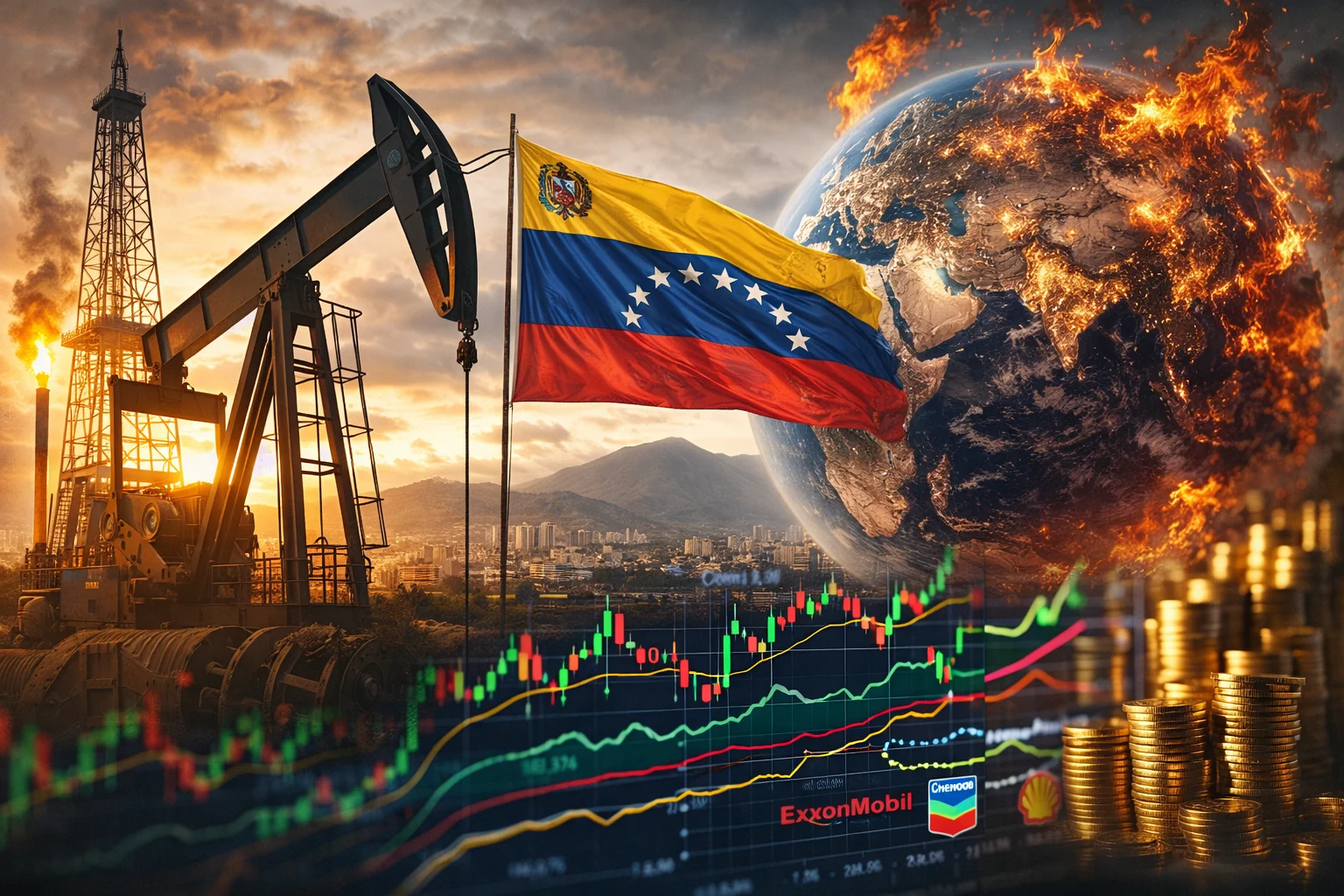
It has been a wild first few weeks of 2026 for the global crude oil prices landscape.
There has been a lot of volatility in energy markets since the dramatic Maduro arrest in Venezuela and the US intervention in Venezuela. Investors, traders, and analysts have been laser-focused on how these geopolitical events are moving WTI crude and Brent crude, how they’re affecting the reaction in energy stocks, and shaping the future of global energy flows.
In this blog, we dissect the oil market reaction as it unfolds, measure the energy sector’s strength, and investigate why oil stocks rise or fall on uncertainty.
Crude Oil Prices: Range-Bound Despite Shock News
Many people initially reacted to the news of Venezuelan President Nicolás Maduro’s capture in a U.S. raid by anticipating soaring oil prices on the horizon. But crude prices haven’t reacted as strongly as past geopolitical disruptions would imply. The benchmarks for both WTI and Brent nudged slightly — more a reflection of broader market currents than raw response to a single event.
WTI crude was trading near the mid-$50s, and Brent crude in the low- to mid-$60s — evidence that many risks have already been traded into the global market. The somewhat placid price behavior is occurring against the backdrop of an expected oil supply glut in 2026 that threatens to overshadow transitory geopolitical shocks. (The Economic Times)
This lukewarm price response is significant more generally. It indicates that traders are cautious about overestimating the immediate implications of developments in Venezuela and expect robust supplies elsewhere to offset the impact.
Oil Markets: Geopolitical Oil Risk in the HeadlinesHighlights Oil marketsreaction already seen It has been pointed out repeatedly on Strategic Energy & Economic Research, Inc. (SEER) that geopolitical oil risk should be a major focus for oil markets and other intelligence.#portsTheabove-linked article (accessed by NYT here) focuses on international shipping and ports in their assessment of whether tight oil supplies have remaine…
Geopolitical Risk Premiums are Alive and Well! While crude prices have remained fairly stable, the geopolitical risk premiums carry on. Tensions between Iran and the United States and other supply-sensitive regions have compounded the Venezuela situation to put markets on edge. Such risks, analysts say, can continue to push prices up in certain scenarios — even if broader measures are stable.
Growing uncertainty about exports in the Middle East and restructuring in Venezuela added a geopolitical layer that temporarily spurred bullish bets on crude markets for some futures contracts, such as oil. (Yahoo Finance)
In short, investors are balancing those geopolitical oil risks with longer-term factors, including global demand growth and non-OPEC+ supply.
Venezuela Oil and the Prospects for Future Supply
Venezuela is home to some of the world’s largest proven oil reserves, which are deeply concentrated in heavy crude Venezuela grades requiring complex refining. The state oil giant, PDVSA, has struggled for years with production that was falling because of underinvestment and sanctions.
With the changing of political power following Maduro’s capture, markets are trying to price in the possibility of Venezuelan crude exports flowing again :
- U.S. officials showed that they wanted to organize US Venezuela regime change for the control of Venezuelan oil sales.
- Washington may receive as many as 50 million barrels of formerly shut-in crude, according to reports.
- Reuters sources suggest that PDVSA has initiated production re-openings, but at nowhere near historic levels.
But analysts warn that returning Venezuela’s oil output to a meaningful size will require investment over the years, particularly for rehabilitating ancient infrastructure. While short-term supply isn’t expected to surge, energy stock Venezuela remains a bit speculative.
Energy Stocks Reaction: Winners and Losers
The reaction in energy stocks was much more pronounced, even as crude prices hovered. Equity markets tend to look past present commodity price levels, and instead, funds react to the longer-term perception of conditions; the narrative of a future oil recovery in Venezuela sparked a rally across the entire suite of energy equities.
Big U.S. energy players Chevron Venezuela (CVX stock) and Exxon Mobil oil (XOM) witnessed contrasting reactions :
Chevron, which has a long history in Venezuela, initially was optimistic about prospects as markets priced future production potential. Still, a dose of caution entered the market as analysts cautioned that reviving Venezuelan oil could come at a huge cost and take years.
ExxonMobil’s stock also responded well at times, but the company’s more cautious approach to re-entry into Venezuela slightly dampened a broader rally.
Shares of oilfield services names Halliburton and SLB also rallied. These names frequently get an early lift from expansion narratives, as they have more to gain than almost anyone else if cap-ex increases in up-and-coming oil basins.
Energy indexes like the XLE ETF (Energy Select Sector SPDR Fund) surged, with traders buying into the sector’s risk-on spirit. The performance of the ETF has become a measure of how investors are feeling about energy stocks.
Oil Stocks Are Surging — But It’s Not Game On Yet
The first rally in oil stocks was based on :
- More crude from Venezuela in the future.
- Possible re-designation of Venezuela as a reliable source.
- Rising demand for drilling and services related to American and allied activity.
But within days, some of that enthusiasm ebbed as industry participants reckoned with the daunting realities of converting Venezuela’s crude potential into a reality, at least when a 2026 oil supply glut, driven by surging production from elsewhere, was lurking.
Performance of the Energy Sector vs Crude Oil Prices
One notable theme in this period is the apparent disconnect between sector performance and spot crude prices. The industry’s stocks often reflect expectations about future supply, investment flows, and geopolitical gamesmanship rather than just the price of oil at that moment.
For instance, despite only slight fluctuations in WTI and Brent, energy stocks actually managed to outperform larger indices such as the S&P 500.
These increases were reflected in similar sub-sectors :
- Stocks for oilfield services companies fared better than some producers.
- Integrated majors posted mixed results if we consider exposure to Venezuela and longer-term strategic stakes.
- This behaviour is consistent with the notion that equity markets may factor in structural shifts before they occur in commodity markets.
OPEC+ and Venezuela: A New Regime?
The possibility of Venezuela reintegrating into the global oil flows creates pressure on OPEC+ dynamics. Once close to the group, Venezuela’s diminished production has diminished its influence. A revived Venezuelan supply presence could also reshape alliances.
OPEC+ producers remain watchful. Should Venezuela’s exports rise significantly, OPEC may need to reconsider quotas that hold back supply and keep pressure off prices.
But the more immediate question is how fast Venezuela’s heavy crude can be exported and whether global demand will be able to absorb production, without falling into even deeper oversupply.
Conclusion
So what’s the market going to feel like? And how might we respond when U.S. intervention comes down the pike?
My guess is these factors will play a significant role in turning sentiment :
- The speed at which the supply of Venezuelan crude increases.
- And if investments by Chevron, Exxon, and the oilfield services follow.
- The persistent oil supply.
- Wider geopolitical risks in the Middle East and elsewhere.
For the moment, crude prices are offering a nuanced picture — not spiking dramatically, but not exactly disregarding geopolitical risk. Energy stock Venezuela, and energy stocks more broadly, are being whipped around by news and speculation of future supply and profits.
The direction of the oil market as it emerges from the downturn — to bullish territory or back into a state of oversupply- is being shaped by these developments, and how nimbly the world’s energy ecosystem moves with them.
Disclaimer: This analysis of oil markets and energy stocks is for informational purposes only and does not constitute financial advice. Geopolitical situations are unpredictable, so please consult a certified financial advisor before making any investment decisions.