
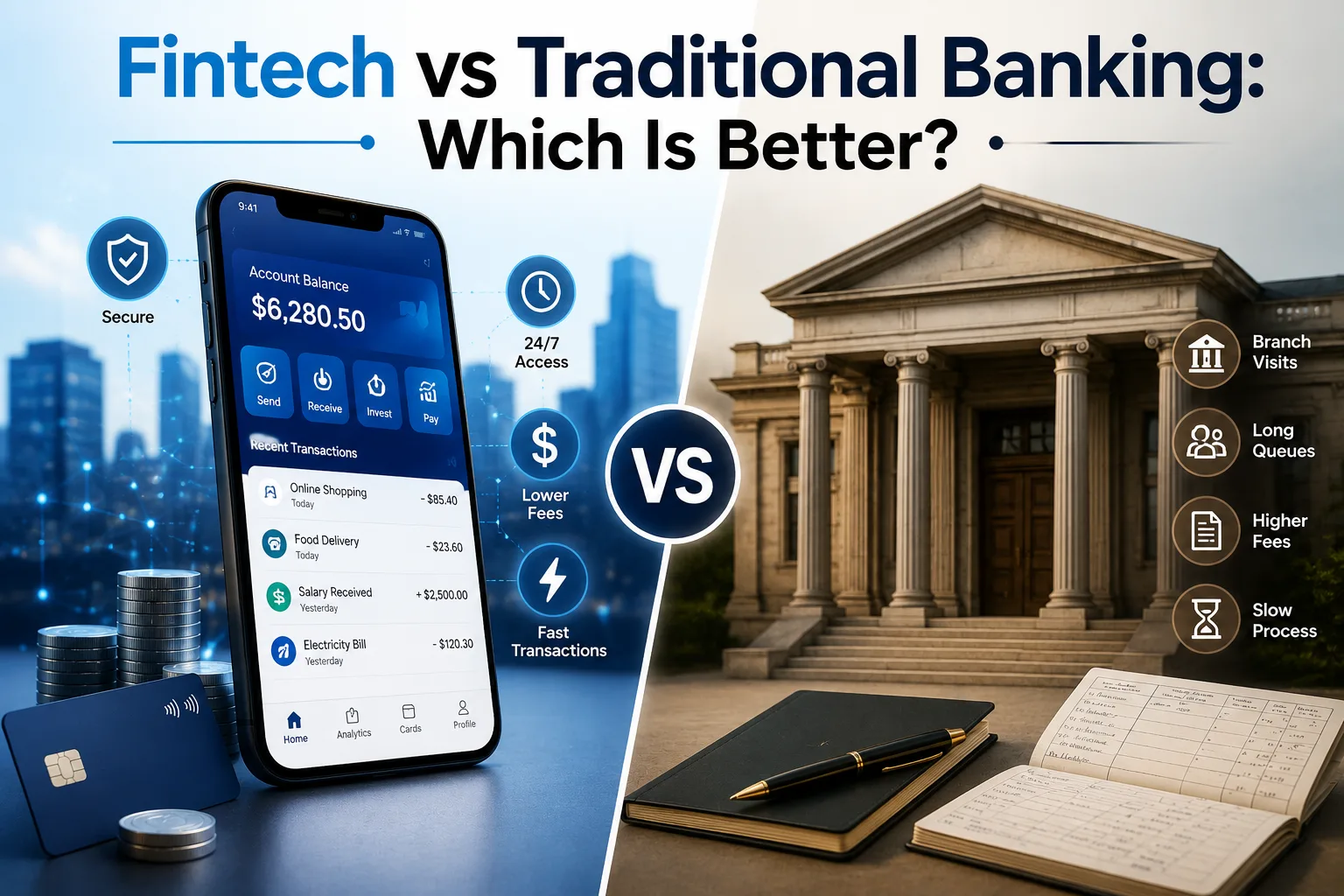
Managing money has changed significantly over the past decade. People no longer have to visit a bank branch to transfer funds, pay bills, apply for loans, or track their spending. With the rise of fintech and digital banking, many financial services are now available through smartphones and web applications. At the same time, traditional banking continues to play an important role by offering trusted financial products, strong regulatory oversight, and personalized customer support.
This shift has raised an important question for individuals and businesses alike: fintech vs traditional banking—which is the better choice?
The answer isn’t as straightforward as choosing one over the other. Both serve different needs, and each comes with its own strengths and limitations. While fintech companies focus on speed, convenience, and innovation, traditional banks emphasize stability, compliance, and long-term financial relationships.
Whether you’re opening your first account, running a growing business, or simply looking for a better way to manage your finances, understanding the difference between fintech and traditional bank models can help you make more informed decisions.
In this guide, you’ll learn:
- What fintech and traditional banking actually mean
- How they differ in terms of technology, costs, security, and customer experience
- The advantages and disadvantages of both
- Which option is better for individuals and businesses
- Why many banks and fintech companies are now working together
- What the future of banking may look like
By the end, you’ll have a clear understanding of which financial approach best fits your goals.
What is Fintech?
Fintech, short for financial technology, refers to companies that use modern technology to deliver financial products and services more efficiently. Instead of relying on physical branches, fintech businesses provide digital solutions that allow users to manage their finances from anywhere using a smartphone, tablet, or computer.
Over the years, fintech has expanded far beyond online payments. Today, it includes services such as digital wallets, lending platforms, investment apps, insurance technology, budgeting tools, and payment processing solutions.
Many fintech platforms are built around solving everyday financial challenges. For example, instead of waiting several days for a money transfer, users can send payments instantly through a mobile app. Similarly, applying for a loan often takes minutes rather than days because automated systems can process applications much faster.
Some of the most common fintech services include:
- Digital wallets for cashless transactions
- Mobile and online banking applications
- Peer-to-peer payments
- Payment gateway solutions for businesses
- Personal finance and budgeting tools
- Investment and micro-investing platforms
- Buy Now, Pay Later (BNPL) services
- Peer-to-peer lending platforms
- AI-powered financial assistance
- Embedded finance solutions integrated into non-financial apps
Another reason fintech continues to grow is its ability to improve financial access. Many people who previously had limited access to banking services can now open accounts digitally without visiting a branch. This has contributed to greater financial inclusion, especially in regions where traditional banking infrastructure is limited.
Modern fintech platforms also make use of technologies such as:
- Artificial Intelligence (AI)
- Machine Learning
- Cloud Computing
- Blockchain
- Open Banking APIs
- Banking Automation
These technologies help deliver faster transactions, smarter fraud detection, personalized financial recommendations, and improved customer experiences.
As customer expectations continue to evolve, many organizations are investing in custom fintech app development to create secure, user-friendly financial applications tailored to specific business needs. A reliable fintech app development company can help businesses build scalable platforms that support everything from digital payments to investment management.
Simply put, fintech focuses on making financial services more accessible, efficient, and convenient through technology.
What is Traditional Banking?
Traditional banking refers to the long-established banking system where licensed financial institutions provide services through physical branches alongside digital channels. These banks have been serving individuals, businesses, and governments for decades by offering a wide range of financial products backed by strict regulations.
Unlike many fintech companies that specialize in specific services, traditional banks usually provide comprehensive financial solutions under one roof.
Common services offered by a traditional bank include:
- Savings and current accounts
- Fixed deposits
- Personal and business loans
- Credit cards
- Mortgage financing
- Wealth management
- Investment services
- Foreign exchange
- Business banking
One of the biggest strengths of traditional banks is trust. Since they operate under strict regulatory compliance requirements, customers often feel more confident storing their savings and managing long-term financial assets through established institutions.
Although traditional banks were once known for paperwork and lengthy approval processes, many have embraced digital banking by offering:
- Mobile banking apps
- Online banking portals
- Digital account opening
- Contactless payments
- Online fund transfers
- Bill payment services
- Card management tools
These improvements allow customers to enjoy the convenience of technology while still having access to physical branches whenever needed.
Traditional banks also continue to invest heavily in banking technology to improve customer services, reduce operational costs, and strengthen security. Features such as biometric authentication, AI-powered fraud detection, and automated customer support have become increasingly common across the banking sector.
For businesses, traditional banks remain important partners because they offer services that fintech providers may not always provide, including:
- Corporate financing
- Trade finance
- Treasury management
- Business credit facilities
- Merchant banking
- International banking services
While the traditional banking system may sometimes appear slower than fintech platforms, it remains a cornerstone of the global financial ecosystem due to its reliability, regulatory oversight, and comprehensive service offerings.
Fintech vs Traditional Banking: Key Differences
Although fintech companies and traditional banks both provide financial services, they operate very differently. Understanding these differences can help consumers and businesses choose the right financial partner based on their specific needs.
1. Business Model
The biggest difference between fintech and traditional banking lies in how they operate.
Traditional banks typically offer a full range of financial products, including deposits, loans, investments, and business banking. Their revenue comes from interest income, service fees, lending activities, and financial products.
Fintech companies, on the other hand, often focus on solving one or two specific financial problems exceptionally well. Some specialize in digital payments, while others concentrate on lending, investment management, budgeting, or digital wallets.
Instead of maintaining expensive branch networks, fintech companies invest more heavily in software development and digital experiences. This lean business model often enables them to introduce new features much faster.
2. Target Audience
Traditional banks generally serve a broad customer base, including:
- Individuals
- Families
- Small businesses
- Large enterprises
- Government organizations
Fintech companies often target customers looking for fast, digital-first experiences. Younger generations, freelancers, startups, and technology-focused businesses frequently choose fintech platforms because of their convenience and ease of use.
However, fintech adoption is expanding rapidly across all age groups as digital financial services become more common.
3. Technology and Innovation
Technology is where fintech has a clear advantage.
Many fintech businesses are built using modern cloud infrastructure, API integrations, AI-powered automation, and real-time analytics from the beginning. This allows them to release updates quickly and introduce innovative features based on customer feedback.
Traditional banks are also investing heavily in banking innovation, but many continue to rely on legacy systems that require more time and resources to upgrade.
As a result, fintech companies often introduce new financial products and customer features more rapidly than conventional banks.
4. Speed and Convenience
One of the main reasons customers switch to fintech is speed.
Opening an account, verifying identity, sending payments, or applying for a loan can often be completed within minutes through a mobile application.
Traditional banks have improved considerably, especially with online banking and mobile banking, but certain services may still involve additional documentation or in-person verification.
For customers who prioritize convenience, fintech generally provides a faster digital experience.
5. Cost and Fees
Cost is one of the biggest factors when comparing fintech vs traditional banking.
Many fintech companies operate without physical branches, allowing them to reduce overhead expenses. These savings are often passed on to customers through lower transaction fees, minimal account maintenance charges, or even free financial services. Some fintech platforms also offer competitive foreign exchange rates and low-cost international transfers.
Traditional banks, however, typically have higher operating costs due to branch networks, staffing, and legacy infrastructure. As a result, customers may encounter charges such as:
- Monthly account maintenance fees
- ATM withdrawal fees (outside the bank’s network)
- Wire transfer fees
- Loan processing charges
- Minimum balance penalties
That said, pricing varies by institution and service. Before choosing either option, it’s always worth comparing the fee structure to ensure it aligns with your financial needs.
6. Security and Regulatory Compliance
Security is a top priority for both fintech companies and traditional banks, but they approach it differently.
Traditional banks operate under strict regulatory compliance frameworks set by financial authorities. They must follow detailed rules related to customer protection, anti-money laundering (AML), and data privacy. Many also offer deposit insurance, giving customers additional confidence in the safety of their funds.
Fintech companies also prioritize banking security, using technologies such as:
- End-to-end encryption
- Multi-factor authentication
- Biometric login
- AI-powered fraud detection
- Real-time transaction monitoring
Because fintech businesses often rely on digital platforms, cybersecurity plays a central role in protecting customer information.
Whether you’re using a bank or a fintech app, choosing providers with strong security practices, transparent policies, and regulatory approvals is essential.
7. Customer Experience
Customer expectations have changed dramatically, and financial providers are adapting to keep up.
Fintech companies typically focus on delivering a simple, intuitive, and fast user experience. Their apps are designed to help customers complete tasks with minimal effort, whether it’s transferring money, tracking expenses, or managing investments.
Features such as instant notifications, personalized dashboards, spending insights, and digital onboarding have become standard across many fintech platforms.
Traditional banks are also investing heavily in improving the customer experience in banking. Modern banking apps now offer features like digital account management, online support, and contactless payment options while still giving customers access to branch staff when face-to-face assistance is needed.
For users who value convenience and digital interactions, fintech often has the edge. Those who prefer personal guidance may find traditional banks more reassuring.
Features Comparison: Fintech vs Traditional Banking
The following table highlights how fintech and traditional banks compare across key financial services.
| Feature | Fintech | Traditional Banking |
|---|---|---|
| Account Opening | Mostly digital and fast | Digital or branch-based |
| Accessibility | Available anytime through apps | Digital plus physical branches |
| Payments | Instant and digital-first | Reliable but sometimes slower |
| Loans | Faster approvals for eligible users | More documentation and verification |
| Investment Options | App-based investing and micro-investing | Comprehensive wealth management |
| Customer Support | Chat, email, AI assistants | Branch, phone, email, live support |
| Innovation | Rapid feature updates | Gradual technology upgrades |
➤ Accessibility and Ease of Use
Accessibility is one of fintech’s strongest advantages.
Most fintech apps allow users to create accounts, verify identity, and begin using financial services without visiting a branch. Everything can usually be completed from a smartphone.
Traditional banks have expanded their digital offerings significantly, but some services still require branch visits, especially for complex financial products.
For customers living in remote areas, fintech can improve financial inclusion by making banking services more accessible.
➤ Mobile Banking Features
Both fintech companies and banks now provide mobile banking solutions, but their priorities often differ.
Fintech apps frequently include:
- Instant payment notifications
- Expense categorization
- Budget tracking
- QR code payments
- Digital wallet integration
- Bill reminders
- Spending analytics
Traditional banking apps generally focus on:
- Account management
- Fund transfers
- Bill payments
- Card controls
- Loan management
- Statement downloads
Both approaches continue to evolve as customer expectations grow.
➤ Payment and Money Transfer
Digital payments have become an essential part of everyday life.
Fintech platforms often excel in:
- Peer-to-peer payments
- International transfers
- Digital wallets
- QR payments
- Contactless payments
- Payment gateway solutions for businesses
Traditional banks continue to provide secure domestic and international transfers while supporting debit cards, credit cards, and business payment services.
Depending on the transaction type, either option may be the better choice.
➤ Loan and Credit Services
Traditional banks have decades of experience in lending.
They offer:
- Home loans
- Business loans
- Education loans
- Auto loans
- Credit cards
- Personal loans
Fintech lenders simplify the borrowing process by allowing customers to apply online with faster approvals and digital documentation.
However, eligibility requirements, loan limits, and interest rates vary across providers, making it important to compare options before applying.
➤ Investment and Wealth Management
Fintech has made investing more accessible.
Many apps allow users to:
- Start micro-investing with small amounts
- Invest in mutual funds
- Buy stocks
- Track portfolios
- Automate investments
Traditional banks continue to offer professional wealth management, retirement planning, and investment advisory services, making them attractive for customers seeking long-term financial guidance.
➤ Interest Rates and Fees
Fintech providers often compete by offering lower service charges and attractive savings options.
Traditional banks may charge higher fees for certain services but often provide a broader range of financial products and personalized assistance.
Rather than focusing only on price, customers should evaluate the overall value they receive.
➤ Customer Support
Support preferences vary from person to person.
Fintech companies generally rely on:
- Live chat
- AI chatbots
- Email support
- In-app help centers
Traditional banks typically offer:
- Branch assistance
- Telephone support
- Relationship managers
- Online customer service
People who prefer face-to-face communication may appreciate traditional banking, while digitally confident users often find fintech support sufficient.
➤ Security and Fraud Protection
Both fintech companies and banks invest heavily in fraud prevention.
Common security measures include:
- Multi-factor authentication
- Encryption
- Device verification
- Fraud alerts
- Transaction monitoring
- Biometric authentication
Users also play an important role by creating strong passwords, avoiding phishing scams, and monitoring account activity regularly.
Pros and Cons of Fintech
♦ Advantages of Fintech
Fintech has transformed how people access financial services by making them faster and more convenient.
Some of the biggest benefits of fintech include:
- Quick account setup
- Easy-to-use mobile apps
- Lower operating costs
- Faster money transfers
- Better digital payment experiences
- Continuous innovation
- Greater financial inclusion
- Personalized financial insights
- Convenient online access 24/7
Many fintech platforms also help users improve financial habits by offering budgeting tools, spending analysis, and savings recommendations. Features that support personal budgeting tips, building an emergency fund, understanding needs vs. wants, and learning about saving vs. investing are becoming increasingly common.
♦ Disadvantages of Fintech
Despite its advantages, fintech also has limitations.
These may include:
- Limited physical customer support
- Dependence on internet connectivity
- Some services may not be available in every country
- Regulatory requirements vary across regions
- Certain customers may prefer human assistance for complex financial matters
Not every fintech platform offers the same level of security or customer service, so researching providers before signing up is important.
Pros and Cons of Traditional Banking
♦ Advantages of Traditional Banking
Traditional banks continue to be a trusted choice for millions of people because they offer a wide range of financial services backed by years of experience and strict regulatory oversight.
Some of the key advantages of traditional banking include:
- Strong regulatory compliance and consumer protection
- Access to physical branches for in-person assistance
- Wide range of financial products under one institution
- Established reputation and customer trust
- Deposit protection (where applicable under local regulations)
- Personalized financial advice
- Comprehensive business banking services
- Better support for complex financial needs, such as mortgages and commercial lending
For customers who value face-to-face interactions or need tailored financial guidance, traditional banks remain a dependable option.
♦ Disadvantages of Traditional Banking
Although traditional banks have embraced digital transformation, they still face certain challenges.
Some common drawbacks include:
- Longer account opening and loan approval processes
- Higher service charges in some cases
- Limited working hours for branch services
- Slower adoption of new technologies compared to many fintech companies
- More paperwork for certain financial products
However, these limitations continue to decrease as banks invest in banking technology and modernize their digital services.
Which is Better For Individuals?
There is no one-size-fits-all answer. The right choice depends on your financial goals, lifestyle, and preferences.
Fintech may be the better option if you:
- Prefer managing finances through a smartphone
- Make frequent digital payments
- Want quick money transfers
- Use digital wallets regularly
- Need budgeting tools and spending insights
- Value speed and convenience
Many fintech apps also make everyday financial management easier by helping users track expenses, set savings goals, and manage cash flow. Educational resources such as how online banking simplifies modern financial management can help users get even more value from digital financial tools.
Traditional banking may be the better choice if you:
- Prefer visiting a local branch
- Need large loans or mortgage services
- Want personalized financial advice
- Manage significant savings or investments
- Feel more comfortable with established financial institutions
For many people, the ideal approach is not choosing one over the other but using both. For example, someone may keep their salary account with a traditional bank while using a fintech app for budgeting, payments, or investing.
Which is Better For Businesses?
Businesses often have more complex financial requirements than individual consumers.
Traditional banks continue to play an essential role by offering:
- Business current accounts
- Commercial loans
- Treasury management
- Trade finance
- Merchant services
- Payroll solutions
- International banking
Meanwhile, fintech companies provide solutions that improve operational efficiency, including:
- Digital payment platforms
- Automated invoicing
- Expense management
- Online payment gateways
- Cross-border payment solutions
- Banking automation
Small businesses and startups often appreciate fintech platforms because they reduce manual work and simplify financial operations.
Larger organizations, however, may benefit from combining fintech tools with traditional banking services to achieve greater flexibility.
Businesses looking to build their own financial products frequently partner with a financial app development company or invest in fintech app development services to create secure and scalable digital solutions. Depending on their requirements, they may also choose digital banking app development or work with a banking software development company to modernize existing systems.
Can Fintech and Traditional Banks Work Together?
Rather than competing directly, many fintech companies and banks are now collaborating to deliver better financial services.
Banks bring trust, regulatory expertise, and established customer relationships, while fintech companies contribute innovation, agility, and advanced technology.
These partnerships help both sides respond more effectively to changing customer expectations.
➤ Examples of Bank-Fintech Partnerships
Across the financial industry, banks increasingly work with fintech providers to improve their digital capabilities.
Common examples include:
- Banks integrating digital wallet services
- AI-powered fraud detection solutions
- Embedded finance within retail and e-commerce platforms
- Faster digital loan approvals
- Open Banking integrations through secure APIs
- Real-time payment processing
- Automated customer support
These collaborations allow banks to modernize without replacing their entire infrastructure while enabling fintech companies to scale through trusted financial institutions.
➤ Benefits of Collaboration
When banks and fintech companies work together, customers often receive the best of both worlds.
Some key benefits include:
- Faster product innovation
- Improved customer experience
- More secure digital services
- Better financial accessibility
- Stronger regulatory compliance
- Reduced operational costs
- More personalized financial products
This collaborative approach is becoming increasingly common as the financial industry continues to evolve.
Future of Fintech vs Traditional Banking
The future of financial services is likely to involve greater collaboration, smarter technologies, and more personalized customer experiences.
Instead of replacing traditional banks, fintech is encouraging the entire industry to innovate more quickly.
Several trends are expected to shape the future of banking.
✦ Role of AI and Automation
AI in banking is already changing how financial institutions operate.
Artificial intelligence is being used for:
- Fraud detection
- Customer support chatbots
- Credit risk assessment
- Personalized financial recommendations
- Automated compliance monitoring
- Transaction analysis
As AI continues to improve, customers can expect faster services, better security, and more personalized financial experiences.
✦ Digital-Only Banks and Neobanks
The rise of the neobank has introduced a new approach to banking.
Unlike traditional banks, digital-only banks operate without physical branches and provide services entirely online.
Customers are choosing neobanks because they often offer:
- Simple account opening
- Low fees
- Fast international transfers
- Modern mobile banking apps
- Real-time spending notifications
- Easy budgeting tools
The growing popularity of neobank vs traditional bank comparisons reflects changing consumer expectations for faster and more convenient financial services.
✦ Regulatory Changes Ahead
As fintech adoption grows, governments and regulators continue updating financial regulations.
Future regulatory priorities are likely to include:
- Stronger cybersecurity requirements
- Enhanced consumer protection
- Greater transparency
- Responsible AI governance
- Improved Open Banking standards
- Cross-border payment regulations
These developments aim to create a safer and more innovative financial ecosystem for consumers and businesses alike.
How to Choose the Right Option for Your Financial Needs
Choosing between fintech and traditional banking depends on what matters most to you.
Ask yourself the following questions:
- Do you prefer digital convenience or in-person support?
- How often do you visit a bank branch?
- Do you frequently make online or international payments?
- Are low fees an important priority?
- Do you need advanced business banking services?
- Will you require large loans or investment advice?
- How important are budgeting and financial management tools?
If speed, flexibility, and mobile-first experiences are your priorities, fintech may be the right fit.
If you value stability, comprehensive financial services, and personal assistance, traditional banking may better suit your needs.
For many individuals and businesses, combining both options offers the greatest flexibility. Using a traditional bank for core financial services while relying on fintech apps for payments, budgeting, investing, or money management can provide a balanced financial experience.
Conclusion
The debate around fintech vs traditional banking isn’t about declaring a single winner. Both have distinct strengths that serve different financial needs.
Fintech has reshaped the financial industry by making services faster, more accessible, and easier to use. Features such as mobile banking, digital payments, digital wallets, and banking automation have changed how people manage their money every day.
Traditional banks, meanwhile, continue to provide trusted financial services backed by regulatory oversight, extensive banking expertise, and comprehensive product offerings.
As technology continues to advance, the gap between the two is becoming smaller. Many banks are adopting fintech innovations, while fintech companies are working closely with established financial institutions to deliver better customer experiences.
The best choice depends on your personal or business requirements. By understanding the strengths and limitations of each model, you can confidently select the financial services that align with your goals—whether that’s embracing digital innovation, relying on traditional expertise, or combining both for the best possible outcome.