
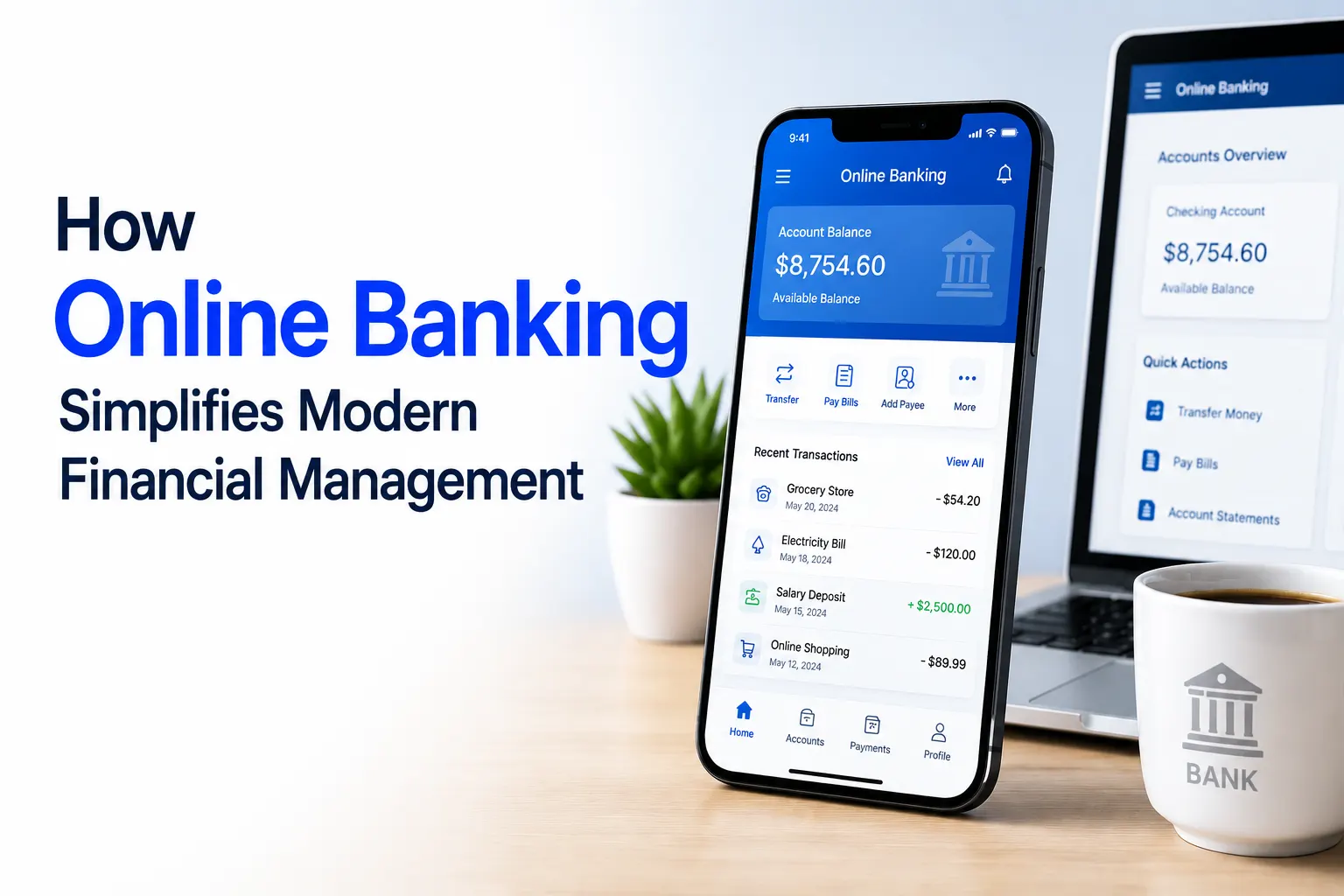
Managing money has become much easier than it was a few years ago. People no longer need to visit a bank branch for every small task, whether it’s checking an account balance, paying a utility bill, or sending money to someone. With online banking, most financial activities can now be completed within minutes using a computer or smartphone.
The growing adoption of digital banking has changed the way individuals and businesses handle their finances. Instead of relying on paperwork and fixed banking hours, users now have access to convenient, fast, and secure financial services anytime and from almost anywhere. This shift has made modern financial management more organized, efficient, and accessible.
Whether you’re trying to monitor your daily expenses, make online money transfers, automate recurring payments, or improve your personal finance management, online banking offers practical tools to help you stay in control of your finances.
In this guide, you’ll learn what online banking is, how it has evolved over the years, its key benefits, and how it supports both individuals and businesses in achieving better financial management.
What Is Online Banking?
Online banking, also known as internet banking, allows customers to access and manage their bank accounts through a secure website or mobile banking app. Instead of visiting a physical branch, users can perform many everyday banking tasks online.
Some of the most common online banking features include:
- Account balance check online
- Bank statement download
- Online fund transfer
- Online bill payment
- Transaction history
- Debit and credit card management
- Beneficiary management
- Auto bill payment setup
- Loan and deposit information
These services help customers save time while giving them better control over their financial activities.
► Common Online Banking Services
| Service | Purpose |
|---|---|
| Account Balance Check | View your available balance anytime |
| Online Fund Transfer | Send money between accounts or to other banks |
| Online Bill Payments | Pay electricity, water, internet, and other utility bills |
| Bank Statement Download | Access monthly or custom account statements instantly |
| Auto Bill Payment | Schedule recurring payments to avoid late fees |
| Digital Wallet Integration | Connect your account with supported digital payment platforms |
| Mobile Banking Apps | Manage finances using a smartphone or tablet |
These features make digital financial management much more convenient than traditional banking methods.
The Evolution of Banking: From Traditional to Digital
Banking has changed significantly over the last two decades. Earlier, customers depended almost entirely on physical branches to complete even the simplest banking tasks. Today, technology has transformed banking into a faster and more flexible experience.
Let’s understand how this transition happened:
► Traditional Banking Challenges
Traditional banking worked well for many years, but it also had several limitations that affected customer convenience.
Some of the common challenges included:
- Limited banking hours
- Long queues at bank branches
- Paper-based documentation
- Slow processing of transactions
- Delays in cheque clearance
- Difficulty accessing account information outside banking hours
For individuals managing multiple financial responsibilities or businesses handling frequent transactions, these limitations often consume valuable time. As people’s lifestyles became busier, the demand for faster and more accessible banking solutions increased.
► Rise of Digital Banking Services
The introduction of online banking services marked a major shift in the banking industry. Customers could now access banking facilities from home, work, or while traveling. With the growth of smartphones and high-speed internet, mobile banking became a preferred option for millions of users.
Today’s digital banking platforms allow customers to:
- Transfer funds instantly
- Pay bills online
- Monitor account activity in real time
- Download account statements
- Apply for financial products
- Receive transaction alerts
- Manage multiple accounts from one platform
Banks have also improved online banking security by implementing features such as:
- Multi-factor authentication
- Biometric login
- End-to-end encryption
- Real-time fraud monitoring
- Secure transaction verification
These improvements have increased customer confidence while making banking both convenient and secure.
Key Benefits of Online Banking for Modern Financial Management
Using online banking is about much more than replacing visits to a bank branch. It helps people make smarter financial decisions, stay organized, and manage money more efficiently.
Here are some of the biggest advantages:
♦ 24/7 Access to Financial Services
One of the most valuable online banking benefits is round-the-clock access to banking services. Unlike traditional branches that operate during fixed business hours, online banking gives customers access to their accounts at any time.
Whether it’s early in the morning, late at night, or during a holiday, users can:
- Check account balances
- Transfer funds
- Pay bills
- Review recent transactions
- Download account statements
This flexibility is especially useful for people with busy schedules and business owners who often need immediate access to financial information. Having financial services available anytime also supports better financial planning tools, allowing users to make timely decisions without waiting for bank branches to open.
♦ Real-Time Account Monitoring
Keeping track of your finances becomes much easier when you can monitor every transaction as it happens. Most mobile banking apps provide instant notifications whenever money is credited or debited from an account.
Real-time monitoring helps users:
- Detect unauthorized transactions quickly
- Track daily spending habits
- Verify incoming payments
- Monitor recurring expenses
- Stay updated on account balances
This level of visibility improves personal finance management and helps reduce unnecessary spending. People who practice Personal Budgeting often find real-time account monitoring especially useful because it provides accurate spending data throughout the month.
♦ Faster Fund Transfers and Payments
Sending money has become significantly faster with online money transfer services. Instead of filling out paper forms or visiting a branch, users can complete a fund transfer online in just a few steps.
Some common uses include:
- Paying family members
- Sending rent
- Paying utility bills
- Shopping online
- Making business payments
- Transferring money between personal accounts
Similarly, online bill payments allow users to settle electricity, water, internet, insurance, and credit card bills without standing in long queues. Many banks also offer Auto bill payment, which automatically pays recurring bills before their due dates. This helps customers avoid missed payments and late payment charges while making monthly financial management much simpler.
The combination of faster payments and banking automation saves both time and effort, making everyday financial tasks much more efficient.
♦ Better Budgeting and Expense Tracking
One of the biggest advantages of online banking is that it helps people understand where their money goes. Instead of manually recording every transaction, your banking dashboard automatically organizes income and expenses, making it easier to monitor your financial habits. Most digital banking platforms provide detailed transaction histories, spending summaries, and monthly statements. These features allow users to identify unnecessary expenses and make informed financial decisions.
Some banks also categorize transactions into different sections, such as:
- Groceries
- Transportation
- Entertainment
- Shopping
- Utilities
- Dining
This makes it easier to review spending patterns and improve personal finance management over time. If your bank offers financial tracking tools, you can compare your monthly spending and identify areas where you can save more. These insights are especially useful for anyone working on Personal Budgeting or planning future financial goals.
The table below highlights how online banking supports better money management.
| Traditional Money Management | Online Banking |
|---|---|
| Manual expense tracking | Automatic transaction history |
| Paper records | Digital records available anytime |
| Limited spending insights | Real-time expense analysis |
| Manual bill reminders | Auto bill payment options |
| Physical bank visits | Banking from anywhere |
| Delayed account updates | Instant transaction notifications |
By providing a clear picture of your finances, online banking services make budgeting much more practical and less time-consuming.
How Online Banking Helps Individuals Manage Their Finances
Managing personal finances is about more than simply earning money. It also involves tracking expenses, building savings, planning for future goals, and making informed financial decisions. Modern digital finance solutions provide several tools that help individuals stay organized while reducing the stress of managing everyday finances.
✦ Tracking Income and Expenses
Knowing how much money comes in and where it goes is the foundation of good financial management. With online banking, every transaction is recorded automatically, giving users a complete financial history whenever they need it.
Instead of maintaining spreadsheets or notebooks, users can simply log into their account and:
- Review daily transactions
- Monitor salary deposits
- Check recurring subscriptions
- Identify unnecessary expenses
- Download monthly statements
Many banks also allow users to filter transactions by date, amount, or category, making financial reviews much easier. Regularly reviewing these records helps individuals make better financial decisions and avoid overspending.
✦ Managing Savings Goals
Saving money becomes easier when you can monitor your progress regularly.
Many online banking services allow customers to create separate savings accounts or assign specific goals for future expenses, such as:
- Emergency funds
- Vacation savings
- Home purchases
- Education expenses
- Vehicle purchases
Tracking savings digitally provides motivation because users can clearly see how close they are to reaching each goal. When planning for the future, it’s also important to understand saving vs. investing. While savings are generally intended for short-term financial needs and emergencies, investing focuses on growing wealth over the long term and may involve higher risk.
Online banking helps users build healthy saving habits while giving them better visibility into their financial progress. Some banking platforms even support Micro-Investing by connecting with investment services through Digital wallet integration, making it easier for users to begin investing small amounts alongside their regular savings.
✦ Automating Bill Payments
Paying bills on time is essential for maintaining good financial habits. Missing payment deadlines can result in late fees, service interruptions, or unnecessary financial stress. Fortunately, Auto bill payment simplifies this process.
Customers can schedule recurring payments for:
- Electricity bills
- Water bills
- Internet services
- Mobile recharge
- Insurance premiums
- Credit card payments
- Loan EMIs
Once scheduled, payments are processed automatically on the selected dates. This reduces the chances of forgotten payments while saving valuable time every month. For people managing multiple monthly expenses, automated payments provide peace of mind and improve overall financial planning.
How Online Banking Benefits Businesses
Businesses process dozens or even hundreds of financial transactions every month. Managing payroll, vendor payments, customer receipts, and operating expenses manually can consume significant time and resources.
This is where online banking becomes an important business tool. Modern banking technology allows businesses to manage finances more efficiently while maintaining greater accuracy and transparency.
➤ Streamlined Cash Flow Management
Healthy businesses rely on effective cash flow management. Business owners need to know exactly how much money is coming in, how much is going out, and whether enough funds are available to cover upcoming expenses. With online banking services, companies can monitor cash flow in real time.
Business owners can:
- Track incoming customer payments
- Review outgoing expenses
- Monitor account balances
- Transfer funds between business accounts
- Download financial records instantly
Having access to updated financial information helps businesses make faster decisions and avoid cash shortages. Instead of waiting for monthly reports, business owners can monitor financial performance daily.
➤ Payroll and Vendor Payments
Paying employees and suppliers accurately and on time is one of the most important business responsibilities. Using online fund transfer services makes this process much faster than traditional banking methods.
Businesses can process:
- Employee salaries
- Contractor payments
- Vendor invoices
- Supplier settlements
- Business reimbursements
Many banks also allow businesses to schedule recurring payments, reducing manual work and improving efficiency.
Since payments are completed electronically, businesses spend less time handling paperwork and more time focusing on operations.
➤ Improved Financial Reporting
Good financial records support better business planning. Every transaction completed through online banking is automatically recorded, creating a reliable financial history.
Businesses can quickly generate reports by using features such as:
- Bank statement download
- Transaction history
- Payment confirmations
- Monthly account summaries
These records help business owners:
- Prepare tax documents
- Reconcile accounts
- Monitor operating expenses
- Review business performance
- Support financial audits
Accurate reporting also improves decision-making because managers always have access to updated financial information. Instead of relying on paper documents, businesses can securely store and retrieve financial records whenever needed. Overall, secure online banking reduces administrative work while making business finances easier to manage.
Future of Online Banking and Digital Finance
The banking industry continues to evolve as technology becomes more advanced. While today’s online banking platforms already offer convenience and efficiency, future developments are expected to make banking even smarter, faster, and more personalized. Banks are investing in new technologies that improve customer experience while strengthening security and simplifying everyday financial tasks.
Let’s look at some of the key trends shaping the future of digital banking.
✸ AI-Powered Banking
Artificial intelligence (AI) is becoming an important part of modern banking. Rather than replacing human support, AI helps banks deliver faster services and more personalized experiences.
Some of the ways AI is improving online banking services include:
- Providing instant customer support through virtual assistants
- Detecting unusual account activity to reduce fraud risks
- Offering personalized spending insights
- Recommending savings opportunities based on spending habits
- Speeding up loan application reviews
AI also helps strengthen online banking security by identifying suspicious transactions in real time. Instead of relying only on fixed security rules, AI systems analyze transaction patterns and flag activities that appear unusual. This allows banks to respond more quickly to potential fraud while reducing inconvenience for genuine customers.
As AI technology continues to improve, users can expect more intelligent financial recommendations that support better financial management and smarter everyday banking decisions.
✸ Mobile Banking Innovations
The popularity of smartphones has made mobile banking one of the fastest-growing banking channels. Today’s mobile banking apps already allow customers to perform nearly every banking activity without visiting a branch. Future innovations are expected to make these applications even more convenient.
Some emerging improvements include:
- Faster biometric authentication using fingerprint and facial recognition
- Smarter budgeting tools with personalized spending insights
- Enhanced digital wallet integration for seamless payments
- More secure authentication methods
- Better investment and savings management features
- Simplified international online money transfer services
Banks are also improving user interfaces to make applications easier to navigate for customers of all ages. As banking automation continues to advance, routine tasks such as recurring transfers, savings contributions, and bill payments will require even less manual effort. These improvements will help individuals and businesses spend less time managing finances while maintaining greater control over their money.
Conclusion
Online banking has transformed the way people and businesses manage their finances. From checking account balances and making online bill payments to completing online fund transfer transactions and tracking expenses in real time, digital banking has made everyday financial activities faster, simpler, and more convenient.
For individuals, it supports better personal finance management by helping track income, manage savings goals, automate recurring payments, and monitor spending. For businesses, it simplifies cash flow management, payroll processing, vendor payments, and financial reporting, allowing teams to focus more on growth and less on administrative work.
As banking technology continues to evolve with AI, smarter automation, and improved mobile banking apps, customers can expect even more secure, efficient, and personalized banking experiences.
Whether you’re looking to improve your daily budgeting, build better financial habits, or streamline business operations, adopting online banking services can make modern financial management more organized, accessible, and effective. Choosing the right banking tools and using them wisely can help you stay in control of your finances today while preparing for future financial goals.
Thank you for taking the time to read our blog, “How Online Banking Simplifies Modern Financial Management.” We hope you found it helpful and learned something new about how online banking makes managing your finances easier. We appreciate your time and hope this information was useful to you.