
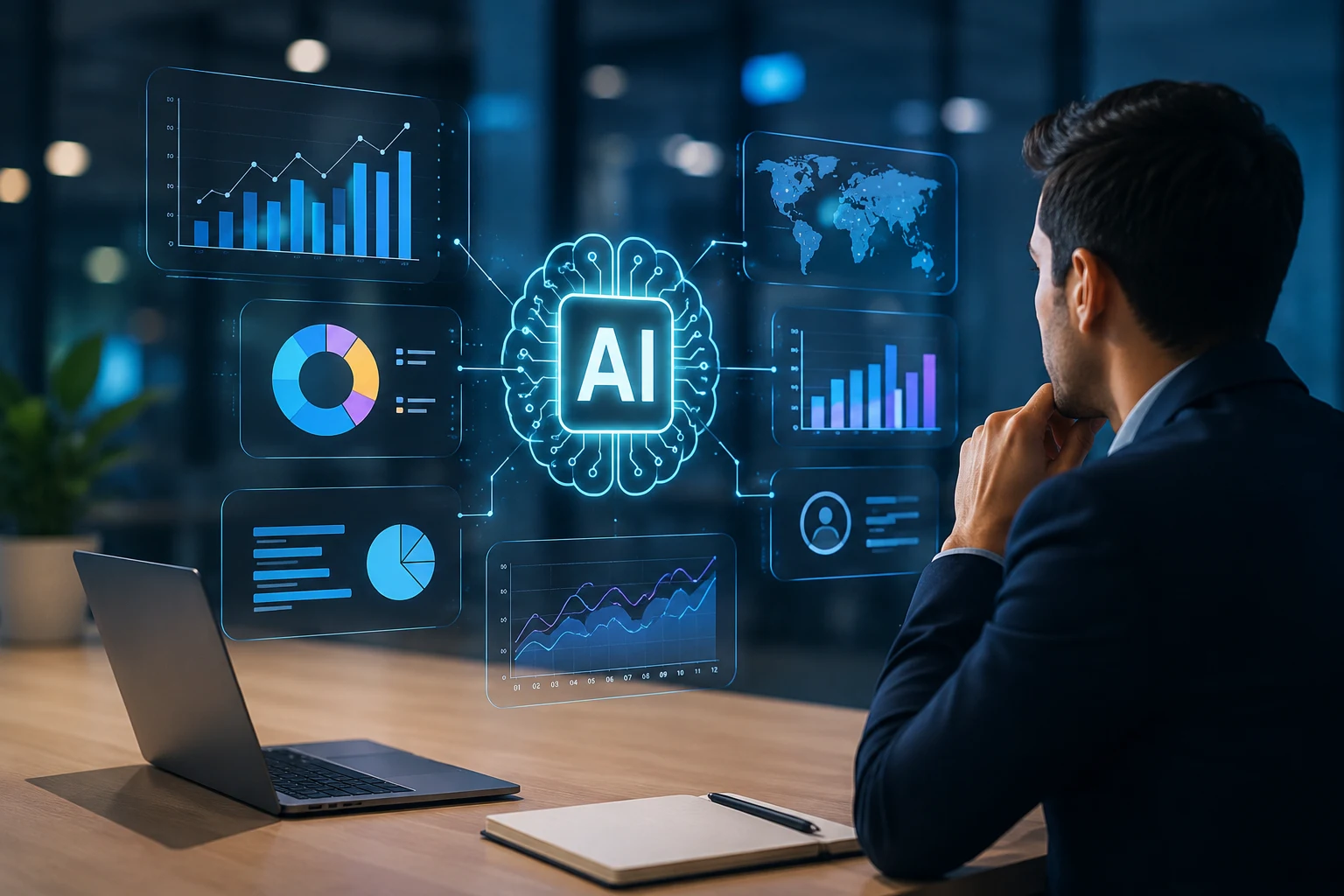
Every business collects data every day. Sales records, customer feedback, website traffic, social media engagement, and operational reports all generate valuable information. The challenge is not collecting this data but understanding it and using it to make better decisions.
This is where AI in Data Analysis is making a real difference. Instead of spending hours reviewing spreadsheets and reports, businesses can now use Artificial Intelligence in Data Analysis to identify patterns, predict future outcomes, and discover useful insights much faster.
Whether a company wants to improve customer service, increase sales, reduce costs, or strengthen its overall business strategy, AI helps transform raw information into meaningful actions. It also supports Data-Driven Decision Making, allowing business leaders to rely on facts instead of assumptions.
In this article, you’ll learn what AI Data Analytics is, why more businesses are adopting it, how it supports smarter decisions, its key benefits, popular technologies, common challenges, and what the future looks like for AI-powered business analytics.
What Is AI in Data Analysis?
AI in Data Analysis refers to the use of artificial intelligence technologies to collect, organize, process, and interpret large amounts of data. Instead of relying only on manual analysis, AI automatically finds patterns, identifies trends, and generates insights that help businesses make informed decisions. Traditional Business Data Analysis often requires analysts to spend significant time preparing reports and reviewing information. AI speeds up this process by analyzing data much faster while reducing manual effort.
Modern AI-Powered Data Analysis combines several technologies, including:
- Machine learning
- Predictive analytics
- Natural language processing (NLP)
- Business intelligence platforms
- Automated reporting tools
Together, these technologies help businesses discover opportunities, identify risks, and improve overall performance.
► Traditional Data Analysis vs AI Data Analysis
| Traditional Analysis | AI Data Analytics |
|---|---|
| Mostly manual | Highly automated |
| Time-consuming | Fast processing |
| Limited pattern detection | Detects complex patterns |
| Reactive decisions | Predictive decision-making |
| Requires constant human effort | Automates repetitive analysis |
As businesses continue generating larger amounts of information, Data Analytics with AI has become an important part of modern business operations.
Why Businesses Are Adopting AI for Data Analysis
Businesses across different industries are investing in AI for Business Analytics because it helps them work smarter, improve efficiency, and respond to market changes more quickly. Instead of making decisions based on intuition alone, companies can use accurate data insights to support long-term growth.
► Growing Volume of Business Data
Businesses now collect data from multiple sources, including:
- Websites
- Mobile applications
- CRM systems
- Customer support platforms
- Social media
- Marketing campaigns
- IoT devices
Managing such large amounts of information manually is becoming increasingly difficult. Big data analytics combined with AI allows organizations to process millions of records quickly while identifying useful patterns that humans may overlook. This makes Artificial Intelligence in Data Analysis valuable for businesses of every size.
► Faster and More Accurate Decision-Making
Business decisions often need to be made quickly. Waiting several days for reports can result in missed opportunities. AI analyzes information in minutes and provides meaningful recommendations based on historical and current data.
Examples include:
- Identifying profitable products
- Monitoring marketing performance
- Detecting unusual spending
- Improving inventory planning
- Supporting financial forecasting
By improving AI for decision-making, businesses reduce uncertainty and make decisions with greater confidence.
► Reducing Manual Work and Human Errors
Many reporting tasks involve repetitive activities such as:
- Collecting data
- Cleaning datasets
- Organizing reports
- Updating dashboards
- Creating summaries
These manual tasks consume valuable employee time and increase the possibility of errors. Automated data analysis helps businesses automate repetitive work while allowing employees to focus on planning, innovation, and solving complex problems. This also improves time management, especially for teams handling large amounts of operational data.
► Gaining Competitive Advantage
Companies that understand their data can often respond to market changes faster than competitors.
AI helps businesses:
- Detect emerging customer trends
- Monitor competitor performance
- Improve pricing strategies
- Optimize marketing campaigns
- Support product development
Better insights allow organizations to adjust their plans before competitors react. As a result, AI Business Intelligence becomes an important tool for companies looking to strengthen their market position.
► Improving Customer Experience
Understanding customers is one of the biggest advantages of AI.
Using Customer behavior analysis, businesses can learn:
- What customers prefer
- Which products perform best
- Why do customers stop buying
- Which marketing campaigns work
- How customer satisfaction changes over time
These insights help companies personalize experiences, improve customer support, and build stronger relationships. Businesses that understand customer needs are often better prepared to grow a small business as well as expand larger organizations.
How AI Helps Businesses Make Smarter Decisions
Good business decisions depend on accurate information. Instead of relying on assumptions, Artificial intelligence data analysis enables companies to use facts, historical trends, and predictive models to guide decision-making.
Here are some of the most important ways AI supports smarter business decisions.
♦ Identifying Trends and Patterns
One of AI’s biggest strengths is its ability to discover hidden relationships within large datasets.
For example, AI can identify:
- Seasonal buying patterns
- Customer preferences
- Product demand changes
- Marketing performance trends
- Employee productivity patterns
These AI Data Insights help businesses recognize opportunities before they become obvious. They also support better planning and stronger business growth strategies by helping organizations understand what is working and what needs improvement.
♦ Predicting Future Outcomes
Looking at past performance is helpful, but planning for the future is even more valuable. Using Predictive Analytics with AI, businesses can estimate future outcomes based on historical data.
Common examples include:
- Sales forecasting
- Market demand prediction
- Customer churn prediction
- Inventory planning
- Revenue forecasting
These predictions help companies prepare for future changes instead of simply reacting after problems occur. This makes Predictive analytics for business one of the most practical applications of AI.
♦ Automating Data Analysis
Businesses no longer need to manually review thousands of reports every week.
AI systems automatically:
- Collect data
- Organize information
- Detect unusual patterns
- Create dashboards
- Generate reports
This significantly reduces reporting time while improving consistency. Organizations using AI analytics tools often spend less time creating reports and more time making informed business decisions.
♦ Supporting Real-Time Decision-Making
Markets change quickly. Customer preferences, supply chains, and sales performance can all shift within hours. AI enables Real-time analytics, allowing businesses to monitor important metrics as events happen. Instead of waiting for weekly reports, managers receive updated insights immediately.
Real-time information supports faster responses to:
- Inventory shortages
- Customer complaints
- Marketing campaign performance
- Website traffic changes
- Operational issues
This improves overall Decision support systems, making businesses more responsive and adaptable.
♦ Improving Business Performance with Actionable Insights
Collecting data alone has little value unless it leads to action. AI converts raw information into recommendations that decision-makers can actually use.
These insights may include:
- Improving operational efficiency
- Optimizing pricing strategies
- Identifying high-performing products
- Enhancing customer retention
- Reducing unnecessary expenses
- Monitoring KPI tracking
Businesses that regularly use actionable insights often improve productivity while avoiding costly business mistakes that result from incomplete or outdated information. Instead of relying only on historical reports, leaders gain continuous visibility into business performance and can make smarter decisions based on current data.
Key Benefits of AI in Data Analysis
Businesses are not adopting AI simply because it is a popular technology. They are investing in it because it delivers measurable benefits across different departments. From finance and marketing to operations and customer service, AI Data Analytics helps organizations work more efficiently while making better business decisions.
➤ Saves Time and Increases Efficiency
One of the biggest advantages of AI-Powered Data Analysis is speed. Tasks that once took hours or even days can now be completed within minutes.
AI can automatically:
- Collect data from multiple sources
- Clean and organize datasets
- Generate reports
- Update dashboards
- Identify trends and unusual patterns
By automating repetitive work, employees can spend more time solving business problems instead of preparing spreadsheets. Better time management also allows teams to focus on planning, innovation, and improving customer experiences.
➤ Improves Data Accuracy
Human errors can affect business reports, especially when dealing with large datasets. Incorrect formulas, duplicate records, or missing information may lead to poor decisions. AI reduces these risks by processing data consistently and identifying potential errors before reports are finalized.
Higher data accuracy helps businesses:
- Build reliable reports
- Improve forecasting
- Make confident decisions
- Reduce reporting mistakes
Accurate information is the foundation of successful Data-Driven Decision Making, especially when businesses rely on analytics to support daily operations.
➤ Enhances Business Productivity
Employees are more productive when they spend less time on repetitive tasks.
Instead of manually reviewing reports, teams can use AI-generated insights to:
- Improve marketing campaigns
- Monitor sales performance
- Track business KPIs
- Optimize workflows
- Support faster decision-making
This allows departments to collaborate more effectively while improving overall Operational efficiency. Businesses that make better use of their data often complete projects faster and achieve stronger results with the same resources.
➤ Reduces Operational Costs
Manual reporting, inefficient workflows, and delayed decisions can increase operating expenses.
AI helps reduce costs by:
- Automating repetitive business processes
- Improving resource allocation
- Detecting unnecessary expenses
- Optimizing inventory management
- Reducing reporting time
Although implementing AI may require an initial investment, many businesses recover those costs over time through improved efficiency and better resource management.
➤ Enables Better Risk Management
Every business faces risks, including financial losses, operational disruptions, changing customer demand, and security threats. AI helps organizations identify risks earlier by analyzing large volumes of historical and real-time information.
For example, AI can support:
- Fraud detection
- Financial risk analysis
- Customer churn prediction
- Supply chain monitoring
- Compliance reporting
Businesses should also balance innovation with strong data privacy practices. Protecting customer information while using AI builds trust and helps organizations meet legal and regulatory requirements.
Top AI Tools and Technologies Used in Data Analysis
Several technologies work together to make Artificial Intelligence in Data Analysis more effective. Each technology serves a different purpose and helps businesses gain deeper insights from their data.
✦ Machine Learning
Machine learning is one of the most widely used technologies in AI-powered analytics. It allows computer systems to learn from historical data without being explicitly programmed for every task.
Businesses use Machine Learning Data Analysis for:
- Customer behavior analysis
- Sales forecasting
- Fraud detection
- Product recommendations
- Demand forecasting
As more data becomes available, machine learning models continue improving their accuracy over time.
✦ Natural Language Processing (NLP)
Natural Language Processing (NLP) enables AI to understand and analyze human language.
Instead of reviewing thousands of customer comments manually, businesses can automatically analyze:
- Customer reviews
- Survey responses
- Emails
- Support tickets
- Social media conversations
This helps organizations better understand customer opinions and identify areas that need improvement. NLP also powers AI assistants, intelligent search systems, and automated reporting.
✦ Predictive Analytics
Predictive analytics uses historical information and statistical models to estimate future outcomes.
Businesses commonly use predictive analytics for:
- Revenue forecasting
- Customer retention
- Inventory planning
- Market trend analysis
- Risk analysis
Rather than reacting after problems occur, companies can prepare in advance and make proactive decisions.
✦ Business Intelligence (BI) Platforms
Modern Business intelligence (BI) platforms combine dashboards, reports, visualizations, and AI-powered insights into one place.
These platforms help decision-makers:
- Monitor KPIs
- Track performance
- Compare departments
- Analyze trends
- Share reports across teams
When combined with AI, Business intelligence AI platforms provide deeper insights while reducing the manual effort required to generate reports. Data visualization also makes complex information easier to understand, helping business leaders make informed decisions more quickly.
✦ Generative AI in Business Analytics
Generative AI is becoming an important part of modern business analytics.
Instead of only analyzing data, it can also:
- Create summaries
- Generate reports
- Explain trends
- Answer business questions
- Recommend next steps
This allows managers to understand complex datasets without reviewing lengthy reports. While generative AI improves productivity, businesses should still verify important recommendations using human expertise before making major decisions.
Challenges of Using AI in Data Analysis
Although AI offers many advantages, successful implementation also comes with challenges. Understanding these issues helps businesses plan better and maximize the value of their investment.
► Poor Data Quality
AI systems depend on high-quality data. If business information is incomplete, outdated, or inaccurate, the results generated by AI may also be unreliable.
Common data quality issues include:
- Duplicate records
- Missing values
- Inconsistent formats
- Incorrect information
Businesses should regularly clean and organize their data before using AI analytics tools.
► Data Privacy and Security Concerns
Businesses often analyze sensitive customer and financial information. Without proper security measures, this data may become vulnerable to unauthorized access or cyber threats.
Organizations should:
- Encrypt sensitive information
- Control user access
- Follow regulatory requirements
- Monitor security risks
- Develop clear data privacy policies
Companies using AI should also consider AI in cybersecurity to strengthen their overall security strategy and protect valuable business information.
► High Implementation Costs
Building an AI-powered analytics system often requires investment in:
- Software
- Infrastructure
- Cloud services
- Employee training
- System integration
For smaller businesses, these initial costs may seem high. However, many organizations begin with smaller AI projects and expand their capabilities as they see measurable business benefits.
► Lack of Skilled Professionals
Successfully implementing AI requires professionals with expertise in:
- Data science
- Machine learning
- Business analytics
- AI model development
- Data engineering
Finding experienced talent can be challenging, especially for growing companies. Businesses often address this challenge by training existing employees while gradually expanding their AI capabilities.
► Integration with Existing Systems
Many businesses already use CRM software, ERP platforms, accounting tools, and other business applications. Integrating new AI solutions with these existing systems can take time and require careful planning.
A successful implementation should ensure that information flows smoothly between systems while minimizing disruptions to daily operations. Proper planning also helps businesses avoid unnecessary delays and additional costs during deployment.
The Future of AI in Business Data Analysis
The use of AI in Data Analysis continues to grow as businesses look for faster, smarter, and more efficient ways to work. AI technologies are becoming more accessible, allowing organizations of all sizes to improve how they collect, analyze, and use data. While human expertise will always play an important role, AI will continue to support decision-makers by providing deeper insights, faster reporting, and more accurate predictions.
Here are some of the key trends shaping the future of Business Data Analysis.
♦ More Automated Decision-Making
Businesses are increasingly automating routine decisions using AI.
Instead of manually reviewing reports every day, AI systems can automatically:
- Monitor business performance
- Detect unusual activities
- Recommend actions
- Generate alerts
- Create reports
This allows managers to focus on strategic planning rather than repetitive analysis. However, important business decisions should still involve human oversight, especially when financial, legal, or customer-related risks are involved.
♦ Real-Time Business Intelligence
Businesses no longer want to wait until the end of the week or month to understand their performance. The future of Business intelligence lies in real-time reporting.
With AI-powered dashboards, organizations can continuously monitor:
- Sales performance
- Customer engagement
- Marketing campaigns
- Inventory levels
- Financial performance
- KPI tracking
Access to real-time information helps businesses respond quickly to changing market conditions and customer needs.
♦ Increased Adoption Across Industries
AI is no longer limited to large technology companies. Organizations across many industries are adopting AI for Business Analytics to improve efficiency and support smarter decisions.
Some common industries using AI include:
| Industry | Common AI Applications |
|---|---|
| Retail | Customer behavior analysis, inventory management |
| Healthcare | Patient data analysis, operational planning |
| Banking | Fraud detection, risk analysis |
| Manufacturing | Quality control, predictive maintenance |
| Logistics | Route optimization, demand forecasting |
| Marketing | Campaign optimization, market trend analysis |
As AI tools become easier to use, more businesses will integrate them into their daily operations to improve productivity and support long-term growth.
♦ Responsible and Ethical AI
As businesses rely more on AI, responsible use becomes increasingly important.
Organizations should ensure that AI systems are:
- Transparent
- Fair
- Secure
- Regularly monitored
- Free from unnecessary bias
Businesses should also protect customer information by maintaining strong data privacy standards and following applicable regulations. Building trust is just as important as improving efficiency. Companies that use AI responsibly are more likely to earn customer confidence and maintain long-term success.
♦ The Growing Role of Generative AI
Generative AI is expected to play a larger role in business analytics over the coming years.
Instead of only analyzing information, it can also help users:
- Summarize complex reports
- Create business presentations
- Generate executive summaries
- Explain trends in simple language
- Answer business-related questions
These capabilities make data easier to understand, even for employees without a technical background. As generative AI continues to improve, businesses will likely combine it with traditional analytics, Machine learning, and Business Intelligence Solutions to make faster and more informed decisions.
Bottom Line
AI in Data Analysis has become an essential tool for businesses that want to make smarter, faster, and more informed decisions. By turning large amounts of data into meaningful insights, AI helps organizations improve efficiency, understand customer behavior, predict future trends, and reduce manual work.
From Machine learning and Predictive analytics to Business intelligence (BI) platforms and real-time reporting, AI is changing the way businesses analyze information and plan for the future. While challenges such as implementation costs, system integration, and data privacy should not be overlooked, the long-term benefits often outweigh these obstacles when AI is implemented thoughtfully.
Whether you’re looking to improve daily operations, strengthen business growth strategies, or simply make better business decisions, adopting the right AI-powered analytics tools can provide valuable support. As AI continues to evolve, businesses that combine technology with human expertise will be better positioned to adapt, innovate, and grow in an increasingly data-driven environment.
Thank you for reading this blog. We hope you found it helpful and learned something useful.