
Starting a business is really exciting at first. You have a lot of ideas. You feel full of energy and confidence when you start a business. A new business is a deal, and it feels great to start a business.
But here is the uncomfortable truth. Most businesses do not fail because of a lack of effort. They fail because of avoidable mistakes.
I have seen this up close when I work with people who are just starting their businesses and owners of small companies. The way things happen is usually the same, with these early-stage founders and small business owners. Smart people make simple errors that slowly damage the business.
If you can identify these common business mistakes early, you can save time, money, and stress.
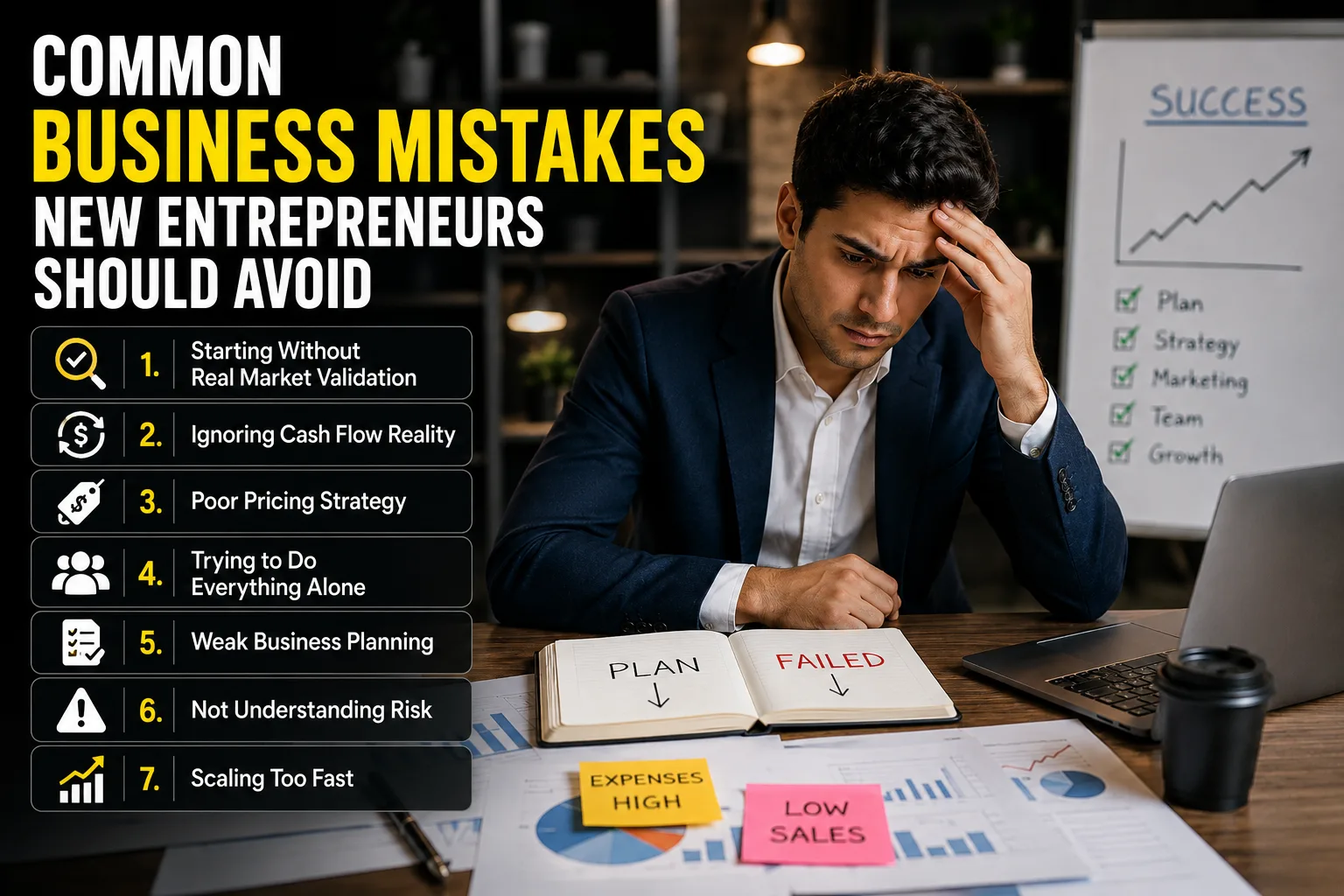
Here Are 7 Common Business Mistakes Every Entrepreneur Should Avoid
Let’s Discuss:
1. Starting Without Real Market Validation
One big mistake that a lot of companies make is that they create things that people do not really need. They build something. Then they figure out that people are not really looking for that thing.
It’s a problem because the new company wasted a lot of time and money creating something that people don’t actually want.
They spent months building it. It turns out people don’t want it. That’s a shame because now all that time and money are down the drain. The company thought they knew what people wanted. It turns out they were wrong.
Now they have to go to the drawing board and start over. New companies, like this, should focus on building things that people really need. Many new entrepreneurs assume: “If I like this idea, others will too.” That assumption is risky.
What actually works:
- Talk to real users before launching
- Validate demand with small tests
- Check if people are willing to pay
A product is not successful because it is good. It is successful because it solves a real problem.
2. Ignoring Cash Flow Reality
This is one of the most dangerous business mistakes. Revenue looks impressive on paper. But cash flow decides survival.
I once worked with a business owner in the United States who was generating steady monthly sales but this business owner was still having a tough time paying expenses. The business owner was doing okay with sales every month. The business owner was still struggling to pay the bills. The issue was delayed payments and poor planning.
Lesson:
Profit does not keep you alive. Cash flow does.
What you should do:
- Track incoming and outgoing money weekly
- Maintain a minimum cash buffer
- Avoid overcommitting expenses early
3. Poor Pricing Strategy
Pricing is not just about covering costs. It directly impacts perception and sustainability. Many mistakes new entrepreneurs make include:
- Underpricing to attract customers
- Copying competitor pricing without analysis
This leads to low margins, burnout, and difficulty scaling. The better approach is to understand your value, price based on positioning, not fear, and test and adjust gradually.
4. Trying to Do Everything Alone
In the early stage, it feels natural to manage everything yourself. This thing can become a problem for small businesses really fast. You will be doing the marketing and the operations and the finance, and the customer service by yourself. This reduces efficiency and increases errors.
Smart move:
At the right stage, consider:
- Outsourcing specialized tasks
- Or choosing to hire a business consultant for clarity
This is not an expense. It is a strategic investment.
5. Weak Business Planning
A lot of founders skip making a plan because they want to move fast. This can lead to mistakes in their business plan. If you do not have a plan, a few things can go wrong. For example, your goals will not be clear. You will misuse the resources you have. Your business will grow in a way.
At least you need to have a few basic things in place. You need an idea of how you will make money from your business. You need to know who your target audience is. Also, you need to understand how much things will cost.
Planning your business does not mean you will move slower. It actually helps you avoid going in the direction of your business plan. The business plan is what helps you make decisions and stay on track. Making a business plan is important for your business.
6. Not Understanding Risk
Every business carries risk. Ignoring it does not remove it. One of the critical entrepreneur mistakes is operating without backup thinking.
How to manage risk in business:
- Identify worst-case scenarios
- Build emergency funds
- Diversify revenue streams
- Avoid dependency on a single client or channel
Risk management is not pessimism. It is preparation.
7. Scaling Too Fast
Growth is a thing. It feels good to see a business grow.. When growth is not controlled, it can really hurt a business. A lot of startups make this mistake. It is often overlooked. For example:
Hiring people fast, expanding the business when money is not coming in steadily. Spending more on fixed costs when it is not the time. The truth is: if the foundation of a business is not strong, growing too fast will make problems worse. Growth is a thing, but uncontrolled growth can destroy a business.
Quick Breakdown of Mistakes and Solutions
The table below shows the mistakes people make when they start a business and the solutions to those mistakes for starting a business.
| Mistake | What Happens | Practical Fix |
| No market validation | Product fails to sell | Test demand before launch |
| Poor cash flow management | Financial stress | Track and plan cash weekly |
| Wrong pricing | Low profit margins | Price based on value |
| Doing everything alone | Burnout and errors | Delegate or outsource |
| Weak planning | Lack of direction | Create a basic business plan |
| Ignoring risk | Sudden setbacks | Build financial and operational buffers |
| Scaling too fast | Business instability | Grow only after validation |
Final Thought
Most mistakes business owners make are not complex. They are simple decisions taken without enough clarity. You do not have to be flawless to make it. You have to be on the lookout.
If you steer clear of some of these usual business errors your odds of creating a steady and lucrative business go up a lot. Take your time, it’s okay to go.
Don’t rush to think it through. Being aware of what can go helps. A few simple mistakes can make a difference. Think clearly. And build with intention. Because in business, small mistakes do not stay small for long.