
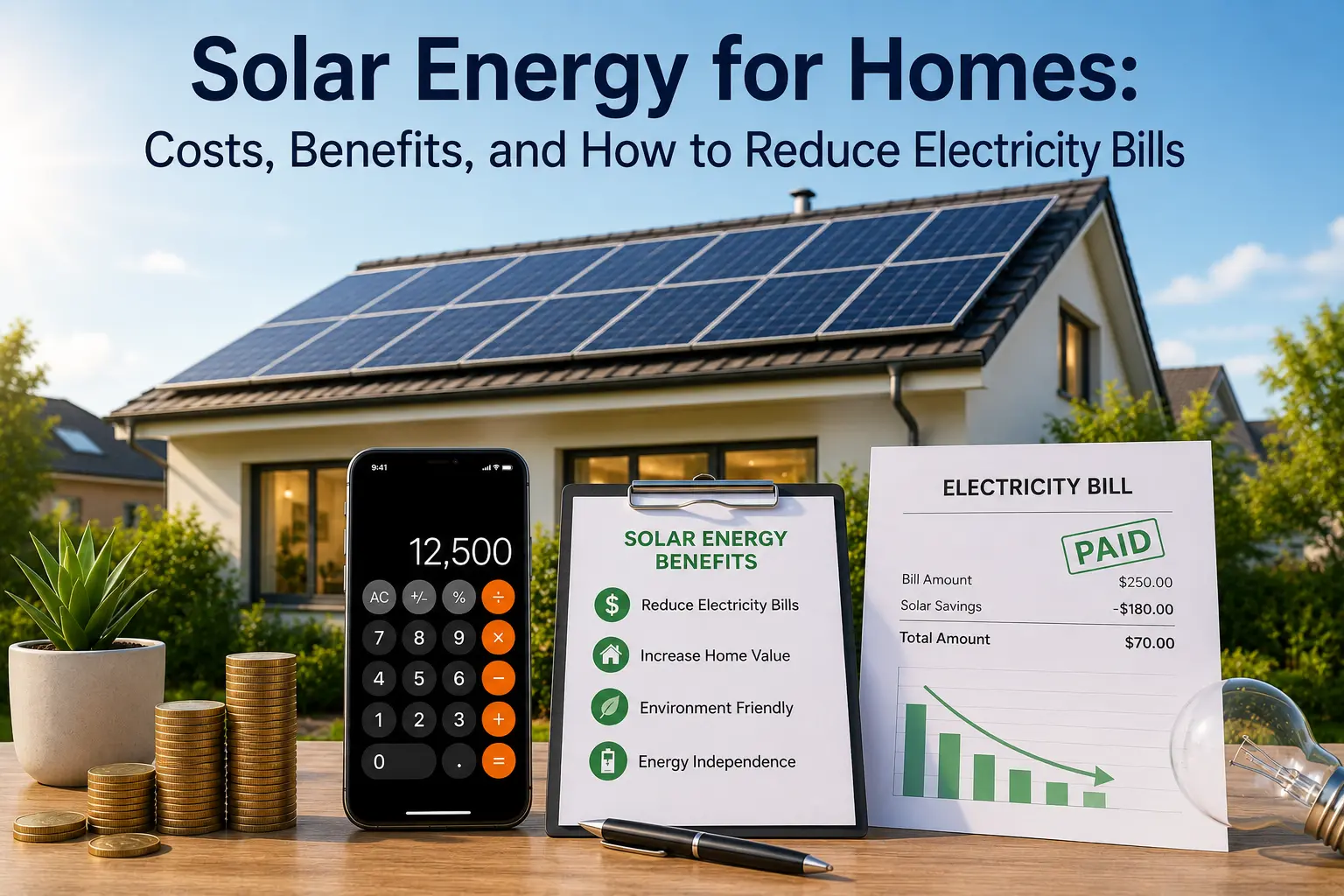
You would see solar panels on big commercial buildings or brand new homes. Now you see panels in neighborhoods all over the country. The reason is really simple. Electricity bills are getting higher and higher. Many homeowners want to reduce their expenses on electricity bills.
Solar panels are a way for homeowners to do that. Using energy is one option people consider. They want to know if saving money on electricity is enough to justify the initial cost of going solar.
So you are thinking about getting panels for your home. You should know what solar panels cost and what the benefits of panels are.
How Much Electricity Do You Use?
Most people ask: How much do solar panels cost?. A better question is: How much electricity does my home use every month?
This determines everything:
► The number of panels you need
► How much does it cost to install them
► How much you can save
► How long does it take to get your money
A home with a $75 monthly bill will be different from one that pays $300 every month.
What Does a Home Solar System Cost?
The cost of the system depends on the location, roof type, and solar panel size. For homeowners in the United States, the cost of installing the system is somewhere in this range. Before you get any discounts, it can be $10,000, or it can be $25,000.
The cost of the system really depends on these things. These numbers are just estimates. The real cost depends on things like the design of your roof, the quality of the equipment, labor costs, and local rules. The good news is that many homeowners can get tax incentives, which can lower the final cost a lot.
Solar System Cost Breakdown:
| System Size | Avg Cost (Before Incentives) | Estimated Cost After Tax Credit* | Best For |
|---|---|---|---|
| Small (4–6 kW) | $10,000 – $15,000 | $7,000 – $10,500 | Low usage homes |
| Medium (7–9 kW) | $15,000 – $20,000 | $10,500 – $14,000 | Average households |
| Large (10–12 kW) | $20,000 – $25,000 | $14,000 – $17,500 | High electricity usage |
How Much Can Solar Actually Save?
This is the question that really matters. The honest answer is that it depends on a lot of things. I know it can be frustrating to hear that. The truth is, every household is different. It’s hard to say exactly how much someone will save.
Your savings depend on:
➤ What you pay for electricity in your area
➤ How much sunlight your area gets
➤ Which way does your roof face
➤ How you use energy
➤ What your utility company’s policies are
For example, a homeowner who pays $250 every month for electricity has more room to save than someone who pays $90.
Over time, those monthly savings can add up to thousands of dollars. The biggest advantage is not getting rid of your electricity bill completely. It is reducing your dependence on electricity prices that just keep going up.
Monthly Bill vs Estimated Savings:
| Monthly Electricity Bill | Approximate Monthly Solar Savings | Savings Level |
|---|---|---|
| $75 | $20 – $40 | Low |
| $150 | $60 – $90 | Medium |
| $250+ | $150 – $200 | High |
Why Are More Homeowners Choosing Solar?
The money you save is what gets your attention first. Many homeowners are happy with solar for reasons they did not think about at first.
♦ More Predictable Energy Costs
Utility rates can change. Your mortgage payment is predictable. Your electricity bill is often not. Making some of your electricity gives you more control over what you pay in the future.
♦ Long-Term Value
Unlike home upgrades that just look nice, solar panels can keep giving you financial benefits for years and years. The system just keeps making electricity year after year.
Pros & Cons of Solar Energy:
| Pros of Solar | Cons of Solar |
|---|---|
| Lower electricity bills | High upfront investment |
| Long-term savings | Roof condition is important |
| Predictable energy costs | Shade can reduce performance |
| Cleaner energy source | Battery systems cost extra |
| Can increase home value | Not ideal for every property |
What Solar Companies Do Not Always Emphasize?
This is where homeowners need to pay attention. Solar is not perfect. It is not right for every property.
1. Your Roof Matters
If your roof is getting old, it might be smarter to replace it before you install panels. Taking them off and putting them back on later can cost more than it needs to.
2. Shade Can Reduce Performance
Trees, buildings,s and things on your roof can block sunlight. Limit how much energy you can make. Even a designed system cannot work its best if it does not get enough sunlight.
3. Batteries Increase Costs
Battery storage systems can give you power when the electricity is out. They are useful in some situations. They also make the whole project cost more. For some homeowners, rs it is worth it. For others, it is not.
Other Ways to Lower Electricity Costs
Solar works best when you use energy smartly. Before you install a system, think about:
► Switching to lights
► Sealing gaps around doors and windows
► Making your attic insulation better
► Getting appliances
► Using programmable thermostats
► Running appliances when electricity is cheaper
These changes can reduce how much energy you use before you even get solar panels. Using less energy means you might need a smaller solar system.
Smart Ways to Reduce Electricity Costs:
| Energy Saving Tip | Estimated Monthly Savings | Difficulty Level |
|---|---|---|
| Switch to LED lighting | $5 – $15 | Easy |
| Seal door & window gaps | $10 – $25 | Easy |
| Use programmable thermostats | $10 – $30 | Easy |
| Improve attic insulation | $20 – $50 | Medium |
| Upgrade to energy-efficient appliances | $15 – $40 | Medium |
Is Solar Worth It?
For homeowners, yes. Not because it is a trend. Not because every ad says you will save a lot. It is worth thinking about because electricity costs keep going up, and solar technology is more available than it was ten years ago.
The right solar system for your home can lower your monthly expenses and give you long-term value. The wrong system in the home can be a disappointment that costs too much. That is why you need to do your research.
Final Thoughts
Solar energy is not the fix. It won’t make your utility bills vanish or save every household money. Solar energy is a good way to have more say in their monthly expenses for people who own homes and are struggling with increasing electricity costs.
It helps homeowners deal with rising electricity costs. Solar energy is an option for them.
It is best to start with your electricity bills. Also, it is good to understand the energy usage in your household. You can compare prices and ask tough questions. You should make decisions based on numbers, not just what advertisers promise.