
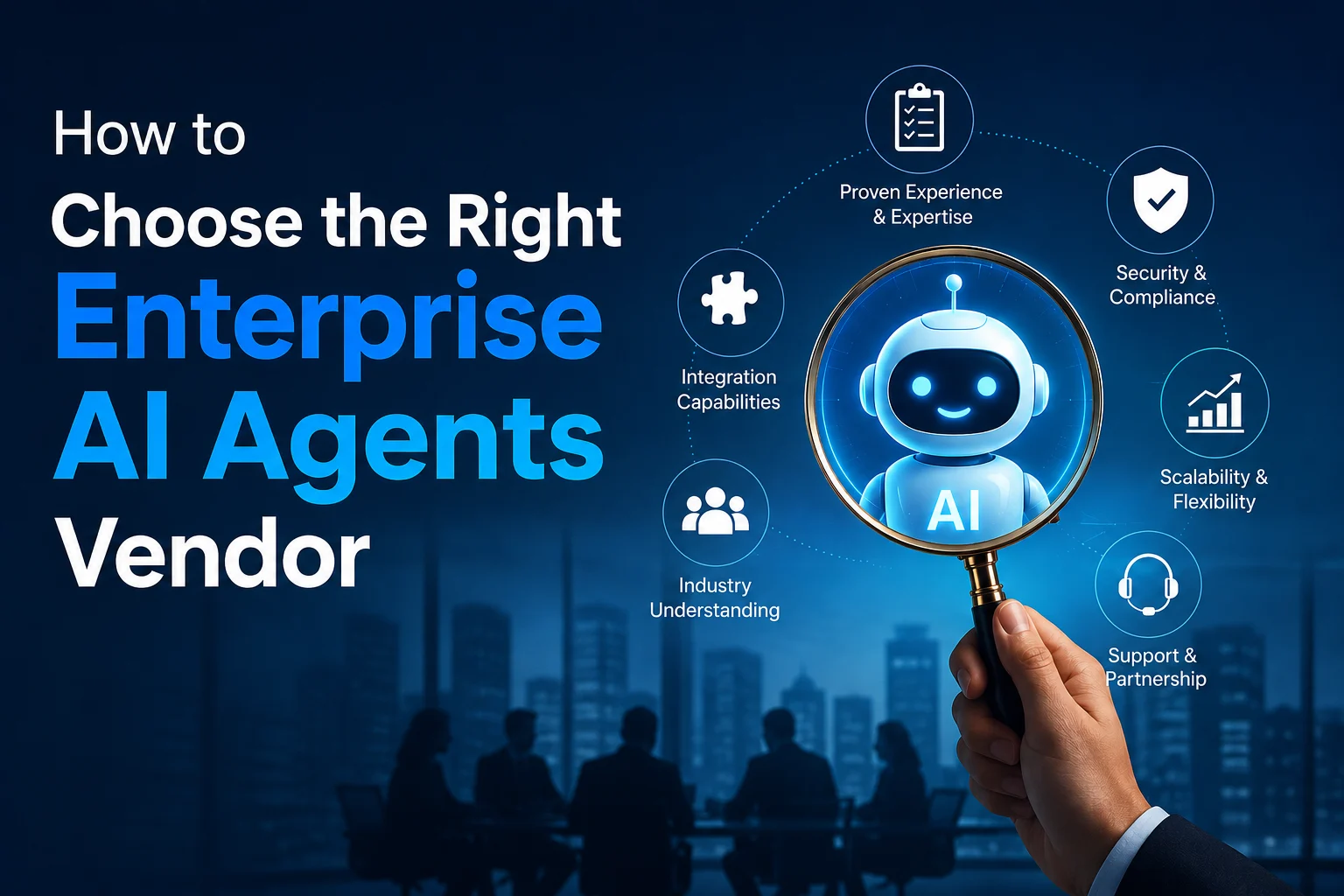
Choosing an AI agent vendor is no longer a small IT decision. It’s a choice that touches your data security, your customer experience, your operational costs, and how your teams work every single day. With so many companies now marketing themselves as leaders in agentic AI, it can be genuinely hard to tell which platforms are built for serious enterprise use and which ones are still finding their footing.
This is exactly the gap this guide is meant to close. If you’re evaluating enterprise AI agents for the first time, or you’ve already tried a pilot that didn’t scale, you’ll find a practical, no-fluff framework here. We’ll walk through what enterprise AI agents actually are, the risks of picking the wrong partner, the features that separate a serious platform from a flashy demo, and the security and compliance questions that too many buyers skip until it’s too late.
By the end, you’ll have a clear checklist for enterprise AI vendor selection, a list of questions to ask any vendor in your first call, and an honest look at some of the platforms currently leading this space. Whether you’re exploring AI agents for business for the first time or comparing AI agent development services for a company-wide rollout, this guide is built to help you make a decision you won’t regret in twelve months.
What Are Enterprise AI Agents and Why Do They Matter?
1. What Are Enterprise AI Agents?
Enterprise AI agents are software systems built on large language models that can understand a goal, plan the steps needed to reach it, and carry out actions across your business systems with little or no human intervention. Unlike a simple chatbot that answers a question and stops, an AI agent can look up information, make decisions based on that information, trigger actions in other software, and follow up until a task is actually complete.
Think of a support ticket that needs a refund approved, a database updated, and a confirmation email sent. A traditional tool would require a human to do each of those steps. An AI agent, connected properly through API integration, can handle the entire chain on its own and only loop in a person when a decision falls outside its defined boundaries.
2. Why Do Enterprises Need AI Agents?
Large organizations run on repetitive, multi-step processes — onboarding new employees, processing invoices, handling customer inquiries, generating reports, and much more. These processes are expensive to run manually and hard to scale during periods of growth or seasonal demand.
Enterprise AI automation addresses this directly. Instead of hiring more staff to handle a growing volume of routine work, businesses use AI agents to absorb that volume while freeing employees to focus on judgment calls, relationship building, and strategic work. This isn’t about replacing people; it’s about removing the parts of a job that shouldn’t require a human in the first place.
3. How Enterprise AI Agents Differ From Traditional AI Tools, Chatbots, and RPA
It’s easy to lump AI agents in with older automation technology, but the differences matter a lot when you’re making a purchasing decision.
- Chatbots follow scripted conversation flows and struggle the moment a query falls outside their training. They respond; they don’t act.
- Robotic Process Automation (RPA) follows rigid, pre-programmed rules. It’s fast and reliable for repetitive tasks but breaks the moment a process changes or requires judgment.
- Traditional AI tools typically analyze data or generate content but don’t take independent action across systems.
- Autonomous AI agents, by contrast, combine reasoning, memory, and the ability to call external tools and APIs. They can adapt to variations in a task, make decisions within set boundaries, and coordinate with other agents or humans when needed.
This distinction is why so many businesses evaluating enterprise AI platforms in 2026 are moving past basic chatbot deployments and looking specifically at agentic architecture.
4. Why Enterprise AI Agents Matter for Business Growth
The business case for enterprise AI agent solutions comes down to three things: speed, consistency, and cost control. Agents don’t get tired, don’t take sick days, and don’t lose focus during a long shift. They apply the same logic every time, which reduces errors in areas like compliance checks, data entry, and customer communication.
Just as importantly, agents scale in a way people can’t. A single well-built agent workflow can handle a 10% increase in ticket volume or a 300% spike during a product launch without needing weeks of hiring and training. That kind of elasticity is a genuine competitive advantage, particularly for companies operating in fast-moving markets.
The Risks of Choosing the Wrong AI Agents Vendor
Not every vendor claiming to offer enterprise AI agent capabilities is actually ready for enterprise workloads. Picking the wrong one carries real consequences, and it’s worth understanding these risks before you sign a contract.
➤ Security and Data Exposure Risks
AI agents often need access to sensitive systems — CRMs, financial records, HR data, customer databases. A vendor with weak enterprise data security practices, poor access controls, or unclear data handling policies can turn a productivity tool into a serious liability. If an agent has broad permissions and no proper guardrails, a single misconfiguration or prompt manipulation could expose confidential information.
➤ Poor Performance and Reliability
Some platforms perform well in a sales demo but struggle under real production load. Slow response times, inconsistent outputs, or agents that “hallucinate” incorrect information can damage customer trust and create more manual cleanup work than the automation was supposed to save.
➤ Integration and Scalability Challenges
An agent that can’t connect cleanly to your existing tech stack is of limited use. Vendors that offer only shallow legacy system integration, or that require heavy custom engineering for every connection, will slow your rollout and inflate your budget. Scalability issues also tend to surface only after go-live, when transaction volumes and user counts grow beyond what was tested during the pilot.
➤ Vendor Lock-In and Limited Flexibility
Some platforms are built in a way that makes it difficult to switch providers later, whether through proprietary data formats, closed model access, or workflows that can’t be exported. This limits your negotiating power and can leave you stuck with rising costs and shrinking support quality.
➤ Unexpected Costs and Weak ROI
Pricing that looks affordable at the pilot stage can balloon once you scale to full production usage. Per-conversation fees, per-agent charges, and hidden implementation costs are common surprises that erode the return on investment a project was supposed to deliver.
➤ Low User Adoption and Wasted Investment
Even a technically excellent platform fails if employees or customers don’t trust it or find it confusing to use. Poor onboarding, unclear escalation paths, and a lack of change management support from the vendor often lead to underused tools sitting on the shelf.
Core Features to Look for in an Enterprise AI Agent Platform
♦ Autonomous Task Execution and Workflow Automation
The core value of an AI agent is its ability to complete multi-step tasks independently. Look for a platform that supports genuine workflow automation and business process automation — not just single-turn responses. The agent should be able to plan a sequence of actions, execute them, and adjust course if a step fails or returns unexpected results.
♦ Multi-Agent Orchestration and Collaboration
Complex enterprise workflows often need more than one specialized agent working together. A platform with strong AI orchestration capabilities allows different agents — say, one focused on data retrieval and another on customer communication — to hand off tasks to each other smoothly. This is the foundation of true multi-agent systems, and it’s a strong signal of platform maturity.
♦ Context Awareness and Knowledge Retrieval
An agent is only as useful as the information it can access. Strong platforms use retrieval methods that pull accurate, up-to-date context from your internal documents, databases, and knowledge bases before generating a response or taking action. This reduces hallucinations and keeps outputs grounded in your actual business data.
♦ Enterprise System and API Integrations
Check how easily the platform connects to the tools you already rely on — CRM, ERP, ticketing systems, communication platforms, and internal databases. Native connectors and well-documented APIs matter far more than a long feature list, since API integration quality often determines how fast (and how expensive) your rollout will be.
♦ Human-in-the-Loop Controls
No matter how capable an agent is, some decisions should require human sign-off — refunds above a certain amount, sensitive HR actions, or anything with legal implications. A mature platform makes human-in-the-loop checkpoints simple to configure, so you control exactly where automation ends and human judgment begins.
♦ Monitoring, Analytics, and Observability
You can’t manage what you can’t see. Look for built-in AI monitoring and AI observability tools that show you what an agent did, why it made a particular decision, and where it might be failing. This visibility is essential for troubleshooting, compliance reporting, and continuous improvement.
♦ LLM and Model Flexibility
Vendors that lock you into a single large language model limit your ability to adapt as models improve or as costs shift. Platforms that support multiple LLM-powered agents and allow you to swap models based on performance or price give you more long-term control.
♦ Customization and Low-Code/No-Code Tools
Not every team has deep engineering resources. Platforms that offer low-code or no-code agent builders let business teams design and adjust workflows without waiting on a developer queue, which speeds up iteration and reduces dependency on your vendor’s professional services team.
Security, Privacy, and Compliance Considerations
This section deserves careful attention, since security and compliance failures are among the costliest mistakes a business can make when adopting agentic AI.
► Data Protection, Encryption, and Access Controls
Confirm that data is encrypted both in transit and at rest, and that the platform supports granular, role-based access controls. Agents should only be able to see and act on the data relevant to their specific task — nothing more.
► Identity, Authentication, and Authorization
Ask how the platform verifies both human users and the agents themselves. Strong identity management, single sign-on support, and clear authorization boundaries prevent unauthorized actions and reduce the risk of an agent being manipulated into performing tasks outside its intended scope.
► Data Privacy and Governance
Data privacy should never be an afterthought. Understand exactly what data the vendor collects, how long it’s retained, whether it’s used to train external models, and what happens to it if you end the contract. A trustworthy vendor will document this clearly rather than leaving it buried in a lengthy terms-of-service page.
► Regulatory and Industry Compliance
Depending on your industry, you may need to confirm alignment with standards like SOC 2, ISO 27001, HIPAA, GDPR, or industry-specific frameworks. Compliance requirements vary widely by sector, so ask for current certifications rather than assuming they apply by default.
► Auditability and Governance
Strong AI governance means every agent action can be traced, reviewed, and explained after the fact. Look for detailed audit logs, version history for agent configurations, and clear accountability for who approved which automation.
► Data Residency and Model Training Policies
For global enterprises, where your data physically resides can carry legal weight. Ask whether the vendor offers regional data hosting and whether your business data is ever used to train models shared with other customers.
Integration and Scalability Considerations
✸ API, SDK, and Extensibility Support
A well-documented API and SDK make it far easier for your internal teams to extend the platform over time. This matters especially for organizations with in-house engineering talent, including teams already comfortable working with ai coding agents for developers on other parts of the tech stack.
✸ Compatibility With Existing Enterprise Architecture
Your AI agent platform shouldn’t require you to rebuild your existing systems around it. Evaluate how well it fits into your current architecture, including your data warehouses, identity providers, and communication tools.
✸ Scalability and Performance
Ask for real performance benchmarks under enterprise-level load, not just pilot-scale numbers. Scalability and reliability should be demonstrated with evidence, not promised in a sales deck.
✸ Deployment Options and Infrastructure Flexibility
Some organizations require self-hosted or air-gapped deployments for security reasons, while others are comfortable with a fully managed cloud service. Confirm the vendor offers the deployment model that matches your risk tolerance and IT policies.
✸ Cross-Department and Multi-Use-Case Scalability
A platform that works well for customer support may not automatically translate to finance, HR, or operations. Check whether the vendor’s architecture supports interoperability across multiple departments and use cases without requiring a separate implementation each time.
Pricing and Total Cost of Ownership
✦ Common Enterprise AI Agent Pricing Models
Vendors typically price their platforms in a few different ways: per-seat or per-user licensing, per-conversation or per-transaction fees, usage-based consumption pricing, or flat enterprise contracts. Each model suits different usage patterns, so match the pricing structure to how heavily and how predictably your teams will use the platform.
✦ Implementation and Integration Costs
Beyond the subscription fee, factor in the cost of connecting the platform to your existing systems, migrating data, and configuring workflows. These implementation costs can sometimes rival or exceed the first year of licensing fees, especially for complex legacy system integration projects.
✦ Ongoing Maintenance and Operational Costs
Agents need monitoring, tuning, and occasional retraining as your business processes evolve. Ask what ongoing maintenance looks like and whether it’s included in your contract or billed separately.
✦ Hidden Costs to Watch For
Watch for charges tied to API call volume, additional agent instances, premium support tiers, or advanced analytics features that aren’t included in the base plan. A platform that looks inexpensive at first glance can become costly once these add-ons are factored in.
✦ How to Evaluate AI Agent ROI
To calculate genuine AI ROI, compare the fully loaded cost of the platform — subscription, implementation, and maintenance — against measurable outcomes like reduced handling time, lower staffing costs, faster resolution rates, and improved customer satisfaction. A proof-of-concept phase is the best time to establish these baseline metrics before committing to a larger rollout.
Questions to Ask an Enterprise AI Agent Vendor
1. Questions About Technology and Capabilities
- What LLMs does the platform support, and can we switch models later?
- How does the agent handle tasks that fall outside its trained scope?
- What does your AI agent architecture look like under the hood?
2. Questions About Security and Compliance
- What certifications do you currently hold, and can you share recent audit reports?
- How is our data isolated from other customers?
- What is your incident response process if a breach occurs?
3. Questions About Integration and Scalability
- Which systems do you have native connectors for, and which require custom development?
- Can you share performance benchmarks from a comparable enterprise deployment?
- What deployment options do you support — cloud, self-hosted, or hybrid?
4. Questions About Pricing and Support
- What does pricing look like at our expected volume, not just at pilot scale?
- What implementation support and technical support are included, and what costs extra?
- What does a typical onboarding timeline look like for a company our size?
Common Mistakes to Avoid When Choosing a Vendor
➤ Choosing Based on Features Alone
A long feature list means little if those features don’t map to your actual business problems. Prioritize vendors who take time to understand your workflows over those who simply demo every capability they have.
➤ Skipping Proof-of-Concept and Real-World Testing
A proof of concept run against your real data and real workflows will reveal far more than any sales presentation. Skipping this step is one of the most common reasons enterprise AI projects underdeliver.
➤ Failing to Define Business Goals and Success Metrics
Without clear, measurable goals set before implementation, it’s nearly impossible to judge whether a platform is actually working. Define what success looks like — reduced ticket volume, faster processing time, cost savings — before you sign a contract.
➤ Overlooking Vendor Support and Reliability
Enterprise deployments run into issues. A vendor with slow support response times or limited documentation will cost you time and money long after the contract is signed. Ask current customers about their support experience, not just the vendor’s own claims.
➤ Ignoring Exit Strategy and Long-Term Flexibility
Always understand what happens if you need to leave. Can you export your workflows and data? Are you locked into proprietary formats? Planning your exit strategy before you commit protects you from being trapped in an underperforming partnership.
Top Enterprise AI Agents Vendors to Consider
Top 5 Enterprise AI Agents Vendors List –
- Rasa
- LangGraph Platform
- Sierra AI
- Decagon
- Cognigy (NICE)
Below is a comparison of some of the leading platforms currently serving enterprise customers, based on publicly available information about their positioning, deployment options, and pricing.
1. Rasa
Rasa stands out for organizations that need self-hosted or air-gapped deployment, making it a strong fit for regulated industries like banking, healthcare, and government where enterprise AI security requirements are strict. Its patented orchestrator and native support for both voice and chat channels give it broad applicability across large, complex organizations.
| Platform | Best For | Key Differentiator | Deployment | Starting Price | Integrations |
|---|---|---|---|---|---|
| Rasa | Enterprise-wide deployments and regulated industries | Patented Orchestrator, native voice + chat, self-hosted architecture | Self-hosted / Private Cloud / Air-gapped | Custom enterprise pricing | MCP, A2A, CRM, CCaaS, Voice Stream |
2. LangGraph
Built for engineering teams already familiar with the LangChain ecosystem, LangGraph uses graph-based state machines to manage complex, stateful multi-agent workflows reliably in production. Its track record with large companies and its extensive integration library make it a strong choice for technically sophisticated teams building custom agentic systems.
| Platform | Best For | Key Differentiator | Deployment | Starting Price | Integrations |
|---|---|---|---|---|---|
| LangGraph | Stateful production multi-agent workflows; engineering teams using LangChain | Graph-based state machines, durable execution; proven references including Klarna and Uber | Cloud / Self-hosted | From $39/user/month | MCP, 700+ integrations via LangChain |
3. Sierra AI
Sierra AI focuses on premium, customer-facing enterprise support experiences. Founded by well-known technology leaders, it uses an outcome-based pricing model, which appeals to enterprises that want vendor incentives tied directly to results rather than seat counts.
| Platform | Best For | Key Differentiator | Deployment | Starting Price | Integrations |
|---|---|---|---|---|---|
| Sierra AI | Premium enterprise customer service and customer-facing enterprise support | Founded by Bret Taylor and Clay Bavor; outcome-based pricing | Cloud (managed) | ~$150K+/year, custom enterprise | Zendesk, Salesforce, telephony |
4. Decagon
Decagon targets mid-market to enterprise businesses looking to modernize customer service through omnichannel automation and natural-language agent configuration. Its flexible, conversation-based pricing model can work well for companies with variable support volumes.
| Platform | Best For | Key Differentiator | Deployment | Starting Price | Integrations |
|---|---|---|---|---|---|
| Decagon | Customer service for mid-market to enterprise businesses | AOPs, natural-language agent definition, omnichannel CX | Cloud (managed) | Custom per-conversation + platform pricing | Zendesk, Salesforce, API integrations |
5. Cognigy (NICE)
Cognigy, now part of NICE, is built for voice-first enterprise contact centers. With low-latency voice processing and recognition as a Gartner Leader, it’s a solid option for organizations where phone-based customer interaction remains a primary channel.
| Platform | Best For | Key Differentiator | Deployment | Starting Price | Integrations |
|---|---|---|---|---|---|
| Cognigy (NICE) | Voice-first enterprise contact centers | Native Voice Gateway, ~500ms latency, Gartner Leader | Cloud / On-prem | $2,500/month enterprise; ~$115K/year | 100+ integrations, CCaaS, CRM |
Conclusion
Choosing the right enterprise AI agents vendor is less about finding the platform with the most features and more about finding the one that fits your security requirements, your existing systems, your budget, and your actual business goals. The businesses that get the most value from enterprise AI adoption are the ones that treat vendor selection as a structured process — testing real workflows, asking hard questions about security and compliance, and calculating true total cost of ownership before signing anything.
If you take one thing away from this guide, let it be this: run a genuine proof of concept before committing to a long-term contract, and don’t be afraid to ask vendors uncomfortable questions about data handling, pricing at scale, and what happens if the relationship doesn’t work out. A little diligence upfront saves a lot of frustration later.
FAQs
What is the difference between an AI agent and a chatbot?
A chatbot responds to messages within a scripted or trained conversation flow. An AI agent can reason through a goal, take independent actions across multiple systems, and complete multi-step tasks with minimal human input.
How much do enterprise AI agent platforms typically cost?
Pricing varies widely, from a few thousand dollars a month for mid-market platforms to six-figure annual contracts for large-scale enterprise deployments. Costs depend on deployment model, usage volume, and the level of customization required.
Should we build our own AI agents or buy from a vendor?
This depends on your internal engineering capacity, timeline, and how specialized your use case is. Buying is usually faster and lower-risk for common use cases like customer support, while building may make sense for highly proprietary workflows where a vendor platform can’t be customized enough.
How long does it take to implement an enterprise AI agent platform?
Implementation timelines range from a few weeks for simple use cases to several months for complex, multi-department rollouts involving deep legacy system integration.
What security certifications should we look for in a vendor?
Common benchmarks include SOC 2 Type II, ISO 27001, and, depending on your industry, HIPAA or GDPR compliance. Always ask for current audit documentation rather than relying on marketing claims.
Can enterprise AI agents integrate with our existing software?
Most established vendors offer native connectors for common enterprise systems like CRMs, ERPs, and ticketing platforms, along with APIs for custom integrations. Integration depth varies significantly between vendors, so this should be tested during your proof of concept.
Thank you sincerely for reading. I hope this blog gave you the information you were looking for. Choosing the right AI agent vendor is a significant decision, but with the right information, that decision becomes far easier to make. Take the time to understand your business needs, be patient through the process, and move forward with confidence — the results will follow.