
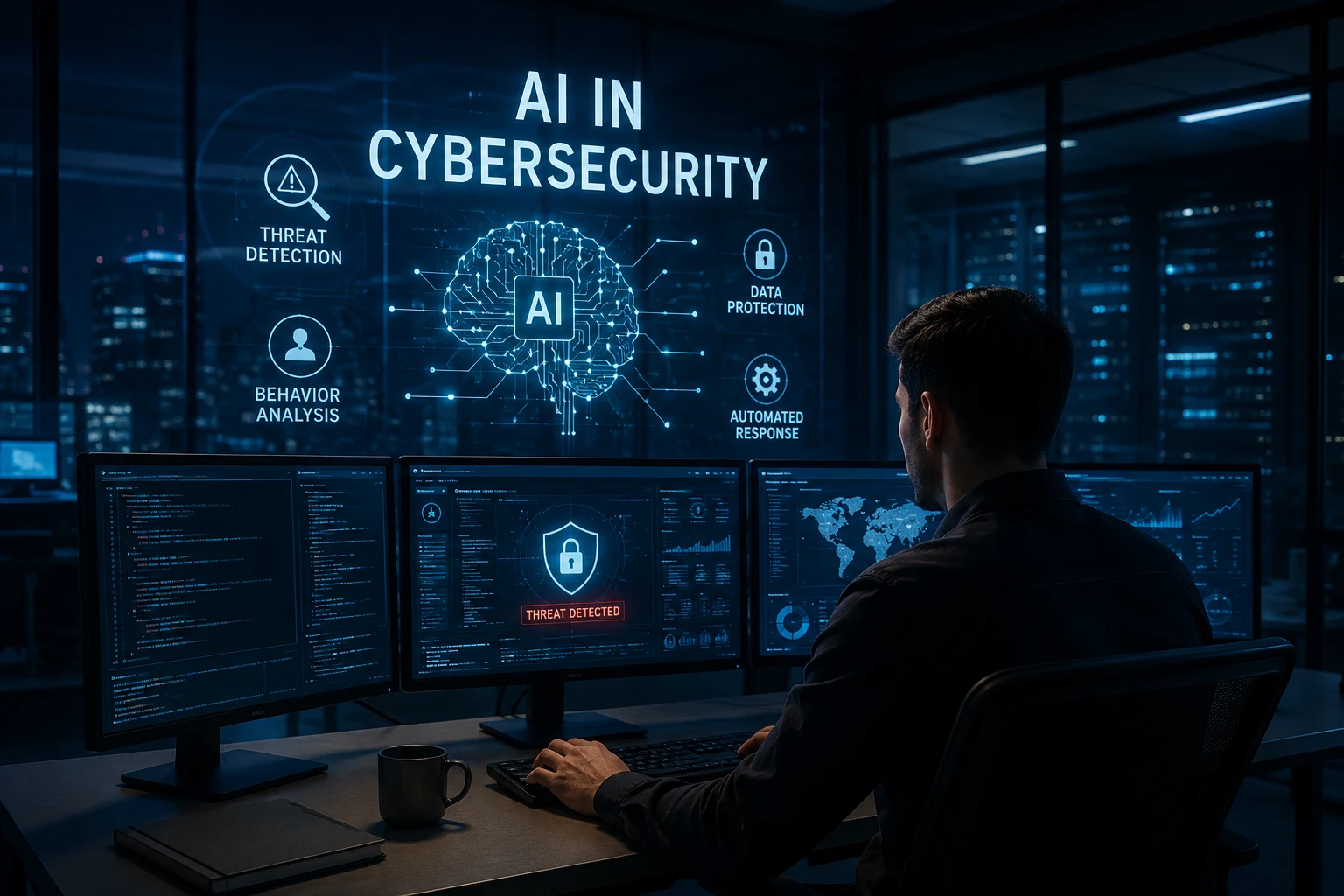
Digitization has revolutionized how businesses function, but it also brought in complicated cyber threats.
Ranging from ransomware to zero-days, modern threats are now finding new ways to evolve that outpace the capabilities of traditional security. This is why Cybersecurity embedded with AI has become a strategic imperative for organizations looking for sustainable and adaptable protection.
Through the convergence of automation, intelligence, and real-time analytics, artificial intelligence is revolutionizing how companies protect their information, networks, and digital assets.
Understanding AI in Cybersecurity
AI in cybersecurity is the utilization of machine learning and RA algorithms, as well as automated decision-making, to analyze, determine, or prevent threats. AI, unlike point security products which rely on static rule sets, are able to continuously learn from patterns in the data and new attacks.
This dynamic method of implementation enables companies to uncover new threats and maneuver away from requiring manual intervention. With digital ecosystems spanning across clouds, IoT networks, and remote work environments, AI in cybersecurity brings the flexibility to remain secure everywhere.
Why Do Businesses Need AI-Powered Cyber Security?
Today’s businesses are confronted with problems that traditional malware detection can’t solve. Attackers of today have employed automation, social engineering, and AI-driven methods themselves. That leaves businesses in a never-ending arms race against cyber criminals.
Key challenges include:
- Huge amounts of security logs and events
- Lack of experienced cybersecurity experts
- Advanced phishing scams and identity-based attacks
- Increasing regulatory compliance requirements
AI tackles these issues by processing data at a large volume so it can rank threats and respond in a more timely manner than humans. This is at the core of modern business cybersecurity solutions.
How AI-Powered Cybersecurity Solutions Work
AI-based cybersecurity products work at several layers of the IT stack:
- Network traffic analysis
- Endpoint behavior monitoring
- User activity tracking
- Cloud workload security
- Threat intelligence correlation
By detecting departures from the normal, AI systems can strike red flags in real time. Machine Learning in Cybersecurity gets better detection by learning from previous incidents, which helps in reducing false positives and identifying advanced persistent threats.
What is cool about this continuous learning approach is that protection gets better, not worse, over time.
AI-Driven Cybersecurity Solutions For the Enterprise
At scale and complexity Big organisations need a security framework that scales up. AI is a component in enterprise cybersecurity solutions that combines visibility and automated defense across global operations.
These systems include:
- AI-driven Security Information and Event Management
- Endpoint Detection and Response
- Identity and Access Management
- Cloud Security Posture Management
- Automated threat remediation tools
For businesses that manage confidential financial, health, and customer information, AI for cybersecurity enterprise security tools offer a round-the-clock shield with less overhead.
A Corporate Perspective on Cybersecurity in the AI era
An up-to-date corporate strategy for cybersecurity must incorporate AI as a fundamental capability, not an add-on extra.
Effective AI-based strategies include:
- Risk assessment using predictive analytics
- Automated vulnerability scanning
- Behavioural analysis for insider threat detection
- Continuous compliance monitoring
- Incident response automation
If AI is integrated with strategic planning, organizations become more secure in the long run and have stronger control of digital assets.
The Ways AI Is Transforming Cybersecurity For Businesses
Business leaders need to know how AI enhances cybersecurity protection for businesses so that they can justify the investment.
AI delivers measurable improvements by:
- Pattern Recognition for Earlier Threat Detection
- Automating mitigations to minimize the impact of a breach
- Intelligent linking to cut investigation times
- Strengthening identity verification
- Supporting 24/7 monitoring without fatigue
These enhancements have a direct impact on uptime, the bottom line of a company, and can be good for a brand’s reputation.
Benefits of AI in Cybersecurity
The advantages of AI for cybersecurity cut across operational, economic, and strategic dimensions:
- Speed and accuracy – AI can digest the kinds of threats more quickly than human teams.
- False Alert Reduction – Machine learning enhances the accuracy of detecting intrusions
- Lower operational expenses – Automation minimizes the need for manual work
- Proactive protection – Computational models to predict attacks.
- Better adherence – Real-time measurement underpins compliance with the regulatory framework
- Adaptability – AI scales with business infrastructure
Collectively, these benefits enable enterprises to keep strong security in place without compromising productive output.
Cybersecurity Automation Using AI
Cybersecurity automation with AI is one of the most game-changing benefits of implementing AI.
Automated systems can:
- Isolate infected devices
- Block malicious IP addresses
- Reset compromised credentials
- Deploy patches
- Trigger incident response workflows
Automation decreases response time from hours to seconds, massively reducing the window of exposure during assaults.
Cyber Security – The Next Frontier For Agentic AI
Agentic AI in cybersecurity is a new breed of autonomous security systems that can make decisions autonomously within pre-defined parameters.
Contrary to the traditional AI that just responds to commands, agentic AI is able to:
- Investigate alerts
- Cross-reference threat databases
- Launch countermeasures
- Coordinate across multiple tools
- Learn from outcomes
This self-learning ability not only allows the security operation to run around the clock with minimal human intervention but also greatly enhances organizational resilience.
Best AI Tools for Cybersecurity
Selecting the Questionable AI vendors comes down to business size, industry, and risk profile.
Popular categories include:
- AI-powered SIEM platforms
- Behavioral analytics engines
- Endpoint protection platforms
- Cloud security AI services
- Automated threat intelligence platforms
When selecting tools, organizations need to assess their accuracy, scalability, and integration capacity that meet regulatory requirements.
Implementing AI in Cybersecurity Strategy
Successful adoption requires careful planning.
Adoption of AI into the cybersecurity plan should be carried out in well-ordered stages:
- Risk assessment and infrastructure audit
- Business based on the fit of the tool
- Integration with existing systems
- Training security teams
- Continuous monitoring and model optimization
Consistency provides sustainability when IT management and executives reside in alignment.
Key Industry Trends Driving AI in Cybersecurity
Here are some Current AI in cybersecurity trends:
- Zero-trust architecture supported by AI
- Autonomous threat hunting
- AI-driven identity verification
- Cloud-native AI security platforms
- Behavioral biometrics
This all points towards AI as being the underlying basis of security postures, and it is just around the corner.
AI: The Future of Cybersecurity
The future of cybersecurity with AI involves a fully autonomous security ecosystem that can predict and prevent threats before breaches occur.
- The more AI systems mature, the more they will:
- Continuously evolve defense mechanisms
- Integrate with regulatory reporting
- Enable global threat intelligence sharing
- Provide predictive security forecasting
Early AI adopters have a competitive edge for trust, compliance, and business continuity.
Conclusion
Cyber risks will only grow in complexity, frequency, and cost. Simplistic defense is no longer an option. Embracing Cybersecurity with AI companies has adaptive, scalable, and intelligent protection that grows with threats of today.