
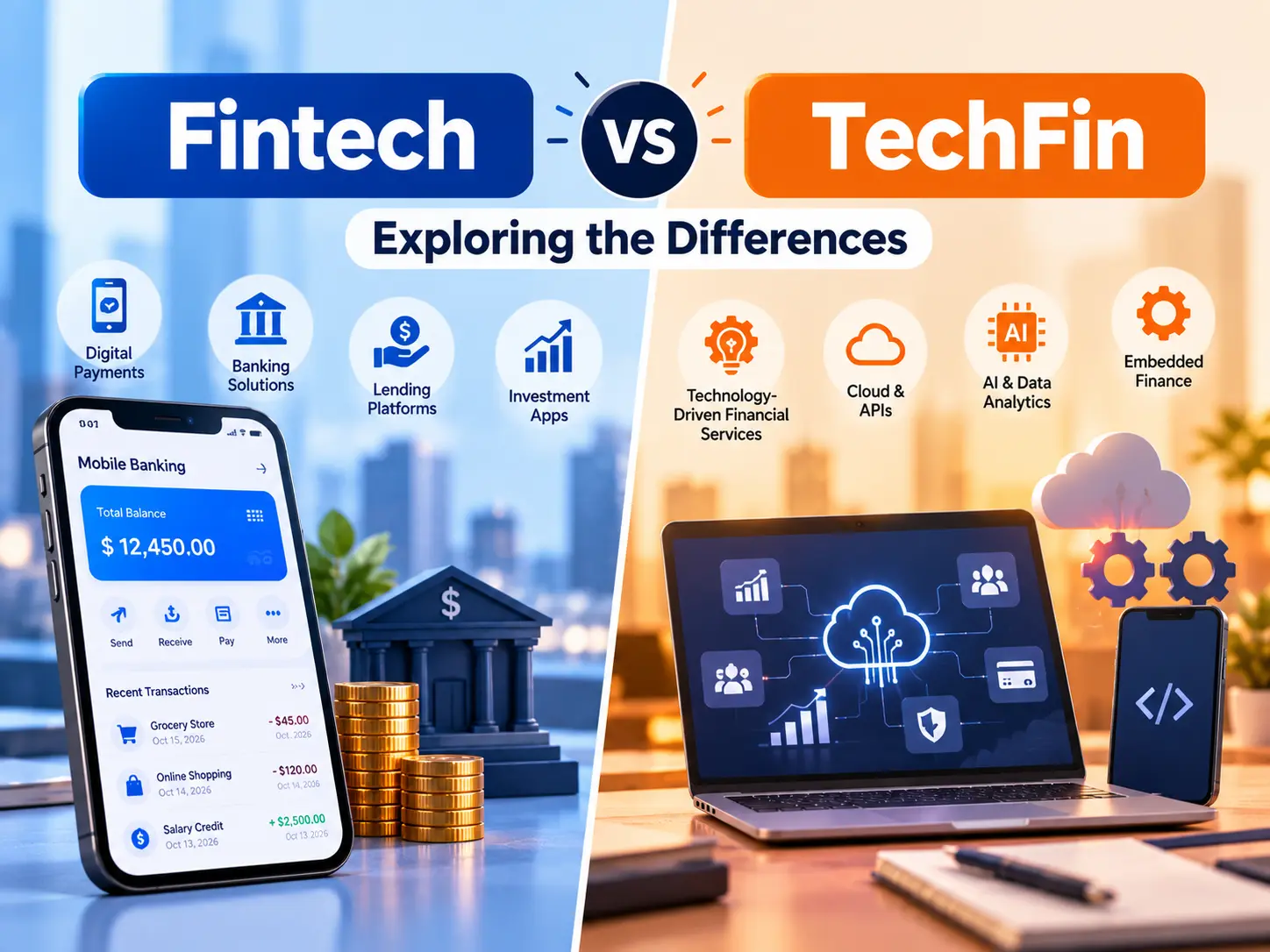
Fintech and TechFin both put technology at the center of money, but they start from opposite ends. Fintech companies begin with a financial problem and build technology to solve it. TechFin companies begin with a large technology platform and add financial services on top of it. That one difference shapes their business models, regulation, data, and growth.
The terms are often used as if they mean the same thing, and the line between them is getting thinner. A payments startup may now run on a cloud giant’s infrastructure, while a marketplace may hold its own lending license. Still, the distinction matters if you are a founder choosing a model, a bank planning partnerships, or a reader trying to understand who is changing the digital finance ecosystem.
This guide explains what fintech is, what TechFin is, how the two differ, what they mean for banks and customers, which model suits which business, and where both are heading in 2026 and beyond. It uses no invented statistics. Where a claim depends on fast-moving regulation or market data, it is described in general terms so you can verify current figures with the relevant regulator or company.
What is Fintech and How Does It Work?
Fintech (financial technology) refers to companies that use software, data, and digital platforms to deliver or improve financial services such as payments, lending, investing, insurance, and banking. A fintech company’s core business is a financial product. Technology is how it delivers that product faster, cheaper, or with a better experience than traditional providers.
In practice, a fintech takes a familiar financial job, such as sending money abroad, approving a small business loan, or splitting a bill, and rebuilds the process digitally. Many fintechs work as a layer between customers and regulated institutions, either by getting their own licenses or by partnering with licensed banks.
Key Characteristics of Fintech
Most fintech companies share a handful of traits:
- Financial problem first: The product exists to solve a specific financial pain point, such as slow cross-border transfers or hard-to-access credit.
- Technology-first approach to delivery: Apps, APIs, and automation replace branches, paperwork, and manual review.
- Customer-centric financial solutions: Design focuses on speed, transparency, and low friction.
- Regulated activity: Because they handle money or credit, fintechs usually operate under financial licenses or partner with licensed institutions.
- Agility: Many are startups that ship updates quickly and can test new financial products without legacy systems slowing them down.
How the Fintech Business Model Works
The fintech business model is built around earning revenue directly from financial activity, such as fees, interest, subscriptions, or a share of transaction volume. Because the financial product is the business, revenue is closely tied to how many people use it and how much money moves through it.
Common fintech revenue streams include:
- Transaction fees: A small percentage or flat fee on each payment processed.
- Interest and lending spread: Income from loans, or from the gap between what a company earns and what it pays out.
- Subscription fees: Monthly plans for premium accounts, analytics, or business tools.
- Interchange revenue: Fees earned when customers spend with a card the fintech issues.
- Software and API fees: Charges to businesses that use a fintech’s payment processing technology or financial data tools.
A typical growth path starts narrow, perhaps one product for one customer group, and then expands into adjacent services once trust is built.
Popular Fintech Services and Real-World Examples
Fintech services now cover nearly every corner of finance. Here are the main categories with well-known examples:
| Category | What it does | Example companies |
|---|---|---|
| Digital payments and gateways | Accept and move money online and in person | Stripe, PayPal, Adyen |
| Neobanks and online banking platforms | Offer account services without physical branches | Revolut, Chime, Monzo |
| Digital lending platforms | Provide loans and credit using online underwriting | Upstart, SoFi |
| Buy now, pay later (BNPL) | Split purchases into installments | Klarna, Affirm |
| Cross-border transfers | Send money internationally at lower cost | Wise |
| Investing apps | Offer trading and wealth tools | Robinhood |
| Open banking connectors | Let apps securely access bank data | Plaid |
| Insurtech and RegTech | Modernize insurance and compliance | Lemonade, Chainalysis |
These companies make up the core of the modern FinTech industry. If you want to see how one slice of this works from the customer side, our guide to online banking shows how digital account management has changed everyday money habits.
What is TechFin and How Does It Work?
TechFin refers to established technology companies that extend their existing platforms, data, and user bases into financial services. Instead of being a financial company that uses technology, a TechFin firm is a technology company that offers finance as an additional service. The term is widely credited to Jack Ma, the Alibaba founder, who used it to describe Ant Group’s approach.
The core idea is distribution and data. A technology company already has millions of users, rich behavioral data, and strong infrastructure, so adding payments, credit, or insurance can feel like a natural next step for its customers.
Key Characteristics of TechFin
- Technology first, finance second: The financial service supports a larger ecosystem rather than being the sole product.
- Massive existing user base: Customers arrive through e-commerce, social, search, mobile devices, or ride and delivery apps, not through a financial offer.
- Data advantage: Years of shopping, messaging, or usage data can help assess creditworthiness and detect fraud.
- Large-scale infrastructure: Cloud computing, machine learning, and engineering resources already exist.
- Ecosystem lock-in: Financial services keep users engaged inside the platform.
How the TechFin Business Model Works
The TechFin business model uses financial services to strengthen a core technology business, rather than treating finance as the main profit engine. Payments make checkout smoother, lending increases merchant sales, and wallets keep users inside the ecosystem longer.
Here is the typical flow:
- The company builds a large platform (marketplace, device ecosystem, social app, or search engine).
- It adds a payment or wallet feature to reduce friction.
- It uses transaction and behavior data to offer credit, savings, or insurance, often through licensed partners.
- Financial activity increases engagement, loyalty, and core business revenue.
Revenue can still come from fees and interest, but the strategic value often lies in stronger customer retention and richer data.
Examples of Technology Companies Offering Financial Services
The usual examples of big tech in finance include:
- Ant Group (Alipay): Grew out of Alibaba’s e-commerce ecosystem and became a leading digital payments and credit platform in China. It is the standard example of TechFin.
- Tencent (WeChat Pay): Added payments to a messaging super-app.
- Apple (Apple Pay, Apple Card): Uses its device ecosystem to offer wallet and card services, working with banking partners.
- Google (Google Pay): Offers digital wallets and payment tools across Android and its services.
- Amazon (Amazon Pay, seller lending): Provides payments and merchant financing tied to its marketplace.
- Grab and similar super-apps: Add wallets, lending, and insurance to ride, food, and delivery platforms.
Many of these firms work with banks or hold licenses in specific markets, so the exact setup varies by country.
Fintech Vs TechFin: Key Differences
The main difference between fintech and TechFin is the starting point: fintech starts with financial services and adds technology, while TechFin starts with technology and adds financial services.
The table below compares the two across the aspects that matter most.
| Aspect | Fintech | TechFin |
|---|---|---|
| Business approach | Finance-first; uses technology to improve financial products | Technology-first; adds finance to an existing platform |
| Primary focus | Solving a specific financial problem (payments, lending, investing) | Growing and strengthening the broader ecosystem |
| Revenue models | Fees, interest, subscriptions, interchange, API charges | Mix of financial fees plus indirect gains such as retention, commerce growth, and data value |
| Customer relationships | Built around a financial need; customers choose the product for the service | Built on an existing platform relationship; customers often discover finance inside a product they already use |
| Data and technology | Data focused on financial behavior; technology built for the product | Large, varied behavioral data and mature infrastructure such as cloud and AI |
| Financial infrastructure | Often builds on or partners with banks and payment networks, or holds its own licenses | Often uses partner banks and licensed entities, or builds its own infrastructure at scale |
| Regulatory requirements | Directly regulated as a financial services provider in most cases | Faces financial rules on the finance arm, plus scrutiny on data, competition, and market power |
| Market positioning | Specialist or challenger to traditional banks | Platform giant extending into financial services |
Where Fintech and TechFin Overlap
The two models share more than the names suggest. Both rely on digital financial services, APIs, cloud systems, and real-time data. Both compete with banks for customer attention, and both must satisfy regulators and protect user data. Our explainer on the importance of data privacy is useful background here, since data handling sits at the heart of both models.
The lines also blur in practice. A fintech like Stripe has grown into a broad platform with its own ecosystem, which looks a lot like TechFin. A tech company like Apple may rely on a bank partner for its card, which looks a lot like a fintech partnership. The most useful way to think about it is as a spectrum rather than two separate boxes.
Impact of Fintech and TechFin on the Financial Industry: Benefits and Challenges
Together, fintech and TechFin have made financial services faster, more accessible, and more convenient, while also raising new questions about risk, data, and competition. Their impact on the financial technology ecosystem is positive in many ways, but it is not free of trade-offs.
Key Benefits for Consumers and Businesses
- Speed and convenience: Account opening, payments, and loan decisions that once took days can now happen in minutes.
- Lower costs: Digital operations often reduce fees, especially for cross-border payments and small-business services.
- Financial inclusion: Mobile wallets and digital accounts can reach people who lack easy access to branches.
- Better experience: Clear interfaces, instant notifications, and personalized tools improve the customer experience.
- Smarter tools for businesses: Payment gateways, automated accounting, and financial data analytics help merchants manage cash flow and make decisions faster.
- Stronger security options: Techniques such as AI-driven fraud detection and digital identity verification can spot suspicious activity earlier.
Major Challenges and Risks
- Data privacy and security: Handling sensitive financial and behavioral data creates a large target for breaches and raises questions about consent.
- Regulatory gaps: New products can move faster than rules, leaving gray areas around consumer protection and responsibility.
- Concentration of power: Big tech firms entering finance can dominate markets, raising competition concerns.
- Credit and algorithm risk: Data-driven lending can reduce bias in some cases but can introduce it in others if models are not carefully tested.
- Operational dependence: Outages at a major cloud or payment provider can affect many businesses at once.
- Sustainability of startups: Some fintech startups depend on partner banks or funding cycles, which can create fragility.
Impact on Traditional Banks and Financial Institutions
Traditional banks face both competition and opportunity from fintech and TechFin, and most are responding through digital transformation in banking rather than resistance. In the debate of traditional banking vs. fintech, banks keep clear strengths: trust, balance sheets, licenses, and deposit bases. Fintechs and tech platforms bring speed, design, and data.
The result is a mix of responses:
- Modernizing core systems and adopting banking automation.
- Partnering with fintechs to launch features faster than building in-house.
- Offering banking-as-a-service (BaaS) so other companies can embed financial products.
- Investing in mobile banking applications and personalized digital experiences.
- Strengthening compliance with RegTech tools to manage growing regulatory demands.
In many markets, the story is less about replacement and more about collaboration, with banks supplying regulated infrastructure and technology players supplying distribution and user experience.
Fintech Vs TechFin: Which Model is Right for Your Business?
The right model depends on what you already have: if you have a financial specialty, a fintech model usually fits; if you already own a large user base and technology platform, a TechFin model may fit better. Many businesses will land somewhere in between.
Key Factors to Consider Before Choosing a Model
Ask these questions before committing:
- Core strength: Is your edge in financial expertise or in platform and data?
- Customer base: Do you already have users, or do you need to win them from scratch?
- Regulatory capacity: Can you obtain licenses, or do you need a regulated partner?
- Capital and timeline: How much can you invest, and how quickly do you need to launch?
- Technology resources: Do you have the engineering depth to build secure, scalable financial infrastructure?
- Risk appetite: How comfortable are you with credit, fraud, and compliance exposure?
When a Fintech Model Is the Better Fit
A fintech model is often the better choice when:
- You are solving a clear, specific financial problem.
- You are a financial technology startup without an existing user base.
- Your advantage is deep domain knowledge, such as lending, payments, or compliance.
- You want to start lean with an MVP and expand step by step.
- You are building B2B tools such as payment gateway integration, lending software, or compliance automation for other companies.
Founders in this position often work with specialists. Typical needs include custom fintech software development, API integration, and fintech MVP development to test the idea before scaling.
When a TechFin Model Is the Better Fit
A TechFin model is often the better choice when:
- You already run a platform with a large, active user base.
- You hold valuable data that can improve credit, risk, or personalization.
- Financial services would clearly improve your core product, such as faster checkout or merchant financing.
- You have the engineering and capital resources to operate at scale.
- Your goal is ecosystem growth, not finance as a standalone product.
Hybrid Models and Strategic Partnerships
Hybrid models combine a fintech’s financial expertise with a technology company’s reach, and they are increasingly common. A retailer might embed a lending product from a fintech partner. A bank might offer white-label fintech solutions under its own brand. A platform might use a licensed partner for regulated activity while owning the customer experience.
Common hybrid structures include:
- Embedded finance partnerships, where a non-financial brand offers financial products through a partner.
- Banking-as-a-service, where a licensed bank provides the infrastructure behind another company’s product.
- API-based collaboration, where businesses connect to specialized providers instead of building everything.
Whatever the structure, clear responsibility for compliance, data handling, and customer support should be agreed up front.
Future Trends in Fintech and TechFin
The next phase of fintech trends in 2026 centers on AI, embedded finance, open data, and clearer regulation, which together are pushing fintech and TechFin closer together. Market data and rules change quickly, so check current regulator and industry sources before making decisions.
AI and Data-Driven Financial Services
AI in finance is moving from experimentation to everyday operations. Financial firms use it for:
- AI-driven fraud detection that flags unusual patterns in real time.
- Data-driven lending that assesses risk with broader signals.
- Generative AI in banking for customer support, document summarization, and internal productivity.
- Agentic AI in finance, where AI systems carry out multi-step tasks such as monitoring accounts or preparing reports, usually with human oversight.
The main challenge is trust. Firms need explainable models, strong data governance, and clear human accountability, particularly for credit decisions.
Embedded Finance and Open Banking
Embedded finance places payments, lending, and insurance inside non-financial apps, so customers never have to leave the experience they are already using. Open banking technology supports this by letting customers share their financial data securely with approved providers through APIs. The broader idea of open finance extends that sharing beyond bank accounts to areas such as investments, pensions, and insurance, though how far it goes depends on the country.
Other areas to watch include real-time payment systems, stablecoin payments, and tokenized financial assets, which are being tested and in some markets rolled out as the rules become clearer.
Regulatory Evolution and Fintech-TechFin Convergence
Regulators are paying closer attention to both models. Expect more focus on data protection, operational resilience, consumer safeguards, and the role of large tech platforms in finance. Rules on digital assets and stablecoins are also developing in several regions.
At the same time, the two models are converging. Fintechs are growing into platforms, tech companies are working with or acquiring financial capabilities, and banks are acting more like technology firms. The practical effect is that competitive advantage will depend less on the label and more on trust, compliance, and execution.
Conclusion
Fintech starts with finance and uses technology to improve it. TechFin starts with technology and uses finance to strengthen its ecosystem. Both are reshaping the digital finance ecosystem, and both are pushing banks to modernize.
For businesses, the decision comes down to your strengths. Choose a fintech model if you have financial expertise and a focused problem. Consider TechFin if you already own a large platform and data. Many will end up with a hybrid, supported by smart partnerships. Whichever direction you take, build on strong security, clear compliance, and a genuine focus on customer needs. If you are exploring a build, a fintech software development company or a financial technology consulting team can help you validate the model before you invest heavily.
FAQs
What is the Main Difference Between Fintech and TechFin?
Fintech companies are financial service providers that use technology to improve finance. TechFin companies are technology firms that add financial services to an existing platform. The difference lies in the starting point: finance first versus technology first.
What Are Some Real-World Examples of Fintech and TechFin Companies?
Fintech examples include Stripe, PayPal, Revolut, Wise, Klarna, and Plaid. TechFin examples include Ant Group (Alipay), Tencent (WeChat Pay), Apple (Apple Pay), Google (Google Pay), and Amazon (Amazon Pay). Some companies sit between the two categories.
How Do Fintech and TechFin Companies Make Money?
Fintechs mostly earn from transaction fees, interest, subscriptions, interchange, and API or software fees. TechFin companies can earn from similar fees, but they also benefit indirectly through higher user engagement, stronger merchant sales, and more valuable data inside their core platform.
Is TechFin Better Than Fintech?
Neither is better in every case. TechFin firms have scale, data, and distribution, while fintechs offer focus, agility, and specialization. The better model depends on a company’s resources, goals, and customers.
Do the Same Regulations Apply to Fintech and TechFin Companies?
Not exactly. Both must follow financial rules for activities such as payments, lending, and anti-money-laundering controls, and requirements vary by country. TechFin companies also face extra scrutiny related to data use, competition, and market power. Always confirm with local regulators or legal counsel.
Which Model is Better for a Startup?
Most startups are better suited to a fintech model, since they lack an existing user base and can win by solving one problem well. Starting with an MVP and a licensed partner can reduce cost and compliance burden.
Will TechFin Replace Fintech in the Future?
Unlikely. Both are expected to coexist and increasingly overlap through partnerships, embedded finance, and shared infrastructure. Specialized fintechs continue to innovate, while large tech platforms bring scale. Banks will remain central as regulated institutions.
Disclaimer –
This article is for general informational purposes only and does not constitute financial, legal, or investment advice. Regulations, products, and market conditions in fintech change frequently and vary by country. Please consult a qualified professional or the relevant regulator before making business or financial decisions.