
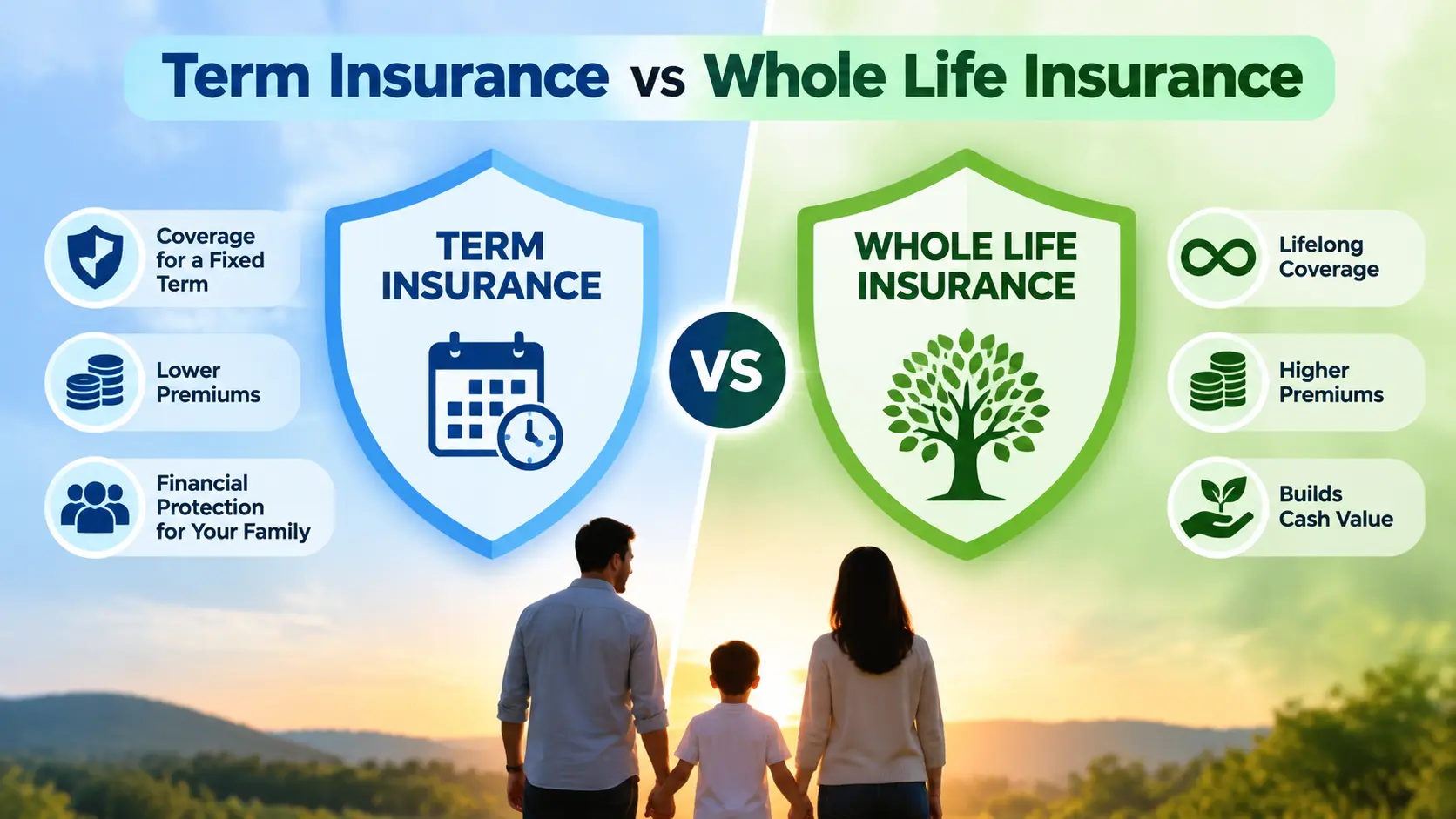
Term insurance covers you for a fixed period at a low cost. Whole life insurance covers you for your entire life and builds cash value, but costs much more. The right choice depends on your budget, your dependents, and how long you need financial protection.
If you’re comparing term life insurance vs. whole life insurance, you’re probably asking one of three things: What’s the difference? Which is cheaper? Which is better for my family? This guide answers all three in plain language.
Both policies pay a death benefit to your beneficiaries when you die. Beyond that, they work very differently. One is built for pure protection. The other combines lifelong coverage with a savings feature. Below, you’ll find how each works, how they compare on cost and benefits, and how to decide.
What is Term Insurance and How Does It Work?
Term life insurance pays a death benefit to your beneficiaries if you die within a set period, such as 10, 20, or 30 years. You pay premiums during that period. If you outlive the term, coverage ends, and nothing is paid out.
Think of it as renting protection for the years you need it most: while you have a mortgage, young children, or income others depend on. Because the insurer only covers a limited window, term insurance is the most affordable way to get a large amount of coverage. That’s why it’s often called a “pure protection plan.”
Key Features of Term Insurance
- Fixed coverage period (policy term): Coverage lasts for the term you choose, then expires.
- Level premium: Most term policies have a fixed premium for the whole term, so your payment doesn’t rise mid-policy.
- Large coverage amount at low cost: You can buy a high sum assured (death benefit) for a modest premium.
- No cash value: A standard term policy doesn’t build savings. Once the term ends, so does the coverage.
- Simple to understand: The structure is easy to compare across insurers.
- Optional riders: Add-ons such as accidental death, critical illness, or waiver of premium can be added for extra cost. Check each rider’s terms before buying.
Types of Term Insurance Plans
| Plan type | How it works | Best suited for |
|---|---|---|
| Level term | Same death benefit and premium throughout the term | Most families, mortgage protection |
| Decreasing term | Death benefit shrinks over time | Covering a reducing debt, such as a loan |
| Increasing term | Death benefit grows over time | Keeping pace with rising costs |
| Return-of-premium term | Refunds premiums if you outlive the term | Buyers who want something back, at a higher premium |
| Convertible term | Can be converted to permanent coverage | People who may want lifelong coverage later |
| Annual renewable term | Renews yearly at a rising premium | Short-term needs only |
What is Whole Life Insurance and How Does It Work?
Whole life insurance is permanent life insurance that covers you for your entire life, as long as premiums are paid. It pays a guaranteed death benefit whenever you die and builds cash value you can borrow against or withdraw.
Part of each premium covers the cost of insurance. The rest goes into a cash value account that grows at a rate set by the insurer, usually with a guaranteed minimum. Over decades, that cash value can become a financial resource alongside the death benefit.
Key Features of Whole Life Insurance
- Lifetime coverage: There’s no expiry date as long as you keep paying.
- Fixed premium: Premium payments stay level for life, or for a set payment period.
- Guaranteed death benefit: Your beneficiaries receive the death benefit regardless of when you die.
- Cash value growth: The cash value accumulates tax-deferred, with a guaranteed portion and sometimes dividends.
- Policy loans: You can borrow against the cash value. Unpaid loans reduce the death benefit.
- Surrender option: You can cancel the policy and receive the surrender value, which may be lower than what you’ve paid in, especially in early years.
Types of Whole Life Insurance Plans
- Traditional (ordinary) whole life: Lifetime premiums with a guaranteed death benefit and cash value.
- Limited-pay whole life: You pay premiums for a fixed period (such as 10 or 20 years, or until age 65), then stay covered for life. Annual premiums are higher.
- Single-premium whole life: One lump-sum payment buys a fully paid-up policy.
- Participating whole life: May pay dividends, which are not guaranteed.
- Non-participating whole life: No dividends, with more predictable values.
Some markets and insurers also offer related permanent products, such as universal life, which have different rules. Ask for a policy illustration and read it carefully before buying.
Term Insurance vs Whole Life Insurance: Key Differences
The main difference between term vs whole life insurance is duration and purpose: term covers a set period at low cost, while whole life covers your lifetime and adds a cash value savings component at a higher price.
| Feature | Term insurance | Whole life insurance |
|---|---|---|
| Coverage length | Fixed (10-30 years typically) | Lifetime |
| Premiums | Low | Significantly higher |
| Cash value | None (standard plans) | Yes, grows over time |
| Death benefit | Paid only if death occurs during term | Paid whenever death occurs |
| Maturity payout | None (except return-of-premium plans) | Cash value accessible; policy-specific |
| Complexity | Simple | More complex |
| Best for | Income replacement, debt protection | Estate planning, lifelong needs |
Coverage Period and Purpose
Term insurance is temporary life insurance designed to protect you during your highest-responsibility years. Whole life is long-term life insurance designed to last until you die.
Term answers “What if something happens while my family depends on my income?” Whole life answers “How do I guarantee a payout and build a financial resource no matter when I die?” Your answer to those two questions largely decides which one fits.
Death Benefit and Maturity Payout
Both policies offer a death benefit paid to your nominee or beneficiary. With term, it’s paid only if you die during the policy term. With whole life, the guaranteed death benefit is paid whenever you die, as long as the policy is in force.
On maturity: standard term policies have no maturity benefit. If you outlive the term, coverage simply ends. Whole life policies don’t “mature” in the traditional sense, but many mature at a stated age (often 100 or 121), when the cash value equals the face amount and may be paid out. Return-of-premium term plans refund premiums at the end of the term. Terms vary by insurer, so check the policy document.
Cash Value and Savings Component
Does term life insurance have cash value? No. Does whole life insurance build cash value? Yes.
Whole life’s cash value grows slowly in the early years, since much of your premium covers costs. Over time, it can be borrowed against or withdrawn, though withdrawals and unpaid loans can reduce the death benefit. Term insurance has no savings element, which is why it costs so much less.
Term Insurance: Advantages and Disadvantages
Term insurance is best known for affordability and simplicity. Its main drawback is that coverage ends and builds no cash value.
Advantages of Term Insurance
- Affordable life insurance: Low premiums for high coverage.
- High coverage amount: Easier to cover your mortgage, income, and children’s education needs.
- Straightforward: Few moving parts.
- Flexible term lengths: Match the term to a mortgage or to when your kids become independent.
- Conversion options: Some policies let you convert to permanent coverage without a new medical exam.
- Frees up money: The savings versus whole life can go toward your emergency fund or other goals.
Disadvantages of Term Insurance
- Coverage expires: If you outlive the term, you receive no payout (except on return-of-premium plans).
- No cash value: Nothing to borrow against or withdraw.
- Renewal can be costly: Renewing or buying a new policy at an older age costs more, and health changes can limit your options.
- Not permanent coverage: If you need coverage past the term, you’ll need another solution.
Whole Life Insurance: Advantages and Disadvantages
Whole life insurance offers guaranteed lifetime coverage and a growing cash value, but at a much higher premium.
Advantages of Whole Life Insurance
- Permanent coverage: It never expires while premiums are paid.
- Guaranteed death benefit: Beneficiaries are protected whenever you die.
- Cash value growth: A forced savings feature that grows tax-deferred.
- Level premiums: Fixed for life, so costs don’t rise with age.
- Estate planning and wealth transfer: Useful for leaving a legacy, covering estate costs, or providing for a dependent with lifelong needs.
- Access to funds: Policy loans can help in emergencies.
Disadvantages of Whole Life Insurance
- High cost: Premiums are many times higher than term for the same death benefit.
- Slow cash value growth: Early years may show little accumulation, and surrendering early can mean losing money.
- Lower flexibility: Missing payments can cause a policy lapse or reduce benefits.
- Returns may trail other options: Compare it against saving vs investing alternatives before committing.
- Complexity: Fees, dividends, loan interest, and surrender charges take time to understand.
Term Insurance vs Whole Life Insurance: Cost Comparison
Term insurance is significantly cheaper than whole life insurance. For the same death benefit, whole life premiums are often 10 to 15 times higher, or more.
Pricing varies by insurer, age, health, and location, so use any figures below as a guide, not a quote.
Sample Premium Comparison
The table shows illustrative monthly ranges for a healthy, non-smoking adult buying a $500,000 policy (20-year term vs whole life). These are not actual quotes.
| Age | Term (20-year) | Whole life |
|---|---|---|
| 30 | roughly $20-$35 | roughly $350-$550 |
| 40 | roughly $35-$65 | roughly $600-$850 |
| 50 | roughly $90-$160 | roughly $1,000-$1,500 |
For real numbers, request term life insurance quotes and whole life insurance quotes from several insurers or a licensed agent.
Why Whole Life Insurance Costs More
- It covers you for life. The insurer will almost certainly pay a claim, while most term policies expire unclaimed.
- It includes a cash value component. Part of your premium funds savings, not just protection.
- Premiums are locked in. Level pricing means younger years are priced to subsidize older years.
- Guarantees and fees. The insurer’s guarantees, commissions, and admin costs are built in.
Factors That Affect Life Insurance Premiums
- Age at purchase
- Health and medical history
- Tobacco use
- Coverage amount and policy term
- Gender (in markets where it’s used)
- Occupation, hobbies, and family medical history
- Insurance underwriting results
- Optional riders
Premium Differences at Different Ages
The younger and healthier you are, the lower your premium. Buying term at 30 can cost a fraction of buying at 45, because risk rises with age. Whole life premiums also climb with age at purchase, but because they lock in for life, a policy bought young stays at the same level.
The takeaway for young adults: lock in coverage early, while premiums and health are most favorable.
Coverage and Cash Value: Comparing Long-Term Costs
A cheaper premium doesn’t always mean the better value, and a more expensive one isn’t always wasteful. Over 20 years, term may cost a small fraction of whole life. But whole life gives you lifetime coverage plus a cash value you can access.
A common strategy is “buy term and invest the difference”: buy term, then put the savings into investments or retirement accounts. Whether that beats whole life depends on your discipline and returns. Keep in mind that inflation can erode the value of savings over decades, which is worth factoring into any long-term plan.
Who Should Buy Term Insurance?
Term insurance suits most people who need affordable, high-value family protection for a specific period. It’s often the best life insurance for families on a budget.
Term may be right for you if you:
- Are a young adult or first-time buyer wanting low-cost coverage
- Have dependents relying on your income (income replacement)
- Have a mortgage or other debts (debt and mortgage protection)
- Want to cover children’s expenses until they’re independent
- Prefer to invest separately rather than through an insurance policy
- Need coverage as a parent: it’s often the best life insurance for parents who need maximum coverage at minimum cost
Who Should Buy Whole Life Insurance?
Whole life insurance suits people who want guaranteed lifelong coverage, can comfortably afford high premiums, and have long-term financial or estate planning goals.
It may make sense if you:
- Have lifelong dependents, such as a child with special needs
- Want to leave an inheritance or cover estate costs
- Have already maxed out other retirement and savings options
- Value a guaranteed, conservative savings element
- Own a business and need permanent coverage for succession planning
If you’re wondering, “Is whole life insurance worth it?” it typically is only when you have a clear lifetime need and enough cash flow that the premium won’t strain your budget.
How to Choose Between Term and Whole Life Insurance
Start with your needs, not the product. Decide how much coverage you need, for how long, and what you can afford. Then match the policy.
Key Factors to Consider
- Dependents and income: Who relies on you financially, and for how long?
- Budget: Build your premium into your personal budgeting plan. Separating needs vs. wants helps here.
- Debts and obligations: Add up mortgage, loans, and education costs. Understanding assets vs. liabilities clarifies how much protection is needed.
- Time horizon: Temporary need or lifetime need?
- Goals: Pure protection, savings, or wealth transfer?
Can You Combine Term and Whole Life Insurance?
Yes. Many people hold both. A common approach is a large term policy to cover big, temporary obligations (mortgage, child-raising years) and a smaller whole life policy for permanent needs such as final expenses or legacy planning. This gives high coverage when you need it while keeping lifelong protection manageable.
Key Factors to Consider Before Choosing a Policy
Once you’ve settled on a type, compare the details:
- Insurer strength and claim settlement ratio: Check the company’s financial ratings and claim record.
- Policy features: Premium, riders, conversion rights, and loan terms.
- Exclusions and conditions: Read what isn’t covered.
- Medical and documents: Know the eligibility rules and documents required, such as ID, income proof, and a medical exam if needed.
- Accuracy of your application: Disclose health and lifestyle details honestly, since misstatements can lead to denied claims.
- Nominee/beneficiary details: Keep them current.
- Quote comparison: Get multiple quotes before deciding. Online tools such as a life insurance coverage calculator can help estimate your needs.
Conclusion
Term insurance and whole life insurance serve different jobs. Term gives you affordable, high-coverage protection for a defined period. Whole life gives you lifelong coverage and cash value at a much higher cost.
For most families, term insurance covers the biggest financial risk at the lowest price. Whole life fits people with lifelong needs, estate planning goals, or room in the budget for a long-term financial tool. Many people find that a mix works best.
Whichever you choose, review your coverage after major life events like marriage, children, or a new mortgage. Consider speaking with a licensed insurance professional or financial advisor for advice tailored to you.
FAQs
Is Term Insurance Cheaper Than Whole Life Insurance?
Yes. Term insurance is much cheaper because it covers a limited period and has no cash value. For the same death benefit, whole life can cost many times more.
Does Whole Life Insurance Offer a Maturity Benefit?
Not in the way an endowment plan does. Whole life stays in force for life, but many policies “mature” at a stated age (often 100 or beyond), when the cash value may be paid out. Check your policy’s terms.
Do I Get Any Money Back If I Outlive My Term Insurance Policy?
Usually no. Standard term insurance pays only if you die during the term. A return-of-premium term plan refunds premiums if you outlive the term.
Can I Have Both Term Insurance and Whole Life Insurance?
Yes. Many people use term for large, temporary needs and whole life for permanent ones. You must be able to afford both sets of premium payments.
How Much Term Insurance Coverage Do I Need?
It depends on income, debts, dependents, and future costs. A common rule of thumb is 10 to 15 times your annual income, but a needs-based calculation is more accurate. Add up debts, living costs, and education, then subtract existing savings and coverage.
At What Age Should I Buy Term Insurance?
As early as you have dependents or debts, ideally in your 20s or 30s. Premiums are lowest when you’re young and healthy, and you lock the rate for the full term.
Which Type of Life Insurance Is Better for Retirement Planning?
Neither is a primary retirement tool. Whole life’s cash value can supplement retirement income through loans or withdrawals, but dedicated retirement accounts usually offer better growth. Term helps protect your family while you build retirement savings.
Is Whole Life Insurance a Good Investment?
It’s primarily protection with a savings feature, not a high-growth investment. Cash value grows slowly and conservatively, with guarantees. It can suit estate planning or conservative savers, but compare it with other options first.
Can I Convert My Term Insurance Policy Into Whole Life Insurance?
Often yes, if your policy has a conversion option. Conversion usually lets you switch to permanent coverage without a new medical exam, but it must be done within a set window. Ask your insurer.
What is a Return-of-Premium Term Plan, and Is It Worth Buying?
It’s a term plan that refunds your premiums if you outlive the term. The premium is substantially higher than a regular term plan, and the refund doesn’t include growth. It can suit people who dislike “losing” premiums, but many do better buying standard term and investing the difference.
Are Term and Whole Life Insurance Premiums Eligible for Tax Deductions?
It depends on your country. In the U.S., premiums for personal life insurance are generally not deductible, while death benefits are generally income-tax-free to beneficiaries. Other countries offer premium deductions. Check local tax rules or consult a tax professional.
What Happens When a Term Insurance Policy Expires?
Coverage ends, and no payout is made. You can renew (at a higher premium), convert it if eligible, or buy a new policy, though a new one will cost more and depends on your health.
Does Whole Life Insurance Build Cash Value?
Yes. A portion of each premium goes into a cash value account that grows over time, usually slowly in the early years. You can borrow against it or surrender the policy for the cash value.
What Happens If I Stop Paying Premiums on a Whole Life Insurance Policy?
The policy may lapse. Depending on terms and accumulated cash value, you may be able to use the cash value to cover premiums, take a reduced paid-up policy, or surrender for the surrender value. Contact your insurer early to explore options.
Disclaimer –
This article is for general educational purposes only and does not constitute financial, insurance, tax, or legal advice. Premium figures shown are illustrative examples, not actual quotes, and will vary by insurer, age, health, location, and policy terms. Tax rules and policy features differ by country and may change over time. Please consult a licensed insurance agent or financial advisor before buying any life insurance policy.