
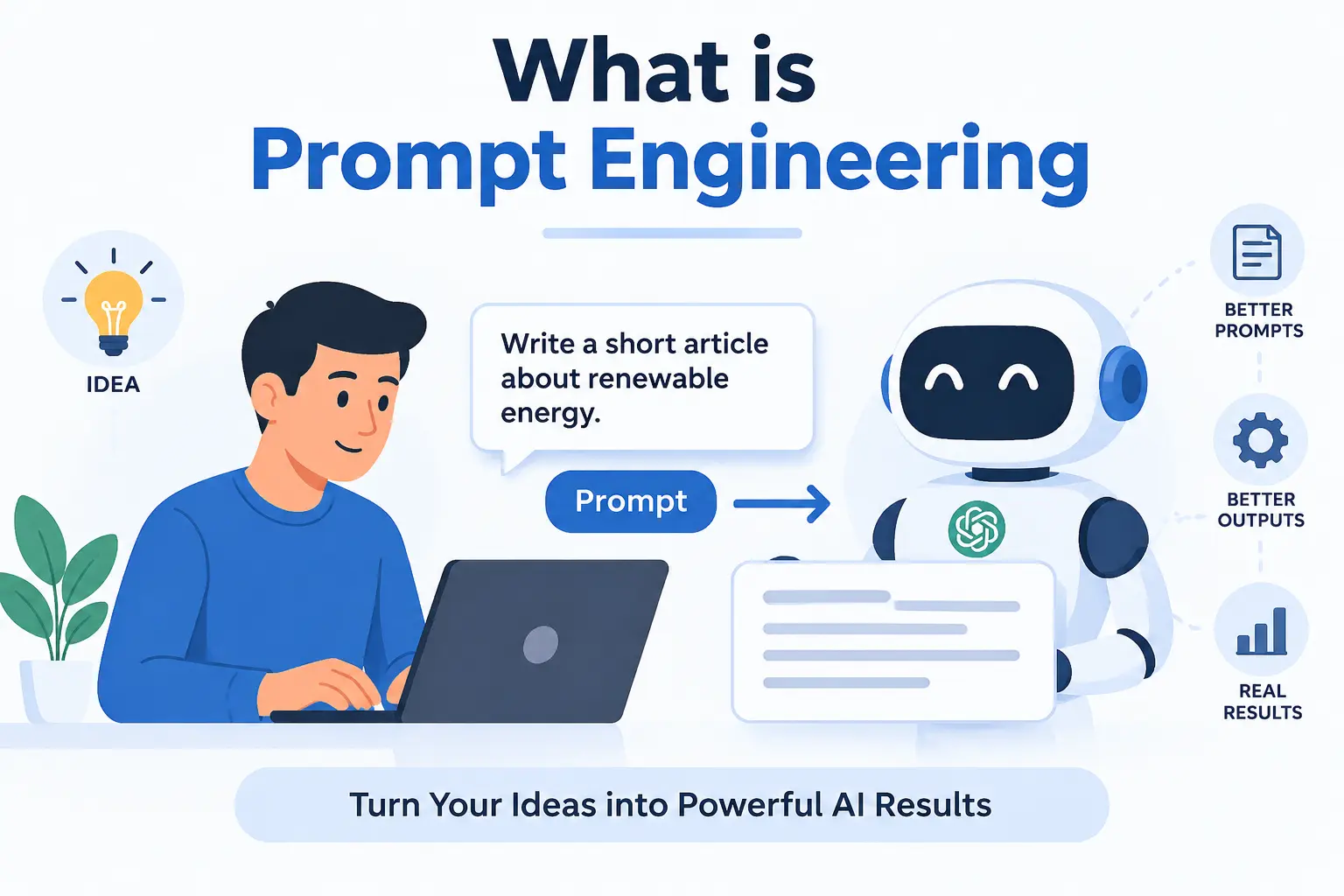
Prompt engineering is the practice of writing and refining instructions so an AI model gives accurate, useful, and well-formatted answers. It sits between what you want and what a large language model can deliver, and it has become a core skill for anyone working with generative AI.
If you have ever rewritten a ChatGPT prompt three times because the first answer missed the point, you have already done a little prompt engineering. This guide explains what it is, why it matters, which techniques work, what skills employers look for, what the career looks like, and what prompt engineers earn in India and the US.
A quick note on honesty: the job market here is changing fast. The standalone title is shrinking while the skill is spreading into many other roles. We cover both sides so you can plan realistically.
What is Prompt Engineering and How Does It Work?
Prompt engineering is the process of designing, testing, and improving the inputs (prompts) you give a generative AI model so it produces reliable, relevant output. A prompt can be a question, an instruction, an example, a block of background data, or a mix of all four.
The reason it works comes down to how large language models (LLMs) behave. These AI language models predict the most likely next piece of text based on everything in the prompt. Clearer and richer input narrows the range of likely outputs. If you want a deeper look at the mechanics, read about how LLMs work.
The field draws on natural language processing (NLP), machine learning, and plain good writing. Major providers publish their own guidance, including the OpenAI prompt engineering guide, Anthropic’s Claude prompt engineering documentation, and the Google Gemini prompting strategies guide.
How Prompt Engineering Works Step by Step
The prompt engineering process is a loop: define the goal, draft a prompt, test it, evaluate the response, and refine. Skilled practitioners rarely get a perfect prompt on the first try.
- Define the task and success criteria. Decide what a good answer looks like (format, length, tone, accuracy).
- Draft the prompt. Include the task, relevant context, constraints, and the desired output format.
- Run it and read the output critically. Check facts, structure, and tone.
- Diagnose the gap. Was the instruction vague? Was context missing? Did the model ignore a constraint?
- Refine and retest. Change one thing at a time so you know what helped.
- Save what works. Store strong versions as prompt templates for reuse.
For production systems, step 3 usually means testing against a set of sample inputs rather than a single try.
Key Elements of an Effective Prompt
An effective prompt usually contains a clear task, enough context, defined constraints, and an output format. Not every prompt needs all of them, but missing elements are the most common reason for weak answers.
| Element | What it does | Example |
|---|---|---|
| Task | States what the model should do | Summarize this report |
| Context | Gives background the model lacks | The readers are non-technical executives |
| Role (optional) | Sets perspective and tone | Act as an experienced financial analyst |
| Constraints | Limits scope, length, or style | Keep it under 150 words |
| Format | Shapes the output | Return three bullet points and one risk |
| Examples | Shows the pattern you want | One sample input and ideal output |
The context window, which is the amount of text a model can consider at once, limits how much of this you can include. Put the most important instructions where the model will not lose them.
Examples of Good and Bad Prompts
A good prompt is specific about the audience, goal, and format; a bad prompt leaves the model to guess. Here are two side-by-side comparisons.
| Weak Prompt | Stronger Prompt |
|---|---|
| Write about electric cars. | Write a 300-word explainer on how electric cars differ from petrol cars for first-time buyers in India. Cover running costs, charging, and maintenance. Use plain language and three short subheadings. |
| Fix my code. | This Python function should return the average of a list but crashes on empty lists. Explain the bug, then show a corrected version with a short comment on the change. |
| Make this email better. | Rewrite this email to a client who missed a payment deadline. Keep it polite and firm, under 120 words, and end with a clear next step. |
The stronger versions are not longer for the sake of it. Each added detail removes a guess the model would otherwise make.
Common Prompt-Writing Mistakes to Avoid
The most common mistakes are vagueness, overloading a single prompt, and trusting the first answer without checking it.
- Being vague. Words like good, short, or professional mean different things to different readers.
- Cramming many tasks into one prompt. Split big jobs into steps.
- Skipping the output format. If you need a table or JSON, say so.
- Leaving out context. The model cannot see your project, audience, or earlier decisions unless you share them.
- Not verifying. Models can produce confident but wrong statements, so check facts and figures.
- Pasting sensitive data. Be careful with confidential information. See why the importance of data privacy matters when using AI tools.
Why is Prompt Engineering Important?
Prompt engineering is important because the quality of an AI’s output depends heavily on the quality of its input. The same model can give a vague answer or an excellent one depending on how you ask.
Key benefits:
- Better Response Quality: Clear prompts reduce irrelevant or generic output.
- Hallucination Reduction: Giving source material and asking the model to stay within it lowers the chance of invented facts, though it does not remove it.
- Time and Cost Savings: Fewer retries mean less wasted effort, and shorter, targeted prompts can reduce token usage in API workflows.
- Consistency at Scale: Tested prompt templates make AI-generated content more predictable across a team.
- Safer Behavior: Well-designed system prompts and guardrails help with responsible AI usage.
- Faster Adoption: Teams that understand human-AI interaction get value from AI tools sooner.
In short, prompt engineering turns a general-purpose model into something that fits a specific job.
What Are the Main Prompt Engineering Techniques?
The main prompt engineering techniques are zero-shot, few-shot, chain-of-thought, role-based, contextual, chained, and iterative prompting. You can combine them. Which one you pick depends on task difficulty and how much control you need.
Zero-Shot and Few-Shot Prompting
Zero-shot prompting gives the model a task with no examples; few-shot prompting includes a few examples so the model copies the pattern.
- Zero-Shot: Classify this review as positive, negative, or neutral.
- Few-Shot: The same instruction, plus three labeled sample reviews before the new one.
Use zero-shot for simple, common tasks. Use few-shot when you need a specific format, tone, or labeling style. Keep examples consistent, because the model will copy their quirks too.
Chain-of-Thought Prompting
Chain-of-thought prompting asks the model to work through a problem step by step before giving a final answer. It helps with math, logic, and multi-part analysis. Example: Solve this problem step by step, then state the final answer on its own line. Note that some newer reasoning models already think internally, so explicit step-by-step instructions can matter less. Check your provider’s documentation for the model you are using.
Role-Based Prompting
Role prompting assigns the model a perspective, such as a code reviewer or a customer support lead, to shape tone, depth, and vocabulary. Example: You are a senior HR manager. Review this job description for unclear requirements and biased wording. In applications, roles often live in system prompts that stay constant across a conversation. A role helps with style but does not add knowledge the model lacks.
Contextual Prompting
Contextual prompting supplies the background the model needs: audience, goals, source text, constraints, and prior decisions. It is the practical core of context-aware prompting. This is also where retrieval-augmented generation (RAG) comes in. RAG fetches relevant documents and inserts them into the prompt, so answers are grounded in your data rather than the model’s memory alone.
Prompt Chaining
Prompt chaining breaks a complex task into a series of smaller prompts, where each output feeds the next. For example, to produce a market brief: (1) extract key facts from a source document, (2) group them into themes, (3) draft the brief, (4) check the draft against the facts. Each step is easier to test and fix than one giant prompt. Chaining is also a building block of agentic AI workflows.
Iterative Prompting and Prompt Refinement
Iterative prompting means improving a prompt through repeated test-and-adjust cycles based on what the model returns. Change one variable at a time, keep a record of versions, and compare outputs against the same test inputs. Teams doing this seriously use LLM evaluation metrics, human review, and sometimes automated prompt optimization to compare versions.
What Skills Are Required to Become a Prompt Engineer?
A prompt engineer needs a blend of clear writing, analytical thinking, AI literacy, and, for many roles, basic programming. Technical depth requirements vary a lot by employer, so read job descriptions closely.
Communication and Clear Instruction Writing
Clear instruction writing is the foundation: you must say exactly what you want, for whom, and in what format. This overlaps with technical writing. Strong candidates break tasks into steps, define terms, and avoid ambiguity. They can also explain their prompts to non-technical teammates.
Critical Thinking, Testing, and Output Evaluation
Prompt engineers treat every output as something to test, not trust. They check accuracy, completeness, tone, and consistency.
- Build small test sets with typical and tricky inputs.
- Define what counts as a pass (a rubric helps).
- Look for patterns in failures rather than fixing one case at a time.
This is where analytical thinking, logical reasoning, and problem-solving skills show up most.
Understanding AI Models, Their Capabilities, and Limitations
You need to know what models can and cannot do. That includes token limits, the context window, temperature settings, and why models hallucinate.
It also helps to understand how AI chatbots generate answers, how foundation models are trained, and how instruction tuning shapes behavior. Different tools (ChatGPT, Google Gemini, Anthropic Claude, Microsoft Copilot) respond differently to the same prompt, so test across them if your work needs it.
Technical Skills and Basic Programming Knowledge
Basic programming is not required for every role, but it opens many more doors. Python is the most common starting point.
Useful technical skills include:
- Python and working with JSON and APIs (such as the OpenAI API)
- Frameworks such as LangChain for chaining and orchestration
- Version control and prompt libraries for managing prompt versions
- Testing frameworks for LLM outputs
- Basic understanding of RAG and structured output generation
Domain Knowledge and Responsible AI Awareness
Domain expertise often separates a good prompt from a great one. A prompt for a legal summary needs someone who understands legal summaries.
Responsible AI awareness matters just as much. That means avoiding biased outputs, protecting private data, and defending against prompt injection, where malicious text tries to override your instructions. The OWASP guidance on prompt injection is a solid starting reference. Security-minded readers may also like our piece on AI in cybersecurity.
What Are the Career Opportunities in Prompt Engineering?
Career opportunities exist both as dedicated prompt engineer roles and, more commonly now, as AI-related roles where prompting is a core skill. Many companies have moved from the pure title to broader ones like applied AI engineer or GenAI developer. Searching only for the exact title will undercount your options.
Common Job Roles in Prompt Engineering and Generative AI
Typical roles include prompt engineer, AI prompt specialist, conversational AI designer, LLM application developer, and AI automation specialist.
- Prompt Engineer: designs, tests, and maintains prompts and templates for AI products.
- Conversational AI Designer: shapes chatbot dialogue, tone, and fallback behavior.
- LLM / GenAI Application Engineer: builds apps using APIs, RAG, and agents.
- AI Content or Workflow Specialist: uses AI to speed up content and operations.
- Evaluation or AI Quality Analyst: measures response quality and flags failures.
What does a prompt engineer do day to day? Usually: writing and testing prompts, building evaluation sets, documenting best practices, working with developers and product teams, and monitoring output quality over time.
How is the role different from an AI engineer? An AI engineer typically builds and deploys models and AI systems with deeper software and machine learning work. A prompt engineer focuses on getting the best behavior from existing models through instructions and context. In practice, the lines blur, and prompt skills are increasingly expected from AI engineers.
Industries Hiring Prompt Engineering Professionals
Technology, marketing, finance, healthcare, education, e-commerce, and consulting all hire for prompting skills.
- Technology and SaaS: product features, copilots, and developer tools.
- Marketing and media: content workflows and brand-consistent copy.
- Banking and finance: research summaries, document review, and compliance support.
- Healthcare: documentation support and information retrieval, with strict human oversight.
- Education: tutoring tools and content design.
- Customer service: chatbot design and support automation.
Freelance, Consulting, and Remote Opportunities
Freelance and remote work is common because AI projects are often short, specialized, and location-independent. Options include prompt libraries for businesses, chatbot setup, workflow automation, team training, and AI audits. Companies also hire consultants for LLM integration and AI automation. Success here depends on a visible portfolio and proof of results, so build those first. Be cautious of offers that promise very high pay for minimal work.
How to Become a Prompt Engineer?
To become a prompt engineer, learn how generative AI works, practice core techniques, build projects that show results, and add technical skills like Python. You do not need to follow a rigid order, but this sequence works well for beginners.
Learn the Fundamentals of Generative AI
Start with what generative AI is, how LLMs process text, and where they fail. Cover tokens, context windows, temperature, hallucinations, and basic NLP concepts. The official guides from OpenAI, Anthropic, and Google (linked earlier) are free and kept current. Our explainer on how search engines work is also a helpful companion for understanding retrieval and ranking ideas that show up in RAG.
Take Courses and Explore Relevant Certifications
Courses give structure, and certificates can help, but employers care most about demonstrated skill. Look for courses that include hands-on exercises and graded projects. Well-known places to look include DeepLearning.AI’s short courses on prompting, Coursera’s generative AI programs, and the free Learn Prompting website. Provider documentation is also a strong free resource.
When comparing a prompt engineering certification course:
- Check that it covers current models and techniques, not just basic tips.
- Prefer courses with practical assignments.
- Look at the instructor’s background.
- Treat any claim of guaranteed jobs as a red flag.
Practice Prompt Engineering Techniques and Evaluate Results
Practice daily on real tasks and judge the results honestly. Try the same task with zero-shot, few-shot, and chain-of-thought prompts, then compare.
- Keep a prompt journal with versions and notes on what changed.
- Create a small rubric (accuracy, clarity, format, tone).
- Test the same prompt in more than one model.
Build Projects and a Portfolio
A portfolio proves you can get results. Show the problem, your prompt versions, the test method, and the measured improvement.
Project ideas:
- A customer support reply assistant with a tone guide
- A document summarizer with a structured JSON output
- A research assistant that cites provided sources
- A prompt library for a specific profession, such as recruiters or teachers
Publish your work on GitHub or a simple website and describe your testing approach.
Develop Technical Skills and Gain Practical Experience
Add Python, API basics, and a framework like LangChain, then apply them in internships, freelance work, or internal company projects. What if you have no computer science degree? Many people enter through writing, marketing, research, or analysis. A degree helps for some engineering-heavy roles, but projects and clear evidence of skill carry real weight. If you are drawn to software, explore how AI coding agents for developers are changing the work.
What is the Salary of a Prompt Engineer?
Prompt engineer salaries vary widely by source, location, and how much engineering work the role includes. US averages reported by major job sites fall roughly between $98,000 and $113,000, while Indian figures cluster at the low end for entry-level and reach much higher for roles that require Python and RAG skills. These numbers come from salary aggregators and job postings, which use different methods and small samples. Treat them as ranges, not promises.
Average Prompt Engineer Salary in India and the US
In the US, Indeed reports an average base of about $112,800, and ZipRecruiter reports about $97,900. In India, entry-level roles commonly fall between ₹4 and ₹8 lakh per year.
| Region | Source | Reported figure |
|---|---|---|
| US | Indeed (52 postings, updated Aug 2026) | Average base about $112,806; range about $72,377 to $175,819 |
| US | ZipRecruiter (Aug 2026) | Average about $97,940 |
| India | Indeed India and Glassdoor India, as summarized by Jobrise (early 2026) | Indeed average base about ₹5.33 LPA; Glassdoor median total pay about ₹6.79 LPA |
| India | Recrew salary guide (2026) | Entry ₹4 LPA and up; ₹25 to 60 LPA reported for roles that add Python, RAG, and LLM evaluation |
LPA means lakhs per annum. Prompt engineering jobs in India are often posted under broader titles, so pay depends heavily on the title and employer.
Prompt Engineer Salary by Experience Level
Pay rises with experience, and the biggest jumps go to people who combine prompting with engineering and evaluation skills.
For the US, the KORE1 2026 salary guide reports these base-salary bands:
| Level | Typical US base salary |
|---|---|
| Junior (0 to 2 years) | $95,000 to $130,000 |
| Mid-level (3 to 5 years) | $135,000 to $185,000 |
| Senior (5 to 8 years) | $185,000 to $260,000 |
| Staff or principal (8+ years) | $260,000 to $380,000 |
Note that KORE1 groups the higher levels under applied AI engineering, which again shows how the title is evolving. Other aggregators report lower figures for pure prompt engineer titles, so expect variation.
For India, freshers commonly see ₹4 to ₹8 LPA, and the Recrew guide suggests that non-coding roles tend to plateau earlier while engineering-capable profiles earn more. Salary guides are estimates, so confirm against live job postings.
Factors That Affect Prompt Engineer Salaries
Technical depth, employer type, location, and proven results move pay the most.
- Technical skills: Python, APIs, RAG, and evaluation experience raise earning potential.
- Employer: AI labs, large tech firms, and well-funded startups generally pay more than small agencies.
- Location: US coastal cities and Indian tech hubs like Bengaluru tend to pay more, while remote pay may follow company salary bands.
- Domain Expertise: Finance, healthcare, and legal knowledge can command a premium.
- Portfolio and measurable impact: Evidence that your prompts improved accuracy, speed, or cost helps in negotiation.
- Job title: The same work may be called prompt engineer, GenAI engineer, or AI developer, with very different pay.
What is the Future of Prompt Engineering?
Prompt engineering is not disappearing, but it is changing: the standalone title is fading while prompting, evaluation, and context design become standard parts of AI jobs. Models understand loosely written requests better than before, so basic tricks matter less. The work that remains valuable is designing reliable systems.
Key trends to watch in 2026 and beyond:
- Context Engineering: Teams increasingly manage everything the model sees, including instructions, retrieved documents, tool outputs, and memory, not just the prompt text. Context engineering vs prompt engineering is a useful distinction: prompt engineering is writing the instruction well, while context engineering is deciding what information reaches the model and when. Prompt design is one part of the larger system.
- Agentic AI: AI agents plan steps and use tools, so prompts must define goals, boundaries, and when to ask for human approval.
- Automated Prompt Optimization: Tools can test and improve prompts against evaluation sets, shifting human effort toward judging quality and setting goals.
- Evaluation and Safety: Measuring response quality and defending against prompt injection are growing responsibilities.
- Multimodal Prompting: Prompts now include images, audio, and documents, as well as text.
Practical Takeaway: pair prompting with a second strength, such as Python, data analysis, a business domain, or evaluation, and keep learning as models change.
What Are the Real-World Applications of Prompt Engineering?
Prompt engineering applications span content, support, software, analysis, education, and regulated fields. Here is how it shows up across each area.
Content Creation and Marketing
Marketers use prompts to draft, outline, repurpose, and localize content faster. Good prompts carry brand voice, audience, and format. Humans still need to fact-check, add original insight, and edit. AI-generated content works best as a draft partner, not a final publisher.
Customer Support and Business Automation
Support teams use prompts to power chatbots, summarize tickets, draft replies, and route requests. System prompts set tone and escalation rules, which support customer support automation and wider business process automation. Always provide a clear path to a human agent.
Software Development and Coding
Developers prompt AI to generate code, explain errors, write tests, and refactor. Specific prompts with language, framework, constraints, and expected behavior produce better code. Review everything before shipping, since generated code can contain bugs or security flaws.
Data Analysis and Research
Analysts use prompts to clean data, write queries, summarize findings, and explore hypotheses. Share schema and definitions rather than raw sensitive data. For more on this area, see AI in data analysis. Verify any number the model produces against the source.
Education and Personalized Learning
Teachers and students use prompts to create practice questions, explain topics at different levels, and give feedback. A tutor-style prompt can ask the model to guide with hints instead of giving answers. Educators should still check accuracy and keep academic integrity rules in mind.
Healthcare and Finance
In healthcare and finance, prompts support summarization, documentation, and research, but outputs need expert review because errors carry high stakes. Teams in these fields add strict guardrails, privacy controls, and audit trails. AI should assist professionals, not replace clinical or financial judgment.
Conclusion
Prompt engineering is the skill of getting reliable, useful results from generative AI through clear instructions, good context, and careful testing. Its importance comes from a simple fact: better inputs lead to better outputs, and teams that learn this early save time and avoid costly errors.
If you want to build a career, start with the fundamentals, practice the main techniques, build a portfolio, and add technical skills like Python. Salaries vary widely, and the standalone job title is giving way to broader AI roles, so focus on skills that carry across titles. Pick one small project this week, test several prompt versions, and record what you learn. That habit is the real beginning of a prompt engineering career.
FAQs
What is Prompt Engineering in Simple Words?
Prompt engineering is the skill of writing clear instructions for AI tools, so they give better answers. It involves adding context, setting the format, giving examples when helpful, and improving the prompt after checking the result.
How is Prompt Engineering Different from AI Engineering and Machine Learning?
Prompt engineering focuses on guiding existing models through instructions and context. Machine learning involves building and training models, and AI engineering covers building and deploying AI systems. The roles overlap, and AI engineers often use prompt engineering as part of their work.
Do You Need Coding Skills to Become a Prompt Engineer?
Not always. Content, support, and research roles may need little code. However, Python and API knowledge open up more roles and generally higher pay, especially in development and automation work.
How Long Does It Take to Learn Prompt Engineering?
You can learn the basics in a few weeks of regular practice. Building job-ready skills, including evaluation, a portfolio, and some programming, typically takes several months. Timelines depend on your background and the time you invest.
Can You Become a Prompt Engineer Without a Computer Science Degree?
Yes. Many people enter from writing, marketing, analytics, or domain-specific fields. Employers usually look for demonstrated results, such as a portfolio with tested prompts, though some engineering-heavy roles prefer a technical degree.
Is Prompt Engineering a Good Career Choice in 2026?
It can be, with a caveat. Demand for prompting skills is strong, but dedicated prompt engineer titles are less common and are often folded into AI engineer or GenAI developer roles. Combining prompting with technical or domain skills gives the best prospects.
Will AI Replace Prompt Engineering Jobs?
AI is automating simpler prompt writing, so basic prompt-only work faces pressure. However, designing, evaluating, securing, and managing AI systems still needs human judgment. People who adapt and keep building skills are better positioned.
Disclaimer –
This article is for educational and informational purposes only. Salary figures are estimates based on publicly available job postings and salary aggregators as of 2026, and actual pay varies by employer, location, skills, and experience. Information related to healthcare, finance, or other regulated fields is general in nature and is not medical, legal, or financial advice; AI-generated outputs in these areas should always be reviewed by a qualified professional. Tools, AI models, and job market conditions change quickly, so please verify details with official documentation and current sources before making any decisions.