
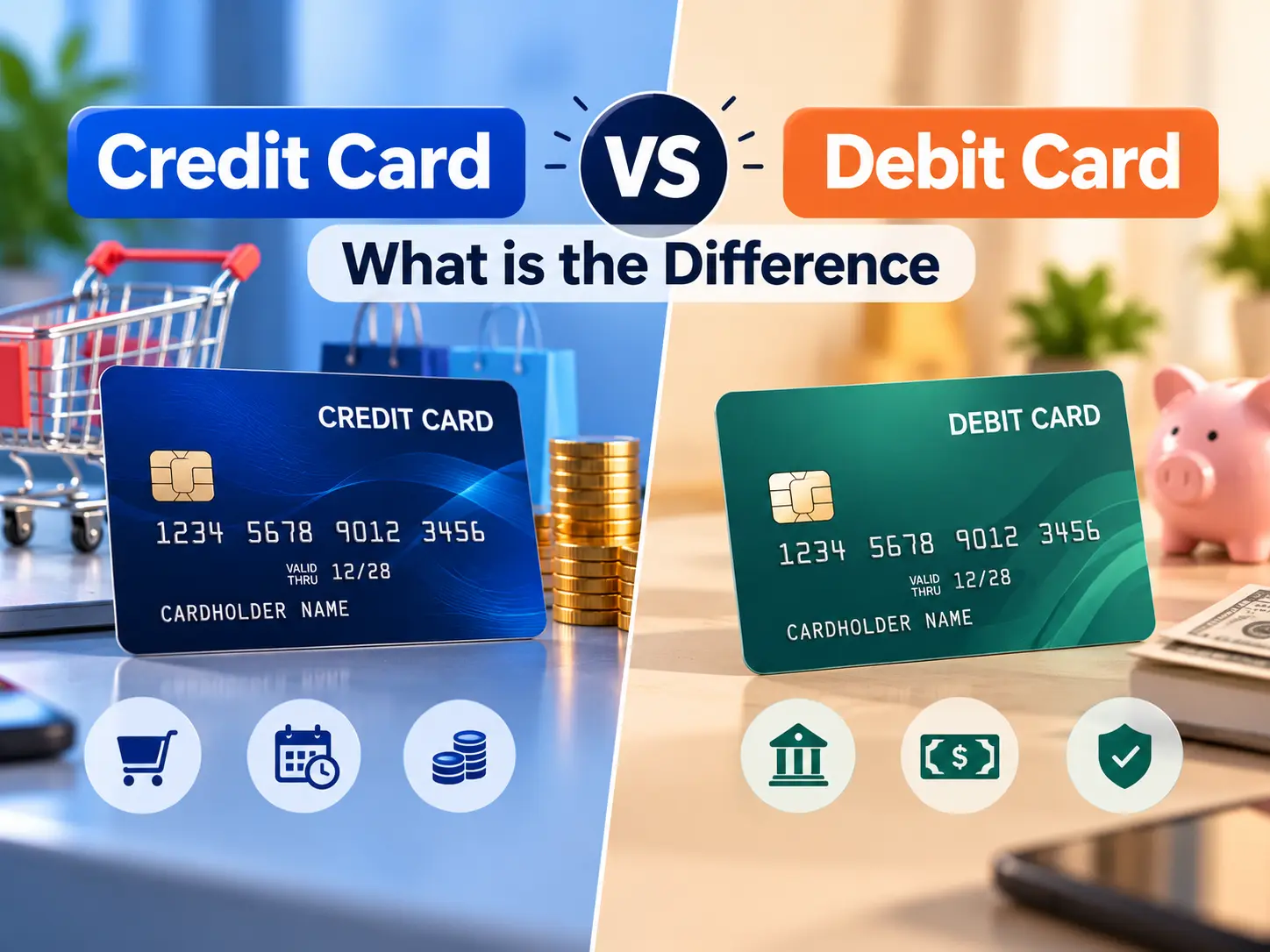
A debit card spends money you already have in your bank account. A credit card spends money the issuer lends you, which you repay later. That one difference affects your fees, your credit score, your fraud protection, and your budget.
Both are payment cards with a similar look, and both work with contactless payments and online checkout. Whether to use a credit or debit card depends on what you’re buying, how disciplined you are with repayment, and what you want from the card. This guide covers how each works, how they compare on cost, rewards, credit impact, and safety, and when each makes sense.
What is a Credit Card and How Does It Work?
A credit card is a payment card that lets you borrow money from an issuer up to a set credit limit. You repay what you spent later, either in full or in part. If you carry a balance, interest charges apply. This makes it a revolving line of credit.
Here is the cycle in practice:
- You get a credit limit. The issuer sets it based on your credit score, credit history, and income.
- You make purchases. Each one reduces your available credit.
- A monthly statement arrives. It lists your transactions, your total balance, and your minimum due.
- You pay by the due date. Pay the full statement balance and you typically owe no interest on purchases. Pay less and the remaining balance accrues interest at your annual percentage rate (APR).
- Your credit refreshes. As you repay, your available credit goes back up. That’s why it’s called revolving credit.
A credit card is a form of borrowed money, however convenient it feels at the register. The difference between a useful tool and a debt trap is mostly how you repay. If you’re comparing card types, you’ll find basic cards, cashback cards, travel cards, and co-branded cards. Some charge cards require full payment each month with no revolving option.
What is a Debit Card and How Does It Work?
A debit card is a payment card linked to your checking account. When you pay, the money leaves your bank account balance almost immediately, so you spend your own funds rather than borrowed money.
When you tap, swipe, or enter your card details online:
- The merchant requests payment through a payment network such as Visa or Mastercard.
- Your bank checks your available balance.
- If the funds are there, the payment is approved, and the amount is deducted.
- If not, the payment is declined, or it goes through as an overdraft if you’ve opted in to overdraft coverage.
Debit cards also work at ATMs for cash withdrawals. A Visa debit card and a Visa credit card use the same payment network, but the money behind them is different. One draws on your deposits and the other on a credit line. Many banks now let you get a debit card online or issue a virtual debit card for web purchases.
What Are the Key Differences Between a Credit Card and a Debit Card?
The core difference is whose money you spend. Debit uses your own funds from a bank account. Credit uses the issuer’s money, which you repay later. Everything else follows from that, including interest, fraud rights, rewards, and credit score impact.
| Feature | Credit Card | Debit Card |
|---|---|---|
| Source of funds | Credit limit from the issuer | Your bank account balance |
| Spending limit | Available credit | Available balance (plus overdraft, if enabled) |
| Interest | Yes, if you carry a balance | None on purchases |
| Credit history | Reported to credit bureaus | Generally not reported |
| Rewards | Common (cashback, points, miles) | Less common, usually smaller |
| Fraud protection | Stronger legal protections in the US | Protection depends on how fast you report |
| Risk of debt | Yes | Low, but overdraft fees possible |
| Approval needed | Yes, based on credit | Usually comes with the account |
How Do Fees, Interest Rates, and Billing Cycles Compare?
Credit cards have more moving parts: APR, annual fees, due dates, and minimum payments. Debit cards are simpler but can still cost you through overdrafts and ATM charges. Knowing which costs apply to you is the first step to avoiding them.
What Fees Can Credit and Debit Cards Charge?
Both card types can charge fees, but the kinds differ.
Credit card fees:
- Annual fee: a yearly charge, often higher for premium cards. Many cards waive it.
- Late payment fee: charged when you miss the payment due date.
- Foreign transaction fee: added to purchases made abroad or in another currency.
- Cash advance fee: a fee for withdrawing cash against your credit limit.
- Balance transfer fee: a percentage of the amount you move from another card.
Debit card fees:
- Overdraft fee: charged if a payment exceeds your balance and your bank covers it.
- ATM withdrawal fee: charged when you use an out-of-network ATM.
- Foreign transaction fee: some banks charge this, others don’t.
- Replacement card fee: some banks charge to reissue a lost card.
Fee schedules vary widely, so check your card’s terms. Some issuers advertise lifetime free credit cards or no annual fee credit cards, which is worth comparing if you want to avoid yearly charges.
How Do Credit Card APR and Interest Work?
Credit card APR is the yearly cost of carrying a balance. If you pay your statement balance in full by the due date, you usually pay no interest on purchases. If you don’t, interest is charged on the unpaid balance and can compound quickly.
Do credit cards charge interest on every purchase? Generally no. Interest on new purchases is typically avoided when you pay in full each cycle. Cash advances are different, since interest often starts immediately with no interest-free period.
A card with a low APR helps if you expect to carry a balance sometimes. But the cheapest way to use a credit card is to never carry one at all.
Debit cards don’t charge APR because you aren’t borrowing.
How Do Billing Cycles, Grace Periods, and Minimum Payments Work?
A billing cycle is the period (usually about 30 days) during which your purchases are recorded. At the end, you get a monthly statement. The grace period is the window between statement date and the payment due date, during which paying in full avoids interest.
Key terms to know:
- Statement balance: what you owed at the end of the cycle.
- Minimum due: the smallest payment that keeps your account in good standing.
- Payment due date: the deadline to pay. Missing it triggers a late payment fee and can hurt your credit.
Paying only the minimum credit card payment keeps the account current but leaves most of your balance accruing interest. Think of it as a floor, not a target. Debit cards have no billing cycle. Purchases are deducted as they happen.
Which Card Offers Better Rewards, Cashback, and Benefits?
Credit cards usually offer richer rewards and benefits. Debit cards occasionally offer small perks, but the best earning potential sits with credit. That advantage only pays off if you avoid interest, since interest charges can wipe out the value of rewards quickly.
What Rewards and Benefits Do Credit Cards Offer?
Credit cards compete on rewards. Common ones include:
- Cashback rewards: a percentage back on purchases, either flat or by category (groceries, fuel, dining).
- Reward points: earned per amount spent, redeemable for travel, gift cards, or statement credits.
- Travel rewards: miles or points, plus perks like lounge access or travel insurance on some cards.
- Purchase protection and extended warranty: coverage on eligible items.
- EMI conversion: the option to turn a large purchase into fixed installments, popular in India.
Premium issuers such as American Express advertise benefits like travel credits and purchase protection, but these often come with higher annual fees. Look at your spending pattern before paying for features you won’t use. If you’re a beginner, a simple cashback or no annual fee card is usually easier to manage than a points-heavy one.
Can Debit Cards Offer Rewards or Cashback?
Yes, but they’re less common and usually less generous. Some banks offer cashback on debit card spending, discounts at partner merchants, or points tied to certain accounts. Terms often depend on the account type or monthly spending.
If rewards are your goal, credit cards generally win. If you want to keep spending tied to your own money, a debit card with modest perks may be enough.
How Do Credit Cards and Debit Cards Affect Your Credit Score?
Credit cards can build or damage your credit score depending on how you use them. Debit cards generally don’t affect your score at all because they don’t involve borrowing and aren’t reported to credit bureaus.
How Does Credit Card Use Affect Your Credit Score?
Responsible credit card use can improve your credit score over time. Irresponsible use can hurt it fast. Issuers typically report your balance and payment behavior to the credit bureaus every month.
What matters most:
- Payment history: paying on time is the biggest factor. A missed payment can stay on your report.
- Credit utilization: the share of your credit limit you’re using. A lower credit utilization ratio is generally better, and many people aim to stay under about 30% as a rule of thumb.
- Length of credit history: older accounts help.
- New applications: each hard inquiry can lower your score slightly in the short term.
In India, the same logic applies to your CIBIL score. If you want to improve your credit score, pay on time, keep balances low, and avoid applying for several cards at once.
Do Debit Cards Build Credit History?
No. A debit card does not build credit. Using one isn’t reported as borrowing, so it won’t help or hurt your credit score. That’s the answer to “does using a debit card affect your credit score?” and “can you build credit with a debit card?”
If you’re trying to start building a credit history, you’ll need a product that reports to credit bureaus. A starter credit card is the usual route, and you can compare credit card offers or use a credit card eligibility checker before applying so you avoid unnecessary hard inquiries.
Which is Safer: A Credit Card or a Debit Card?
In general, credit cards offer stronger fraud protection because the money at risk is the lender’s, not yours. Debit card fraud pulls cash directly from your account, which can leave you short while the dispute is resolved. Both can be safe if you act fast.
How Do Fraud Protection and Liability Differ?
In the US, the law treats the two differently. For a lost or stolen credit card, your liability is capped at $50, and if the fraud involved a phone, online, or mail transaction, your liability is $0. Many issuers also advertise zero liability policies that waive even the $50. fdic
Debit cards follow different rules. Depending on when you report, you may owe no more than $50 or as much as $500 of an unauthorized transfer. The reporting deadline is short: roughly two business days from when you learn the card is missing for the lower cap, and failing to report unauthorized charges within 60 days of your statement can expose you to larger losses. Visa and Mastercard also run zero liability programs on many debit cards, but they come with conditions.
Beyond the legal limits, credit cards have a practical edge: if your card is compromised, the thief is spending the bank’s money while you dispute it. With debit, your own funds are gone from your account in the meantime, which can cause missed bills or overdrafts.
Other safety features that apply to both include chargeback rights for payment disputes, tokenized card payments in mobile wallets, one-time passwords, and virtual cards for online shopping. Rules differ outside the US. In India, for example, the RBI sets its own customer liability framework, so check your bank’s current policy.
What Should You Do If Your Card Is Lost or Used Fraudulently?
Act quickly. Speed limits both your financial exposure and the damage to your accounts.
- Contact your issuer immediately. Use the number on your bank’s website or app, and lock or freeze the card there if you can.
- Request a replacement card. Update recurring bill payments and subscriptions afterward. You can review those against your subscription vs. one-time payment commitments.
- Review recent transactions. Flag anything unauthorized and file a dispute.
- Keep records. Save screenshots, dates, and reference numbers.
- Monitor your accounts. Watch for follow-up fraud and consider checking your credit report if personal data was exposed. Understanding the importance of data privacy helps you spot phishing and shady checkout pages.
What Are the Pros and Cons of Credit Cards and Debit Cards?
Credit cards offer rewards, protection, and credit-building, but risk debt. Debit cards offer simplicity and spending control, but fewer protections and no credit benefit. Neither is “better” overall. It depends on how you use them.
Credit Cards: Pros and Cons
Pros
- Build credit history when used responsibly
- Rewards, cashback, and reward points
- Stronger fraud protection and chargeback rights
- Purchase protection and travel benefits on some cards
- Useful for deferred payment and emergencies
- Handy for rental car payments and hotel holds
Cons
- Interest charges if you carry a balance
- Risk of overspending and debt
- Annual fees on many cards
- Late payment fees and credit damage for missed payments
- Cash advances are costly
Debit Cards: Pros and Cons
Pros
- Spend only what you have
- No interest or monthly bill
- Easy ATM withdrawals
- Simple to get with a bank account
- Helpful for budgeting and spending control
Cons
- Doesn’t build credit
- Fraud can drain your account quickly
- Overdraft fees possible
- Limited rewards
- Some merchants place holds on debit cards (hotels, rental cars)
When Should You Use a Credit Card vs a Debit Card?
Use a credit card when you want protection, rewards, or to build credit, and you can pay the bill in full. Use a debit card when you want strict spending control or need cash. Many people use both for different purposes.
Good times for a credit card:
- Online purchases and bookings where fraud protection matters
- Big purchases where you want purchase protection
- Everyday spending you’d make anyway, to earn rewards
- Travel, hotels, and rental cars
Good times for a debit card:
- Cash at an ATM
- Small, routine purchases when you’re trying to avoid overspending
- Situations where you don’t qualify for or don’t want a credit card
- Paying merchants who add surcharges for credit
A useful test: if you can’t afford to pay for it today, don’t put it on a credit card.
Which Card Is Better for Everyday Purchases, Online Shopping, and Travel?
It depends on the situation. For everyday spending, credit earns rewards while debit controls spending. For online shopping, credit offers stronger protection. For travel, credit usually wins on benefits and booking flexibility, though debit may be handy for local cash.
Which Card Is Better for Everyday Purchases?
Credit cards earn rewards on groceries, fuel, and bills, which makes them the better value if you pay in full. Debit cards suit people who find it easier to stay on budget when spending leaves their account right away. If you tend to overspend, debit might be safer for daily use.
Which Card is Better for Online Shopping?
Credit cards are generally the safer pick for online payments. Fraud liability is typically lower, and chargebacks make payment disputes easier if goods never arrive. Debit cards work too, but a compromised card means cash leaves your account first. A virtual card or mobile wallet adds a layer, since your real card number isn’t shared with the merchant.
Which Card Is Better for Travel?
For international travel, a credit card is usually better. Look for one with no foreign transaction fee, plus travel perks. Rental car payments and hotel deposits often work more smoothly with credit. Carry a debit card for ATM withdrawals, but compare ATM withdrawal fees and currency conversion charges first.
Can You Use Both Cards Together?
Yes, and for many people that’s the best setup. Use your credit card for purchases you’ll repay in full each month, and your debit card for cash or tightly budgeted spending. This gives you rewards and credit-building without losing control.
A simple split:
- Credit card: online shopping, bills, travel, and larger planned purchases
- Debit card: ATM withdrawals and small daily expenses
You can even keep your emergency fund in a separate savings account rather than relying on credit for surprises. And if you’re deciding what to spend on, it helps to separate needs vs. wants before you reach for any card.
What Are Some Tips for Using Credit Cards and Debit Cards Wisely?
Treat both cards as tools, not income. Track what you spend, pay credit card bills in full, and review your accounts regularly. These habits protect your credit score and cut your costs.
How to Set a Budget and Track Card Spending
- List your monthly income and fixed costs.
- Set spending limits by category.
- Use your bank app to track card payments.
- Check weekly, not just at month-end.
A realistic monthly budget plan matters more than any card feature. It also helps to understand assets vs. liabilities. A credit card balance is a liability, and keeping it small keeps your finances healthy.
How to Pay Credit Card Bills in Full and on Time
- Set up autopay for at least the minimum due, ideally the full statement balance.
- Pay a few days before the payment due date.
- Only charge what you could pay from your bank account today.
- If you must carry a balance, pay as much above the minimum as you can.
How to Review Statements and Set Transaction Alerts
- Read each monthly statement for unfamiliar charges.
- Turn on instant alerts for every transaction, or for amounts above a limit.
- Report unauthorized transactions right away.
- Check recurring charges and cancel unused ones.
Final Thoughts
Credit cards and debit cards both make payments easy, but they work in different ways. Credit means borrowing, with rewards, credit-building, and strong fraud protection if you pay on time. Debit means spending your own money, with simplicity and control but fewer protections and no credit benefit.
If you pay in full every month, a credit card is usually the stronger everyday tool. If you worry about overspending, a debit card keeps things grounded. Most people do best with both, used deliberately. Check your issuer’s current terms before you apply.
FAQs
Can You Pay a Credit Card Bill With a Debit Card?
Yes. Most issuers let you pay your credit card bill from your bank account, using online banking, a debit card payment on the issuer’s portal, or direct bank debit. Some issuers don’t accept credit-card-to-credit-card payments, so check yours.
What Happens If You Miss a Credit Card Payment?
You’ll typically be charged a late payment fee, and interest may apply to your balance. If the payment is far enough overdue, the issuer may report it to credit bureaus, which can lower your credit score. Pay as soon as you notice, and contact your issuer to ask about fee waivers.
Can You Withdraw Cash Using a Credit Card?
Yes, this is called a cash advance. It usually comes with a fee and a higher interest rate that often starts accruing immediately, with no grace period. It’s best kept for real emergencies.
Does Closing a Credit Card Affect Your Credit Score?
It can. Closing a card reduces your total available credit, which can raise your credit utilization ratio. It may also shorten your average credit history over time. If a card has no annual fee, keeping it open with occasional use is often better.
Can You Use a Credit Card Like a Debit Card?
Technically yes, since both are tapped or swiped at the same terminals. But the effect is different. A credit card purchase creates a bill and may add interest if unpaid. If you use a credit card, treat it like a debit card by only spending what’s in your account.
What Happens If You Spend More Than Your Debit Card Balance?
The payment is usually declined. If you’ve enabled overdraft protection, the bank may approve it and charge an overdraft fee, and you’d owe the shortfall. Without that opt-in, you generally can’t overspend.
Is a Debit Card the Same as an ATM Card?
Not exactly. An ATM card only works at ATMs for withdrawals and balance checks. A debit card does that too, but also pays at stores and online through payment networks like Visa or Mastercard. Many banks now issue debit cards by default.
Disclaimer –
This article is for general informational and educational purposes only and does not constitute financial, legal, or professional advice. Credit card and debit card fees, interest rates, rewards, and fraud-liability rules vary by issuer, card type, and country. The legal examples here reference US federal rules and may not apply where you live. Please review your card’s terms and conditions and consult your bank or a qualified financial advisor before making financial decisions.