
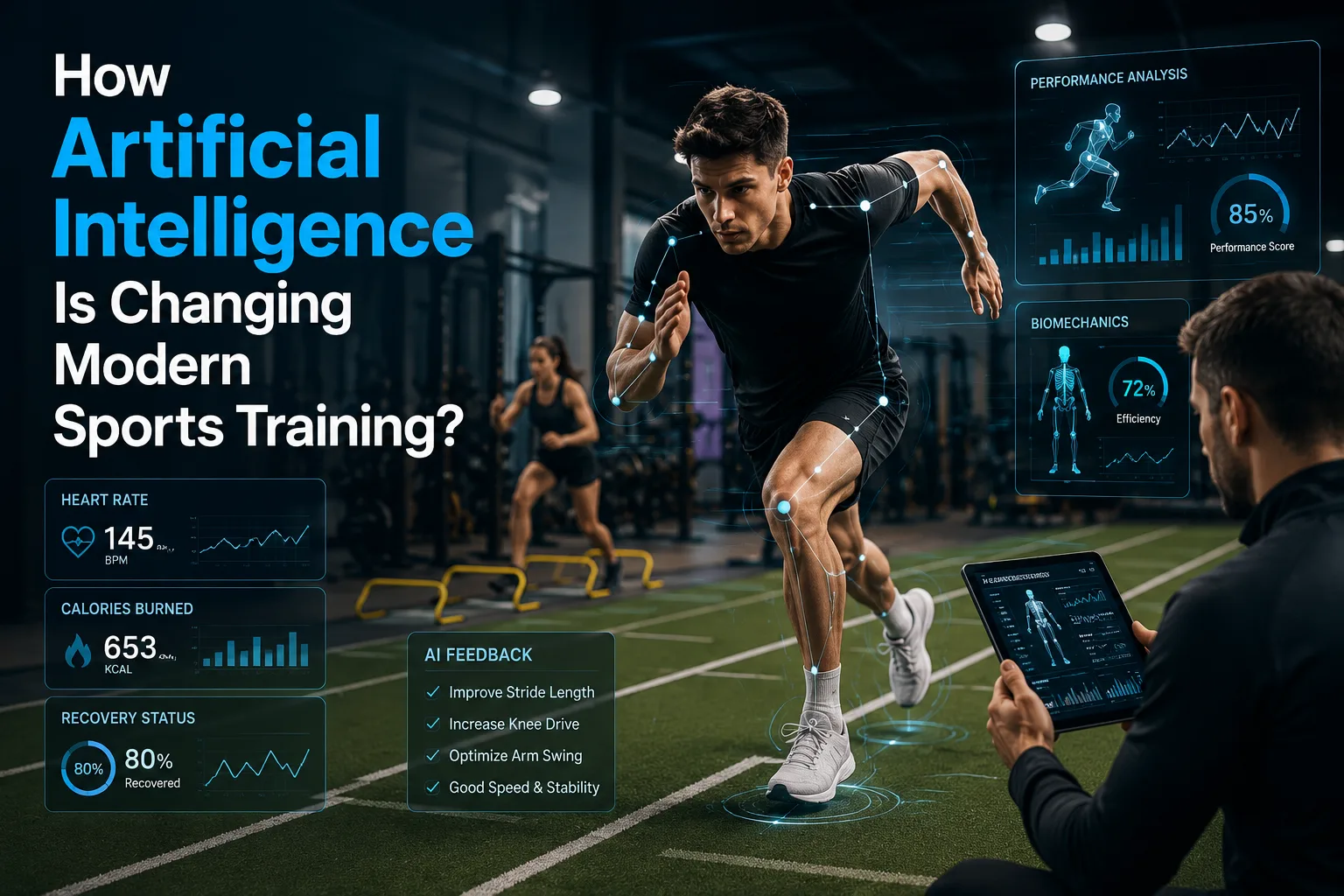
There was a time when improvement in sports depended mostly on instinct, repetition, and a good coach’s eye.
I have worked with athletes and content teams who cover performance training, and one pattern has always stood out. The athletes who improved faster were not always the most talented. They were the ones who understood their data, even before data became a trend.
Now, that advantage has a name. Artificial Intelligence in Sports is no longer a futuristic concept. It is already shaping how athletes in the United States train, recover, and compete.
What Does AI in Sports Training Actually Mean?
When people hear AI in sports training, they often imagine robots or fully automated gyms. That is not the reality.In simple terms, AI is being used to:
-
- Track performance
- Analyze movement
- Predict injuries
- Personalize training plans
It takes thousands of small data points that a human coach might miss and turns them into actionable insights. For example, instead of a coach saying, “Your form looks slightly off,” AI can tell you:
- Exactly which joint angle is incorrect
- At what point in the movement does it break
- How it affects your performance
That level of detail changes everything.
Why the Shift Happened (And Why It Matters in 2026)
Sports in the United States have become more competitive than ever. Margins are thin. Milliseconds matter. One small improvement can decide outcomes. Traditional training methods are still valuable, but they have limitations:
- Human observation is subjective
- Fatigue is hard to measure accurately
- Injury risks are often detected too late
This is where AI sports training becomes powerful. It does not replace coaches. It enhances their decision-making.
A Real Example From Training Environments
I remember reviewing a case study of a college-level athlete who struggled with recurring knee pain. For months, the issue was treated as overuse. When AI-based motion tracking was introduced, the insight was different. The athlete’s landing mechanics were slightly misaligned. Not visible to the naked eye, but consistent across sessions. Once corrected, the pain reduced significantly within weeks. That is the difference. AI does not guess. It detects patterns.
How to Use AI in Sports Training?
This is where most articles stay surface-level. Let us go deeper. If you are an athlete, coach, or even a fitness enthusiast in the US, here is how AI actually fits into your routine.
1. Performance Tracking Beyond Basic Metrics
Earlier, tracking meant:
- Time
- Distance
- Reps
Now, AI tracks:
- Movement efficiency
- Force output
- Reaction time
- Fatigue levels
Wearable devices and smart systems collect this data continuously. The benefit is not the data itself. It is what you do with it.
2. Personalized Training Plans
Generic plans do not work equally for everyone. AI analyzes:
- Your past performance
- Recovery rate
- Strength imbalances
Then it adjusts your training load dynamically. So instead of following a fixed plan, your program evolves with you. This is one of the strongest use cases of Artificial Intelligence in Sports today.
3. Injury Prevention
Injuries do not usually happen suddenly. They build over time. AI identifies early warning signs like:
- Asymmetry in movement
- Decline in performance metrics
- Increased fatigue markers
This helps prevent injuries before they happen. For professional athletes, this can extend careers. For everyday athletes, it prevents setbacks.
4. Recovery Optimization
Recovery is often underestimated.
AI tools now monitor:
- Sleep quality
- Heart rate variability
- Muscle stress
Based on this, they suggest:
- Rest days
- Light sessions
- Intensity adjustments
This removes a lot of guesswork from recovery decisions.
5. Technique and Skill Improvement
This is where things get interesting. Video analysis powered by AI can break down:
- Sprint mechanics
- Swing patterns
- Shooting form
And compare it with elite-level benchmarks. You are not just practicing. You are practicing with feedback.
Traditional Training vs AI Sports Training
To understand the shift clearly, look at this comparison:
| Aspect | Traditional | AI Sports Training |
| Decision Making | Based on the coach’s observation | Data-Driven Insights |
| Personalization | Limited | Highly Customized |
| Injury Detection | Reactive | Predictive |
| Progress Tracking | Basic Metrics | Deep Performance Analysis |
| Feedback Speed | Delayed | Real-Time |
This does not mean traditional training is outdated. It means it is evolving.
The Role of Coaches Is Changing, Not Disappearing
There is a common fear that AI will replace coaches. That is not happening. What is happening is more interesting. Coaches are becoming:
- Data interpreters
- Strategy builders
- Performance optimizers
AI provides the data. The coach provides the context. And that combination is far more powerful than either alone.
Challenges You Should Know (Not Everything Is Perfect)
It’s easy to focus only on the benefits, but there are real challenges too.
► Data Overload
Too much information can confuse athletes if not interpreted properly.
► Accessibility
High-end AI systems are still expensive, though costs are gradually reducing in the US market.
► Over-Reliance on Technology
Ignoring intuition completely can be a mistake. Experience still matters.
Where AI in Sports Training Is Headed
Looking at current trends, a few shifts are becoming clear:
- More affordable AI tools for amateur athletes
- Integration with mobile apps for daily training
- Real-time feedback during live practice sessions
- Deeper mental performance tracking
The gap between professional and everyday athletes is shrinking. And AI is one of the main reasons.
A Practical Starting Point If You Want to Use AI Today
You do not need to spend a lot of money on equipment. Start with the basics. Use a device to track your progress. Record what you do and look for patterns. There are apps that can give you some ideas based on intelligence.
- The thing to remember is to be consistent.
- Do not worry about making things complicated.
- The tools you use are not what get you the results you want.
- It is how you use the tools that matters.
Focus on using the device and the apps to help you, and you will see results if you keep at it. The key is to keep doing what you are doing and not get too caught up in the details.
Final Thoughts
AI in Sports is not about taking the need to try hard. It is about helping people work smarter. The people who will get the most out of AI in Sports are not the ones with the equipment.
They are the ones who:
- Understand their information
- Use what they learn to make decisions all the time
- Stay focused on their goals
If you train consistently, you’ll improve. But if you train smart, you’ll improve faster. In 2026, working out in a smart way is something that Artificial Intelligence in Sports is helping with more and more.
Disclaimer: This content is for informational purposes and not a substitute for professional coaching or medical advice.