
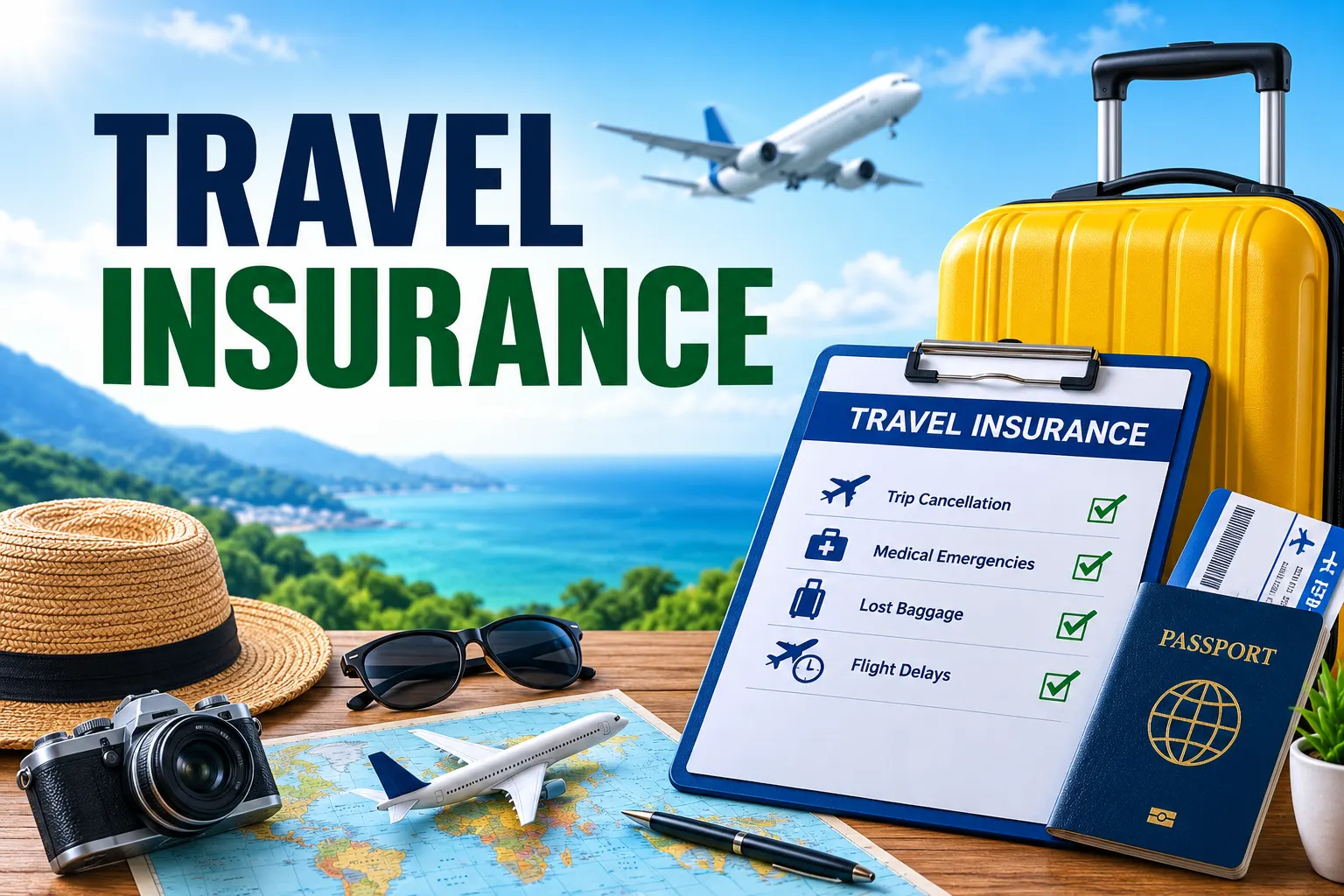
A trip can take months of planning, but unexpected problems can change those plans within hours. A cancelled flight, sudden illness, lost suitcase, missed connection, or medical emergency abroad can quickly turn an enjoyable journey into an expensive and stressful experience.
Travel Insurance helps protect you financially against certain unexpected events before or during a trip. Depending on the Travel Insurance Policy you choose, it may help with trip cancellations, overseas medical expenses, emergency evacuation, lost baggage, delayed flights, and other covered travel emergencies.
However, not every policy provides the same protection. Coverage limits, exclusions, deductibles, eligible reasons for cancellation, and claim requirements can differ considerably between Travel insurance plans.
This Travel Insurance Guide explains what travel insurance is, how it works, the Types of Travel Insurance available, what policies commonly cover and exclude, how much coverage may cost, and how to choose a suitable plan before your next trip.
What is Travel Insurance and Why Do You Need It?
Travel Insurance is a type of insurance designed to provide financial protection against specific risks associated with travelling. You pay an insurance premium for a policy that provides defined benefits when an eligible event occurs during the policy period.
So, why do I need travel insurance?
Consider an international trip where you have already paid for flights, hotels, tours, and other non-refundable bookings. If you unexpectedly need to cancel for a reason covered by your policy, Trip Cancellation Insurance may reimburse eligible prepaid expenses.
The same principle applies during your journey. If you become seriously ill overseas, lose your baggage, or need emergency medical evacuation, appropriate Travel Insurance Coverage can reduce the amount you have to pay yourself.
Common Travel Insurance Benefits may include:
- Trip cancellation coverage
- Trip interruption coverage
- Emergency Medical Coverage
- Emergency evacuation coverage
- Lost or stolen baggage protection
- Travel delay coverage
- Missed connection benefits
- Travel assistance services
The exact Travel Insurance Benefit available depends on your policy coverage.
Insurance is particularly worth considering for international journeys because your regular health insurance may provide limited or no overseas health coverage. Medical treatment and evacuation abroad can also be costly.
Travel insurance should therefore form part of your wider pre-trip planning rather than being treated as an afterthought. Alongside checking passport and visa requirements, preparing your budget, and following practical travel safety tips, reviewing your insurance needs can help you prepare for problems that are difficult to predict.
How Does Travel Insurance Work?
Understanding How Does Travel Insurance Work makes it easier to select appropriate coverage and use it correctly if something goes wrong.
You generally start by selecting a Travel Insurance Policy based on your destination, trip duration, traveller details, trip cost, and required protection. You pay the insurance premium, and coverage applies according to the dates, conditions, coverage limits, and exclusions stated in the policy.
If a covered incident occurs, you contact the insurance provider and follow its claim process. Depending on the benefit and provider, the insurer may reimburse eligible expenses or arrange direct payment to a hospital or service provider.
A simple example is a covered flight cancellation. If the policy includes applicable trip cancellation coverage, you would normally submit evidence showing why the trip was cancelled and documents showing your non-refundable costs. The insurer then reviews the claim against the policy terms before deciding what amount, if any, is payable.
➤ What Happens When a Covered Event Occurs?
The first thing to do is deal with the immediate problem safely. For a medical emergency, seek appropriate medical attention. For stolen luggage, report the theft to the relevant local authority. For a flight disruption, obtain confirmation from the airline.
Next, contact your insurance provider as soon as reasonably possible.
You may need evidence such as:
- Medical reports and bills
- Airline cancellation or delay confirmation
- Police reports
- Baggage reports
- Hotel receipts
- Original booking confirmations
- Proof of payment
- Receipts for additional eligible expenses
Keeping clear records is important because reimbursement usually depends on proving both the covered event and your financial loss.
➤ Reimbursement vs. Direct Payment
Travel insurance claims are commonly handled through reimbursement or, in some circumstances, direct payment.
With reimbursement, you pay an eligible expense yourself and later submit the necessary documents to your insurer. Once approved, the insurer reimburses the covered amount subject to the policy terms, deductible, and coverage limits.
With direct payment, the insurance company or its assistance partner may coordinate payment directly with a hospital or another service provider. This can be particularly valuable during expensive medical emergencies.
Direct payment is not guaranteed simply because a policy includes medical coverage. Availability can depend on the insurer, healthcare facility, location, and circumstances. Contact the insurer’s emergency assistance team whenever possible before assuming an expense will be settled directly.
What Are the Different Types of Travel Insurance?
There is no single Travel Insurance Policy suitable for every traveller. The right option depends on how frequently you travel, where you are going, who is travelling, and what risks you want covered.
Understanding the main Types of Travel Insurance makes comparing policies much easier.
1. Single-Trip Travel Insurance
Single trip travel insurance covers one specific journey for a defined period.
It can be suitable for people taking one or a few trips per year. Coverage usually starts and ends according to the dates and conditions stated in the travel policy.
If you are planning one holiday, business visit, or international journey, a single-trip policy may be simpler than paying for annual protection.
2. Annual or Multi-Trip Travel Insurance
Annual travel insurance, sometimes called multi-trip travel insurance, is intended for people who take several eligible trips during a year.
Rather than purchasing separate Trip Insurance for every journey, one annual policy can cover multiple trips subject to its conditions.
Pay particular attention to the maximum permitted duration of each individual trip. An annual policy might cover several journeys while still limiting how many consecutive days each trip can last.
When comparing single trip vs annual travel insurance, consider your expected travel frequency, average trip length, destinations, and total premium rather than price alone.
3. Domestic Travel Insurance
Domestic Travel Insurance provides protection for eligible journeys within your home country.
Although overseas medical expenses may not be relevant, domestic travellers can still face flight cancellation, delayed flights, lost baggage, missed connections, and non-refundable booking costs.
Check whether benefits overlap with protection already provided by your health insurance, airline, credit card, or booking provider.
4. International Travel Insurance
International Travel Insurance is designed for overseas journeys and can include broader protection against risks that become more significant when travelling outside your home country.
Travel Insurance for International Travel may include overseas medical expenses, medical evacuation insurance, trip cancellation, baggage protection, emergency assistance, and repatriation benefits.
Destination requirements matter as well. For example, some travellers may need travel insurance for Schengen visa purposes that meets specific requirements. Always check current entry and insurance requirements with the relevant official authorities before travelling.
5. Student Travel Insurance
Student travel insurance is designed for students studying or travelling away from home, particularly those attending educational institutions overseas.
Depending on the plan, coverage may extend beyond ordinary holiday insurance and include eligible medical expenses, personal belongings, emergency assistance, and other student-related risks.
Students should compare the policy against any insurance requirements set by their university, visa, host country, or study program.
6. Senior Travel Insurance
Senior travel insurance is intended for older travellers whose insurance needs may differ from those of younger travellers.
Age limits, medical screening requirements, premiums, coverage limits, and rules concerning pre-existing medical conditions can vary significantly between providers.
When considering travel insurance for seniors, focus on meaningful medical and emergency coverage rather than choosing a plan purely because it has the lowest premium.
7. Family Travel Insurance
Family travel insurance allows eligible family members to receive coverage under one policy.
It can make arranging Travel Protection Insurance easier for parents travelling with children. However, insurers can define “family” and dependent children differently.
Check who is included, individual and shared coverage limits, age restrictions, and whether every family member is protected for the entire journey.
8. Group Travel Insurance
Group Travel Insurance provides coverage for multiple people travelling together, such as organised groups, employees, tour participants, or other eligible travellers.
A group policy can simplify administration, but you should still understand how coverage limits apply. Some benefits may apply to each traveller individually, while others can have shared limits.
What Does Travel Insurance Cover?
What Does Travel Insurance Cover? There is no universal answer because every policy is different.
Comprehensive travel insurance commonly combines several forms of travel coverage. The following are some of the most important benefits to look for.
✦ Trip Cancellation and Interruption
Trip cancellation coverage can reimburse eligible prepaid and non-refundable expenses when you have to cancel your trip for a covered reason.
Covered reasons may include certain illnesses, injuries, family emergencies, natural disasters, or other events specifically listed by the insurer.
Trip interruption insurance works differently. It applies after your trip has already started and may cover eligible costs if a covered event forces you to cut the journey short or interrupts your plans.
Neither benefit covers every reason for changing your mind or cancelling a trip. Always review the policy’s list of covered reasons and exclusions.
✦ Emergency Medical Expenses and Hospitalization
Travel Medical Insurance can help cover eligible treatment when you unexpectedly become ill or injured during your trip.
Depending on the policy, Emergency Medical Coverage may include:
- Doctor consultations
- Emergency treatment
- Hospitalization
- Diagnostic tests
- Prescription medicines
- Ambulance services
This protection deserves particular attention when travelling abroad. Your regular health insurance may not provide adequate overseas health coverage, so verify your existing protection before relying on it.
✦ Emergency Evacuation and Repatriation
A serious medical emergency may require transportation to a more appropriate medical facility or, in certain circumstances, repatriation to your home country.
Emergency evacuation coverage or medical evacuation insurance can help with eligible transportation expenses when the conditions specified in the policy are met.
These arrangements should generally be coordinated through the insurer’s emergency assistance service. Organising expensive transportation independently without approval could affect coverage.
✦ Lost, Stolen, or Delayed Baggage
Does travel insurance cover lost luggage? Many policies do, but limits and conditions apply.
Baggage protection may provide compensation when covered belongings are lost, stolen, damaged, or significantly delayed.
If baggage is delayed, the policy may cover reasonable purchases of essential items such as basic clothing and toiletries, subject to limits.
For stolen luggage, you may need a police report. For baggage lost or delayed by an airline, obtain written documentation from the carrier.
High-value items such as electronics, jewellery, and specialist equipment may have lower individual limits or special exclusions.
✦ Travel Delays and Missed Connections
Travel delay compensation may help cover certain additional expenses when a covered delay lasts longer than the minimum period specified in your policy.
Eligible costs might include meals, accommodation, or transportation.
Missed connection coverage can also help when a qualifying delay causes you to miss an onward connection.
Keep receipts and obtain evidence explaining the disruption. A delayed flight by itself does not automatically mean every resulting expense will be reimbursed.
✦ Accidental Death and Dismemberment
Some travel policies include accidental death and dismemberment benefits.
This coverage can provide a defined payment when a covered accident during the insured journey results in death or certain serious injuries specified by the policy.
Terms can be highly specific, so read this section carefully rather than assuming all accidents qualify.
✦ Personal Liability Coverage
Personal liability coverage may provide financial protection if you accidentally injure another person or damage someone else’s property while travelling and become legally liable.
Coverage varies considerably by policy and may exclude incidents involving vehicles, certain activities, intentional acts, or other circumstances.
What is Not Covered by Travel Insurance?
Travel insurance exclusions are just as important as the benefits.
Buying a policy does not mean every unexpected travel problem is insured. Claims are assessed according to the exact wording, limits, conditions, and exclusions of your contract.
► Pre-Existing Medical Conditions
A pre-existing medical condition is one of the most important areas to check when purchasing Travel Medical Insurance.
Insurers have specific definitions and look-back periods for pre-existing medical conditions. Some policies exclude them, while others may provide coverage when eligibility requirements or waiver conditions are satisfied.
Do not assume an existing condition is automatically covered. Read the relevant terms and disclose information accurately when required.
► High-Risk Activities and Adventure Sports
Standard travel policies may exclude injuries resulting from particular high-risk activities.
Examples can include certain forms of climbing, diving, skiing, racing, or other adventure activities.
If such activities are part of your itinerary, look for adventure travel insurance or an appropriate add-on that explicitly covers them.
► Alcohol- or Drug-Related Incidents
Claims connected to alcohol or non-prescribed drug use may be excluded or restricted.
Policy wording differs between insurers, so travellers should understand these conditions before departure.
Following sensible travel safety tips can reduce avoidable risks, but it is equally important to know how your insurer treats incidents involving intoxication.
► Travel Against Government Advisories
Travelling to a destination against an applicable government warning or advisory may affect your coverage.
The exact consequence depends on the policy and nature of the advisory. Before departure, check current official travel guidance for your destination and review how your insurer handles government advisories.
► Self-Inflicted Injuries
Intentional or self-inflicted injuries are commonly excluded from standard Travel Insurance Coverage.
The exact wording and applicable exceptions can vary, so rely on your policy documents for definitive information.
► Foreseeable or Known Events
Insurance is primarily intended to protect against covered unexpected events rather than problems already known when the policy is purchased.
For example, buying insurance after a particular disruption has become known does not usually make losses arising from that event automatically covered.
This is one reason travel insurance before your trip should be considered early rather than after a problem appears likely.
► Unattended or Improperly Secured Belongings
A policy may refuse or reduce a baggage claim if belongings were left unattended or were not secured as required by the policy.
Take reasonable care of passports, money, electronics, luggage, and valuables. Read the baggage conditions carefully, particularly if you are carrying expensive items.
How Much Does Travel Insurance Cost?
How much does travel insurance cost? There is no fixed price.
Travel Insurance Cost depends on the traveller, trip, destination, coverage selected, and insurance provider. Two people travelling to the same destination can receive different quotes because their circumstances and coverage needs are different.
Rather than searching only for affordable travel insurance, compare the price with the protection you actually receive.
♦ Factors That Affect Travel Insurance Premiums
Common factors that can influence an insurance premium include:
- Traveller age
- Destination
- Trip duration
- Number of travellers
- Total insured trip cost
- Medical coverage selected
- Coverage limits
- Deductible
- Optional benefits or add-ons
- Type of policy
- Planned activities
International trips involving expensive prepaid bookings or higher medical risks may cost more to insure than shorter, lower-cost journeys.
Age can also influence premiums, particularly for senior travellers.
♦ Average Travel Insurance Cost
There is no reliable universal average that applies to every traveller or country. Pricing models differ among travel insurance providers, and premiums can change based on the factors above.
The most useful approach is to get a travel insurance quote from several suitable providers using the same trip details and similar coverage levels.
When making a travel insurance comparison, look beyond the premium. A cheaper plan with low medical limits, a high deductible, or restrictive exclusions could provide less useful protection when you actually need it.
Your insurance premium should also be included in your broader travel budget. Good personal budgeting tips can help you account for insurance, accommodation, transportation, meals, activities, and an emergency fund without relying on unrealistic estimates.
When Should You Buy Travel Insurance?
When should I buy travel insurance? In many cases, it makes sense to consider coverage soon after making significant non-refundable travel bookings.
Buying earlier can be important because certain time-sensitive benefits may only be available when a policy is purchased within a specified period after an initial trip payment.
Can I buy travel insurance after booking a flight? Often, yes. You generally do not have to purchase insurance at the exact moment you book your flight. However, waiting can affect your eligibility for certain benefits and will not normally provide retroactive protection for events that were already known.
Before purchasing, confirm:
- When your cancellation protection starts
- When medical and other trip coverage begins
- Whether any benefits have purchase deadlines
- Whether pre-existing medical condition provisions have timing requirements
- The policy’s effective and expiry dates
Do not wait until a storm, illness, strike, natural disaster, or other event is already expected and assume a newly purchased policy will cover it.
How to Compare and Choose the Right Travel Insurance Plan
Finding the best travel insurance is less about identifying one universally superior company and more about finding coverage that fits your particular journey.
Here’s how to Choose Travel Insurance based on practical needs rather than marketing language.
✸ Assess Your Trip and Coverage Needs
Start with your itinerary.
Consider your destination, trip duration, traveller ages, planned activities, non-refundable expenses, existing health coverage, and the value of the belongings you are taking.
Ask yourself what financial losses would be difficult to manage without insurance.
For an expensive overseas holiday, strong medical, cancellation, interruption, and evacuation protection might be priorities. A short domestic journey may require a different level of Trip protection.
✸ Compare Coverage Limits and Benefits
Once you understand your needs, compare travel insurance plans on a like-for-like basis.
Look at limits for:
- Emergency medical treatment
- Medical evacuation
- Trip cancellation
- Trip interruption
- Baggage
- Travel delays
- Personal liability
A high headline coverage amount does not necessarily mean the policy is better. Check sub-limits for individual benefits and belongings as well.
✸ Check Exclusions and Policy Restrictions
Do not buy a Travel protection plan based only on its benefits page.
Read its exclusions and restrictions carefully.
Pay particular attention to pre-existing medical conditions, adventure activities, destination restrictions, valuables, government advisories, alcohol-related incidents, and the reasons accepted for cancellation.
This is where many travel mistakes can be avoided. Knowing what is excluded before departure is far better than discovering it during the claim process.
✸ Review Deductibles and Premiums
The deductible is the amount you may have to pay yourself before eligible insurance coverage applies, depending on the policy.
Compare both the deductible and premium.
The cheapest premium may come with a larger deductible or weaker benefits. Conversely, paying more for coverage you do not need may offer little practical value.
Choose a balance that suits both your risk exposure and travel budget.
✸ Check the Claims Process and Assistance Services
A policy becomes most important when something goes wrong, so investigate the Travel insurance claim process before buying.
Check:
- How claims can be submitted
- What documents are required
- Whether online claims are available
- How emergency medical cases are handled
- Whether 24-hour travel assistance is offered
- How to contact assistance from overseas
- Whether direct medical payment may be arranged
Travel insurance reviews can provide additional context about customer experiences, but they should not replace reading the actual policy wording.
How to Buy Travel Insurance: Step-by-Step
You can often buy travel insurance online within a relatively short time, but choosing the right policy deserves more attention than simply selecting the first quote.
1. Assess Your Travel Needs
Write down the basic details of your journey:
- Destination
- Departure and return dates
- Number and ages of travellers
- Prepaid trip expenses
- Planned activities
- Existing insurance
- Medical considerations
If you are trying to plan a solo trip, consider how you would handle an emergency without a travel companion. Access to reliable travel assistance may be particularly useful.
2. Compare Travel Insurance Plans
Request quotes from suitable travel insurance providers and compare policies with similar benefits.
Do not judge the best travel insurance plans solely by price.
Compare medical limits, evacuation benefits, trip cancellation protection, baggage limits, deductibles, exclusions, and emergency support.
3. Review Coverage, Exclusions, and Policy Terms
Before you buy travel insurance, read the policy documents carefully.
Make sure you understand:
- What events are covered
- What events are excluded
- Coverage limits
- Deductibles
- Claim requirements
- Policy dates
- Destination restrictions
- Cancellation conditions
If something important is unclear, contact the travel insurance company before purchasing.
4. Choose Your Plan and Provide Trip Details
Once you have compared the available options, choose the policy that best matches your needs.
Provide accurate information when requesting or purchasing coverage. Depending on the insurer, this can include traveller details, destination, travel dates, trip cost, and other information relevant to the policy.
Incorrect information can create complications later.
5. Purchase the Policy and Save Your Documents
After you purchase travel insurance online, save your policy certificate and complete policy wording.
Keep digital copies accessible from your phone or secure online storage and consider carrying essential information separately.
Your pre-trip checklist should include:
- Policy number
- Insurance provider contact information
- Emergency assistance number
- Passport and visa documents
- Booking confirmations
- Important medical information where appropriate
You may also want to share essential emergency details with someone you trust before departure.
How to File a Travel Insurance Claim
Even good coverage can become difficult to use if you do not follow the required claim process.
Knowing how to file a travel insurance claim before travelling can save time during a stressful situation.
➤ Notify Your Insurance Provider
Contact your insurance provider as soon as required after a covered incident.
For emergencies, use the insurer’s emergency assistance number where appropriate. For non-emergency situations, follow the notification procedure described in your travel policy.
Do not delay unnecessarily because policies may specify time limits for reporting incidents or submitting claims.
➤ Gather the Required Documents
The insurer needs evidence to evaluate your claim.
Depending on the situation, documents may include:
- Policy details
- Passport or identification
- Booking confirmation
- Medical reports
- Hospital bills
- Receipts
- Police reports
- Airline reports
- Baggage reports
- Proof of delay or cancellation
- Evidence of prepaid non-refundable costs
Take photographs or digital copies of important paperwork whenever practical.
➤ Submit Your Claim: Cashless vs. Reimbursement
For a reimbursement claim, you generally submit your expenses and supporting evidence through the insurer’s specified process.
For eligible medical emergencies, some insurers may coordinate directly with hospitals or assistance networks. This is sometimes described as cashless or direct settlement.
Do not assume direct settlement is automatically available. Contact the insurer as soon as possible so it can explain the correct procedure.
➤ Track Your Claim Status
After submission, keep your claim reference number and monitor its progress.
Respond promptly if the insurer requests additional documents or clarification.
Keep copies of everything you submit, including forms, receipts, emails, and supporting records, until the claim has been fully resolved.
➤ What to Do If Your Claim Is Denied
A denied claim does not necessarily mean you have no further options.
First, ask for the reason for denial in writing and compare it with your policy wording.
Check whether:
- Documents were missing
- The expense exceeded a coverage limit
- A deductible applied
- The incident fell under an exclusion
- More evidence is required
- The insurer interpreted the event differently from you
If you believe the decision is incorrect, follow the insurer’s appeal or complaint process and provide relevant supporting evidence. Further options can depend on the laws and insurance regulations applicable to your policy.
Common Mistakes to Avoid When Buying Travel Insurance
Travel insurance is easier to use when you understand what you purchased before leaving home.
Some common mistakes include:
- Choosing a policy based only on the lowest price.
- Not reading travel insurance exclusions.
- Assuming every cancellation reason is covered.
- Buying insurance too late for time-sensitive benefits.
- Choosing inadequate medical coverage for an overseas trip.
- Ignoring coverage limits and sub-limits.
- Forgetting to check the deductible.
- Assuming pre-existing medical conditions are automatically covered.
- Failing to check adventure activity exclusions.
- Providing inaccurate trip information.
- Assuming expensive belongings are fully insured.
- Failing to save receipts and supporting documents.
- Not keeping the emergency assistance number accessible.
- Assuming credit card protection provides everything needed.
Another mistake is confusing insurance with a replacement for sensible planning. Insurance can reduce certain financial risks, but basic travel hacks, secure handling of valuables, careful bookings, and good preparation remain important.
For example, learning how to save money on hotel bookings may reduce your overall trip cost, while insurance serves a different purpose: protecting you from specific covered financial losses when plans unexpectedly go wrong.
Is Travel Insurance Worth It?
Is Travel Insurance Worth It? For many trips, it can be valuable, but the answer depends on your financial exposure and existing protection.
A useful way to decide is to consider what would happen if you had to cancel the trip tomorrow, needed medical treatment abroad, or had to return home unexpectedly.
If those costs would create a significant financial burden, suitable Travel protection may be worth considering.
► When Travel Insurance is Worth Buying
Travel insurance can be particularly valuable when:
- You are travelling internationally
- You have substantial non-refundable bookings
- Your health insurance provides limited overseas coverage
- Emergency evacuation would be financially difficult
- You are taking an expensive holiday or cruise
- You have multiple connecting flights
- Your destination presents particular travel risks
- You need specific coverage for visa requirements
- You are travelling with family members
- You want access to travel assistance during emergencies
Travel insurance for overseas travel deserves particular attention because medical systems, treatment costs, and payment requirements can differ greatly between destinations.
A good policy cannot prevent an emergency, but it can help make the financial consequences of a covered event more manageable.
► When You May Not Need Travel Insurance
You may decide that extensive Trip Insurance offers limited value for a particular journey when your financial exposure is very low.
For example, you might be taking a short domestic trip with refundable bookings, minimal prepaid expenses, adequate health insurance, and no costly activities.
You may also already have some protection through a credit card, employer, airline, or another insurance product.
However, verify that protection rather than assuming it exists. Check the actual limits, exclusions, eligibility requirements, and claim conditions.
Think of travel insurance as part of sensible financial planning. Just as understanding needs vs wants helps you decide where your money matters most, assessing the risks of a particular journey helps you decide how much travel insurance you genuinely need.
Final Thoughts
Travel plans do not always go as expected. Flights can be cancelled, baggage can disappear, illness can strike abroad, and emergencies can force you to return home earlier than planned. Travel Insurance is designed to reduce the financial impact of certain covered events, but its usefulness depends heavily on choosing the right policy and understanding its terms.
Before buying, consider your destination, trip cost, health coverage, activities, and existing protection. Compare travel insurance based on meaningful benefits, coverage limits, deductibles, exclusions, emergency assistance, and claim requirements rather than premium alone.
Most importantly, read your Travel Insurance Policy before you leave. Good trip planning combines appropriate insurance with sensible budgeting, secure travel documents, careful preparation, and practical safety measures. That gives you a clearer understanding of the risks you are accepting—and the protection you have if something unexpected happens.
FAQs
What is travel insurance and how does it work?
Travel insurance provides financial protection against specific covered events connected with a trip. You purchase a policy, pay the required premium, and receive coverage subject to its terms, exclusions, deductibles, and limits. If an eligible event occurs, you can submit a claim or contact the insurer for applicable assistance.
Do I need travel insurance for every trip?
Not necessarily. The need depends on your destination, trip cost, existing insurance, health coverage, planned activities, and ability to absorb unexpected expenses. International and expensive non-refundable trips generally involve greater financial exposure than inexpensive domestic journeys.
Does travel insurance cover cancelled flights?
It can provide coverage in certain circumstances, but a cancelled flight does not automatically qualify for payment. Coverage depends on the reason for cancellation, available airline reimbursement, policy terms, and the benefit under which you are claiming.
Does travel insurance cover lost luggage?
Many policies provide protection for lost, stolen, damaged, or delayed baggage. Coverage limits, item sub-limits, exclusions, and documentation requirements apply. Always obtain appropriate reports from the airline, carrier, or police where necessary.
Can I buy travel insurance after booking a flight?
Often, yes. However, some benefits may have purchase deadlines, and insurance generally does not cover known events retroactively. Consider your insurance needs soon after making significant non-refundable bookings.
How much travel insurance do I need?
There is no single amount suitable for everyone. Consider your non-refundable trip costs, destination healthcare expenses, existing medical insurance, evacuation risk, baggage value, and personal financial situation.
What is the difference between trip cancellation and trip interruption coverage?
Trip cancellation generally applies when a covered event prevents you from starting your trip. Trip interruption coverage applies when a covered event disrupts a journey that has already begun.
Does travel insurance cover pre-existing medical conditions?
It depends on the policy. Some exclude pre-existing medical conditions, while others may provide coverage subject to specific eligibility rules or waivers. Read the policy definition and requirements carefully before purchasing.
What travel documents should I keep with my insurance?
Keep your policy details, emergency assistance contact information, passport and visa documents, booking confirmations, and relevant receipts accessible. During a claim, additional documents such as medical records, police reports, or airline confirmations may be required.
Is the cheapest travel insurance the best option?
Not necessarily. A low premium can come with lower coverage limits, higher deductibles, or more restrictive exclusions. Compare what each policy actually covers before deciding.
Thank you for taking the time to read this blog. We hope you found the information helpful and gained a better understanding of travel insurance and its importance.If you found this blog useful, please consider sharing it with your friends and family who are planning a trip. Understanding travel insurance, its coverage, and its benefits before travelling can help people prepare for unexpected situations and make more informed decisions.Thank you for reading, and we wish you a safe and enjoyable journey!