
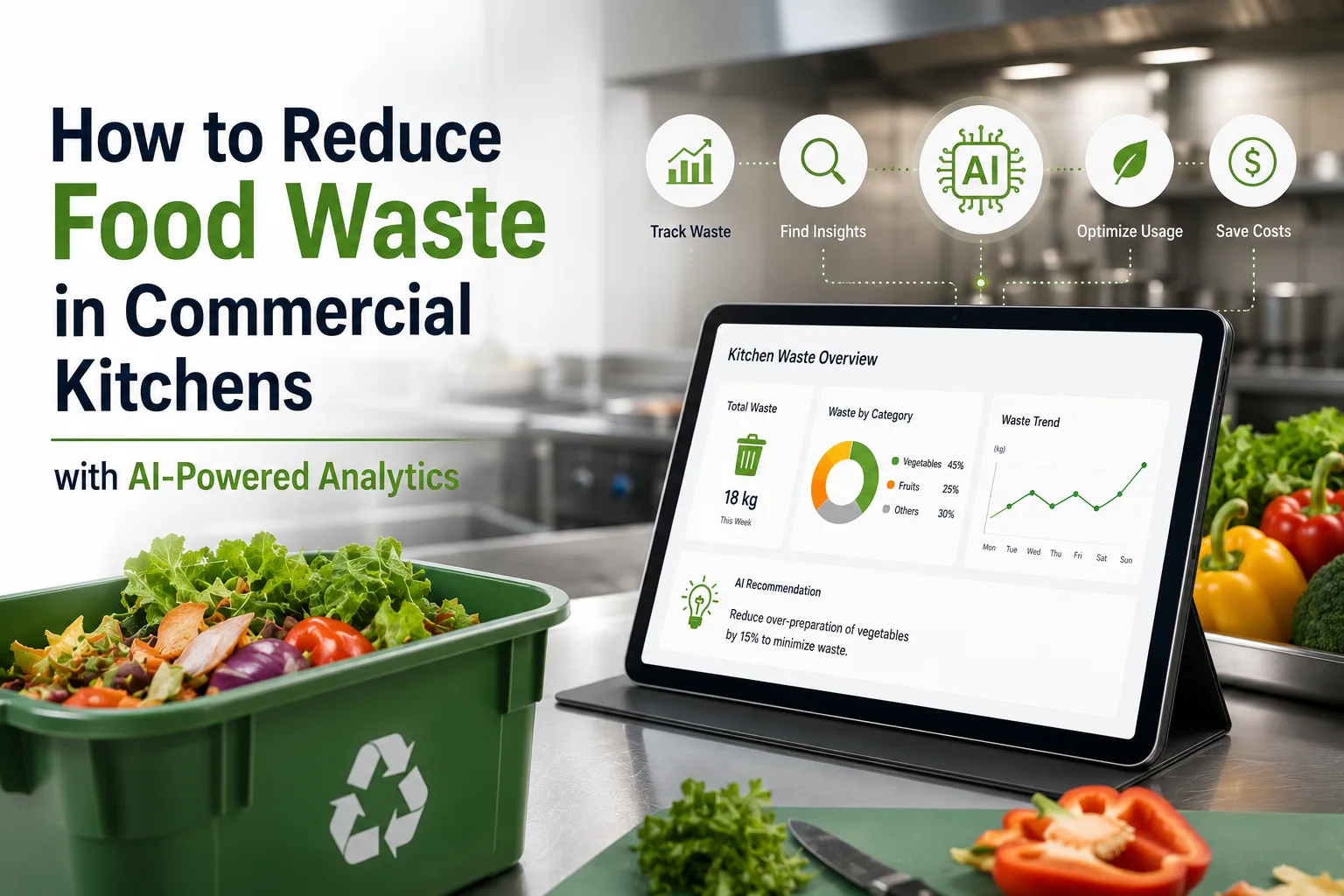
Food waste is one of the biggest challenges facing commercial kitchens today. Whether it’s a restaurant, hotel, catering company, or cloud kitchen, throwing away unused ingredients and prepared meals affects both profits and sustainability. Many businesses lose money every day because of overordering, inaccurate demand predictions, poor inventory control, and inefficient kitchen processes. While some waste is unavoidable, a large portion can be prevented with better planning and smarter decision-making.
Traditional methods of managing waste often rely on manual tracking, spreadsheets, or staff observations. These approaches take time, are prone to human error, and rarely provide a complete picture of where waste is occurring. As food businesses grow, these limitations become even more noticeable.
This is where AI-powered analytics is making a real difference. By combining data from inventory systems, sales records, kitchen operations, and customer demand, AI can identify waste patterns, predict future requirements, and recommend practical actions that reduce unnecessary losses. Instead of reacting after food has already been wasted, businesses can take preventive steps before problems occur.
In this guide, you’ll learn what causes food waste in commercial kitchens, why reducing it matters, how AI-powered analytics works, and the practical ways it helps improve kitchen performance. You’ll also discover the benefits, implementation challenges, best practices, and key factors to consider when choosing the right solution for your business.
Understanding Food Waste in Commercial Kitchens
Reducing food waste starts with understanding where it comes from and why it happens. In a busy commercial kitchen, ingredients move through multiple stages—from purchasing and storage to preparation, cooking, serving, and disposal. Waste can occur at any point in this process, often without staff realizing how much it adds up over time.
By identifying the different forms of waste and their root causes, food businesses can make informed decisions that improve efficiency and reduce unnecessary costs.
➤ What is Food Waste in Commercial Kitchens?
Food waste in commercial kitchens refers to any edible or inedible food that is discarded before it reaches the customer or after it has been served. This includes spoiled ingredients, preparation scraps, unsold meals, overcooked dishes, and leftovers returned by customers.
Waste isn’t always caused by poor kitchen practices. It can also result from inaccurate purchasing, unexpected changes in customer demand, menu complexity, storage issues, or inconsistent portion sizes.
Common examples include:
- Fresh vegetables that spoil before use
- Ingredients ordered in larger quantities than needed
- Meals prepared but never sold
- Excess food left on customers’ plates
- Food damaged during storage or transportation
Effective food waste management focuses on identifying these problems early so kitchens can reduce losses without affecting food quality or customer satisfaction.
➤ Common Sources of Food Waste
Food waste usually comes from a combination of operational issues rather than a single mistake. Understanding these sources helps businesses target improvements where they will have the greatest impact.
1. Preparation Waste
Preparation waste occurs while ingredients are being cleaned, peeled, trimmed, or cut. Although some waste is unavoidable, excessive trimming, inconsistent knife skills, and poor preparation techniques often increase losses.
Examples include:
- Over-trimming vegetables
- Excess meat removed during preparation
- Incorrect recipe measurements
- Ingredients accidentally damaged during cooking
Regular staff training and standardized preparation methods can significantly reduce this type of waste.
2. Spoilage
Perishable ingredients have a limited shelf life. Improper storage, incorrect temperatures, delayed usage, or poor stock rotation often cause food to expire before it can be used.
Common reasons include:
- Buying more than required
- Improper refrigeration
- Ignoring expiration dates
- Poor inventory rotation
Using kitchen inventory management systems alongside AI-driven monitoring can help businesses identify ingredients that need to be used first.
3. Overproduction
Preparing more food than customers actually order is one of the largest contributors to commercial kitchen food waste.
This usually happens because of:
- Inaccurate sales forecasts
- Seasonal demand changes
- Special events with uncertain attendance
- Poor communication between kitchen and front-of-house teams
AI-powered predictive analytics can analyze historical sales patterns and upcoming demand to reduce unnecessary food preparation.
4. Plate Waste
Plate waste refers to food left uneaten by customers.
Common causes include:
- Oversized portions
- Dishes customers don’t enjoy
- Menu items that don’t meet expectations
- Side dishes customers rarely finish
Tracking plate waste helps restaurants understand customer preferences and make better menu decisions.
➤ Types of Food Waste
Commercial kitchens generally deal with two primary categories of food waste.
| Type | Description | Examples |
|---|---|---|
| Pre-Consumer Waste | Waste generated before food reaches customers | Preparation scraps, spoiled ingredients, expired inventory, cooking errors |
| Post-Consumer Waste | Waste generated after food has been served | Plate leftovers, buffet waste, uneaten side dishes |
1. Pre-Consumer Waste
This type of waste is usually easier to control because it happens within kitchen operations.
Reducing pre-consumer waste involves:
- Better purchasing decisions
- Accurate inventory management
- Improved storage practices
- Recipe standardization
- Smarter production planning
Many businesses use food waste tracking software to monitor these losses and identify recurring issues.
2. Post-Consumer Waste
Post-consumer waste provides valuable insights into customer behavior.
Restaurants often analyze:
- Which menu items produce the most leftovers
- Average portion sizes
- Customer preferences
- Frequently discarded side dishes
These insights support better portion control, menu improvements, and overall restaurant food waste reduction.
➤ Food Waste Statistics in Commercial Kitchens
Food waste continues to be a major challenge across the global food service industry. According to international organizations such as the United Nations Environment Programme (UNEP) and the Food and Agriculture Organization (FAO), large amounts of food are wasted every year throughout the supply chain, with restaurants, hotels, cafeterias, and other commercial food businesses contributing significantly.
Some common industry findings include:
- A substantial share of commercial kitchen waste comes from overproduction and spoilage.
- Fresh produce, dairy products, baked goods, and prepared meals are among the most frequently discarded food items.
- Poor inventory planning and inaccurate demand forecasting remain two of the leading causes of avoidable waste.
- Even small reductions in daily waste can result in meaningful annual savings for food businesses.
These findings highlight why many organizations are investing in food waste monitoring and data-driven decision-making. Rather than relying on estimates, AI-powered systems can provide detailed insights into where waste occurs, why it happens, and how it can be reduced over time.
As food businesses continue to focus on cost control and operational efficiency, reducing waste is no longer viewed as just an environmental initiative. It has become an essential part of improving profitability, managing resources responsibly, and delivering more sustainable food service operations.
Why Reducing Food Waste Matters for Food Businesses
Reducing food waste is about much more than throwing away less food. It directly affects operating costs, inventory management, sustainability goals, regulatory compliance, and customer perception. Every ingredient that ends up in the bin represents money that has already been spent on purchasing, storage, labor, preparation, and energy.
For restaurants, hotels, catering companies, and other businesses in the commercial food service industry, even small improvements in waste reduction can lead to noticeable financial and operational benefits. As customer expectations continue to evolve, businesses are also under increasing pressure to operate responsibly and demonstrate a genuine commitment to sustainability.
Understanding the broader impact of food waste helps organizations see why reducing it should be an ongoing business priority rather than an occasional cost-cutting exercise.
✸ Financial Impact and Cost Savings
Food waste has a direct effect on a business’s bottom line. Every ingredient that is purchased but never served represents a financial loss. The cost doesn’t stop at the price of the food itself—it also includes labor, storage, utilities, transportation, and disposal expenses.
For example, if a restaurant regularly prepares more meals than it sells, the business loses money on ingredients, staff time, and energy used during preparation. Over weeks and months, these small losses can add up to thousands of dollars.
Reducing waste allows businesses to improve food cost management without compromising food quality or customer satisfaction. Instead of cutting menu options or reducing ingredient quality, restaurants can use data to make smarter purchasing and production decisions.
Some practical ways businesses save money by reducing waste include:
- Purchasing ingredients based on actual demand
- Improving storage practices to extend shelf life
- Reducing overproduction during slow business hours
- Standardizing recipes and portion sizes
- Monitoring ingredient usage across multiple locations
Many businesses also combine food waste tracking software with restaurant inventory management software to identify unnecessary losses and make informed purchasing decisions. This data-driven approach helps managers focus on preventing waste instead of reacting after it occurs.
✸ Environmental and Sustainability Benefits
Food waste affects more than business profits. It also has a significant environmental impact throughout the food supply chain.
Every ingredient requires land, water, energy, labor, and transportation before it reaches a commercial kitchen. When food is discarded, all of those resources are wasted as well. In addition, food sent to landfills can produce methane, a greenhouse gas that contributes to climate change.
Reducing waste supports both environmental responsibility and long-term business sustainability.
Some of the key environmental benefits include:
- Lower greenhouse gas emissions
- Reduced landfill waste
- More efficient use of water and energy
- Better use of agricultural resources
- Reduced pressure on food supply chains
Many food businesses now include sustainability in restaurants as part of their overall business strategy. By improving kitchen waste management, they not only reduce operating costs but also demonstrate a commitment to responsible business practices.
AI-powered analytics supports these efforts by identifying waste patterns that are difficult to detect through manual monitoring. Over time, these insights help businesses adopt more sustainable kitchen practices while maintaining operational performance.
✸ Regulatory Compliance and Food Waste Regulations
Governments and local authorities are placing greater emphasis on reducing food waste and encouraging responsible waste disposal. While regulations vary by country and region, many food businesses are expected to follow rules related to food safety, waste segregation, recycling, and environmental reporting.
Commercial kitchens may need to comply with requirements such as:
- Proper disposal of food waste
- Safe handling of expired ingredients
- Waste separation and recycling programs
- Record-keeping for waste management practices
- Environmental sustainability initiatives
Keeping accurate records can become challenging when waste is tracked manually. AI-powered systems simplify this process by automatically collecting data, generating reports, and helping businesses identify recurring issues before they become larger problems.
Having reliable waste data also makes it easier to demonstrate compliance during inspections or internal audits.
✸ Brand Reputation and Customer Trust
Customers are paying closer attention to how food businesses operate. Many people prefer restaurants, hotels, and food service providers that show a genuine commitment to reducing waste and operating responsibly.
A business that actively manages food waste often benefits from:
- Greater customer confidence
- Stronger brand reputation
- Improved public perception
- Better alignment with corporate sustainability goals
- Increased customer loyalty
Transparency also plays an important role. Sharing measurable progress toward waste reduction goals can strengthen trust with customers, business partners, and investors.
Modern smart restaurant technology allows businesses to monitor waste more accurately and demonstrate continuous improvement. Rather than relying on assumptions, organizations can use real operational data to support sustainability initiatives and improve decision-making.
For businesses exploring broader digital transformation, understanding topics such as AI in data analysis can provide additional insight into how data-driven technologies improve operational efficiency beyond food waste management.
What is AI-Powered Analytics and How Does It Work?
Managing food waste has become more complex as commercial kitchens handle larger inventories, changing customer demand, and fast-paced operations. Traditional tracking methods often rely on manual records or visual estimates, making it difficult to identify the root causes of waste.
AI-powered analytics offers a smarter approach. By analyzing data from multiple sources in real time, artificial intelligence helps businesses understand why waste occurs, predict future needs, and recommend actions that improve kitchen performance.
Instead of making decisions based on guesswork, kitchen managers can rely on accurate data to reduce waste, improve inventory planning, and optimize daily operations.
✦ What Is AI-Powered Food Waste Analytics?
AI-powered food waste analytics is the process of using artificial intelligence to collect, analyze, and interpret data related to food waste throughout kitchen operations.
The system gathers information from sources such as:
- Inventory records
- Point-of-sale (POS) systems
- Kitchen production data
- Food disposal records
- Customer purchasing patterns
Using this information, AI identifies trends that may not be obvious through manual observation.
For example, it can detect:
- Ingredients that are consistently overordered
- Menu items that generate excessive waste
- Times of day when overproduction occurs
- Seasonal demand changes
- Inventory items approaching expiration
This allows managers to take preventive action before waste occurs, making AI food waste management a practical tool for improving both efficiency and profitability.
✦ Core Technologies Behind AI Food Waste Analytics
Several technologies work together to make AI-powered food waste analytics effective.
1. Machine Learning
Machine learning enables systems to learn from historical data and improve predictions over time. As more operational data becomes available, forecasting becomes increasingly accurate.
2. Predictive Analytics
Predictive analytics examines historical sales, customer trends, weather patterns, holidays, and other variables to estimate future food demand. This helps kitchens prepare the right quantity of food without excessive overproduction.
3. Computer Vision
Some advanced systems use cameras to recognize discarded food automatically. These systems categorize waste, identify frequently discarded ingredients, and reduce the need for manual recording.
4. Cloud-Based Data Platforms
Cloud platforms combine information from multiple restaurant locations, allowing managers to compare performance, monitor trends, and make consistent improvements across their operations.
Together, these technologies create a more complete picture of kitchen performance and support informed decision-making.
✦ How AI Collects, Analyzes, and Predicts Food Waste
AI-powered systems follow a continuous process of collecting and analyzing operational data.
The typical workflow includes:
| Stage | AI Activity |
|---|---|
| Data Collection | Gathers inventory, sales, production, and waste information |
| Data Analysis | Identifies waste trends and operational patterns |
| Pattern Recognition | Detects recurring causes of waste |
| Forecasting | Predicts future inventory and customer demand |
| Recommendations | Suggests purchasing, production, and menu adjustments |
For example, if historical sales show that certain menu items sell less on weekdays, the system may recommend reducing preparation quantities during those periods.
Similarly, if ingredients frequently expire before use, AI can recommend smaller purchasing quantities or improved stock rotation.
Over time, these recommendations support better inventory optimization, improve commercial kitchen efficiency, and help businesses build more sustainable operating practices.
In addition to food waste management, organizations adopting AI should also consider areas such as AI in cybersecurity to help protect operational data, connected devices, and cloud-based management systems as digital technologies become more integrated into daily business operations.
How AI-Powered Analytics Helps Reduce Food Waste
Artificial intelligence does more than identify waste after it happens. It helps commercial kitchens prevent waste before it occurs by turning operational data into practical recommendations. Instead of relying on assumptions, managers can make informed decisions based on real-time insights into inventory, customer demand, and kitchen performance.
By combining food waste monitoring, sales data, inventory records, and production trends, AI helps businesses reduce unnecessary waste while maintaining consistent food quality and service standards.
► Real-Time Food Waste Tracking
One of the biggest advantages of AI is its ability to monitor waste as it happens. Traditional methods often depend on staff recording discarded food manually, which can be time-consuming and inconsistent. AI-powered systems automate much of this process, giving managers a clearer view of what is being wasted and why.
Real-time tracking helps identify:
- Ingredients that are discarded frequently
- Waste generated during food preparation
- Overproduction during specific shifts
- Items that regularly expire before use
- Menu items associated with higher waste levels
With accurate and timely data, managers can address problems immediately instead of waiting until the end of the week or month. This proactive approach improves restaurant waste management and supports more efficient daily operations.
► Predictive Inventory Management
Ordering the right amount of inventory is one of the most effective ways to reduce food waste. Purchasing too much increases the risk of spoilage, while ordering too little can lead to stock shortages and disappointed customers.
AI improves Restaurant inventory management by analyzing historical sales, supplier schedules, seasonal trends, and inventory turnover. Instead of relying solely on experience or manual estimates, businesses can make purchasing decisions based on data.
Benefits of predictive inventory management include:
- Reduced ingredient spoilage
- Better stock rotation
- Fewer emergency purchases
- Improved purchasing accuracy
- Lower storage costs
Many businesses also use AI inventory management software to automate inventory recommendations and maintain optimal stock levels across multiple kitchen locations.
► Demand Forecasting for Better Food Planning
Customer demand changes throughout the week and across different seasons. Holidays, local events, weather conditions, and promotional campaigns can all influence the number of meals a kitchen needs to prepare.
AI uses demand forecasting and predictive analytics for restaurants to estimate future demand more accurately. By analyzing historical patterns alongside current business conditions, the system helps managers prepare the right quantity of food.
More accurate forecasting leads to:
- Less overproduction
- Better staffing decisions
- Improved purchasing plans
- Reduced food shortages
- More consistent customer service
For businesses with multiple locations, AI can create location-specific forecasts, helping each kitchen prepare according to local demand rather than using a one-size-fits-all approach.
► Menu and Portion Optimization Using AI
Not every menu item performs the same way. Some dishes consistently generate high profits, while others contribute to unnecessary waste due to low demand or excessive ingredient usage.
AI analyzes sales performance, ingredient costs, and waste patterns to support menu engineering. These insights help managers refine menus without compromising customer choice.
AI can also improve portion control by identifying dishes that frequently result in plate waste. If customers consistently leave part of a meal unfinished, adjusting portion sizes may reduce waste while maintaining customer satisfaction.
Some common recommendations include:
- Adjusting recipe quantities
- Removing consistently low-performing dishes
- Modifying portion sizes
- Highlighting popular menu items
- Optimizing ingredient usage across multiple recipes
These improvements contribute to better Food cost control while maintaining a positive dining experience.
► AI-Driven Waste Reporting and Actionable Insights
Collecting data is only useful if it leads to meaningful action. AI-powered reporting transforms raw operational information into clear, easy-to-understand insights.
Modern dashboards can show:
- Daily and weekly waste trends
- Most frequently wasted ingredients
- Financial losses associated with waste
- Inventory turnover rates
- Department or location comparisons
- Waste reduction progress over time
Managers can use these reports to identify recurring problems, evaluate the effectiveness of new procedures, and make continuous improvements.
This type of reporting also strengthens decision-making by replacing assumptions with measurable performance data. As a result, businesses can improve operational efficiency while creating a more structured approach to food waste prevention.
Benefits of Using AI to Minimize Food Waste in Commercial Kitchens
Reducing food waste has clear financial and environmental advantages, but the benefits extend much further. AI-powered analytics supports better operational planning, improves resource utilization, and helps businesses make faster, more informed decisions.
As AI becomes more integrated into food service operations, businesses are discovering that waste reduction often leads to improvements across multiple areas of the organization.
♦ Lower Food Costs and Higher Profit Margins
Every kilogram of food that is saved represents money that remains within the business. AI helps reduce unnecessary purchasing, minimize spoilage, and prevent overproduction, resulting in lower operating costs.
Financial benefits include:
- Reduced ingredient waste
- Lower purchasing costs
- Improved inventory utilization
- Fewer disposal expenses
- Better overall profitability
Because AI supports more accurate planning, businesses can maintain product availability without carrying excessive inventory.
♦ Improved Inventory and Resource Management
Managing inventory efficiently requires balancing customer demand with available stock. AI simplifies this process by continuously analyzing inventory movement and recommending adjustments based on actual business performance.
Improved inventory management helps businesses:
- Reduce stock shortages
- Improve ingredient rotation
- Minimize expired inventory
- Optimize storage space
- Improve supplier ordering schedules
When combined with Kitchen inventory management software, AI creates a more accurate and responsive inventory system that adapts to changing business conditions.
♦ Increased Staff Efficiency and Accountability
Manual waste tracking often requires significant staff time and can produce inconsistent results. AI automates many monitoring tasks, allowing employees to focus on food preparation and customer service instead of paperwork.
AI also improves accountability by providing objective performance data.
Managers can:
- Monitor waste by department
- Identify recurring operational issues
- Evaluate process improvements
- Measure team performance over time
- Support staff with data-driven coaching
Rather than assigning blame, AI helps create a culture of continuous improvement based on measurable results.
♦ Enhanced Sustainability and Business Performance
Reducing waste contributes directly to long-term business sustainability. Lower food waste means fewer resources are consumed, less waste enters landfills, and overall kitchen operations become more efficient.
Businesses adopting Food waste reduction technology often experience additional operational benefits such as:
- Better resource utilization
- Improved planning accuracy
- Stronger environmental performance
- Increased customer confidence
- More efficient day-to-day operations
As digital transformation continues across the hospitality industry, AI-powered analytics is becoming an important part of broader restaurant operations software and AI restaurant management software. These integrated systems help businesses improve performance while supporting responsible growth and long-term sustainability.
Real-World Applications of AI-Powered Food Waste Analytics
AI-powered food waste analytics is no longer limited to large restaurant chains with extensive technology budgets. Today, businesses of all sizes are adopting AI to improve kitchen operations, reduce waste, and make better use of resources. From independent restaurants to hotel kitchens and cloud kitchens, AI is helping food service businesses make more informed decisions based on operational data.
While the specific challenges vary by business type, the goal remains the same: reduce unnecessary waste without affecting food quality or customer experience.
✦ Restaurants and Restaurant Chains
Restaurants generate food waste at multiple stages, including purchasing, preparation, cooking, and serving. For businesses operating several locations, maintaining consistent inventory practices and production standards can be particularly challenging.
AI-powered analytics helps restaurant managers by providing a centralized view of kitchen performance across all locations. Instead of relying on manual reports, they can compare inventory usage, monitor waste trends, and identify opportunities for improvement.
Common applications include:
- Forecasting ingredient demand based on sales history
- Tracking food waste by menu item
- Identifying slow-moving inventory
- Optimizing purchasing schedules
- Monitoring food costs across different branches
These insights help improve restaurant operations while reducing unnecessary food waste and controlling operating expenses.
✦ Hotels, Catering Services, and Hospitality Kitchens
Hotels, banquet facilities, and catering businesses often prepare meals for large groups, making accurate forecasting more difficult. Guest numbers can change unexpectedly, and buffet-style service may result in significant food waste if production is not carefully planned.
AI helps hospitality businesses improve planning by analyzing historical booking patterns, seasonal demand, event schedules, and occupancy rates.
Some practical benefits include:
- More accurate purchasing decisions
- Better planning for large events
- Reduced buffet overproduction
- Improved ingredient utilization
- Better coordination between kitchen and event teams
For businesses focused on Sustainability in the hospitality industry, reducing food waste also supports broader environmental goals while improving cost efficiency.
✦ Cloud Kitchens and Quick-Service Restaurants (QSRs)
Cloud kitchens and quick-service restaurants operate in fast-paced environments where speed, consistency, and inventory accuracy are essential.
Because these businesses often depend on online ordering platforms, customer demand can change rapidly throughout the day. AI helps managers respond to these fluctuations by continuously analyzing sales trends and updating inventory recommendations.
Businesses operating or planning digital-first food services may also benefit from learning how to start a cloud kitchen business, as inventory planning and waste reduction play a major role in long-term success.
AI applications in cloud kitchens include:
- Real-time inventory monitoring
- Automated demand forecasting
- Production planning based on incoming orders
- Ingredient usage optimization
- Waste reduction across multiple delivery locations
These capabilities help improve efficiency while supporting consistent service during peak demand periods.
✦ Real-World Examples of AI Food Waste Reduction
Many food service businesses have successfully integrated AI-powered analytics into their daily operations to reduce waste and improve efficiency.
Common real-world applications include:
| Business Type | AI Application | Expected Outcome |
|---|---|---|
| Restaurant Chains | Demand forecasting | Lower overproduction |
| Hotels | Buffet production planning | Reduced leftover food |
| Catering Companies | Event-based forecasting | Better purchasing accuracy |
| Cloud Kitchens | Inventory optimization | Lower spoilage rates |
| Quick-Service Restaurants | Real-time production planning | Improved food freshness |
While implementation methods differ from one business to another, successful organizations typically follow a similar process:
- Track food waste consistently.
- Analyze operational data.
- Identify recurring waste patterns.
- Adjust purchasing and production.
- Monitor improvements over time.
Rather than replacing experienced kitchen staff, AI supports better decision-making by providing accurate insights that would be difficult to generate manually.
Challenges of Implementing AI-Powered Food Waste Solutions
Although AI offers significant advantages, successful implementation requires careful planning. Businesses should understand the potential challenges before investing in new technology.
Recognizing these obstacles early makes it easier to create a realistic implementation strategy and maximize long-term value.
1. High Initial Investment and Implementation Costs
Introducing AI-powered systems often requires an upfront investment in software, hardware, and system integration.
Initial expenses may include:
- Software licensing
- Smart sensors or connected devices
- Camera-based waste monitoring systems
- Integration with existing POS and inventory systems
- Staff onboarding and training
While these costs may seem substantial, many businesses recover their investment over time through reduced food waste, improved inventory accuracy, and lower operating expenses.
Before purchasing any solution, organizations should compare expected savings with the total cost of implementation.
2. Staff Training and Change Management
Technology alone cannot reduce food waste. Employees must understand how to use AI tools effectively and incorporate data into their daily decision-making.
Successful implementation usually involves:
- Staff training sessions
- Clear operating procedures
- Management support
- Ongoing performance reviews
- Continuous feedback
Encouraging employee participation helps build confidence in new systems and reduces resistance to operational changes.
3. Data Accuracy and System Reliability
AI depends on accurate data. If inventory records, sales information, or waste reports are incomplete or inconsistent, recommendations may become less reliable.
Businesses should establish processes that ensure:
- Inventory records remain up to date
- Waste is recorded consistently
- Sales data is accurate
- System integrations function correctly
- Equipment is regularly maintained
High-quality data leads to more accurate forecasting and better operational recommendations.
4. Integration With Existing Kitchen Management Systems
Many commercial kitchens already use software for inventory, purchasing, accounting, and point-of-sale operations. Integrating AI with these existing systems can sometimes be complex.
Before selecting an AI platform, businesses should confirm compatibility with their current technology.
Key integration considerations include:
- POS software compatibility
- Inventory management integration
- Purchasing system synchronization
- Cloud accessibility
- Reporting capabilities
- Data security standards
Choosing a solution that integrates smoothly with existing operations reduces implementation challenges and minimizes disruption.
Measuring ROI: Cost Savings and Business Impact of AI-Driven Waste Reduction
Investing in AI-powered analytics should produce measurable business results. Tracking return on investment (ROI) helps organizations evaluate whether waste reduction initiatives are delivering meaningful financial and operational improvements.
Rather than focusing on a single metric, businesses should monitor several performance indicators over time.
➤ Key Metrics for Measuring ROI
The following metrics provide valuable insight into the effectiveness of AI-powered waste reduction initiatives:
| Metric | Why It Matters |
|---|---|
| Food waste volume | Measures total waste reduction |
| Food cost percentage | Tracks purchasing efficiency |
| Inventory turnover | Indicates stock utilization |
| Spoilage rate | Measures inventory management performance |
| Gross profit margin | Shows financial improvement |
| Waste disposal costs | Reflects operational savings |
| Forecast accuracy | Evaluates AI planning performance |
Monitoring these metrics regularly helps managers identify both short-term improvements and long-term trends.
➤ Estimating Cost Savings and Waste Reduction
Calculating ROI involves comparing implementation costs with measurable savings over time.
Typical areas where businesses may experience savings include:
- Reduced ingredient purchases
- Lower spoilage losses
- Fewer disposal costs
- Improved inventory utilization
- Better production planning
- Reduced emergency ordering
Businesses should also consider indirect benefits, such as increased staff productivity and improved customer satisfaction, when evaluating overall performance.
Because every operation is different, results will vary depending on business size, menu complexity, and existing operational practices.
➤ Long-Term Business Benefits of AI Food Waste Reduction
The value of AI extends beyond immediate cost savings. As businesses collect more operational data, AI systems continue to improve their recommendations, creating ongoing opportunities for optimization.
Long-term benefits include:
- Better forecasting accuracy
- More efficient purchasing decisions
- Improved operational consistency
- Stronger sustainability performance
- Better resource utilization
- Enhanced profitability
Over time, these improvements contribute to a more resilient business that can adapt to changing customer demand and market conditions while maintaining efficient kitchen operations.
How to Choose the Right AI Food Waste Analytics Solution
Choosing the right AI-powered food waste analytics solution is an important decision for any food business. The ideal platform should not only help reduce waste but also fit seamlessly into your existing operations. A solution that matches your business size, kitchen workflow, and future growth plans is more likely to deliver long-term value.
Before making a decision, evaluate your operational needs, current technology, budget, and the level of support offered by the vendor.
1. Essential Features to Look For
Different AI platforms offer different capabilities, so it’s important to focus on features that directly support waste reduction and operational efficiency.
Some essential features include:
- Real-time food waste tracking
- Automated waste reporting
- Inventory monitoring and forecasting
- AI-powered demand forecasting
- Dashboard with easy-to-read analytics
- Mobile or cloud-based access
- Alerts for low stock or expiring ingredients
- Multi-location reporting (if applicable)
- Customizable reports and performance metrics
If your business plans to expand, choosing a solution with advanced restaurant analytics software capabilities can make future scaling easier.
2. Scalability and Integration Capabilities
Your AI solution should grow alongside your business. A platform that works well for one restaurant should also support multiple locations without requiring a complete system replacement.
When evaluating scalability, consider whether the software can:
- Support additional kitchen locations
- Handle increasing data volumes
- Manage multiple users and roles
- Adapt to menu changes
- Integrate with future technologies
Integration is equally important. The solution should work smoothly with your existing:
- Point-of-sale (POS) system
- Inventory management software
- Purchasing system
- Accounting software
- Kitchen display system (KDS)
A well-integrated platform reduces manual work and provides a more complete picture of kitchen operations.
3. Pricing, ROI, and Total Cost of Ownership
The lowest-priced solution is not always the most cost-effective. Businesses should evaluate the total cost of ownership rather than focusing only on the initial purchase price.
Factors to consider include:
- Software subscription fees
- Hardware requirements
- Installation costs
- Training expenses
- Ongoing maintenance
- Technical support
- Software updates
Estimate how long it may take for waste reduction and improved efficiency to offset these costs. A platform that delivers consistent operational improvements often provides better long-term value than a cheaper alternative with limited functionality.
4. Vendor Support, Training, and Reliability
Technology works best when users understand how to use it effectively. Reliable vendor support can significantly improve implementation and long-term success.
Look for vendors that provide:
- Comprehensive onboarding
- Staff training resources
- Technical documentation
- Regular software updates
- Responsive customer support
- Reliable system uptime
- Data security and backup measures
Reading customer reviews, requesting product demonstrations, and asking for references can also help you evaluate a vendor’s reliability before making a commitment.
Best Practices for Implementing AI-Powered Food Waste Tracking
Implementing AI technology is not simply about installing software. Success depends on combining accurate data, trained staff, and continuous process improvement. Following best practices helps businesses achieve better results while avoiding common implementation challenges.
✦ Set Clear Food Waste Reduction Goals
Before introducing AI, establish measurable objectives that align with your business priorities.
Examples of practical goals include:
- Reduce ingredient spoilage by a specific percentage
- Lower food purchasing costs
- Improve inventory accuracy
- Reduce overproduction during off-peak hours
- Improve forecasting accuracy
Clear goals make it easier to evaluate progress and demonstrate the value of AI over time.
✦ Train Kitchen Staff and Build Awareness
Employees play an important role in successful food waste reduction. Even the most advanced AI system depends on accurate operational data and consistent kitchen practices.
Training should cover:
- How waste is tracked
- Why accurate data matters
- Inventory handling procedures
- Standardized food preparation
- Portion consistency
- Daily reporting processes
Regular communication helps staff understand that AI is a tool for improving operations rather than monitoring individual performance.
✦ Monitor Performance Using AI Dashboards and Reports
AI dashboards provide valuable information, but their insights are only useful when reviewed consistently.
Managers should monitor:
- Daily food waste levels
- Inventory turnover
- Forecast accuracy
- High-waste menu items
- Ingredient spoilage
- Purchasing trends
Scheduling regular performance reviews helps identify new opportunities for improvement and ensures waste reduction remains an ongoing priority.
✦ Continuously Optimize Processes Using Data Insights
Food service operations constantly change due to customer preferences, seasonal demand, supplier availability, and menu updates. AI systems become more effective when businesses regularly act on the insights they provide.
Continuous improvement may involve:
- Updating purchasing quantities
- Refining production schedules
- Adjusting menu offerings
- Improving storage procedures
- Revising portion sizes
- Strengthening supplier relationships
Small improvements made consistently often produce greater long-term results than large one-time changes.
Conclusion
Reducing food waste in commercial kitchens requires more than good intentions. It demands accurate data, efficient processes, and informed decision-making at every stage of food preparation and service. Traditional methods can identify waste after it happens, but AI-powered analytics helps businesses prevent unnecessary waste before it occurs.
By combining real-time monitoring, predictive forecasting, inventory optimization, and detailed reporting, AI enables restaurants, hotels, catering companies, and cloud kitchens to improve operational efficiency while reducing food costs. These improvements also support sustainability goals, strengthen resource management, and create better long-term business outcomes.
As AI technology continues to evolve, businesses that adopt data-driven waste management practices will be better equipped to adapt to changing customer demand, control operating costs, and build more efficient kitchen operations. Choosing the right solution, training staff effectively, and continuously acting on data insights can help organizations achieve lasting improvements in both financial performance and environmental responsibility.
FAQs
What is AI-powered food waste analytics?
AI-powered food waste analytics uses artificial intelligence to collect and analyze data from kitchen operations, inventory, and sales systems. It helps businesses identify waste patterns, predict future demand, and recommend actions to reduce unnecessary food waste.
How does AI help reduce food waste in commercial kitchens?
AI analyzes historical and real-time data to improve inventory planning, forecast customer demand, monitor food waste, and optimize production schedules. This helps businesses reduce spoilage, overproduction, and unnecessary purchasing.
Is AI-powered food waste management suitable for small restaurants?
Yes. Many AI solutions are designed for businesses of different sizes. Small restaurants can benefit from improved inventory control, better purchasing decisions, and reduced operating costs without needing large-scale technology investments.
What are the biggest causes of food waste in commercial kitchens?
Some of the most common causes include:
- Overordering ingredients
- Poor inventory management
- Improper food storage
- Overproduction
- Inaccurate demand forecasting
- Large portion sizes
- Preparation waste
- Plate waste
How long does it take to see results from AI-powered food waste tracking?
The timeline varies depending on business size, operational practices, and implementation quality. Many businesses begin identifying waste patterns within the first few weeks, while measurable improvements in food costs and inventory management often become more noticeable over several months of consistent use.
Can AI integrate with existing restaurant management systems?
Most modern AI platforms are designed to integrate with existing systems such as POS software, inventory management platforms, purchasing systems, and kitchen management tools. Before selecting a solution, businesses should verify compatibility with their current technology stack.
What should businesses consider before investing in an AI food waste solution?
Key considerations include:
- Business requirements
- Available budget
- Integration capabilities
- Scalability
- Vendor support
- Ease of use
- Reporting features
- Expected return on investment
Evaluating these factors helps businesses choose a solution that aligns with both current operations and future growth plans.
Thank you for taking the time to read this blog.
If you found this article helpful, please consider sharing it with your colleagues, friends, or anyone who works as a chef, cook, or in restaurants, commercial kitchens, hotels, catering services, or cloud kitchens. It may help them discover practical ways to reduce food waste and improve kitchen efficiency.
Today, food waste is one of the biggest challenges facing the food service industry. It not only increases operating costs but also has a significant impact on the environment. The good news is that AI-powered analytics can help businesses track food waste, identify its root causes, and take proactive steps to prevent it before it happens.
By working together to reduce food waste, we can build more efficient kitchens, support sustainable business practices, and protect valuable resources for the future.
Remember: “Save Food, Save the Future. Every meal we save today helps create a better tomorrow.”