
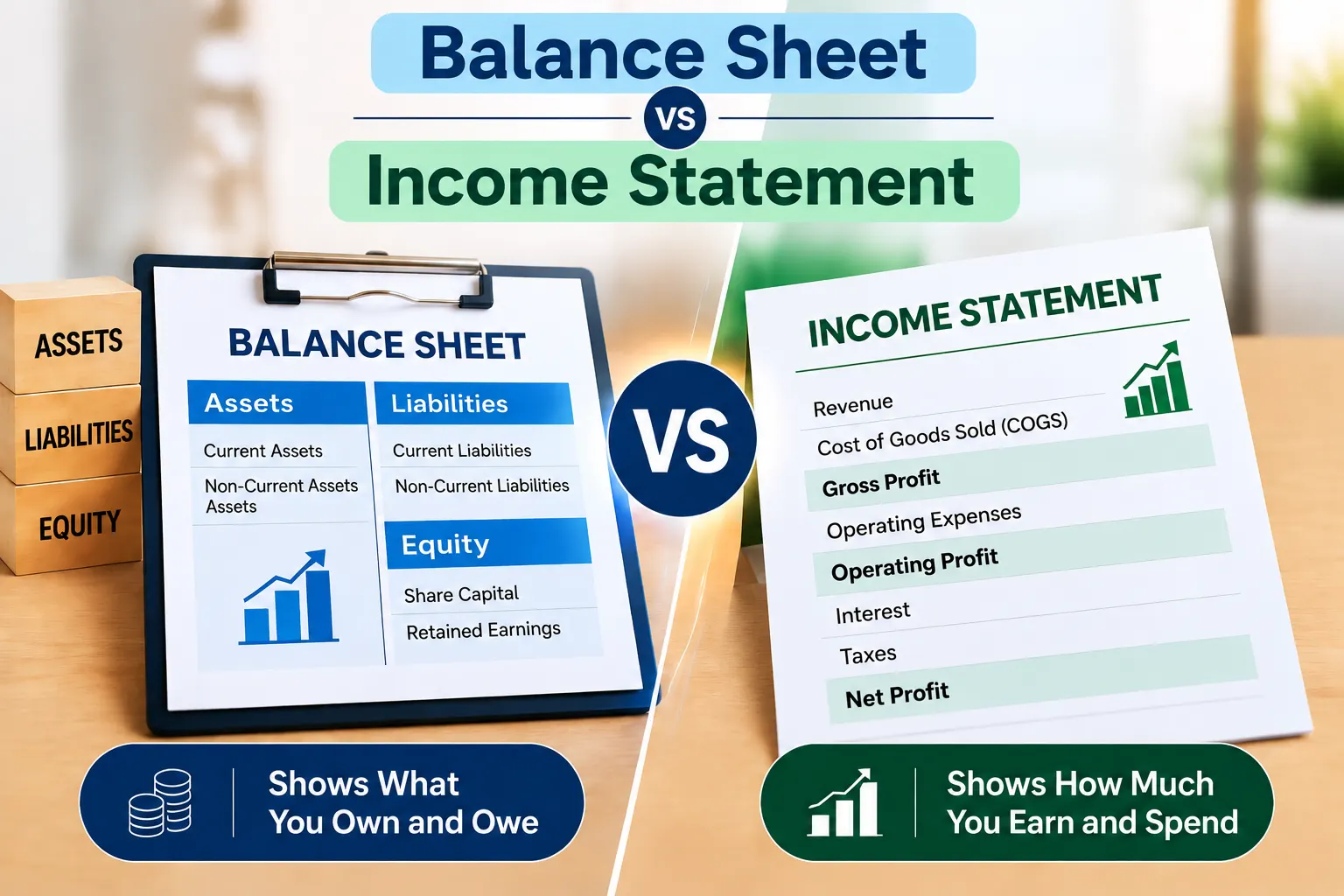
A balance sheet and an income statement answer two different questions about your business. The balance sheet shows what your business owns and owes at a single point in time. The income statement shows whether your business made or lost money over a period of time. Both are core financial statements, and confusing one for the other is one of the most common accounting mistakes business owners make.
If you have ever looked at a profit and loss statement showing a healthy net profit while your bank account tells a different story, you already know why understanding both reports matters. Lenders ask for both. Investors ask for both. Your accountant builds your tax return from both. Learning to read them isn’t optional bookkeeping trivia — it’s a basic business skill.
This guide breaks down what each statement is for, how they’re built, how they connect to each other, and how to actually use them to make better decisions — with real-world examples and the common mistakes to avoid along the way.
What is a Balance Sheet?
A balance sheet is a financial statement that shows a company’s financial position at a specific moment — usually the last day of a month, quarter, or fiscal year. It lists everything the business owns (assets), everything it owes (liabilities), and what’s left over for the owners (equity). Unlike an income statement, it’s a snapshot, not a summary of activity over time.
Purpose of a Balance Sheet
The purpose of a balance sheet is to show the financial position of a business at one point in time — not how it performed, but what it currently has and owes. It answers questions like: Can this business cover its short-term obligations? How much of the company is funded by debt versus owner investment? What is the company actually worth on paper?
Lenders rely heavily on the balance sheet during loan applications because it shows collateral, debt load, and liquidity. Investors use it to judge financial stability before committing capital. Business owners use it to track whether the company is building real equity over time or simply generating revenue that gets absorbed by liabilities.
Balance Sheet Formula: Assets = Liabilities + Equity
Every balance sheet is built on one accounting equation:
Assets = Liabilities + Owner’s Equity
This is the foundation of double-entry bookkeeping. Everything the business owns (assets) was either paid for with borrowed money (liabilities) or with the owner’s own investment and retained earnings (equity). If this equation doesn’t balance, something in the books is wrong — which is exactly why it’s called a “balance” sheet.
For example, if a business has $150,000 in total assets and $60,000 in total liabilities, owner’s equity must equal $90,000. This relationship never changes, no matter the size of the business.
Key Components — Assets, Liabilities, and Owner’s Equity
Assets: What the Business Owns
Assets are everything of value the business controls. They’re typically split into two categories:
- Current assets — cash, accounts receivable, inventory, and other items expected to convert to cash within 12 months
- Fixed assets — property, equipment, vehicles, and other long-term resources used to operate the business
Liabilities: What the Business Owes
Liabilities are the business’s financial obligations to others:
- Current liabilities — accounts payable, short-term loans, and other debts due within a year
- Long-term liabilities — mortgages, equipment loans, and other obligations due beyond 12 months
Owner’s Equity: Owner’s Claim on Business Assets
Owner’s equity (called shareholders’ equity in a corporation) is what remains after liabilities are subtracted from assets. It represents the owner’s or shareholders’ stake in the business, made up of initial investment plus retained earnings, minus any withdrawals or dividends paid out. Understanding the relationship between what a business owns versus what it owes is easier once you’re clear on the difference between assets vs. liabilities individually.
What is an Income Statement?
An income statement — also called a profit and loss statement or P&L statement — shows how much money a business earned and spent over a specific period, such as a month, quarter, or fiscal year. It ends with net profit or net loss, telling you whether the business was profitable during that period.
Purpose of an Income Statement
The purpose of an income statement is to measure financial performance over time, not financial position at a single moment. It shows whether the business generated more revenue than it spent on operating expenses, cost of goods sold, and other costs during the reporting period.
Business owners use it to track profitability trends, compare performance across periods, and identify which expenses are eating into margins. Investors and lenders use it to judge whether the business model actually works before looking at anything else.
How Revenue, Expenses, and Profit Are Calculated
An income statement follows a straightforward top-down structure:
- Start with total revenue (sales income)
- Subtract cost of goods sold (COGS) to get gross profit
- Subtract operating expenses to get operating profit
- Subtract taxes, interest, and other non-operating costs to get net income
Each line moves you closer to the true bottom line — what’s actually left after every cost has been accounted for.
Key Components — Revenue, Expenses, and Profit
Revenue and Sales Income
Revenue is the total income generated from selling goods or services before any costs are subtracted. It’s the starting point of the income statement and the figure most business owners watch first — though revenue alone doesn’t tell you whether the business is actually profitable.
Expenses and Operating Costs
Expenses include cost of goods sold (materials, direct labor, production costs) and operating expenses (rent, salaries, marketing, software, utilities). Tracking these carefully is essential — many businesses find real margin improvement not by increasing sales, but by learning how to reduce business costs without cutting into service quality or staff pay.
Gross Profit, Operating Profit, and Net Profit Explained
- Gross profit = Revenue − Cost of Goods Sold
- Operating profit = Gross Profit − Operating Expenses
- Net profit (net income) = Operating Profit − Taxes, Interest, and Other Costs
Each of these numbers tells a different story. Gross profit shows how efficiently you produce your product or service. Operating profit shows how well you run the business day to day. Net profit is what’s actually left for the owner after everything.
Balance Sheet vs Income Statement: Key Differences
The core difference between a balance sheet and an income statement is timing and purpose: a balance sheet shows financial position at one point in time, while an income statement shows financial performance over a period of time. One answers “what do we have right now”; the other answers “how did we do.”
Balance Sheet vs Income Statement Comparison Table —
| Aspect | Balance Sheet | Income Statement |
|---|---|---|
| Purpose | Shows financial position | Shows financial performance |
| Time period | A single point in time | A period (month, quarter, year) |
| Main components | Assets, liabilities, equity | Revenue, expenses, profit |
| Core formula | Assets = Liabilities + Equity | Revenue − Expenses = Net Profit |
| Also known as | Statement of financial position | Statement of operations / P&L |
| Used for | Liquidity, solvency, net worth | Profitability, cost control |
| Common users | Lenders, investors, owners | Owners, investors, management |
Difference in Purpose and Financial Information Provided
A balance sheet provides information about what a business owns, owes, and is worth on paper. An income statement provides information about how the business generated revenue and where that money went. Neither replaces the other — a business can look financially strong on its balance sheet while still posting a net loss for the quarter, and vice versa.
Difference in Time Period Covered
This is the clearest distinguishing factor. A balance sheet is dated as of a specific day — “as of December 31” — because it captures a snapshot. An income statement always covers a range — “for the year ended December 31” — because it’s measuring activity, not a static state.
Difference in Structure, Formula, and Financial Calculations
The balance sheet follows the accounting equation (Assets = Liabilities + Equity) and must always balance. The income statement follows a subtractive formula (Revenue − Expenses = Net Profit) and doesn’t need to “balance” against anything — it simply reports whether the result was positive or negative for the period.
How Balance Sheets and Income Statements Work Together
The balance sheet and income statement are not separate stories — they’re connected through net income, and together they give a complete financial picture that neither statement can provide alone.
How Net Income Connects the Income Statement and Balance Sheet
Net income calculated on the income statement flows directly into the equity section of the balance sheet as retained earnings. If a business earns $40,000 in net profit during the year and doesn’t distribute it to owners, that $40,000 increases owner’s equity on the balance sheet. This is the single most important link between the two statements — profitability directly builds (or erodes) net worth.
How Both Statements Provide a Complete Financial Picture
Looking at either statement alone leaves gaps. The income statement won’t tell you if the business is drowning in debt. The balance sheet won’t tell you if the business is actually generating profit. Used together, they answer both “is this business profitable” and “is this business financially stable” — two very different but equally important questions.
Using Financial Ratios That Combine Both Statements
Several key ratios pull numbers from both statements:
- Return on Assets (ROA) = Net Income (income statement) ÷ Total Assets (balance sheet)
- Return on Equity (ROE) = Net Income (income statement) ÷ Owner’s Equity (balance sheet)
- Asset Turnover Ratio = Revenue (income statement) ÷ Total Assets (balance sheet)
These ratios show how efficiently a business uses what it owns to generate profit — insight you simply can’t get from either statement in isolation.
When and How to Use Each Statement for Business Decisions
Choosing which statement to use depends on the decision you’re making: use the balance sheet to evaluate financial stability and use the income statement to evaluate profitability, then combine both for long-term planning.
Using a Balance Sheet to Analyze Financial Position
Pull up the balance sheet when you need to know if the business can cover upcoming obligations, how much debt it’s carrying relative to equity, or whether assets are growing faster than liabilities. It’s the right tool for loan applications, ownership valuation discussions, and liquidity checks.
Using an Income Statement to Analyze Profitability
Pull up the income statement when you want to know if a specific product line, service, or time period was profitable, where expenses are trending upward, or whether pricing needs adjusting. It’s the right tool for budgeting decisions and performance reviews.
Using Both Statements Together for Business Planning
Serious business growth strategies require both reports side by side. A business might show strong monthly profit on its income statement but a weak balance sheet loaded with short-term debt — a warning sign that growth is being funded unsustainably. Reviewing both together before major decisions, like taking on new debt or hiring, gives a far more accurate picture than either report alone.
Common Mistakes Business Owners Make When Analyzing Financial Statements
Most financial statement errors aren’t accounting mistakes — they’re interpretation mistakes. Business owners often misread what these reports are actually telling them, which leads to poor decisions even when the underlying bookkeeping is accurate.
Focusing Only on Revenue Instead of Profitability
High revenue with thin or negative margins isn’t success. Owners who track sales income without watching cost of goods sold and operating expenses often discover profitability problems too late, after cash reserves are already strained.
Confusing Profitability With Cash Flow
A profitable income statement doesn’t guarantee cash in the bank. Revenue can be recorded before payment is collected (accounts receivable), and profit doesn’t account for loan repayments or large one-time purchases. This is one of the most frequent sources of confusion for new business owners.
Ignoring the Balance Sheet When Evaluating Business Health
Many owners check their profit and loss statement monthly but rarely glance at the balance sheet. This means rising debt, shrinking cash reserves, or growing liabilities can go unnoticed until they become urgent problems.
Comparing Financial Numbers Without Context
A $50,000 net profit means something very different for a business with $2 million in revenue versus one with $200,000 in revenue. Numbers need to be compared as ratios and percentages, not just raw figures, and ideally benchmarked against prior periods.
Not Reviewing Financial Statements Over Time
A single month’s report is a snapshot, not a trend. Reviewing statements monthly or quarterly over a full fiscal year reveals patterns — seasonal dips, rising costs, improving margins — that a single report can’t show. This kind of consistent financial discipline is one of the practical business skills for young entrepreneurs worth building early.
Real-World Examples of Balance Sheet and Income Statement Analysis
Seeing these statements applied to a simple scenario makes the differences easier to understand than definitions alone.
Example: Balance Sheet Analysis for a Small Business
A small retail business has $80,000 in current assets (cash, inventory, receivables), $45,000 in fixed assets (equipment, fixtures), and $50,000 in total liabilities (a business loan and outstanding supplier invoices). Using the accounting equation:
$80,000 + $45,000 (assets) = $50,000 (liabilities) + $75,000 (equity)
This tells the owner the business has $75,000 in equity — a reasonable cushion — but should watch the $50,000 in liabilities relative to current assets to ensure short-term obligations can be met comfortably.
Example: Income Statement Analysis for a Small Business
The same business reports $220,000 in annual revenue, $90,000 in cost of goods sold, and $95,000 in operating expenses.
- Gross profit: $220,000 − $90,000 = $130,000
- Operating profit: $130,000 − $95,000 = $35,000
- After taxes and interest, net profit comes to roughly $28,000
This shows the business is profitable, but with a gross margin around 59% and a net margin closer to 13%, there may be room to tighten operating expenses.
Example: Using Both Statements for a Business Decision
If this owner is considering opening a second location, the income statement shows the current location generates a healthy net profit, which is encouraging. But the balance sheet shows $50,000 in existing liabilities and only $80,000 in current assets — taking on new debt for expansion without strengthening the balance sheet first could create a cash flow strain even though the business is technically profitable.
How Accounting Software Helps Manage Financial Statements
Modern accounting software has changed how small businesses handle financial reporting, replacing manual spreadsheets and end-of-month scrambles with continuously updated, automatically generated statements.
Automated Financial Reporting and Statement Generation
Platforms like QuickBooks and Xero generate balance sheet reports and income statement reports directly from recorded transactions, removing the need to manually calculate totals or reconcile figures by hand. This reduces the time between “transaction happens” and “report reflects it” to nearly zero.
Real-Time Financial Data Tracking
Instead of waiting until month-end to know where the business stands, real-time dashboards let owners check financial position and performance at any moment. This is particularly valuable for businesses managing tight cash flow or seasonal revenue swings.
Reducing Errors in Financial Statement Preparation
Manual bookkeeping introduces risk — miscategorized expenses, duplicate entries, or simple arithmetic errors that throw off the accounting equation. Automated systems apply consistent rules to every transaction, significantly reducing these errors and keeping the balance sheet formula accurate.
Benefits of Accounting Software for Business Owners
- Faster access to accurate financial statements for loan applications or investor meetings
- Fewer manual errors in categorizing revenue and expenses
- Easier tracking of accounts receivable and payable
- Built-in financial ratios and dashboards for quicker decision-making
- More time for owners to focus on operations instead of manual bookkeeping
Business owners who find bookkeeping consistently falls behind often benefit from working with professional bookkeeping services or a financial reporting consultant to keep both statements accurate and current — freeing up time that would otherwise go into reconciling the books.
Final Thoughts
The balance sheet and income statement aren’t competing reports — they’re two halves of the same financial picture. The balance sheet tells you what the business currently owns and owes. The income statement tells you whether the business is actually making money. Reading them together, consistently, gives business owners a far more accurate read on financial health than either report can provide alone.
Whether you’re applying for a loan, planning growth, or simply trying to understand where your money is going, make reviewing both statements a regular habit rather than something you only think about at tax time.
FAQs
What is the main difference between a balance sheet and an income statement?
A balance sheet shows a company’s financial position — assets, liabilities, and equity — at one specific point in time. An income statement shows financial performance — revenue, expenses, and profit — over a period of time, such as a month or year.
What information does a balance sheet provide?
A balance sheet provides a snapshot of what a business owns (assets), what it owes (liabilities), and the owner’s remaining stake in the business (equity), based on the formula Assets = Liabilities + Equity.
What information does an income statement provide?
An income statement provides a summary of revenue earned and expenses incurred over a specific period, ending in net profit or net loss, showing whether the business was profitable during that time.
Which financial statement shows business profitability?
The income statement shows business profitability. It tracks revenue, cost of goods sold, operating expenses, and net profit for a given period, making it the primary tool for assessing profitability.
Can a profitable business still have cash flow problems?
Yes. A business can show net profit on its income statement while still facing cash flow problems, often because revenue is recorded before payment is received or because cash is tied up in inventory, loan repayments, or large purchases not reflected in profit alone.
How are the balance sheet and income statement connected?
They’re connected through net income. Profit calculated on the income statement flows into the equity section of the balance sheet as retained earnings, directly affecting the business’s net worth over time.
Do small businesses need both a balance sheet and an income statement?
Yes. Small businesses need both statements because each answers a different question — the balance sheet shows financial stability and the income statement shows profitability. Lenders and investors typically expect to see both.
How often should businesses prepare financial statements?
Most businesses benefit from preparing financial statements monthly, with a more detailed review quarterly and annually. Frequent reporting makes it easier to catch problems early and track trends over time.
How does accounting software help manage financial statements?
Accounting software automatically generates balance sheet and income statement reports from recorded transactions, reduces manual errors, and provides real-time access to financial data, saving business owners significant time compared to manual bookkeeping.
Can investors and lenders use balance sheets and income statements?
Yes. Investors and lenders regularly request both statements to evaluate a company’s financial stability, debt levels, and profitability before extending credit or making an investment decision.
Disclaimer —
This article is for general informational and educational purposes only and should not be considered professional financial, tax, accounting, or legal advice. Every business’s financial situation is different — please consult a qualified accountant, bookkeeper, or financial advisor before making decisions based on your own financial statements.
Thank you for reading! We hope you found this guide helpful — feel free to share it with a fellow business owner who might benefit from it too.