
Honestly, nobody really thinks about whether a coach and a trainer are different. We just use the words randomly. If someone says coach or trainer, it feels like the same thing: someone helping in sports.
But they’re not actually the same. There is a major difference between a coach and a trainer in sports. It is simply that we do not really pay attention to what each one really does. Once you do, you can see they have different roles.
First, Think About This…
Just think you are a football player. Match day is coming.
You need someone to:
- Tell you what strategy to use
- Decide your position
- Guide the team
- Motivate you when you’re nervous
But you also need someone to:
- Make sure you’re fit
- Improve your stamina
- Help you run faster
- Prevent injuries
Do you see it already? These are two different kinds of support. That’s where the difference between a coach and a trainer begins.
What a Coach Really Does?
A coach is the person who looks at the whole game. Not just you. Not just fitness. The entire picture.
They think about:
- How the team will play
- What strategy will work
- How to beat the opponent
- Which player fits which role
A coach also works on your skills. If you’re a basketball player, they’ll correct your shooting form. If you’re a cricketer, they’ll improve your shot selection. But more than that, a coach builds confidence. When the team is losing, the coach keeps everyone calm. When pressure is high, the coach guides the players. In simple words, A coach focuses on performance and winning.
What a Trainer Really Does?
Now let’s talk about the trainer. A trainer doesn’t usually decide the match strategy. They don’t choose formations. They don’t shout tactical instructions from the sidelines. Instead, they work behind the scenes on your body.
They help you:
- Build strength
- Improve stamina
- Increase speed
- Recover from injury
If you’re able to play a full 90 minutes and still have energy left, that’s probably because your trainer pushed you in practice.
And if you feel stronger this season than you did last year, that didn’t just happen on its own; that’s your trainer’s effort showing up. At the end of the day, a trainer’s job is pretty simple: they make sure your body is ready for the game.
What Is the Actual Difference Between a Coach and a Trainer in Sports?
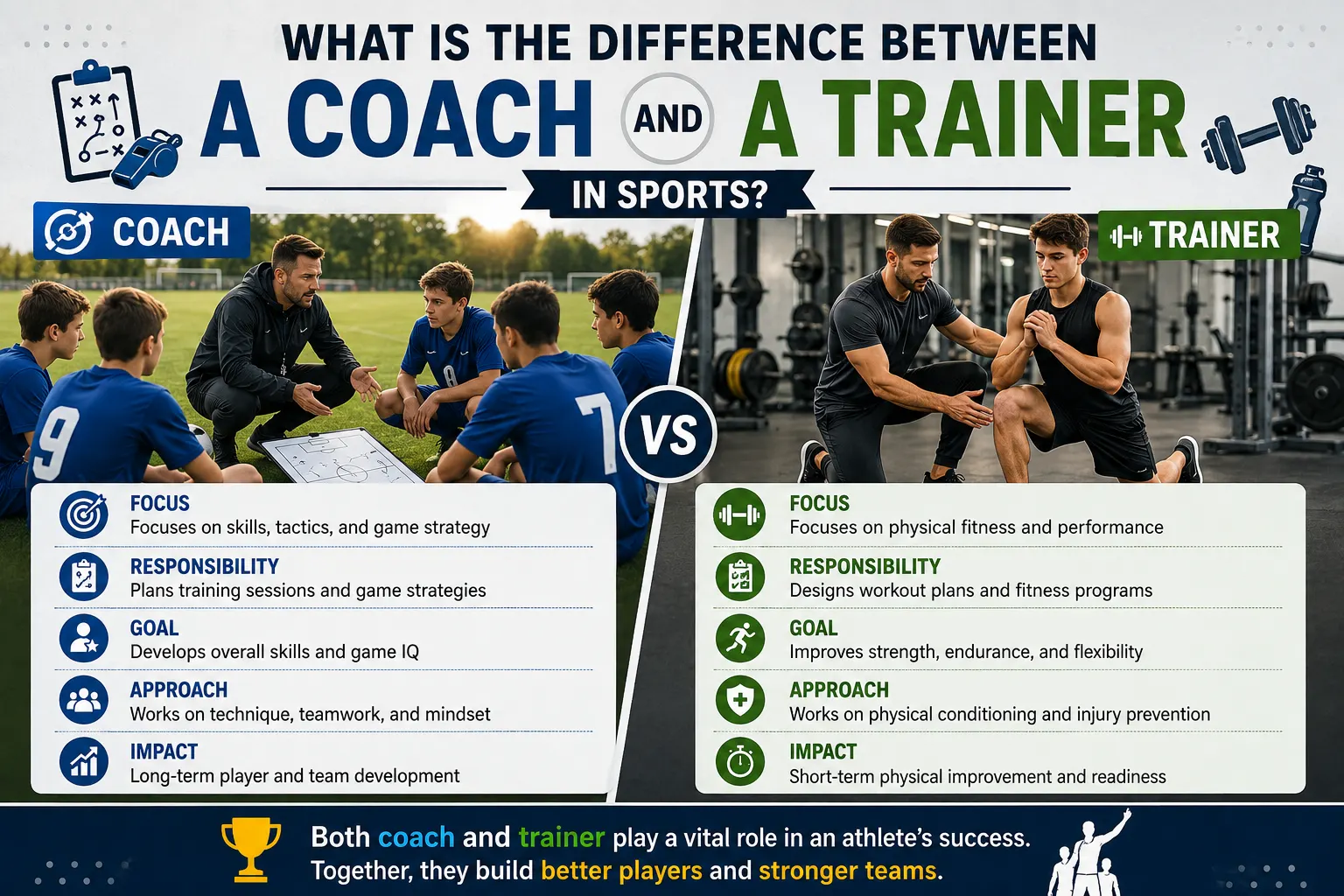
Here it is in the most human way possible: A coach trains your mind and game. A trainer trains your body. That’s the core difference between a coach and a trainer in sports.
Let’s make it even clearer.
Real Examples: Coach vs Trainer in Action –
Virat Kohli had some issues with his batting technique outside the off-stump. His coach, Rahul Dravid, helped him improve his game awareness and choose shots. This really helped Virat Kohli. He worked on his technique with Rahul Dravid’s guidance.
Virat Kohli wanted to become one of the best cricketers in the world, so his trainer made a fitness routine for him that was very hard, with early morning workouts, diet plans, and strength training sessions. He had to work hard to get fit.
Same sport. Two different people. Two completely different jobs.
Or you can think about football. Cristiano Ronaldo always kept his body in great shape with the help of trainers. But the way he understands the game and leads on the field came from coaches like Sir Alex Ferguson and Carlo Ancelotti.
Coaching vs Training – Not the Same Thing
You might have mixed coaching and training. But training is really just about practicing things again and again until they start to feel natural. It’s physical. It’s structured. It’s exercise-based. Coaching is about guidance. It’s strategic. It’s mental. It’s leadership.
Both matter. But they’re not the same.
Comparison Table: Coach vs Trainer
A coach and a trainer both help you in sports. But they do not do the same job. One works on your game. The other works on your body.
This table shows the simple difference between the two, so you never get confused again.
| Aspect | Coach | Trainer |
|---|---|---|
| Main Focus | Improves your game and skills | Improves your fitness and body |
| What They Do | Teaches strategy, techniques, and decision-making | Builds strength, stamina, and endurance |
| Works On | Mindset, game awareness, confidence | Physical fitness, recovery, injury prevention |
| Goal | Make you a better player | Make you physically stronger and fit |
| Qualifications | Sports-specific coaching certification, like BCCI, AIFF | CPT, sports science degree, strength & conditioning certification |
Can One Person Be Both?
Sometimes yes, especially at beginner levels. In small academies, one person may act as both coach and trainer. But in professional sports, these roles are usually separate. Because at a high level, strategy and physical conditioning both need full attention.
That’s why big teams have:
- Head coaches
- Assistant coaches
- Strength and conditioning trainers
- Recovery specialists
Everyone has a role.
Why This Difference Matters?
If you’re serious about sports, this difference matters more than you think.
- If you feel: “I’m fit, but I don’t perform well in matches,” → You probably need better coaching.
- If you feel: “I understand the game, but I get tired quickly,” → You probably need better training.
Understanding the difference between a coach and a trainer helps you know what you’re missing.
What the Numbers Say?
Research supports this. Athletes who have a coach usually do better than those who train alone. They reach their goals faster and make fewer mistakes.
Also, mental coaching really helps. In pressure situations, it can improve performance by 20–30%. In simple terms, it’s not just about practice; it’s about the right guidance.
As Phil Jackson once said, “The strength of the team is each member. The strength of each member is the team.” That’s what coaching is really about, not just physical ability, but how everything comes together.
Which One Does Your Sport Need?
This is the question most players never ask, and they should. If your sport is strategy-heavy, cricket, football, basketball, chess, or boxing, you need a strong coach first. Without game intelligence, raw fitness won’t win you matches.
If your sport is physically demanding, athletics, swimming, boxing, or wrestling, a trainer matters enormously. Half a second faster or 10% more stamina can be the difference between a medal and nothing.
If your sport needs both equally, football, tennis, and badminton, don’t compromise on either. The best players at the top level always have a coach AND a dedicated trainer working separately.
A simple rule: if you’re losing matches despite being fit, you need a better coach. If you understand the game well but fatigue out early, you need a better trainer.
Know the difference. Hire the right one. Win smarter.
Final Thoughts
It’s not like a coach and a trainer are competing with each other. Neither one is more important. They just do different things for the same goal. They do different jobs. Now, if someone asks you about coach vs trainer, you won’t just repeat a definition. You’ll actually understand the difference between a coach and a trainer in sports. And once you understand it, it’s impossible to confuse the two again.