
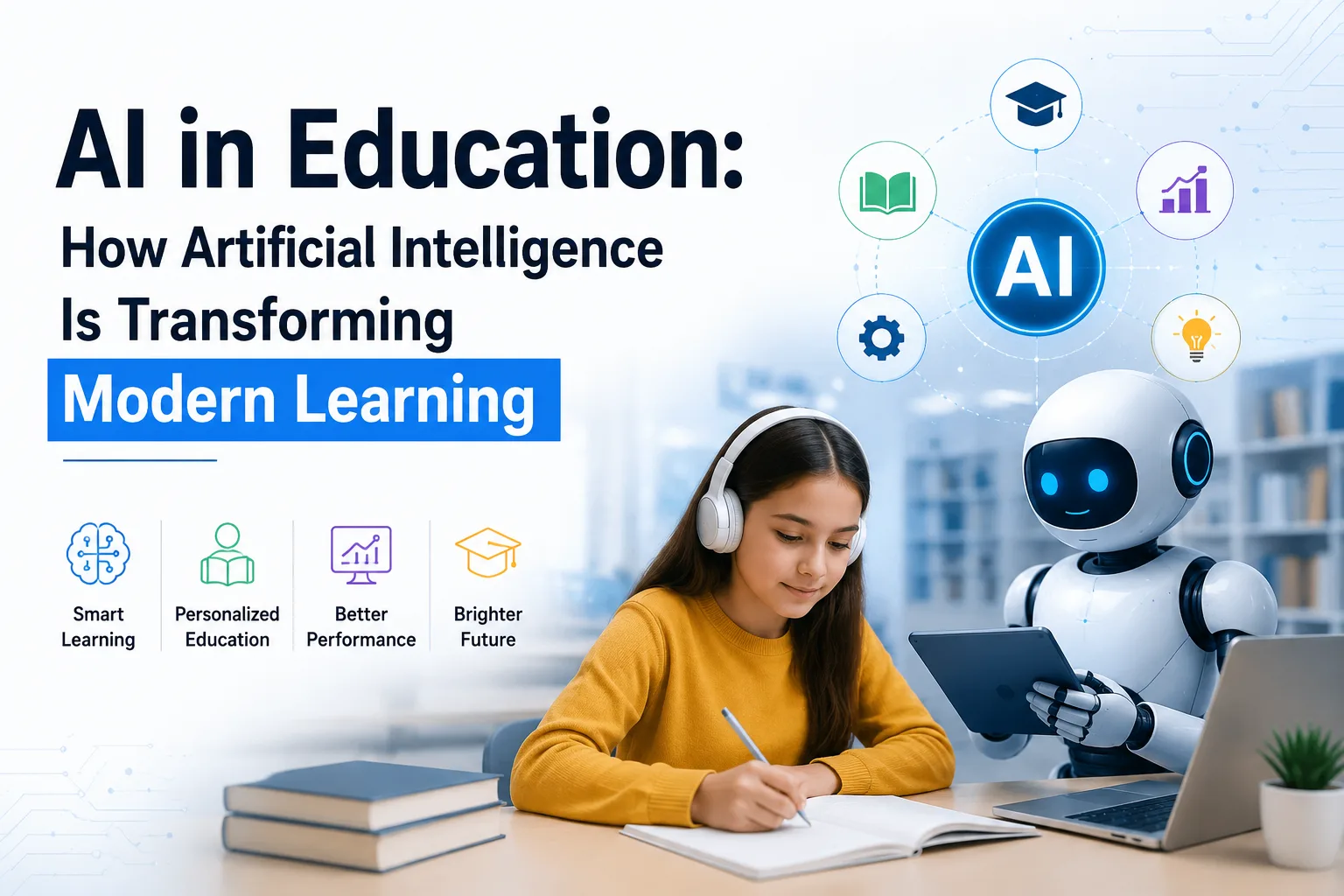
Education has changed significantly over the last decade, and AI in Education is becoming one of the biggest reasons behind this transformation. Schools, colleges, universities, and online learning platforms are using artificial intelligence to make learning more interactive, personalized, and accessible for students of all ages.
Unlike traditional teaching methods, AI can understand individual learning patterns, identify strengths and weaknesses, and provide support based on each student’s needs. Whether it’s answering questions instantly, recommending study materials, helping teachers manage administrative tasks, or improving student performance through data-driven insights, Artificial Intelligence in Education is creating new opportunities for both learners and educators.
The growing use of AI Education Technology is also making education more flexible. Students can learn from anywhere through Digital Classrooms, Virtual Learning, and Online Learning Platforms, while teachers can spend less time on repetitive tasks and focus more on delivering quality education.
However, adopting AI is not just about using new software or tools. Educational institutions also need to balance innovation with responsible practices, including the Importance of Data Privacy, ethical AI usage, and equal access to technology.
In this guide, you’ll learn what AI in Learning really means, how it is changing classrooms and online education, the most popular AI tools used by students and teachers, its key benefits, current challenges, and what the Future of AI in Education may look like.
What is AI in Education?
AI in Education refers to the use of artificial intelligence technologies to improve teaching, learning, and educational management. Instead of delivering the same learning experience to every student, AI systems analyze learning behavior, progress, and performance to provide personalized support.
Modern Educational AI combines technologies such as Machine Learning in Education, natural language processing, and data analysis to help students learn more effectively while assisting teachers with everyday tasks.
Rather than replacing teachers, AI acts as a smart assistant. It helps educators automate routine work, identify students who need additional support, and create engaging learning experiences.
Today, AI in Modern Education is used across many educational environments, including:
- Primary and secondary schools
- Colleges and universities
- Professional certification programs
- Corporate training
- Online learning platforms
- Remote education programs
Some common examples of AI Applications in Education include:
| AI Application | Purpose |
|---|---|
| Intelligent Tutoring Systems | Provide personalized guidance to students |
| Automated Grading | Reduce teachers’ grading workload |
| AI Learning Tools | Help students research, write, and study |
| Learning Management System integration | Track student progress and course completion |
| Chatbots | Answer common student questions instantly |
| Adaptive Learning | Adjust lesson difficulty based on student performance |
As Education Technology continues to evolve, educational institutions are increasingly investing in AI Education Software to improve learning outcomes while making education more accessible and efficient.
How is AI Changing Modern Education?
Artificial intelligence is changing the way education is delivered. Instead of relying only on textbooks and one-size-fits-all teaching methods, educators now have access to intelligent systems that support personalized learning, real-time feedback, and better classroom management.
The Role of AI in Modern Education goes beyond automation. It helps create learning experiences that are more engaging, flexible, and suitable for different learning styles.
Let’s look at some of the biggest ways AI is transforming education.
► AI in Classroom Learning
Traditional classrooms often require teachers to manage students with different learning speeds, abilities, and interests. This can make it difficult to provide individual attention to everyone. With AI in Schools, teachers can better understand each student’s learning progress through real-time data and personalized recommendations.
For example, AI-powered classroom tools can:
- Identify students struggling with specific topics
- Recommend additional learning materials
- Suggest practice exercises based on performance
- Provide instant quizzes and assessments
- Track participation and engagement
Many schools are also introducing Smart Learning Solutions that combine digital boards, AI-powered assessments, and interactive learning activities. These tools encourage students to participate more actively during lessons instead of simply memorizing information.
The use of AI in classroom education also allows teachers to spend more time mentoring students instead of handling repetitive administrative work.
► AI in Online Education
The popularity of AI in Online Education has grown rapidly as more students choose flexible learning options. Online courses often include thousands of learners, making it difficult for instructors to provide individual support. AI helps solve this challenge by delivering personalized learning experiences at scale.
Many AI Learning Platforms now use artificial intelligence to:
- Recommend lessons based on learning progress
- Create personalized study plans
- Answer questions using AI chat assistants
- Provide instant feedback on assignments
- Suggest additional resources for difficult topics
These features make AI-Powered Learning more effective because students receive guidance whenever they need it instead of waiting for instructor responses. AI is also improving E-learning by making Virtual Classrooms more interactive through smart quizzes, discussion assistants, speech recognition, and automated attendance systems.
Students who study remotely can maintain consistent progress while enjoying a learning experience that feels more personalized than traditional online courses.
► AI for Student Performance and Assessment
Assessing student performance is no longer limited to exams and report cards. Modern AI-driven assessment systems analyze multiple factors, including assignment quality, quiz performance, participation, and learning behavior.
Instead of showing only final scores, AI can identify patterns such as:
- Topics where students need additional practice
- Concepts they have mastered
- Learning habits affecting performance
- Areas where extra guidance may improve results
This allows teachers to provide support before students fall behind. Students also benefit from immediate feedback after completing assignments or quizzes. Rather than waiting several days for results, they can understand their mistakes instantly and continue improving.
Many institutions are also using Automated Grading for objective assessments. This saves valuable time for educators while maintaining consistency in evaluation. When combined with Personalized Learning, AI helps students focus on the areas that matter most, making studying more efficient and meaningful.
For learners preparing for competitive exams or balancing multiple responsibilities, combining AI-powered study support with effective time management tips for students can further improve productivity and learning outcomes.
Popular AI Tools Used in Education
Artificial intelligence has become a valuable part of modern education because it helps students learn faster and allows teachers to work more efficiently. From writing assistance and research support to language learning and personalized tutoring, there are now many AI Tools for Education designed to improve the learning experience.
It’s important to remember that these tools should support learning rather than replace critical thinking. Students should use them to understand concepts, generate ideas, and improve their work while still developing their own knowledge and skills.
Below are some of the most widely used AI-powered learning tools in education today.
1. AI Writing and Research Tools
Writing assignments, research projects, and presentations often take a significant amount of time. AI writing and research tools help students organize their ideas, improve writing quality, and find information more efficiently. They also assist teachers in creating lesson plans, quizzes, and educational content.
Let’s look at some of the most popular tools.
♦ ChatGPT
ChatGPT for Education has become one of the most widely used AI tools by students, teachers, and educational institutions. It can explain complex topics in simple language, answer academic questions, summarize long articles, generate study notes, and assist with brainstorming ideas for assignments. Instead of simply providing answers, it can also guide students through problem-solving step by step, making it useful for deeper learning.
Teachers also use ChatGPT to:
- Create lesson plans
- Generate classroom activities
- Prepare quizzes
- Simplify difficult concepts
- Draft emails and educational materials
While ChatGPT is highly useful, students should always verify important information and avoid submitting AI-generated work without reviewing or editing it.
♦ Google Gemini
Google Gemini is another powerful AI assistant that supports learning, research, and productivity. Because it works well with Google’s ecosystem, students can easily use it alongside Google Docs, Google Drive, and other productivity tools. Gemini can summarize information, explain concepts, generate ideas, and help organize research.
Some common educational uses include:
- Research assistance
- Content summarization
- Brainstorming project ideas
- Creating presentation outlines
- Understanding difficult subjects
Its ability to process different types of information, including text and images, makes it useful for a wide variety of learning tasks.
♦ Claude AI
Claude AI is known for producing thoughtful and well-structured responses, making it especially useful for reading, writing, and analysis.
Students often use Claude to:
- Summarize lengthy research papers
- Improve essays
- Review written assignments
- Understand complex academic material
- Organize large amounts of information
Teachers may also use it to prepare instructional content or simplify technical topics for different learning levels. Because Claude handles long documents well, it can be helpful for university students working on research projects or literature reviews.
♦ Grammarly
Grammarly is more than a grammar checker. It helps students improve the overall quality of their writing by identifying grammar mistakes, spelling errors, punctuation issues, and awkward sentence structures.
It also provides suggestions for:
- Better word choice
- Improved clarity
- Sentence rewriting
- Tone adjustments
- Readability improvements
Teachers benefit as well by using Grammarly to prepare professional documents, educational materials, and classroom communications. Students should treat Grammarly as a writing assistant that helps strengthen their communication skills rather than relying on it to write assignments from scratch.
♦ Perplexity AI
Perplexity AI combines conversational AI with search capabilities, making it useful for research-based learning. Instead of displaying a long list of search results, it provides direct answers along with references that users can review for additional context.
Students commonly use Perplexity AI to:
- Start research projects
- Explore unfamiliar topics
- Find reliable explanations
- Compare different viewpoints
- Gather background information before deeper study
For teachers, it can be a helpful starting point when preparing lessons or collecting educational resources. Although it saves time during research, students should still evaluate the credibility of sources and consult textbooks or academic materials when necessary.
2. AI Tutoring and Learning Platforms
Beyond writing and research, AI is also transforming how students practice and master new skills. Modern tutoring platforms use Adaptive Learning Technology to adjust lessons according to each learner’s progress. Instead of following the same path for everyone, these platforms personalize the learning experience based on strengths, weaknesses, and performance.
This approach supports Personalized Learning with AI, helping students spend more time on areas where they need improvement while moving quickly through concepts they already understand.
♦ Khanmigo (by Khan Academy)
Khanmigo is an AI-powered learning assistant developed by Khan Academy to provide guided support instead of simply giving answers. It encourages students to think critically by asking questions, offering hints, and explaining concepts step by step.
Students can use Khanmigo to:
- Practice mathematics
- Improve writing skills
- Learn science concepts
- Prepare for exams
- Receive personalized guidance while studying
Teachers also benefit from support in lesson planning, classroom activities, and creating educational resources. Because Khanmigo focuses on guided learning, it helps students develop problem-solving skills rather than encouraging answer copying.
♦ Duolingo Max (AI-powered)
Duolingo Max builds on the popular language-learning platform by adding AI-powered features that make learning more interactive. Instead of memorizing vocabulary alone, learners can practice realistic conversations, receive explanations for mistakes, and improve language skills through personalized exercises.
Some of its key educational features include:
- Interactive conversations
- Instant feedback
- Personalized practice sessions
- Speaking and writing improvement
- Context-based language learning
The platform adapts lessons based on individual performance, making language learning more engaging and effective. This is a strong example of how AI Education Examples are helping learners build practical skills through interactive experiences rather than traditional memorization.
Choosing the Right AI Tool –
Not every AI tool serves the same purpose. Students and teachers should select tools based on their learning goals rather than using multiple platforms for every task.
| Learning Need | Recommended AI Tool |
|---|---|
| Writing and brainstorming | ChatGPT, Claude AI |
| Grammar and proofreading | Grammarly |
| Research and quick explanations | Perplexity AI, Google Gemini |
| Personalized tutoring | Khanmigo |
| Language learning | Duolingo Max |
For students looking to improve productivity, these platforms are among the best AI tools for students because they support research, writing, language learning, and personalized study. However, they work best when combined with independent thinking, regular practice, and responsible use.
Key Benefits of AI in Education
The growing use of AI in Education is changing how students learn and how teachers manage their classrooms. Instead of replacing traditional teaching methods, AI supports them by making learning more personalized, interactive, and efficient.
From schools and universities to online learning platforms, educational institutions are using AI to improve learning outcomes while reducing repetitive work. When implemented responsibly, AI creates an environment where students receive the support they need, and teachers can focus more on teaching rather than administrative tasks.
Let’s explore the key benefits in detail.
➤ Improved Learning Experience
Every student learns differently. Some understand concepts quickly, while others need additional practice and explanations. Traditional classrooms often struggle to meet these individual learning needs. With AI-Powered Learning, lessons can be adapted based on each student’s progress and understanding. Instead of following a fixed learning path, AI recommends resources and activities that match the learner’s current skill level.
For example, AI can:
- Suggest additional practice for difficult topics.
- Recommend advanced content for faster learners.
- Explain concepts in different ways until students understand them.
- Provide instant feedback after quizzes and exercises.
This creates a more engaging and effective learning experience because students receive support when they need it instead of waiting for the next classroom session.
➤ Better Student Engagement
Keeping students engaged is one of the biggest challenges in education. Long lectures and repetitive assignments can reduce motivation, especially when students struggle to connect with the material. AI helps improve Student Engagement by making learning more interactive and personalized.
Many AI Education Apps and learning platforms include features such as:
- Interactive quizzes
- Gamified learning activities
- Real-time feedback
- Personalized challenges
- AI-powered learning assistants
These features encourage students to participate actively rather than simply memorizing information. In Digital Learning environments, AI can also recommend videos, practice questions, and additional reading based on individual progress. This keeps learners involved and encourages continuous improvement.
➤ Time-Saving for Teachers and Students
One of the most practical AI Education Benefits is the amount of time it saves. Teachers often spend many hours grading assignments, preparing lesson plans, organizing classroom materials, and answering repetitive questions. AI can automate many of these routine tasks, allowing teachers to spend more time helping students.
AI can assist teachers by:
- Automating grading for objective assessments
- Creating quizzes and worksheets
- Organizing lesson materials
- Tracking attendance
- Answering frequently asked student questions
Students also save time by using AI to:
- Summarize study materials
- Organize notes
- Understand difficult concepts
- Plan study schedules
- Review assignments before submission
When students combine AI with effective Time Management Tips for Students, they can study more efficiently without relying on last-minute preparation.
➤ Data-Driven Learning Insights
Modern education generates valuable information about student learning. AI helps educators analyze this information to make better academic decisions.
Instead of looking only at exam scores, AI studies patterns such as:
- Learning speed
- Assignment completion
- Quiz performance
- Classroom participation
- Progress over time
These Data-Driven Learning insights help teachers identify students who may need additional support before their performance declines. Educational institutions can also use this information to improve courses, update teaching strategies, and measure learning outcomes more effectively.
By making decisions based on learning data rather than assumptions, schools can provide more targeted academic support.
➤ Increased Accessibility to Education
AI is helping make education available to more learners regardless of their location or learning needs. Students living in remote areas can now access high-quality educational resources through Online Learning Platforms, while learners with disabilities benefit from AI-powered accessibility features.
Some examples include:
- Speech-to-text tools
- Text-to-speech readers
- Real-time translation
- Closed captions
- Personalized reading assistance
These technologies help create a more inclusive learning environment where more students can participate confidently. AI also supports flexible learning schedules, making it easier for working professionals and lifelong learners to continue their education without attending physical classrooms.
This wider access highlights how Technology in Education can reduce learning barriers and create opportunities for more people.
➤ 24/7 Learning Support
Unlike traditional classrooms, AI-powered systems are available whenever students need help. Whether someone is studying early in the morning or late at night, AI assistants can answer questions, explain concepts, recommend study materials, and provide practice exercises.
This continuous availability is especially valuable for students preparing for exams or completing assignments outside regular school hours.
Some common forms of 24/7 AI support include:
- AI chat assistants
- Intelligent tutoring systems
- Homework support
- Practice quizzes
- Personalized revision recommendations
While AI offers instant guidance, it should complement—not replace—teachers and classroom discussions. Human educators continue to play an essential role in developing critical thinking, creativity, communication, and collaboration skills.
How AI Creates Personalized Learning Experiences
One of the biggest reasons AI in Learning has gained attention is its ability to create personalized learning experiences. Traditional education often follows the same curriculum and pace for every student. However, not everyone learns in the same way. Some students grasp concepts quickly, while others benefit from additional explanations, practice, or different teaching methods.
AI addresses this challenge by adapting the learning experience to each individual. Using learning data and performance analysis, AI creates customized study paths that help students progress at their own pace. This approach to Personalized Learning helps improve confidence, engagement, and overall academic performance.
✦ Adaptive Learning Paths
Adaptive Learning allows educational platforms to adjust lessons automatically based on how students perform. If a student struggles with a topic, the system may recommend additional exercises, videos, or explanations before moving forward. If the student demonstrates strong understanding, the platform can introduce more advanced content without unnecessary repetition.
An adaptive learning system may:
- Increase or decrease lesson difficulty
- Recommend revision when needed
- Skip concepts already mastered
- Suggest additional practice materials
- Adjust learning pace automatically
This creates a more efficient learning journey because students spend time where it matters most.
✦ Personalized Feedback
Feedback plays a vital role in learning, but providing detailed feedback to every student can be difficult in large classrooms. AI helps by offering immediate, personalized responses after assignments, quizzes, and practice exercises.
Instead of simply marking answers as correct or incorrect, AI can explain:
- Why an answer is incorrect
- Which concepts need improvement
- How to solve similar problems
- What topics should be reviewed next
Receiving feedback immediately helps students correct mistakes while the lesson is still fresh in their minds, making learning more effective.
✦ AI-Based Performance Tracking
Monitoring student progress over time allows teachers to identify learning patterns that may not be visible through occasional exams alone.
AI continuously tracks learning activities, including:
- Quiz scores
- Assignment completion
- Participation levels
- Learning consistency
- Topic-wise strengths and weaknesses
This ongoing analysis gives teachers a clearer understanding of each student’s progress. Students also benefit because they can monitor their own learning journey, identify areas for improvement, and set realistic academic goals.
✦ Customized Content Recommendations
Recommendation systems are commonly used in streaming platforms, and education is beginning to benefit from similar technology.
Based on a student’s learning history and interests, AI can recommend:
- Practice exercises
- Educational videos
- Reading materials
- Revision quizzes
- Advanced learning resources
These recommendations reduce the time students spend searching for study materials and help them focus on resources that match their current learning needs. As AI Education Technology continues to evolve, personalized recommendations are expected to become even more accurate, creating learning experiences that are tailored to every student’s goals and progress.
The Role of AI for Teachers and Educational Institutions
While much of the discussion around AI in Education focuses on students, teachers and educational institutions also benefit significantly from its adoption. AI is not designed to replace educators. Instead, it acts as a support system that helps them manage routine work, make informed decisions, and create more engaging learning experiences.
Schools, colleges, and universities are increasingly integrating AI Education Software into their existing Learning Management System to improve teaching, communication, and student support. This allows educators to spend less time on administrative tasks and more time mentoring, teaching, and interacting with students.
Below are some of the key ways AI supports teachers and institutions.
✸ Reducing Administrative Workload
Teachers often spend a large portion of their time on administrative responsibilities outside the classroom. Preparing reports, grading assignments, tracking attendance, and responding to repetitive questions can reduce the time available for lesson planning and student interaction. AI helps simplify many of these tasks by automating routine processes.
Some common examples include:
- Automating attendance records
- Assisting with Automated Grading for objective assessments
- Organizing student performance reports
- Scheduling reminders for assignments and exams
- Answering frequently asked questions through AI chatbots
By reducing repetitive work, teachers can dedicate more attention to helping students understand difficult concepts, encouraging classroom discussions, and providing one-on-one guidance. Educational institutions also benefit from faster reporting, improved record management, and better organization of academic data.
✸ Assisting in Curriculum Design
Designing an effective curriculum requires careful planning and regular updates. Teachers must ensure that learning materials remain relevant, balanced, and aligned with educational goals. AI can support this process by analyzing student performance and identifying areas where learners commonly face difficulties.
For example, AI can help educators:
- Identify topics that require additional classroom time
- Recommend updated learning resources
- Suggest improvements to lesson sequencing
- Highlight knowledge gaps across different student groups
- Generate practice questions and classroom activities
These insights allow teachers to make informed decisions while keeping the curriculum focused on student learning needs. However, final curriculum decisions should always remain with experienced educators who understand the academic objectives and classroom context.
✸ Enhancing Student Engagement
Maintaining student interest throughout a lesson can be challenging, especially in larger classrooms or online learning environments. AI supports Interactive Learning by providing tools that encourage students to participate actively rather than passively consuming information.
Examples include:
- Interactive quizzes with instant feedback
- AI-powered classroom discussions
- Personalized assignments
- Gamified learning activities
- Real-time progress tracking
Teachers can also identify students who may be losing interest or struggling academically before small challenges become larger problems. When combined with strong teaching practices, AI helps create classrooms where students feel more involved in the learning process.
Even with advanced technology, teachers remain the most important part of education. AI provides information and recommendations, but educators continue to guide discussions, encourage creativity, and help students develop communication and critical-thinking skills that technology alone cannot teach.
Challenges of Using AI in Education
Although AI in Modern Education offers many advantages, it also presents challenges that schools and educational institutions must address carefully. Successful implementation requires more than simply adopting new technology.
Institutions must consider privacy, costs, ethical concerns, and the role of human educators to ensure AI supports learning in a responsible way. Understanding these challenges helps educators make informed decisions about when and how AI should be used.
► Data Privacy and Security
AI systems often rely on large amounts of student information to provide personalized learning experiences. This may include academic performance, attendance records, learning behavior, and assessment data. Protecting this information is essential.
Educational institutions should establish clear policies regarding:
- Student data collection
- Secure data storage
- User access permissions
- Responsible data sharing
- Compliance with privacy regulations
Understanding the Importance of Data Privacy becomes even more critical as AI systems become more widely integrated into schools and universities.
Institutions should also strengthen their security practices because educational platforms can become targets for cyber threats. Following best practices related to AI in cybersecurity can help schools protect sensitive student information and maintain trust among students, parents, and educators.
► High Implementation Costs
Introducing AI into an educational institution often requires significant investment.
Costs may include:
- AI software licensing
- Infrastructure upgrades
- Device purchases
- Staff training
- Technical support
- System maintenance
Large universities may have the resources to adopt AI more quickly, while smaller schools may need to introduce these technologies gradually. Before investing, institutions should evaluate whether a particular AI solution aligns with their educational goals and budget rather than adopting technology simply because it is popular.
A phased implementation approach often allows schools to test AI solutions, gather feedback, and expand usage based on measurable results.
► Over-Dependence on Technology
AI makes many learning tasks easier, but excessive dependence can create new challenges.
If students rely on AI for every assignment, they may miss opportunities to develop essential skills such as:
- Critical thinking
- Independent research
- Creative writing
- Problem-solving
- Analytical reasoning
Similarly, teachers should avoid depending entirely on automated recommendations when evaluating student progress or planning lessons. AI should support learning—not replace human judgment. Students benefit the most when AI is used as a study companion rather than a shortcut for completing academic work.
► Bias in AI Algorithms
AI systems learn from the data used to train them. If that data contains inaccuracies, gaps, or bias, the results generated by AI may also be biased.
In education, this can affect:
- Learning recommendations
- Automated assessments
- Student evaluations
- Content suggestions
- Academic decision-making
Educational institutions should regularly review AI-generated outcomes to ensure fairness and accuracy. Teachers also play an important role in identifying situations where AI recommendations may not reflect a student’s actual abilities or learning needs.
Human oversight remains essential for creating an equitable learning environment where technology supports every student fairly. As AI continues to evolve, developers, educators, and policymakers will need to work together to build systems that are transparent, inclusive, and accountable.
The growing adoption of AI demonstrates its potential to improve education, but successful implementation depends on balancing innovation with responsibility. Schools that combine technology with strong teaching practices, ethical guidelines, and continuous evaluation are more likely to achieve meaningful long-term results.
The Future of AI in Education
Artificial intelligence is already changing how students learn and how teachers deliver lessons, but its role in education is expected to grow even further in the coming years. As AI Education Technology continues to improve, educational institutions will have more opportunities to create learning experiences that are flexible, personalized, and accessible.
The future is unlikely to be about replacing classrooms or teachers. Instead, AI will continue to support educators by handling repetitive tasks while helping students receive learning experiences that better match their individual needs and goals.
As schools, colleges, and universities continue adopting AI responsibly, the focus will remain on improving learning outcomes while maintaining human guidance throughout the educational journey.
1. Emerging AI Trends in Education
Several new developments are shaping the Future of AI in Education. While some are already being used today, others are expected to become more common as educational technology continues to evolve.
♦ Greater Personalization
Future AI systems will become even better at understanding how each student learns.
Instead of providing the same lessons to everyone, AI will create highly personalized learning journeys based on factors such as:
- Learning pace
- Strengths and weaknesses
- Preferred learning style
- Previous performance
- Individual academic goals
This level of Personalized Learning with AI can help students stay motivated while improving long-term learning outcomes.
♦ Smarter Digital Classrooms
The next generation of Digital Classrooms is expected to be more interactive and connected.
Teachers may use AI to:
- Monitor classroom participation
- Generate instant quizzes
- Identify learning gaps during lessons
- Recommend classroom activities based on student performance
Rather than replacing classroom interaction, these tools will provide teachers with additional insights that support better decision-making.
♦ Growth of Intelligent Tutoring Systems
Intelligent Tutoring Systems will continue to improve as AI becomes more capable of understanding student behavior.
Future tutoring platforms may:
- Offer step-by-step explanations
- Detect confusion earlier
- Recommend personalized revision plans
- Provide real-time coaching during practice sessions
These improvements can help students receive additional academic support outside normal classroom hours while allowing teachers to focus on higher-value instruction.
♦ More Advanced Generative AI
Generative AI in Education is likely to become more sophisticated in the years ahead.
Students may use AI to:
- Practice writing skills
- Explore different approaches to solving problems
- Generate study guides
- Prepare for presentations
- Review difficult concepts
Teachers may use generative AI to prepare lesson materials, classroom activities, and learning resources more efficiently. However, responsible use will remain essential. Educational institutions will continue developing policies that encourage students to use AI for learning rather than replacing their own thinking and creativity.
♦ Better Integration Across Learning Platforms
Many schools already use a Learning Management System to organize courses, assignments, and student records.
In the future, AI is expected to become more deeply integrated into these systems by providing:
- Personalized course recommendations
- Automated learning progress reports
- Early alerts for students needing additional support
- Smarter content organization
- Improved communication between teachers and students
This integration can make education more efficient while giving educators better visibility into student progress.
2. What the Future Holds for Students and Teachers
The future of education will likely combine human expertise with AI-powered support rather than choosing one over the other. For students, AI will provide greater flexibility and more opportunities to learn at their own pace. Personalized recommendations, intelligent tutoring, and instant feedback can help learners understand concepts more effectively while building confidence.
Teachers will continue to play the central role in education. AI may automate routine administrative work and provide valuable learning insights, but it cannot replace the experience, empathy, encouragement, and mentorship that educators bring to the classroom. Educational institutions will also need to invest in teacher training so educators can confidently use AI tools in responsible and meaningful ways.
At the same time, schools must continue promoting digital literacy. Students should learn not only how to use AI tools but also how to evaluate AI-generated information, think critically, verify facts, and use technology ethically.
The Importance of Education for Career Growth will become even greater as workplaces increasingly expect employees to work alongside AI-powered technologies. Developing strong subject knowledge, communication skills, creativity, and problem-solving abilities will remain just as important as learning to use AI effectively.
Ultimately, the future of education is not about replacing teachers with machines. It is about creating smarter learning environments where technology supports both educators and students in achieving better outcomes.
Conclusion
AI in Education is transforming the way people learn by making education more personalized, interactive, and accessible. From AI in Schools and AI in Higher Education to AI in Online Education, artificial intelligence is helping students receive tailored learning experiences while allowing teachers to focus more on teaching and less on repetitive administrative tasks.
Throughout this guide, we’ve explored how AI supports classroom learning, improves student assessment, powers intelligent learning platforms, and helps create personalized learning paths. We also looked at popular AI tools, the benefits they offer, the challenges educational institutions should consider, and the emerging trends shaping the future of education.
Despite its many advantages, AI should be viewed as a tool that enhances education—not one that replaces educators or independent thinking. Teachers remain essential for guiding students, encouraging creativity, building critical-thinking skills, and creating meaningful learning experiences that technology alone cannot provide.
As Artificial Intelligence in Education continues to evolve, schools and institutions that adopt AI responsibly—while prioritizing privacy, fairness, and quality teaching—will be better positioned to prepare students for a rapidly changing world.
When used thoughtfully, AI can help create a learning environment where students receive the support they need, teachers gain valuable time to focus on instruction, and education becomes more inclusive, engaging, and effective for everyone.
Thank you for taking the time to read this blog. We hope you found it helpful and that it gave you a better understanding of the topic. If you enjoyed reading this article or found it useful, please consider sharing it with your friends, classmates, or colleagues. Your support means a lot and helps us reach more readers.