
You unlock your phone by simply looking at it. You walk through an airport gate without handing over your passport. A retail store flags a known shoplifter the moment they enter. None of this feels unusual anymore, but the technology behind it is more sophisticated than most people realize.
Facial recognition technology has moved from research labs into everyday life faster than almost any other biometric innovation. It now sits quietly behind smartphone unlocking, bank verification, airport security, and even hospital patient identification. Yet most people who use it every day have no real idea how facial recognition technology works, what makes it accurate, or why it sometimes fails.
This guide breaks down the entire process in plain language. You’ll learn how a facial recognition system detects a face, extracts its unique features, and matches it against a database in a matter of seconds. You’ll also get a clear look at the artificial intelligence and machine learning models driving this technology, where it’s being used across industries, what its real limitations are, and how privacy laws around the world are shaping its future. By the end, you’ll understand not just how facial recognition works, but whether it deserves the trust so many organizations are placing in it.
What is Facial Recognition Technology?
Facial recognition technology is a form of biometric identification that uses artificial intelligence to identify or verify a person by analyzing patterns in their facial features. Unlike a password or an ID card, a face is something you carry with you at all times, which makes it a natural candidate for authentication and identity verification.
At its core, a facial recognition system works by converting the geometry of a face, things like the distance between the eyes, the shape of the jawline, and the contour of the nose, into a mathematical representation. This representation is then compared against stored facial data to determine whether there’s a match.
It’s worth separating two terms that often get used interchangeably: face detection and facial recognition. Face detection simply locates a face within an image or video frame. Facial recognition goes a step further by identifying whose face it is. A security camera might detect ten faces in a crowd, but only a facial recognition system can tell you that one of those faces belongs to a specific, named individual already stored in its database.
Modern facial recognition software has become significantly more accurate over the past several years, largely because of advances in deep learning and neural networks. What used to be a technology prone to obvious errors is now precise enough to be trusted for banking authentication, border control, and law enforcement investigations, though, as you’ll see later in this guide, it’s far from infallible.
How Does Facial Recognition Technology Work? (Key Steps in the Process)
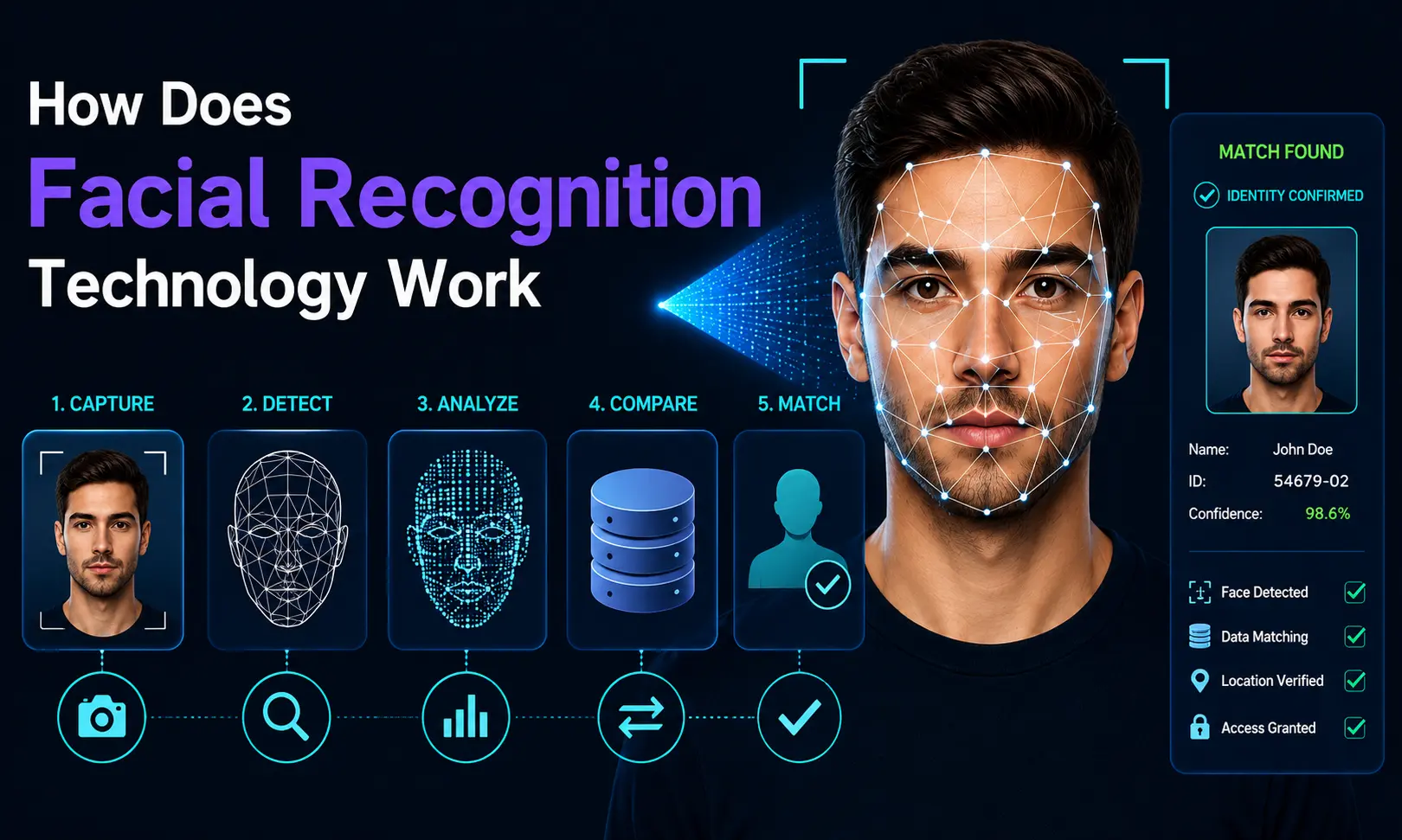
Understanding how facial recognition technology works means breaking it down into a sequence of distinct stages. Each step builds on the one before it, and a weakness in any single stage can affect the accuracy of the final result. Here’s the complete process, from the moment a camera sees a face to the moment a system confirms an identity.
1. Face Detection
The first step in any facial recognition system is simply locating a human face within an image or video feed. This is face detection, and it happens before any recognition takes place.
Face detection algorithms scan an image looking for patterns consistent with a human face, such as the arrangement of eyes, nose, and mouth. Early systems used simpler pattern-matching techniques, but today’s systems rely on convolutional neural networks trained on millions of images to detect faces reliably, even in cluttered scenes, at odd angles, or when a face is partially obscured.
This stage doesn’t identify who the person is. It only answers a basic question: is there a face here, and if so, where exactly in the frame is it located?
2. Face Capture and Image Acquisition
Once a face is detected, the system needs a usable image to work with. This is where cameras and image sensors come into play. Depending on the application, this could be a smartphone’s front camera, a CCTV feed, a dedicated access control camera, or a specialized 3D sensor.
Image quality matters enormously at this stage. A well-lit, front-facing, high-resolution capture gives the system far more usable data than a blurry, poorly lit, or angled one. Some facial recognition software for security cameras captures multiple frames in quick succession and selects the clearest one automatically, improving accuracy before any analysis even begins.
3. Image Preprocessing and Face Alignment
Raw captured images are rarely perfect. Preprocessing cleans up the image and prepares it for analysis. This can involve adjusting brightness and contrast, cropping the image to isolate the face, correcting for tilt, and normalizing the image size.
Face alignment is a particularly important part of this stage. The system identifies key reference points, such as the center of the eyes, and rotates or scales the image so the face is presented in a consistent, standardized orientation. Without this step, the same person photographed at different angles could produce wildly different results, undermining the entire recognition process.
4. Facial Feature Extraction and Embeddings
This is where the real intelligence of facial recognition technology comes into play. The system identifies facial landmarks, distinct, measurable points on the face like the corners of the eyes, the tip of the nose, and the edges of the mouth, and analyzes the relationships between them.
Rather than storing an actual photo, modern systems convert these facial features into a compact numerical representation called a face embedding, a string of numbers, typically a few hundred values, that captures the unique geometry of that face. This is a critical point for anyone concerned about privacy: a face embedding cannot be reversed back into a photograph, and it’s the embedding, not the image itself, that gets stored and compared in most well-designed systems.
Feature extraction is powered almost entirely by deep learning algorithms, specifically convolutional neural networks trained on massive datasets of labeled faces. The quality of this trained model is one of the single biggest factors determining how accurate a facial recognition system will be.
5. Face Matching and Comparison
Once a face embedding has been generated, the system compares it against one or more stored embeddings in a facial recognition database. This comparison uses mathematical distance calculations to measure how similar two embeddings are.
There are two fundamentally different ways this comparison can happen:
- One-to-one matching, used for identity verification, where the system checks a live face against a single stored reference (for example, confirming that the person unlocking a phone matches the phone owner’s registered face).
- One-to-many matching, used for identification, where the system searches an entire database to find out who a face belongs to, without any prior claim of identity.
The speed of this matching process depends heavily on how the database is indexed and how many records it contains, but modern systems can search through millions of stored faces in a fraction of a second.
6. Decision and Confidence Score
The final step is a decision. Every comparison produces a confidence score, a numerical value representing how closely the two embeddings match. The system compares this score against a predefined threshold to decide whether it counts as a match.
This threshold is a deliberate design choice, and it involves a trade-off. A stricter threshold reduces false matches but increases the chance of rejecting a legitimate user. A looser threshold does the opposite. Organizations tune this balance based on how the system is being used; a bank verifying a mobile deposit will typically use a stricter threshold than a retail store flagging repeat visitors for marketing purposes.
The Core Technologies Behind Facial Recognition Systems
Facial recognition doesn’t run on a single piece of technology. It’s the product of several overlapping fields of computer science working together. Here’s what actually powers a modern facial recognition system under the hood.
➤ Artificial Intelligence and Machine Learning
Artificial intelligence and machine learning form the foundation of every modern facial recognition algorithm. Rather than being explicitly programmed with rules for what a face looks like, these systems learn patterns directly from large volumes of labeled facial data.
During training, a machine learning model is shown thousands or millions of face images, each labeled with an identity, and it gradually learns to recognize the subtle patterns that distinguish one face from another. The result is a model that can generalize to faces it has never seen before, which is what makes facial recognition practical at scale.
➤ Deep Learning and Convolutional Neural Networks (CNNs)
Deep learning, and specifically the convolutional neural network, or CNN, is the technology most directly responsible for the accuracy leap facial recognition has seen over the past decade.
A CNN processes an image in layers, with each layer detecting increasingly complex patterns. Early layers might detect simple edges and contrasts. Middle layers combine these into shapes like eyes or noses. Deeper layers combine those shapes into a full representation of a unique face. This layered approach is what allows a convolutional neural network to extract meaningful facial features from raw pixel data automatically, without a human having to manually define what a “good” feature looks like.
➤ Computer Vision and Image Processing
Computer vision is the broader discipline concerned with teaching machines to interpret visual information, and facial recognition is one of its most well-known applications. Image processing techniques within computer vision handle tasks like noise reduction, contrast enhancement, and geometric correction that prepare an image for analysis.
Computer vision also provides the tools for face detection, tracking a face across video frames, and handling variations in pose, expression, and partial occlusion, all of which are essential for facial recognition to work reliably outside of controlled lab conditions.
➤ 3D Modeling and Depth Sensors
Some facial recognition systems go beyond flat, two-dimensional images and capture the actual three-dimensional shape of a face using depth sensors, infrared projectors, or structured light. This creates a 3D facial recognition model that maps the physical contours of a face rather than just its appearance in a photograph.
This approach, popularized by smartphone face unlock systems, is significantly harder to spoof with a printed photo or a flat screen image, since it requires actual depth information that a 2D image simply doesn’t contain.
➤ Cameras and Image Sensors
None of this works without quality hardware. The camera and image sensor used to capture a face directly affects how much usable data the system has to work with. High-resolution sensors, infrared cameras for low-light conditions, and specialized depth cameras all play a role depending on the specific facial recognition solution being deployed. Security-grade facial recognition software for security cameras, for instance, often relies on infrared or thermal imaging to maintain accuracy in the dark or in poor lighting.
Types of Facial Recognition Technology
Not all facial recognition systems work the same way. The underlying capture method and comparison logic vary depending on the use case, cost constraints, and required accuracy.
♦ 2D Facial Recognition
2D facial recognition analyzes a standard flat photograph or video frame. It’s the most common and least expensive approach, and it works well for many everyday applications like tagging photos or basic access control. Its main weakness is sensitivity to lighting, angle, and image quality, since it has no depth information to fall back on when conditions aren’t ideal.
♦ 3D Facial Recognition
3D facial recognition captures the physical contours of a face using depth sensors or structured light. Because it maps actual geometry rather than a flat image, it’s considerably more resistant to changes in lighting and angle, and much harder to fool with a photograph. It’s commonly used in high-security applications and premium smartphone authentication systems.
♦ Thermal (Infrared) Facial Recognition
Thermal, or infrared, facial recognition detects the heat patterns emitted by a person’s face rather than relying on visible light. This makes it uniquely effective in complete darkness, a scenario where standard 2D and even some 3D systems struggle. It’s frequently used in military, surveillance, and specialized security applications where visibility can’t be guaranteed.
♦ Facial Verification (1:1) vs. Facial Identification (1:N)
This distinction matters more than most people realize, because it defines what a system is actually designed to do.
| Aspect | Facial Verification (1:1) | Facial Identification (1:N) |
|---|---|---|
| Purpose | Confirms a claimed identity | Discovers an unknown identity |
| Comparison | One live face against one stored face | One live face against an entire database |
| Common use | Phone unlock, banking apps, e-KYC | Law enforcement, watchlists, crowd surveillance |
| Speed requirement | Very fast, single comparison | Depends heavily on database size |
| Privacy concern | Lower, user-initiated | Higher, often no explicit consent |
Understanding this difference is essential when evaluating facial recognition security claims, since a system built for one-to-one verification is judged on very different criteria than one built for one-to-many identification across a large population.
Real-World Applications and Use Cases of Facial Recognition
Facial recognition technology applications now span nearly every industry that deals with identity, security, or personalization. Here’s where it’s actually being deployed today.
► Security, Surveillance, and Access Control
Facial recognition access control systems have replaced or supplemented keycards and PIN codes at offices, data centers, and residential buildings. Rather than presenting a badge, an employee simply walks up to a scanner, and the system verifies their identity against an authorized list in real time. This same underlying technology powers broader surveillance systems used to monitor restricted areas and detect unauthorized individuals.
► Smartphones and Consumer Device Authentication
If you’ve ever wondered how does facial recognition work on iPhone or similar devices, the answer typically involves 3D facial mapping combined with infrared sensors that project thousands of invisible dots onto your face to build a depth map. This map is converted into a secure, encrypted mathematical representation stored directly on the device, not in the cloud, and compared every time you attempt to unlock your phone. This local-only storage approach is a deliberate privacy safeguard built into most modern consumer devices.
► Banking and Financial Services
Banks and fintech companies use facial recognition for identity verification during account opening, mobile check deposits, and high-value transaction approval. This biometric authentication layer helps reduce account takeover fraud, since a stolen password alone is no longer enough to access an account protected by facial verification.
► Law Enforcement and Public Safety
Law enforcement agencies use facial recognition to match images from surveillance footage or crime scenes against criminal databases, helping investigators identify suspects or locate missing persons. This is also the most legally and ethically contested application of the technology, and it’s subject to the tightest regulatory scrutiny of any use case discussed in this guide, a topic covered in more detail later.
► Retail and Customer Experience
Retailers use facial recognition to identify known shoplifters, personalize in-store advertising, and analyze customer demographics and foot traffic patterns. Some stores also use it to speed up loyalty program recognition, greeting returning customers without requiring them to present a card or app.
► Healthcare
Hospitals and clinics are increasingly using facial recognition to verify patient identity at check-in, reducing medical record mix-ups and administrative fraud. It’s also being explored for detecting certain genetic conditions and monitoring patient pain levels through facial expression analysis, though these clinical applications are still relatively early-stage compared to identity verification use cases.
► Travel and Airport Security
Airports and border control agencies use facial recognition to match travelers against passport photos, speeding up boarding and immigration checks while reducing the need for manual document review. Many international airports now offer facial recognition boarding gates that let passengers move through security without presenting a physical boarding pass at every checkpoint.
Benefits of Facial Recognition Technology
The rapid adoption of facial recognition across industries isn’t accidental. It offers genuine, measurable advantages over traditional identification methods.
✸ Enhanced Security and Fraud Prevention
Unlike a password or PIN, a face can’t be easily stolen, shared, or guessed. This makes facial recognition security a meaningful upgrade for applications where identity fraud is a persistent risk, particularly in banking, access control, and border security.
✸ Speed and Convenience
Facial recognition eliminates the friction of typing passwords, presenting ID cards, or waiting in verification lines. Authentication happens in seconds, which is a major reason smartphone manufacturers and airports have adopted it so aggressively.
✸ Cost and Operational Efficiency for Businesses
For businesses, facial recognition reduces the staffing and administrative overhead associated with manual identity checks. Retailers spend less time on loss-prevention monitoring, and access control systems reduce the need for physical badges, replacement cards, and front-desk verification staff.
✸ Improved User Experience and Personalization
Beyond security, facial recognition enables more personalized experiences, from a phone that instantly recognizes its owner to a retail environment that tailors offers based on returning customer recognition. When implemented thoughtfully and with proper consent, this creates a smoother, more intuitive interaction between people and the systems they use daily.
Challenges and Limitations of Facial Recognition
No discussion of facial recognition technology is complete without an honest look at where it falls short. These limitations are exactly why responsible deployment matters so much.
✦ Accuracy and Environmental Factors (Lighting, Angle, Image Quality)
How accurate is facial recognition technology in real-world conditions? It depends heavily on environmental factors. Poor lighting, extreme angles, low-resolution cameras, and partial face obstruction (like masks or sunglasses) can all reduce accuracy significantly. Systems tested under ideal lab conditions often perform noticeably worse in uncontrolled, real-world environments.
✦ Bias and Demographic Disparities
One of the most well-documented limitations of facial recognition is inconsistent accuracy across different demographic groups. Independent research, including testing by the U.S. National Institute of Standards and Technology, has repeatedly found that many facial recognition algorithms perform less accurately on women, older adults, and people with darker skin tones compared to their performance on other groups. This isn’t a flaw in the underlying concept of facial recognition, but a direct consequence of imbalanced training data, and it remains an active area of research and correction across the industry.
✦ Spoofing and Presentation Attack Vulnerabilities
Facial recognition systems can potentially be fooled using photographs, video replays, or even realistic masks, a category of attack known as spoofing. This is precisely why liveness detection and spoof detection have become standard components of modern facial recognition software. Liveness detection analyzes subtle cues, like blinking, micro-movements, or depth information, to confirm that the system is looking at a live, physically present person rather than a static image or recording.
✦ Scalability and Performance Challenges
Matching a face against a database of a few hundred people is trivial. Matching against millions of records in real time is a significantly harder engineering problem. Large-scale facial recognition deployments require substantial computing infrastructure, optimized database indexing, and careful system architecture to maintain both speed and accuracy at scale.
✦ Cost and Implementation Complexity
Beyond the software itself, deploying facial recognition requires quality cameras, adequate lighting infrastructure, data storage, and often integration with existing security or identity systems. For organizations evaluating custom facial recognition software versus off-the-shelf facial recognition API solutions, implementation cost and complexity are often the deciding factors, particularly for smaller businesses without dedicated technical teams.
Facial Recognition, Privacy, and Ethical Concerns
Facial recognition privacy concerns are not a fringe issue. They sit at the center of nearly every serious conversation about this technology, and for good reason.
➤ User Consent, Transparency, and Surveillance
A face is uniquely difficult to consent to in the way other data typically requires, since it can be captured from a distance, without interaction, and often without the person’s awareness. This raises legitimate concerns about surveillance technology being deployed in public spaces without individuals ever being informed their biometric data is being collected. Transparency about when and how facial recognition is used has become a baseline expectation, not an optional nicety, and reflects the broader importance of data privacy in how organizations handle personal information generally.
➤ Biometric Data Protection and Unauthorized Access
Biometric data carries a risk that passwords don’t: you can reset a password, but you can’t reset your face. If a facial recognition database is breached, the exposed biometric data can’t simply be changed the way a compromised password can. This makes biometric security a genuinely higher-stakes category of data protection, and it’s a major reason regulators treat facial data with more caution than most other categories of personal information, an area where ai in cybersecurity is increasingly being used to help detect and respond to breaches involving sensitive biometric records.
➤ Algorithmic Bias, Discrimination, and Civil Liberties
Beyond the accuracy disparities discussed earlier, there are broader civil liberties concerns tied to how facial recognition is used, particularly by law enforcement and government agencies. Misidentification carries real consequences, and several documented cases of wrongful arrests linked to inaccurate facial recognition matches have fueled ongoing public debate about whether, and how, this technology should be used in policing. These concerns are a core reason many jurisdictions have moved to restrict or ban certain government uses of the technology while still permitting private, consent-based applications like phone unlocking.
Facial Recognition Laws and Regulations Around the World
Regulation of facial recognition has moved quickly in the past few years, and the legal landscape now varies significantly by region.
♦ GDPR and Biometric Data Regulations in the EU
Under the General Data Protection Regulation, biometric data used for identification purposes is treated as a special category of sensitive personal data, generally requiring explicit consent or another narrow legal basis before it can be processed. The European Union has gone further with the AI Act, which layers additional rules specifically on top of GDPR. Under the AI Act, real-time remote biometric identification in public spaces by law enforcement is prohibited in principle, with only narrow exceptions such as preventing imminent terrorist attacks or locating missing persons, and these exceptions require prior judicial authorization. By contrast, biometric verification used purely to confirm someone’s claimed identity, such as face recognition to unlock a phone, is treated as lower risk with only basic transparency obligations. The AI Act has rolled out in phases, with prohibited practices, including untargeted scraping of facial images to build recognition databases, taking effect in February 2025, and the heavier high-risk system obligations becoming fully enforceable in August 2026.
♦ U.S. Federal and State Facial Recognition Regulations
The United States has no comprehensive federal biometric privacy law, so regulation happens almost entirely at the state level, and coverage varies widely depending on where a business or individual is located. As of 2026, only three states have a dedicated, stand-alone biometric privacy statute: Illinois, under the Biometric Information Privacy Act, Texas, under the Capture or Use of Biometric Identifier Act, and Washington. Illinois BIPA is widely considered the strictest of the three, requiring companies to obtain written consent before collecting facial scans and to maintain a publicly available policy on biometric data retention and destruction, with statutory damages available per violation. Texas CUBI imposes similar notice and consent requirements but is enforced only by the state Attorney General rather than through private lawsuits, while Washington’s law likewise limits enforcement to the Attorney General’s office. Beyond these three, roughly twenty additional states protect biometric data as a sensitive category under broader consumer privacy laws, while the remaining states address it only indirectly through general data breach notification rules.
♦ Facial Recognition Regulations in Asia-Pacific and Other Regions
Regulatory approaches outside the EU and U.S. vary considerably. Some Asia-Pacific countries have introduced comprehensive data protection frameworks that treat biometric data as sensitive personal information requiring explicit consent, while others have taken a more permissive approach that favors rapid deployment for public security and digital identity programs. Because this regulatory landscape continues to shift, businesses operating internationally should verify current requirements in each specific jurisdiction before deploying facial recognition rather than assuming rules from one region will apply elsewhere.
♦ Data Retention and Compliance Best Practices
Regardless of jurisdiction, a few compliance practices have become close to universal best practice for any organization handling facial data:
- Collect only the facial data genuinely necessary for the stated purpose
- Obtain clear, informed consent before initial collection wherever legally required
- Set defined retention periods and delete biometric data once it’s no longer needed
- Encrypt stored facial data and embeddings, both at rest and in transit
- Maintain transparent, publicly accessible policies explaining how facial data is used, stored, and shared
- Conduct regular audits to confirm the system remains compliant as regulations evolve
The Future of Facial Recognition Technology
Facial recognition is still evolving quickly, and several trends are already shaping where the technology goes next.
► Improved Accuracy and Liveness Detection
Ongoing advances in deep learning algorithms and larger, more diverse training datasets continue to close the demographic accuracy gaps that have long been a criticism of facial recognition systems. At the same time, liveness detection and spoof detection are becoming more sophisticated, making it increasingly difficult to fool systems with photos, videos, or masks.
► Privacy-Preserving Facial Recognition
A growing area of development focuses on privacy-preserving techniques, such as processing facial data entirely on-device rather than sending it to the cloud, and using encrypted, irreversible facial embeddings that can be matched without ever exposing the underlying facial data. These approaches directly respond to the privacy concerns discussed earlier in this guide and are increasingly viewed as a baseline expectation rather than a premium feature.
► Edge-Based Facial Recognition
Running facial recognition directly on local devices, rather than relying on cloud servers, reduces latency, improves reliability in low-connectivity environments, and keeps sensitive facial data from ever leaving the device. This edge-based approach is becoming increasingly common in smartphones, access control hardware, and security cameras as onboard processing power continues to improve.
► Emerging Applications and Industry Trends
Facial recognition is expanding into new territory, including contactless payment authentication, personalized healthcare monitoring, and integration with broader identity verification ecosystems. As these applications grow, so does the role of ai in data analysis in helping organizations interpret facial recognition results alongside other behavioral and contextual signals, rather than relying on facial matching alone as a single point of decision-making. This layered, multi-signal approach is likely to become the norm as the technology matures.
Conclusion
Facial recognition technology works by moving through a precise sequence of steps: detecting a face, capturing a clean image, aligning and preprocessing it, extracting unique facial features into a mathematical embedding, and comparing that embedding against stored data to produce a confidence-scored match. Behind this process sits a combination of artificial intelligence, deep learning, convolutional neural networks, and computer vision, all trained to interpret the unique geometry of a human face.
The technology has earned its place across banking, security, healthcare, retail, and travel because it genuinely solves real problems around speed, convenience, and fraud prevention. At the same time, its limitations around accuracy, bias, and spoofing are real, and the privacy and regulatory questions surrounding it are far from settled. Anyone evaluating a facial recognition system, whether for personal use or business deployment, should weigh both sides carefully: the technology is powerful, but it works best when paired with transparency, strong data protection practices, and realistic expectations about its limits.
FAQs
How does facial recognition technology work?
Facial recognition technology works by detecting a face in an image, extracting its unique features into a mathematical embedding using deep learning, and comparing that embedding against stored facial data to determine a match, all guided by a confidence score and threshold.
Is facial recognition technology accurate?
Accuracy varies by system and conditions. Well-trained facial recognition algorithms tested under good lighting and clear image quality can be highly accurate, but performance drops in poor lighting, extreme angles, or with obscured faces, and accuracy has historically varied across demographic groups.
Is facial recognition technology safe to use?
It can be safe when implemented with strong security practices, such as encrypted storage, on-device processing, and clear data retention policies. Safety largely depends on how responsibly the organization deploying it handles the underlying biometric data.
What is the difference between facial recognition and facial detection?
Face detection only locates a face within an image, without identifying who it belongs to. Facial recognition goes further by comparing that detected face against stored data to determine or confirm a specific identity.
Can facial recognition be fooled or spoofed?
Basic 2D facial recognition systems can sometimes be fooled with photos or videos, which is why liveness detection and spoof detection have become standard in modern systems. 3D and infrared-based systems are considerably harder to spoof due to depth and heat-pattern requirements.
Is facial recognition technology legal?
Legality depends heavily on jurisdiction and use case. Consent-based applications like phone unlocking are broadly legal almost everywhere, while government surveillance and law enforcement use face much stricter regulation, and in some cases outright bans, particularly in the European Union and specific U.S. states.
What industries use facial recognition technology the most?
Banking, retail, law enforcement, travel and airport security, healthcare, and consumer device manufacturing are among the industries with the heaviest facial recognition adoption today.
Does facial recognition work in low light or in the dark?
Standard 2D facial recognition struggles significantly in low light. However, thermal and infrared facial recognition systems are specifically designed to work in darkness by detecting heat patterns rather than relying on visible light.
Can facial recognition technology be biased?
Yes. Documented research has shown that many facial recognition algorithms perform less accurately on certain demographic groups, primarily due to imbalanced training data. This remains an active focus of improvement across the industry.
Which is better for security: facial verification or facial identification?
Neither is universally “better,” since they serve different purposes. Facial verification (1:1) is ideal for personal authentication, like unlocking a device. Facial identification (1:N) is designed for broader identification tasks, like matching a face against a criminal database, and typically carries greater privacy considerations.
Disclaimer – This article is for informational purposes only and does not constitute legal, financial, or compliance advice. Facial recognition laws and regulations vary by jurisdiction and change frequently – please consult a qualified professional or refer to official government sources for guidance specific to your situation.