
Key Takeaways
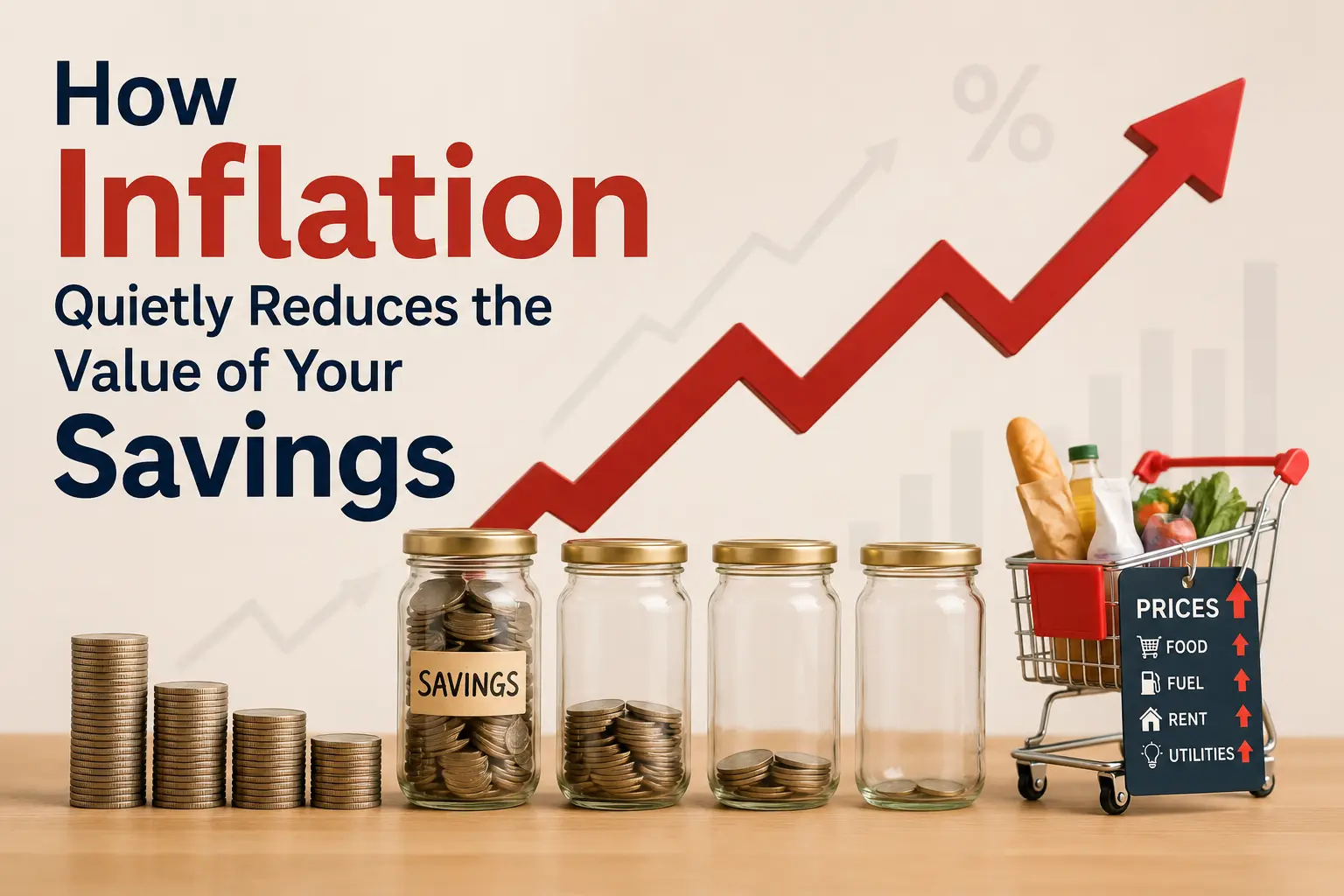
- Inflation steadily reduces the purchasing power of money, even when account balances continue to grow.
- U.S. annual inflation stood at 3.4% as of July 2026, with core inflation at 2.5% (source: USAFacts, BLS data).
- Real returns — nominal returns minus inflation — are the true measure of whether your savings are actually growing.
- Cash and low-yield savings accounts are useful for short-term needs but tend to lose real value over long periods.
- Diversified investments in stocks, real estate, TIPS, and other assets have historically offered better protection against inflation over time.
- Financial goals, especially retirement, should be planned using inflation-adjusted figures rather than today’s prices alone.
- Regularly reviewing and adjusting your financial plan helps you stay ahead of changing economic conditions.
You check your savings account, and the number keeps going up. Yet somehow, groceries cost more, rent feels heavier, and that vacation fund never quite stretches as far as it used to. This isn’t in your head. It’s inflation, and it works silently in the background of every financial decision you make.
Most people understand inflation as “prices going up,” but few realize how directly it chips away at money sitting in a savings account, a retirement fund, or even under a mattress. A dollar today simply won’t buy what it used to, and if your savings aren’t growing faster than inflation, you’re actually losing wealth even while your balance climbs.
This guide breaks down exactly how inflation affects savings, why nominal returns can be misleading, which assets tend to hold up better during inflationary periods, and what practical steps you can take to protect your money’s real value over time. Whether you’re building an emergency fund, planning for retirement, or simply trying to make smarter decisions with your paycheck, understanding this connection is one of the most useful things you can do for your financial future.
What is Inflation and How Does It Actually Work?
➤ Understanding the Basic Meaning of Inflation
Inflation is the gradual increase in the price of goods and services across an economy over time. As prices rise, each unit of currency buys a smaller share of goods than it did before. In simple terms, inflation is the reason a cup of coffee that cost a dollar decades ago now costs several dollars.
It’s important to separate inflation from a simple price increase on one product. A single item can go up in price because of a shortage or higher demand without the economy being “inflationary.” Inflation refers to a broad, sustained rise in prices across many categories — housing, food, transportation, healthcare, and more — measured consistently over time.
➤ Why Prices Increase Over Time in the Economy
Prices rise for a mix of reasons, and economists generally group them into a few core drivers. Demand-pull inflation happens when consumer demand outpaces supply, pushing prices higher. Cost-push inflation occurs when the cost of producing goods rises — think higher wages, raw materials, or energy costs — and businesses pass those costs on to consumers.
There’s also monetary inflation, which happens when the money supply grows faster than the economy’s output of goods and services. When more money chases the same amount of goods, each unit of currency is worth a little less. Supply chain disruptions, geopolitical events, and shifts in global trade can all add short-term pressure on top of these underlying forces.
➤ How Inflation is Measured (CPI and Inflation Rate)
The most widely used measure of inflation in the United States is the Consumer Price Index, or CPI. The Bureau of Labor Statistics tracks the prices of a representative “basket” of goods and services that a typical household buys — including housing, food, medical care, transportation, and apparel — and compares how that basket’s total cost changes over time.
The inflation rate is simply the percentage change in the CPI over a given period, usually reported year-over-year. As of the most recent Bureau of Labor Statistics release, U.S. annual inflation stood at 3.4% for the twelve months ending in July 2026, while core inflation — which strips out volatile food and energy prices — was 2.5% (source: USAFacts). This is a useful benchmark to keep in mind, since it directly affects how much your savings need to earn just to break even in real terms.
➤ The Federal Reserve’s Role in Managing Inflation
The Federal Reserve is tasked with keeping inflation stable while supporting healthy employment, and it primarily does this through monetary policy — most notably by adjusting the federal funds rate. When inflation runs hot, the Fed typically raises interest rates to make borrowing more expensive, which tends to cool spending and slow price growth. When the economy is sluggish, the Fed may lower rates to encourage borrowing and spending.
The Fed’s long-run target for inflation is 2%, measured using the Personal Consumption Expenditures (PCE) price index rather than CPI, since PCE tends to run slightly lower and captures a broader range of consumer behavior. Interest rate decisions ripple through savings account yields, mortgage rates, bond prices, and stock market valuations — which is exactly why Fed policy matters so much to anyone trying to protect the value of their savings.
➤ Different Types of Inflation and Their Impact on Consumers
Not all inflation feels the same. Moderate inflation, typically in the 2-3% range, is considered normal and even healthy for a growing economy — it encourages spending and investment rather than hoarding cash. High inflation, sometimes called double-digit inflation, erodes purchasing power quickly and can strain household budgets significantly.
Hyperinflation is an extreme, rare scenario where prices spiral out of control, often linked to a collapse in confidence in a currency. Then there’s stagflation, a difficult combination of high inflation alongside slow economic growth and rising unemployment, which limits the usual policy tools available to fight rising prices. Each type carries different consequences for consumers, but even moderate, “normal” inflation compounds significantly over years and decades, which is often overlooked.
➤ Why Your Personal Inflation Rate May Be Different From Official CPI Data
The CPI reflects a national average, but your actual cost of living depends on where you live and how you spend. A renter in an expensive metro area facing steep increases in housing costs will experience inflation very differently than a homeowner with a fixed-rate mortgage in a lower-cost region.
If a large share of your budget goes toward categories rising faster than the national average — such as healthcare, childcare, or rent — your personal inflation rate could be meaningfully higher than the headline number. This is worth remembering when setting savings targets: relying solely on the official CPI figure might understate how much you actually need to save to maintain your lifestyle.
How Inflation Reduces the Real Value of Your Savings
1. How Inflation Decreases Your Purchasing Power
Purchasing power is the amount of goods and services your money can buy. When inflation rises, purchasing power falls, because it now takes more currency to buy the same item. This is the core mechanism behind “does inflation reduce the value of money” — yes, it does, consistently and predictably over time, even if the effect isn’t obvious day to day.
The tricky part is that your bank balance doesn’t visibly shrink. The number stays the same or grows through interest, but what that number can actually buy quietly declines. This is why understanding real value, not just the nominal figure on a statement, is essential to sound personal finance.
2. Why the Same Amount of Money Buys Less Over Time
Think of $100 as a claim on a certain basket of goods. If that basket’s cost rises by 3% next year, your $100 no longer buys the entire basket — you’d need $103 to keep pace. Extend this small annual gap across many years, and the cumulative effect becomes substantial, even though each individual year feels minor.
This is sometimes described as a “silent tax,” because there’s no single moment where you feel the loss. Instead, it happens gradually, invisibly, through every grocery run, rent renewal, and insurance premium increase.
3. Example: How Inflation Can Shrink Your Savings Over 10, 20, or 30 Years
To see the scale of the impact, it helps to look at how a fixed sum loses real value at different inflation rates over time. The table below shows the approximate purchasing power of $10,000 left idle, assuming a steady 3% annual inflation rate.
| Years Held | Nominal Value | Approximate Real Value (at 3% inflation) |
|---|---|---|
| 10 years | $10,000 | $7,440 |
| 20 years | $10,000 | $5,540 |
| 30 years | $10,000 | $4,120 |
Notice that the nominal figure never changes if the money simply sits in cash — it’s still $10,000. But the real, inflation-adjusted purchasing power drops by more than half over 30 years. This is precisely why “safe” cash isn’t actually safe from a long-term wealth perspective; it’s safe from market volatility, but not from inflation.
4. Inflation Calculator: How Much Will Your Money Be Worth in the Future?
An inflation calculator lets you estimate how much a given amount of money today will be worth — in terms of purchasing power — at some point in the future, based on an assumed inflation rate. These tools are widely available online, including from government-linked sources like the Bureau of Labor Statistics’ CPI inflation calculator, and are useful for stress-testing your retirement or savings projections.
When using one, it helps to run a few different inflation rate scenarios rather than relying on a single number, since inflation isn’t constant year to year. A conservative approach is to check your plan against both the historical long-run average (roughly 3% annually in the U.S. over the past several decades) and a slightly higher rate, so you’re not caught off guard if costs rise faster than expected.
5. Why Keeping Excess Cash Can Reduce Your Wealth
Cash and low-yield savings accounts serve an important purpose — liquidity, safety, and peace of mind — but holding significantly more than you need in cash comes with a hidden cost. If your cash earns less interest than the inflation rate, its real value is shrinking every single year, even without any market crash or bad investment decision.
This doesn’t mean cash is bad. An emergency fund covering three to six months of essential expenses is a cornerstone of sound personal budgeting tips and should generally stay liquid and low-risk. The issue arises when money that could be working toward long-term goals stays parked in cash far longer than necessary, quietly losing ground to inflation year after year.
Nominal Returns vs Real Returns: The Number That Actually Matters
♦ What is a Nominal Interest Rate?
A nominal interest rate is the stated rate of return on an investment or savings product, before accounting for inflation. If your savings account advertises a 4% annual percentage yield, that 4% is the nominal return — it’s the number you’ll see on your statement, but it doesn’t tell the whole story.
Nominal rates are useful for comparing products at face value, but they can be misleading if inflation isn’t factored in. A high nominal rate can still result in a real loss of purchasing power if inflation is rising even faster.
♦ What is an Inflation-Adjusted Real Rate of Return?
The real rate of return adjusts the nominal return by subtracting the inflation rate, giving a clearer picture of how much your money’s actual purchasing power grew (or shrank). This is the figure that genuinely reflects wealth building, since it measures growth in terms of what your money can actually buy, not just the number on a screen.
For example, if a savings account pays 4% nominal interest and inflation for that year is 3.4%, the real return is roughly 0.6%. That’s a much thinner margin of actual wealth growth than the headline 4% suggests, and it’s why real returns deserve far more attention in financial planning than they typically get.
♦ Why Your Investment Returns May Look Good but Still Lose Value
It’s entirely possible to see a positive nominal return and still lose real wealth. If an investment returns 2% in a year when inflation runs at 3.4%, the real return is negative — about -1.4% — meaning your purchasing power actually declined even though your account balance grew.
This gap is especially important during periods of higher inflation, when it becomes harder for conservative, low-yield investments to keep pace. It’s a key reason financial planners often encourage a mix of asset types rather than concentrating savings in a single low-return vehicle, particularly for goals that are years or decades away.
♦ How to Calculate Your Real Return After Inflation
The simplified formula for real return is:
Real Return ≈ Nominal Return − Inflation Rate
For more precision, especially at higher inflation levels, the Fisher equation offers a more exact calculation:
Real Return = [(1 + Nominal Return) / (1 + Inflation Rate)] − 1
Applying this consistently to your savings accounts, CDs, bonds, and investment portfolios gives you an honest read on whether your money is actually growing or simply keeping pace with — or losing to — rising prices. This single habit is one of the most valuable financial planning strategies available, and it costs nothing but a few minutes of math.
How Inflation Affects Everyday Expenses and Long-Term Financial Goals
► Impact of Inflation on Housing, Rent, Food, and Healthcare Costs
Shelter has consistently been one of the largest contributors to overall inflation in recent years, and it remains a major driver of the current CPI figure, alongside food costs that have also stayed elevated (source: Trading Economics). Rent increases compound over time in a similar way to any other price, meaning a household budgeting for a fixed rent years into the future is likely underestimating the real cost.
Healthcare costs tend to rise faster than general inflation in many years due to rising medical technology costs, labor shortages in caregiving fields, and insurance premium increases. Food costs fluctuate with supply chain conditions, weather events, and energy prices, but they add up to a substantial and unavoidable share of most household budgets — making this category especially important to account for in long-term planning.
► How Inflation Increases College and Education Expenses
Education costs have historically risen faster than general consumer inflation in the U.S. for a sustained period, driven by rising administrative costs, facilities investment, and demand for higher education. For parents saving for a child’s future education, this means a college fund needs to grow at a rate that outpaces not just general inflation, but the specific, often steeper, rate of increase in tuition and associated costs.
This is one of the clearest examples of why a generic savings goal set years in advance can fall short. A target based on today’s tuition costs, without adjusting for the likely rate of increase, risks leaving a meaningful shortfall by the time it’s needed.
► Why Retirement Goals Become More Expensive Over Time
Retirement planning is particularly vulnerable to inflation because the time horizon is long and the “spending phase” can last decades. A retirement number calculated today, based on today’s cost of living, needs to be adjusted upward to reflect the reality that expenses in twenty or thirty years will almost certainly be significantly higher in nominal terms.
Healthcare in retirement is especially exposed to this risk, since medical costs tend to rise steadily and represent a growing share of expenses as people age. This is why most credible retirement planning strategies build in an assumed inflation rate for both the savings phase and the withdrawal phase, rather than using a single static number throughout.
► How Inflation Changes Your Future Financial Needs
Because inflation compounds, the financial target you’re aiming for isn’t fixed — it moves. A goal that seems well-funded today, calculated using current prices, needs to be revisited periodically and adjusted for the reality of rising costs. This is true whether the goal is a home down payment, a child’s education, or a comfortable retirement.
Building this awareness into your financial planning from the start — rather than discovering the gap late — makes it far easier to course-correct gradually instead of scrambling to catch up later.
How Inflation Impacts Different Savings and Investment Options
✸ Savings Accounts and High-Yield Savings Accounts During Inflation
Traditional savings accounts often offer interest rates well below the inflation rate, meaning money sitting in them steadily loses real value. High-yield savings accounts, typically offered by online banks with lower overhead costs, can offer noticeably better rates and sometimes come close to or even match current inflation, particularly during periods when the Federal Reserve has kept benchmark rates elevated.
Even so, savings accounts are generally best suited for short-term goals and emergency funds rather than long-term wealth building, since their returns rarely outpace inflation by a meaningful margin over many years.
✸ Certificates of Deposit (CDs) and Inflation Risk
CDs offer a fixed interest rate in exchange for locking up your money for a set term, which can be useful for predictable, near-term goals. The risk is that if inflation rises after you lock in a CD rate, your real return can shrink or turn negative for the duration of the term, since you’re stuck at that fixed rate regardless of what happens to prices.
CDs work best when rates are relatively high compared to expected inflation, or as part of a “laddering” strategy that keeps some funds regularly maturing and available to reinvest at potentially better rates.
✸ Bonds and Fixed-Income Investments During Rising Inflation
Traditional bonds pay a fixed interest rate, which makes them vulnerable to the same inflation risk as CDs — if inflation rises unexpectedly, the real value of those fixed payments declines. Bond prices themselves also tend to fall when interest rates rise, since newer bonds issued at higher rates make older, lower-rate bonds less attractive.
That said, bonds still play an important diversification role in a portfolio, providing stability and income, particularly for investors closer to or in retirement who prioritize capital preservation over aggressive growth.
✸ Stocks and Equity Investments as Inflation Protection
Historically, stocks have offered one of the more effective long-term hedges against inflation, since company revenues and profits can rise along with prices, and stock valuations have generally outpaced inflation over multi-decade periods. This doesn’t mean stocks are immune to inflation-related volatility in the short term — rising rates and inflation uncertainty can and do cause market swings.
For long-term goals like retirement, maintaining exposure to equities, even at a reduced level as you age, has historically been one of the more reliable ways to preserve and grow real purchasing power over time.
✸ ETFs and Mutual Funds for Long-Term Inflation Growth
Exchange-traded funds and mutual funds allow investors to gain diversified exposure to stocks, bonds, or a mix of both without having to pick individual securities. This diversification can help smooth out volatility while still capturing long-term growth potential that outpaces inflation.
For someone just getting started, low-cost index funds are often recommended as an accessible way to start micro investing, since they allow for small, regular contributions without requiring deep market expertise.
✸ Real Estate and Inflation Protection
Real estate is often considered a natural inflation hedge because property values and rental income tend to rise alongside — or sometimes ahead of — general price levels. Homeowners with a fixed-rate mortgage benefit further, since their largest monthly expense stays constant even as their home’s value and comparable rents rise.
Real estate isn’t without risk or complexity, including maintenance costs, liquidity constraints, and market cycles, but it remains a widely used tool for wealth preservation and long-term asset protection.
✸ Gold and Alternative Assets During Inflation
Gold has a long history as a store of value during periods of currency uncertainty or high inflation, largely because it isn’t tied to any single country’s monetary policy and has limited supply. Many investors hold a modest allocation to gold or other alternative assets as a form of insurance within a diversified portfolio.
Gold doesn’t generate income the way stocks or bonds can, and its price can be volatile in the short term, so it’s generally best treated as one component of a broader wealth preservation strategy rather than a primary growth vehicle.
✸ Treasury Inflation-Protected Securities (TIPS): A Direct Inflation Hedge
TIPS are U.S. government bonds specifically designed to protect against inflation. Their principal value adjusts up (or down) based on changes in the CPI, meaning both the underlying value and the interest payments rise with inflation. This makes TIPS one of the most direct and explicit inflation-protected investments available to everyday investors.
The trade-off is that TIPS often offer a lower base yield compared to standard Treasury bonds, since the inflation protection itself is part of the value proposition. They tend to be most useful for investors specifically prioritizing purchasing power preservation over maximizing nominal returns.
Common Signs Inflation is Hurting Your Financial Progress
✦ Your Savings Balance is Growing, but Your Buying Power Is Falling
If your account balance is rising through interest, but you’re buying fewer groceries, covering fewer bills, or feeling more financial strain with the same income, that’s a clear sign inflation is outpacing your savings growth. This gap between nominal growth and real-world affordability is one of the most direct symptoms of inflation eroding your financial position.
✦ Your Investment Returns Are Lower Than the Inflation Rate
If you calculate the real return on your savings or investments (using the formula covered earlier) and consistently find it near zero or negative, your money isn’t building wealth — it’s treading water at best, or losing ground at worst. This is worth checking periodically rather than assuming a “good-sounding” nominal rate is automatically keeping pace.
✦ Your Retirement Savings May Not Cover Future Expenses
If your retirement projections were built using today’s cost of living without adjusting for inflation over your remaining working years and retirement itself, there’s a strong chance the target is understated. This is a common and often overlooked gap in retirement planning that’s worth revisiting with a financial professional or a detailed inflation-adjusted calculator.
✦ Your Monthly Expenses Keep Rising Despite Similar Spending Habits
If your spending habits haven’t meaningfully changed but your monthly costs keep climbing, that’s inflation showing up directly in your budget. Tracking this trend over several months can help you see which categories — housing, groceries, insurance — are rising fastest for your specific situation, which is often more useful than relying solely on the national average.
Common Money Mistakes People Make During Inflation
➤ Keeping Too Much Money in Cash
Beyond a well-sized emergency fund, holding large amounts of cash for extended periods means accepting a near-certain loss of purchasing power over time. This is one of the most common and easily correctable mistakes in personal finance.
➤ Ignoring Inflation When Setting Financial Goals
Setting a savings or retirement target based purely on today’s prices, without factoring in years of compounding price increases, is a frequent planning error. It’s an easy mistake to make since it requires no immediate action to notice — the shortfall only becomes apparent later, when it’s harder to fix.
➤ Choosing Investments Without Considering Real Returns
Focusing solely on nominal interest rates or headline returns, without checking them against inflation, can create a false sense of financial progress. This is especially risky for products marketed heavily on their nominal yield alone.
➤ Not Increasing Savings Along With Rising Costs
If your income has grown but your savings contributions have stayed flat while your cost of living has risen, your effective savings rate is actually declining. Reviewing and periodically increasing contribution amounts helps keep pace with both lifestyle inflation and general price increases.
➤ Delaying Long-Term Investing Decisions
Waiting for the “perfect” time to start investing often means missing years of potential compounding growth, which historically has been one of the more reliable ways to outpace inflation over time. This is particularly relevant for those weighing saving vs investing – while both have their place, holding everything beyond your emergency fund in cash indefinitely tends to work against long-term financial security.
Smart Strategies to Protect Your Savings Against Inflation
♦ Invest in Assets That Have Inflation-Beating Potential
Directing long-term savings toward assets with historically strong real returns — such as diversified stock funds, real estate, or TIPS — gives your money a better chance of outpacing rising prices. The right mix depends on your timeline, risk tolerance, and specific goals, which is why a one-size-fits-all approach rarely works well.
♦ Diversify Across Stocks, Bonds, Real Estate, and Other Assets
Asset allocation and investment diversification help manage risk while still capturing growth from multiple sources. Different asset classes tend to respond differently to inflation and interest rate changes, so spreading investments across several categories can smooth out returns over time rather than relying on any single asset to perform well in every environment.
♦ Increase Your Savings Rate Over Time
Gradually increasing how much you save — whether through automatic escalation in a retirement account or simply reviewing your budget annually — helps offset both inflation and lifestyle creep. Even small, consistent increases compound meaningfully over a working career.
♦ Build Multiple Income Streams
Relying on a single income source leaves less flexibility to adjust when costs rise. Building passive income streams, whether through investments, rental property, or a side business, can provide additional buffer against inflationary pressure and support broader financial independence. For those exploring entrepreneurship as one such stream, developing solid business skills for young entrepreneurs and understanding business growth strategies early can make a meaningful long-term difference, particularly when learning how to grow a small business during a recession or period of economic uncertainty.
♦ Review and Adjust Your Financial Plan Regularly
Inflation isn’t static, so a financial plan shouldn’t be either. Reviewing your budget, savings targets, and investment allocation at least annually — or whenever there’s a significant change in inflation or personal circumstances — helps ensure your plan stays realistic rather than becoming outdated.
Building an Inflation-Resistant Long-Term Financial Plan
► Define Clear Financial Goals and Timelines
Start by identifying specific goals — an emergency fund, a home purchase, retirement — along with realistic timelines for each. Clear goals make it easier to choose appropriate savings vehicles and investment strategies, since a goal five years away calls for a very different approach than one thirty years out.
► Create an Emergency Fund Without Holding Excess Cash
An emergency fund is essential, but it doesn’t need to be larger than necessary. Distinguishing between needs vs wants when calculating essential monthly expenses helps you size this fund appropriately — typically three to six months of core expenses — so the rest of your savings can be put to work toward longer-term, inflation-beating goals instead of sitting idle.
► Build a Balanced Investment Portfolio Based on Risk
Your portfolio should reflect both your timeline and your comfort with volatility. Someone decades from retirement generally has more room to weather short-term swings in exchange for higher long-term growth potential, while someone nearing retirement typically shifts toward more stability and income-focused investments.
► Plan for Inflation When Preparing for Retirement
Retirement projections should explicitly account for inflation during both the accumulation phase and the withdrawal phase. Many financial planners recommend using a conservative, inflation-adjusted withdrawal rate and revisiting it periodically, rather than assuming a static number will hold steady for a multi-decade retirement.
► Adjust Your Strategy as Economic Conditions Change
Economic conditions, interest rates, and inflation trends shift over time, and a financial plan built years ago may need updates to reflect the current environment. Staying informed about monetary policy trends and periodically reassessing your allocation keeps your plan aligned with reality rather than outdated assumptions.
Historical Examples of Inflation Impact on Savings
✦ How High Inflation Periods Affected American Households
The United States has experienced several notable periods of elevated inflation, most famously during the late 1970s and early 1980s, when annual inflation reached double digits and eroded the value of cash savings significantly for households who didn’t have their money invested in assets that could keep pace. More recently, inflation surged in 2022 amid pandemic-related supply chain disruptions and expansive monetary policy, pushing the annual rate to its highest level in decades before gradually cooling in the years since.
Households who kept the bulk of their savings in low-yield cash accounts during these periods experienced a real, measurable decline in purchasing power, while those with diversified investments in equities, real estate, or inflation-protected securities generally fared better in preserving their wealth over the same stretch.
✦ Lessons Investors Can Learn From Past Inflation Cycles
These historical episodes reinforce a consistent lesson: cash alone is not a reliable long-term store of value during inflationary periods, and diversification across asset classes tends to provide better protection than concentration in any single type of holding. They also highlight the value of staying invested through volatility rather than retreating entirely to cash out of short-term fear, since doing so often locks in inflation-driven losses rather than avoiding them.
Final Thoughts
Inflation isn’t dramatic or sudden most of the time — it’s quiet, steady, and easy to overlook until you compare your buying power today with a decade ago. The good news is that once you understand how it works, protecting your savings becomes a matter of consistent, practical habits rather than guesswork: keep an appropriately sized emergency fund, calculate real returns rather than trusting nominal numbers, diversify your investments, and revisit your financial plan regularly as conditions change. Small, informed decisions made consistently over time are what actually preserve and grow wealth in the face of rising prices.
FAQs
What happens to savings during inflation?
During inflation, the nominal balance of your savings stays the same or grows through interest, but its real purchasing power declines if the interest rate earned is lower than the inflation rate. This means the same amount of money buys less over time.
How does inflation reduce the value of money?
Inflation reduces the value of money by raising the general price level of goods and services, meaning each unit of currency can purchase less than it could before. This happens gradually and consistently rather than through a single dramatic drop.
Is keeping money in a savings account safe during inflation?
A savings account is safe from market volatility and loss of principal, but if its interest rate is lower than the inflation rate, the real value of the money inside it still declines over time. High-yield savings accounts can help narrow this gap but rarely eliminate it entirely during periods of elevated inflation.
How can I protect my savings from inflation?
Protecting savings from inflation generally involves keeping only a necessary emergency fund in cash, investing the rest in a diversified mix of assets like stocks, real estate, and inflation-protected securities, and regularly reviewing your financial plan to ensure it reflects current inflation and economic conditions.
What investments perform well during inflation?
Historically, diversified equities, real estate, and Treasury Inflation-Protected Securities (TIPS) have offered relatively strong protection against inflation over the long term, since their value or income tends to rise alongside general price levels. Gold is also commonly used as a smaller allocation for wealth preservation.
Are CDs enough to beat inflation?
CDs can sometimes match or exceed inflation when interest rates are relatively high, but because their rate is fixed for the term, they carry the risk of underperforming inflation if prices rise unexpectedly after the CD is opened. They’re generally better suited to short-term, predictable goals than long-term inflation protection.
What is the best inflation protection strategy for retirement savings?
There’s no single “best” strategy, but most effective approaches combine a diversified investment portfolio appropriate to your timeline and risk tolerance, an inflation-adjusted withdrawal plan in retirement, and regular reviews to adjust for changing economic conditions and personal circumstances.
How do I calculate the impact of inflation on my savings?
You can estimate the impact using an inflation calculator, or manually by comparing your savings’ nominal return to the current inflation rate to find your real return. Applying this calculation consistently across your accounts and investments gives a clear, ongoing picture of whether your savings are actually growing in real terms.
Disclaimer
The information provided in this article is intended for general informational and educational purposes only. It should not be interpreted as financial, investment, tax, or legal advice, nor should it be relied upon as the sole basis for any financial decision.
While reasonable efforts have been made to ensure the accuracy and reliability of the content at the time of publication, inflation rates, economic conditions, market data, and financial products are subject to frequent change. As a result, some information in this article may become outdated or may not reflect current conditions at the time of reading.