
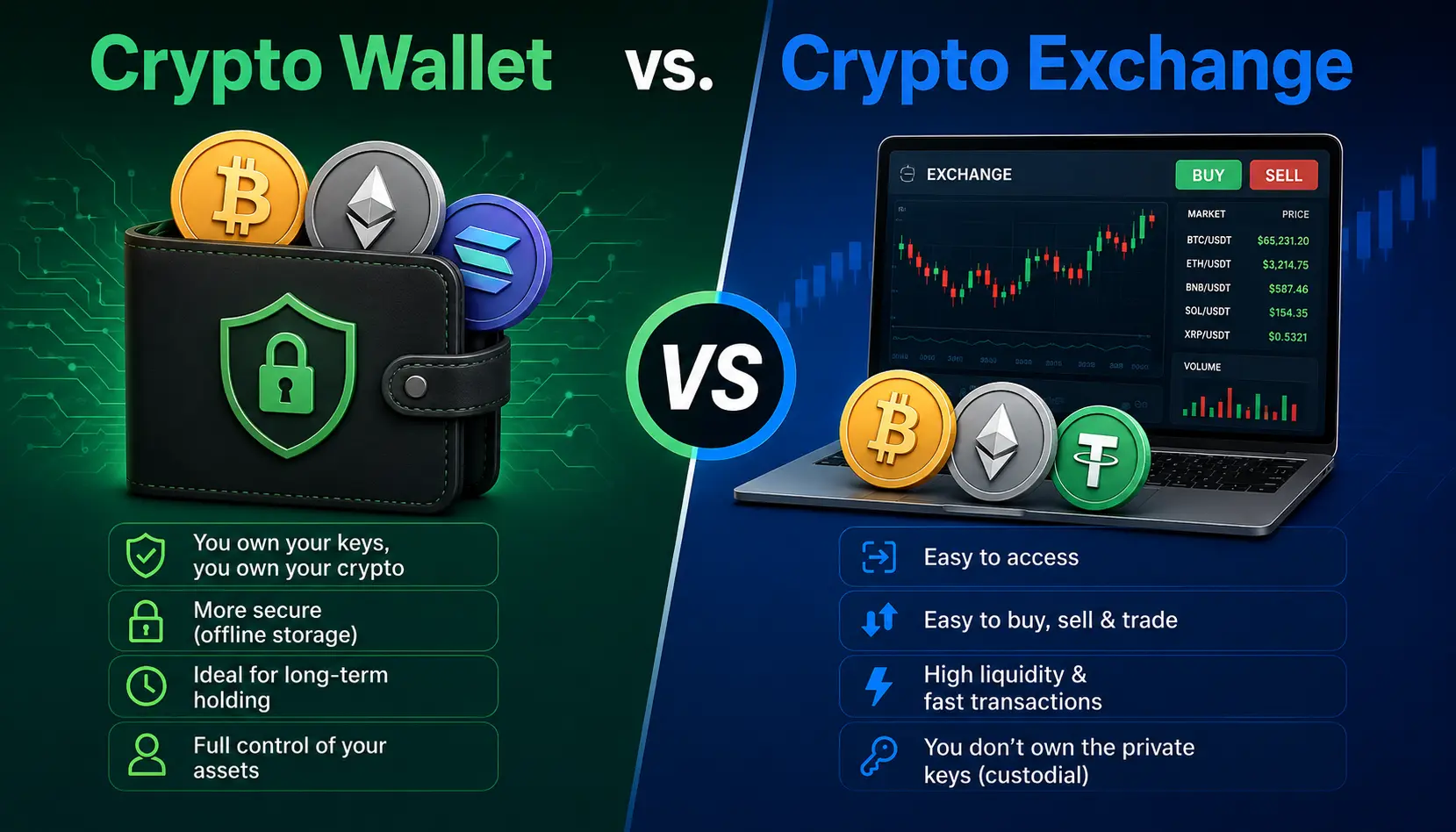
If you have just bought your first Bitcoin or Ethereum, you have probably run into a question that trips up almost every newcomer: should you leave your crypto sitting on the exchange where you bought it, or move it into a separate wallet?
It is a fair question, and it is more important than it might seem at first glance. Cryptocurrency does not work like a traditional bank account. There is no branch you can walk into if something goes wrong, and depending on where and how you store your coins, you might be the only person who can recover them if you lose access.
This guide breaks down the real difference between a crypto wallet and a crypto exchange, how each one actually works behind the scenes, and which option makes more sense depending on what you are trying to do. By the end, you will understand the trade-offs around custody, security, convenience, and cost, so you can decide with confidence rather than guesswork. We will also look at a practical hybrid approach that many experienced crypto users rely on, along with common beginner mistakes worth avoiding from day one.
What is a Crypto Wallet?
A crypto wallet is a tool that lets you store, send, and receive digital assets on the blockchain. Despite the name, a wallet does not actually “hold” your coins the way a physical wallet holds cash. Instead, it stores the private keys that prove you own a specific amount of cryptocurrency recorded on the blockchain, and it gives you the ability to authorize transactions with those keys.
Think of a crypto wallet as a set of keys to a safe-deposit box that lives on a public, shared ledger. The box itself is visible to everyone, but only the person holding the correct key can open it and move what is inside.
1. How Does a Crypto Wallet Work?
Every crypto wallet is built around a pair of cryptographic keys: a public key and a private key.
- The public key generates your wallet address, which you can share freely. People use this address to send you crypto assets, similar to sharing your email address so someone can send you a message.
- The private key is what actually authorizes a transaction. It works like a digital signature that proves the funds are yours to move. Whoever has access to the private key has full control over the assets tied to that wallet.
When you initiate a transaction, your wallet software uses the private key to sign it. That signed transaction is then broadcast to the blockchain network, where it gets verified and recorded permanently. The wallet does not send coins in the traditional sense; it authorizes an update to the blockchain’s ledger.
2. Who Controls the Private Keys?
This is the single most important concept in crypto storage, and it is where the phrase “not your keys, not your crypto” comes from.
If you hold your own private keys, you have what is called self-custody. Nobody else, including the wallet provider, can move your funds without your permission. This gives you complete ownership and control, but it also means the responsibility for keeping those keys safe falls entirely on you.
If a third party, like an exchange, holds the private keys on your behalf, that is called custodial storage. You still technically own the crypto according to the platform’s records, but you are trusting that company to safeguard access and honor withdrawal requests.
3. Main Types of Crypto Wallets
Crypto wallets generally fall into a few categories, each suited to different needs:
- Hot wallets – Connected to the internet, usually in the form of a mobile app or browser extension. Convenient for frequent transactions, but more exposed to online threats.
- Cold wallets – Kept offline, disconnected from the internet most of the time. Much harder for hackers to reach remotely.
- Hardware wallets – A physical device (a type of cold wallet) that stores private keys offline and requires physical confirmation to approve transactions.
- Software wallets – Applications installed on a phone, computer, or as a browser extension. These are hot wallets by nature since the device is typically online.
- Custodial wallets – Provided by an exchange or platform that manages the private keys for you.
- Non-custodial wallets – You alone hold the private keys and the seed phrase, giving you full self-custody.
We will look more closely at the hot-versus-cold comparison a little further down, since it is one of the most practical decisions beginners need to make.
What is a Crypto Exchange?
A crypto exchange is a platform where you can buy, sell, and trade cryptocurrencies, usually in exchange for fiat currency like USD or INR, or for other digital assets. Exchanges act as the marketplace that connects buyers and sellers, and they are typically the first stop for anyone entering the crypto space.
Most beginners create their crypto account on an exchange because it offers a familiar, app-based experience: sign up, verify your identity, deposit funds, and start trading.
1. How Does a Crypto Exchange Work?
A crypto exchange platform matches buy and sell orders between users, similar to how a stock market terms glossary would describe an order book matching buyers with sellers. When you place an order, the exchange’s system looks for a matching order on the other side and executes the trade.
There are two broad categories worth knowing:
- Centralized exchanges (CEX) – Run by a company that manages the platform, holds user funds in custody, and handles the technical infrastructure. Most beginner-friendly exchanges fall into this category.
- Decentralized exchanges (DEX) – Operate using smart contracts on the blockchain, allowing peer-to-peer trading without a central authority holding your funds. This is the essence of the CEX vs DEX distinction, and DEXs generally require more technical comfort with self-custody wallets.
Opening a crypto exchange account usually involves identity verification, known as KYC (Know Your Customer), which is a regulatory requirement in most countries. This step helps exchanges comply with anti-fraud and anti-money-laundering rules.
2. How Exchanges Handle Buying, Selling and Storing Crypto
When you buy crypto on an exchange, the platform credits your account balance instantly, but in most cases, the actual private keys controlling those assets remain with the exchange, not with you. Your crypto exchange login essentially grants you access to a record showing what you own, while the exchange itself retains custody.
This is efficient for active trading because you can buy, sell, and swap assets quickly without moving funds in and out of a personal wallet each time. It also means you are relying on that exchange’s security practices, financial stability, and internal controls to protect your holdings.
Crypto Wallet vs. Crypto Exchange: Key Differences
Now that you understand how each one functions individually, let’s compare them directly across the factors that matter most to a beginner.
➤ Ownership, Custody and Control (Custodial vs. Non-Custodial)
With a non-custodial wallet, you hold the private keys, which means you have complete control over your funds. Nobody can freeze your account, restrict withdrawals, or require approval to move your assets.
With a custodial exchange account, the platform holds the keys. You are trusting the exchange’s internal policies and security infrastructure. This is not necessarily bad; it just shifts responsibility away from you and onto the platform, which comes with its own set of risks.
➤ Security and Risk (including What Happens If an Exchange Is Hacked)
Wallet security largely depends on how well you protect your private keys and seed phrase. A hardware wallet kept offline is extremely difficult for a remote attacker to compromise, since the private keys never touch an internet-connected device.
Exchange security depends on the platform’s infrastructure. Reputable exchanges invest heavily in cybersecurity, cold storage for the majority of user funds, and insurance policies. However, exchanges remain attractive targets for hackers precisely because they hold large pools of centralized funds. If an exchange is hacked or becomes insolvent, users with funds sitting in custodial accounts may face delays, partial losses, or, in worst-case scenarios, permanent loss of access, depending on the platform’s response and any recovery mechanisms available.
This is exactly why understanding the importance of crypto wallet security matters even if you plan to use an exchange for most of your activity.
➤ Ease of Use and Convenience
Exchanges are generally easier for beginners. The interface resembles familiar banking or trading apps, password recovery options exist through customer support, and you do not need to manage a seed phrase directly for daily use.
Wallets, especially non-custodial ones, require more hands-on responsibility. You need to back up your seed phrase correctly, understand how transaction fees work, and accept that there is no “forgot password” option if you lose your recovery phrase.
➤ Buying, Selling and Trading
Exchanges are built for trading. They offer order books, price charts, market and limit orders, and access to a wide range of altcoins and stablecoins like USDC and USDT. Crypto market liquidity is generally much deeper on established exchanges, which means trades execute closer to the expected price with less slippage.
Wallets are not designed for trading in the traditional sense. Some non-custodial wallets now integrate with decentralized exchanges, letting you swap tokens directly, but the experience and available liquidity can vary significantly compared to a centralized platform.
➤ Fees and Costs
Exchanges typically charge trading fees, and sometimes deposit or withdrawal fees, along with network fees when you move crypto off the platform. Fee structures vary widely, so it is worth comparing before settling on one exchange.
Wallets themselves are usually free to download and use, though hardware wallets involve a one-time purchase cost. The fees you pay when using a wallet are mainly blockchain network fees (also called gas fees), which go to the network validating your transaction rather than to the wallet provider.
Hot Wallets vs. Cold Wallets: A Quick Beginner’s Guide
Since wallets themselves come in different forms, it helps to understand the hot wallet vs cold wallet decision separately from the wallet-versus-exchange debate.
♦ Key Differences –
| Feature | Hot Wallet | Cold Wallet |
|---|---|---|
| Internet connection | Always connected | Offline by default |
| Convenience | High, quick access for transactions | Lower; requires extra steps to connect |
| Best for | Frequent, smaller transactions | Long-term holding of larger amounts |
| Vulnerability | Exposed to online threats like phishing and malware | Very low remote attack surface |
| Common examples | Mobile apps, browser extensions | Hardware wallets, paper wallets |
♦ Which is Better For Beginners?
For everyday use, a hot wallet is usually more practical since you can access it instantly from your phone or browser. But if you are holding an amount you would be genuinely upset to lose, a cold wallet, particularly a hardware wallet, offers far stronger protection. Many beginners start with a hot wallet for learning and small transactions, then move toward cold storage as their holdings grow.
Pros and Cons of Crypto Wallet vs Crypto Exchange
► Crypto Wallet: Pros & Cons
Pros:
- Full ownership and control through self-custody
- Not dependent on a third-party company staying solvent or online
- Works across many platforms and decentralized applications
- Better protection against exchange-level hacks
Cons:
- You are fully responsible for backing up your seed phrase
- No customer support to recover lost access
- Less convenient for frequent trading
- Requires a learning curve to use safely
► Crypto Exchange: Pros & Cons
Pros:
- Beginner-friendly interface and onboarding
- Deep liquidity for buying, selling, and trading
- Account recovery options through customer support
- Access to a wide range of coins and trading tools
Cons:
- You do not fully control your private keys
- Vulnerable to platform-wide hacks or insolvency
- Withdrawal limits may apply, especially for new accounts
- Trading and withdrawal fees can add up over time
Which is Best for Beginners?
There is no single correct answer here, because a wallet and an exchange serve different purposes. The better question is when each one fits your specific situation.
✸ When to Use a Wallet
Use a wallet when you want to hold crypto for the medium to long term, when you are interacting with decentralized applications, or when the amount you are holding is significant enough that self-custody security outweighs the convenience of an exchange. A wallet also makes sense if you value the core idea of crypto ownership: controlling your own assets without depending on a company’s continued operation.
✸ When to Use an Exchange
Use an exchange when you are actively buying, selling, or trading, when you are just getting started and still learning the basics, or when you need quick liquidity to convert crypto back into cash. Exchanges are also useful simply as the on-ramp, the place where fiat currency first becomes crypto, even if you do not plan to keep funds there long-term.
Can You Use Both? Combining Wallets and Exchanges Strategically
For most people, this is not really an either-or decision. Experienced crypto users typically rely on both, using each tool for what it does best.
✦ How to Use an Exchange and Wallet Together
A common approach looks like this: buy crypto on a reputable exchange, then transfer the portion you intend to hold long-term into a personal wallet. Keep a smaller, working balance on the exchange for trading or quick access, and move the rest into cold storage once you have decided to hold it.
✦ What to Keep on an Exchange vs. in a Wallet
A practical way to think about this is similar to the difference between saving vs investing, or needs vs wants, in personal finance. Funds you might need soon, or that you are actively trading, can reasonably sit on an exchange. Funds you are holding for the long run, similar to an emergency fund you do not touch unless necessary, belong in a wallet where you control the keys.
✦ A Simple Hybrid Strategy For Beginners
- Buy your crypto on a trusted, verified exchange.
- Set aside the amount you plan to trade actively and leave it on the exchange.
- Move the remaining balance to a non-custodial wallet, ideally a hardware wallet for larger amounts.
- Securely back up your seed phrase in a separate, offline location.
- Review your allocation periodically as your holdings and goals change.
How to Choose a Wallet or Exchange as a Beginner
1. What to Look for in a Wallet
- Whether it is custodial or non-custodial, so you know exactly who controls the keys
- Support for the specific coins you plan to hold, such as BTC, ETH, or stablecoins
- A clear, well-documented backup and recovery process
- Positive reputation and a track record of no major security incidents
- Compatibility with hardware wallets if you plan to upgrade your security later
2. What to Look for in an Exchange
- Regulatory compliance and transparent KYC processes
- Strong account security features, including two-factor authentication (2FA)
- Reasonable trading, deposit, and withdrawal fees
- Sufficient liquidity for the assets you want to trade
- A responsive support team and a clear history of handling security incidents, if any have occurred
Best Practices for Safely Storing Cryptocurrency
Regardless of whether you lean toward a wallet, an exchange, or both, a few habits significantly reduce your risk.
➤ Secure and Back Up Your Seed Phrase
Your recovery phrase is the master key to your funds. Write it down physically, store it in more than one secure location, and never save it as a photo or a text file on a device connected to the internet. Anyone who obtains your seed phrase can access your funds, no password required.
➤ Enable Strong Account Security
Turn on two-factor authentication (2FA) on every exchange account and any wallet app that supports it. Use a dedicated authentication app rather than SMS-based codes where possible, since SMS can be intercepted through SIM-swapping attacks.
➤ Keep Software and Devices Updated
Outdated apps and operating systems are a common entry point for attackers. Keep your wallet app, exchange app, and device operating system updated to the latest version so known vulnerabilities get patched promptly.
➤ Consider Cold Storage for Long-Term Holdings
Once your holdings reach an amount that matters to you, moving a portion into a hardware wallet meaningfully reduces your exposure to online threats. It requires a small upfront investment, but for long-term holders, it is one of the more effective forms of asset protection available.
Common Mistakes Beginners Make
♦ Keeping Large Balances on an Exchange
Leaving a significant amount of crypto sitting on an exchange indefinitely means you are trusting that platform’s security and solvency with your entire portfolio. It is generally safer to withdraw anything beyond your active trading needs into a personal wallet.
♦ Losing or Mishandling Seed Phrases
A shocking number of people lose access to their crypto simply because they misplaced or damaged their seed phrase, or stored it in a way that was not truly secure. Treat it with the same seriousness as you would the deed to a house.
♦ Falling for Phishing and Scams
Crypto scams often mimic real exchange emails, fake customer support messages, or too-good-to-be-true investment offers. Always verify URLs directly, never share your seed phrase with anyone, and remember that legitimate platforms will never ask for your private keys.
♦ Ignoring Two-Factor Authentication
Skipping 2FA because it feels like an extra step is one of the most avoidable security mistakes. It takes a few minutes to set up and dramatically reduces the risk of unauthorized account access.
♦ Using Unverified Wallets or Platforms
Downloading a wallet app from an unofficial source, or using an exchange with no verifiable track record, exposes you to unnecessary risk. Stick to well-known, established crypto wallet apps and exchange platforms, and always double-check official download links.
Final Verdict
There is no universal winner in the crypto wallet vs crypto exchange debate, because the two tools solve different problems. Exchanges make it simple to buy, sell, and trade, while wallets give you true ownership and control over your assets. For most beginners, the most sensible path is to start with a reputable exchange to learn the basics, then gradually shift long-term holdings into a personal, non-custodial wallet as confidence and holdings grow. Treating the two as complementary tools, rather than competing choices, tends to serve crypto users best over time.
FAQs
Is It Safer to Keep Crypto in a Wallet or on an Exchange?
A non-custodial wallet is generally considered safer for long-term storage since you control the private keys directly. An exchange can be reasonably safe for smaller, active trading balances, provided the platform has strong security practices, but it carries the added risk of depending on a third party.
Should Beginners Keep Crypto on an Exchange?
It is reasonable for beginners to keep a small amount on an exchange while learning, especially if they are actively trading. However, holding large amounts on an exchange long-term is generally discouraged once a beginner becomes more comfortable managing a personal wallet.
Do I Need a Crypto Wallet if I Use an Exchange?
You are not required to have a separate wallet to use an exchange, since exchanges provide their own custodial storage. That said, having a personal wallet gives you an added layer of control and security, especially for funds you plan to hold long-term.
Can I Transfer Crypto From an Exchange to a Wallet?
Yes. Most exchanges allow you to withdraw crypto to an external wallet address. You will typically need your wallet’s public address, and the transaction will incur a network fee that varies depending on blockchain congestion at the time.
What Is the Safest Way to Store Cryptocurrency?
For most people, the safest approach combines a hardware wallet for long-term holdings with a securely backed-up seed phrase stored offline. This minimizes exposure to online threats while keeping your funds fully under your control.
Should I Use a Hot Wallet or Cold Wallet?
Use a hot wallet for smaller amounts you access frequently, and a cold wallet for larger amounts you intend to hold for the long term. Many users rely on both, depending on how they plan to use their funds.
How Much Crypto Should I Keep on an Exchange?
A reasonable guideline is to keep only what you actively need for trading or near-term transactions on an exchange, similar to how you would only keep spending money in a checking account rather than your entire savings. The rest is generally better held in a personal wallet.
Do I Need to Report Crypto Held in a Wallet or Exchange for Taxes?
Tax obligations for cryptocurrency vary by country and are generally based on your transactions and gains rather than simply where the crypto is stored. It is best to consult a qualified tax professional in your jurisdiction, since crypto tax rules continue to evolve and this article does not constitute tax advice.
Disclaimer –
The information provided in this article is for educational and informational purposes only and should not be considered financial, investment, legal, or tax advice. Cryptocurrency investments are volatile and carry a high degree of risk, including the potential loss of your entire investment.We are not financial advisors, and nothing on this website should be interpreted as a recommendation to buy, sell, or hold any cryptocurrency, wallet, or exchange product. Always conduct your own research (DYOR) and consult a licensed financial advisor, tax professional, or legal expert before making any investment or storage decisions related to digital assets.While we strive to keep the information accurate and up to date, cryptocurrency regulations, security practices, and market conditions change frequently. We do not guarantee the completeness, reliability, or accuracy of the content, and we are not responsible for any losses or damages arising from the use of this information.Any mention of specific wallets, exchanges, or platforms is for illustrative purposes only and does not constitute an endorsement. Readers are responsible for verifying the legitimacy and security of any third-party platform before use.