
If you have ever tried to sell a cryptocurrency and watched the price drop the moment you placed your order, you have already experienced a liquidity problem firsthand. It is one of those things that most new traders do not think about until it costs them money.
Crypto market liquidity decides whether you can buy or sell an asset quickly, at a fair price, without moving the market against yourself. It affects everything from the size of the trade you can safely place to how much you lose to slippage during volatile moments. Yet it is rarely explained in plain language, and most beginners only learn about it the hard way.
This guide breaks down crypto market liquidity from the ground up. You will learn what liquidity actually means, how it works behind the scenes on exchanges and in DeFi protocols, why it matters for every trade you make, and how to check it before you put your money on the line. By the end, you will be able to look at any coin and judge, with real confidence, whether it is safe to trade or better left alone.
What is Crypto Market Liquidity?
Crypto market liquidity refers to how easily a digital asset can be bought or sold in the market without causing a significant change in its price. A highly liquid market has plenty of buyers and sellers ready to trade at any given moment, which means transactions happen quickly and at prices close to what you expect.
Think of liquidity as the depth of a pool. A deep pool can absorb a large stone without much of a splash. A shallow pool reacts violently to even a small pebble. In crypto, the “stone” is your trade, and the “splash” is the price movement it causes. Liquid markets barely notice large trades. Illiquid markets can swing wildly from a single sizable order.
➤ What Does Liquidity Mean in Crypto?
At its core, liquidity in cryptocurrency measures the balance between buy and sell orders available for an asset at any point in time. When there are enough buy and sell orders sitting close to the current market price, a trader can enter or exit a position almost instantly, at a price that closely matches the quoted rate.
Low liquidity means the opposite. There might be very few orders on either side of the order book, so even a modest trade can push the price up or down more than expected. This is why liquidity is often described as a measure of trading efficiency rather than just trading activity. It tells you not just how much is being traded, but how well the market can handle new trades without breaking down.
➤ How is Crypto Liquidity Different From Traditional Markets?
Traditional financial markets, such as stock exchanges, have been refining their liquidity infrastructure for decades. They operate within fixed trading hours, are backed by regulated market makers, and often benefit from centralized clearing systems that reduce settlement risk.
Crypto markets work differently in several important ways:
- Fragmented liquidity: Instead of one central exchange, crypto liquidity is spread across hundreds of centralized exchanges (CEXs) and decentralized exchanges (DEXs), each with its own order book or liquidity pool.
- 24/7 trading: Crypto markets never close, so liquidity can shift dramatically depending on the time of day, region, or ongoing news events.
- Lower regulatory oversight: Many crypto trading pairs, especially smaller altcoins, do not have dedicated market makers ensuring consistent liquidity the way listed stocks often do.
- On-chain liquidity pools: DeFi introduced an entirely new liquidity model built on automated market makers, which does not exist in traditional finance at all.
This fragmentation means that a coin can look highly liquid on one exchange and almost untradeable on another, something that rarely happens with a single stock listed on a major exchange.
➤ Key Characteristics of a Liquid Crypto Asset
A genuinely liquid crypto asset typically shows the following traits:
- Tight bid-ask spreads, meaning the gap between the highest buy offer and the lowest sell offer is small
- Deep order books with substantial buy and sell orders stacked near the current price
- Consistent, high trading volume across multiple exchanges rather than a single venue
- Minimal slippage even when executing larger orders
- Wide availability across several trading pairs and platforms, both centralized and decentralized
Bitcoin and Ethereum are the clearest examples of this. They trade on nearly every major exchange, carry deep order books, and rarely suffer from meaningful slippage even on sizable trades.
Crypto Market Liquidity vs. Trading Volume
These two terms get used interchangeably so often that many traders assume they mean the same thing. They do not, and confusing them can lead to costly trading mistakes.
Trading volume tells you how much of an asset has actually changed hands over a specific period, usually 24 hours. Liquidity tells you how easily you could trade that asset right now, based on the depth of standing buy and sell orders. A coin can show impressive volume figures while still being difficult to trade in large size if that volume is concentrated in a few large transactions rather than spread across a healthy order book.
♦ Key Differences Between Liquidity and Trading Volume
| Aspect | Trading Volume | Market Liquidity |
|---|---|---|
| What it measures | Total value traded over a time period | Ease of executing a trade without moving the price |
| Time frame | Historical (already happened) | Current, real-time condition |
| Can be misleading | Yes, wash trading can inflate volume artificially | Harder to fake, reflects actual standing orders |
| What it tells a trader | How active a market has been | How safe it is to enter or exit a position now |
| Best measured by | 24-hour volume figures | Order book depth, bid-ask spread, slippage |
A practical way to remember this: volume looks backward at what has already traded, while liquidity looks at what is available to trade right now. Both matter, but liquidity is the more reliable signal when you are deciding whether to place a trade.
How Does Crypto Market Liquidity Work?
Liquidity is not a single number pulled from thin air. It emerges from the constant interaction between buyers and sellers placing orders on an exchange. Understanding this mechanism makes it much easier to judge liquidity for yourself instead of relying on headline volume figures.
► What is an Order Book? A Basic Concept
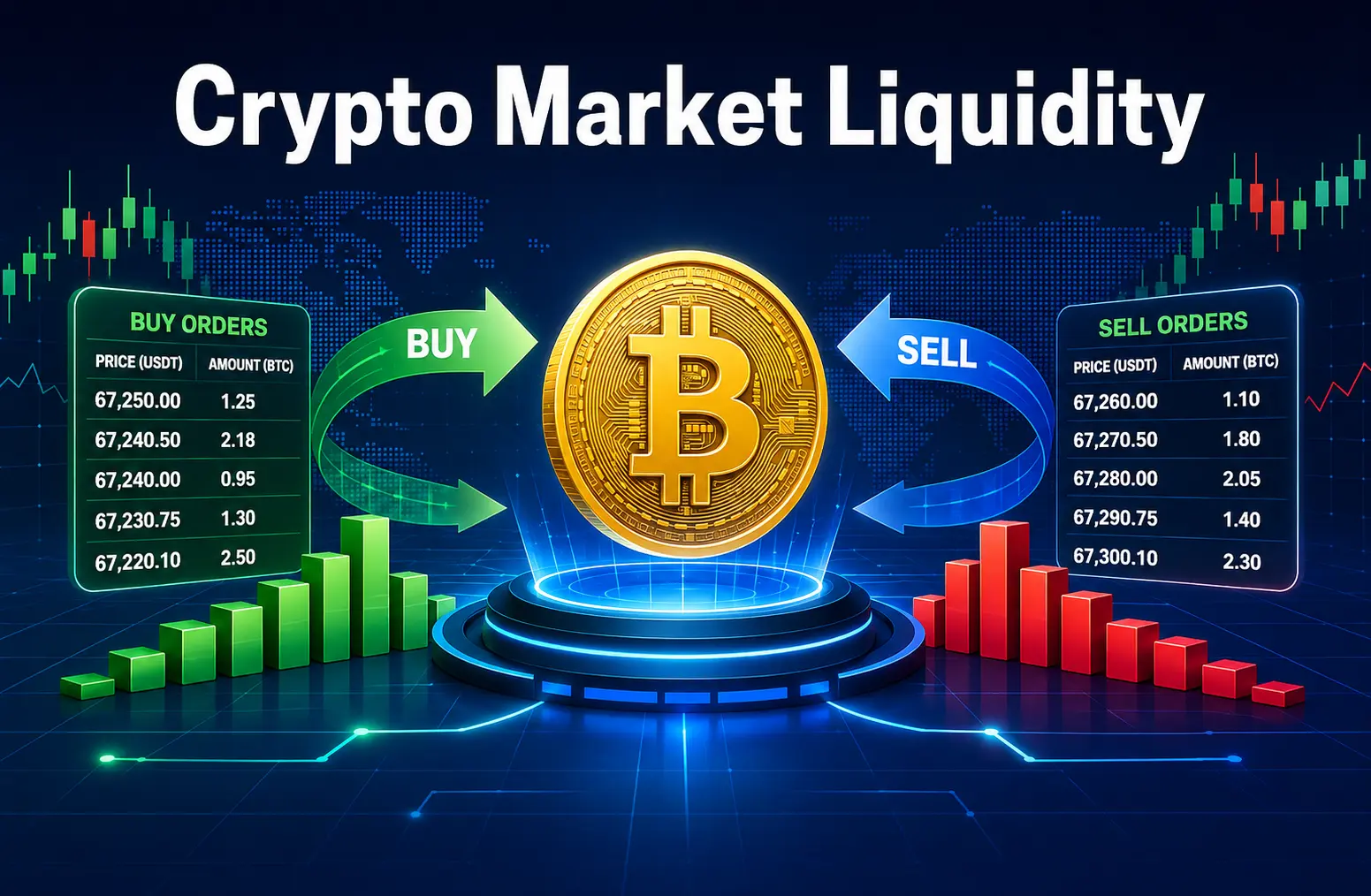
An order book is a real-time list of all the buy and sell orders for a particular trading pair on an exchange. It is split into two sides: bids, which are buy orders listed from highest to lowest price, and asks, which are sell orders listed from lowest to highest price.
When you place a market order, it gets matched against the best available price on the opposite side of the book. When you place a limit order, it simply joins the book and waits until someone else is willing to trade at your specified price. The order book essentially gives you a live snapshot of supply and demand for that asset at that exact moment.
► How Buyers and Sellers Create Market Liquidity
Liquidity is created every time someone places a buy or sell order that is not immediately matched. These resting orders form the depth of the market. The more orders sitting on both sides of the book, close to the current price, the more liquid that market is.
Market makers play an outsized role here. They continuously place both buy and sell orders around the current price, profiting from the small difference between the two while providing the depth that everyday traders rely on. Retail traders contribute too, but professional market makers and liquidity providers are usually responsible for the bulk of resting orders in any actively traded pair.
► The Role of Order Books in Price Discovery
Price discovery is the process by which a market determines the fair value of an asset based on the interaction of buy and sell orders. Every time a market order is matched against a limit order, a new price point is set, and this constant matching process is what keeps the quoted price aligned with what buyers and sellers are actually willing to pay.
In liquid markets, this happens continuously and smoothly, so the price reflects genuine supply and demand at almost every moment. In illiquid markets, price discovery can become erratic, since a single large trade might be the only thing that moves the price for an extended stretch of time, leading to prices that do not accurately reflect broader market sentiment.
► How Liquidity Changes Under Different Market Conditions
Liquidity is not fixed. It expands and contracts depending on market conditions:
- During calm, steady markets, liquidity tends to be stable as market makers confidently quote tight spreads.
- During high volatility or major news events, liquidity often thins out rapidly because market makers widen their spreads or temporarily withdraw orders to avoid being caught on the wrong side of a fast move.
- During low-activity hours or weekends, especially for smaller altcoins, liquidity can dry up simply because fewer traders are active.
- During flash crashes or sudden liquidation cascades, liquidity can vanish almost instantly, which is exactly when slippage tends to be at its worst.
This is why traders who rely on a coin’s liquidity during quiet periods can be caught off guard when that same liquidity disappears during a market shock.
Types of Liquidity in Crypto Markets
Liquidity in crypto is not a single, universal figure. It varies depending on the asset, the trading pair, the exchange, and even the specific blockchain being used.
✸ Asset and Trading Pair Liquidity
Every trading pair, such as BTC/USDT or ETH/USDC, has its own independent liquidity profile. A coin might be highly liquid when paired with a major stablecoin but far less liquid when paired with a smaller altcoin, simply because fewer traders are actively trading that specific combination.
This is an important distinction for beginners. Checking “the liquidity of Bitcoin” is not enough; you need to check the liquidity of the specific trading pair you intend to use.
✸ Exchange-Level Liquidity
Liquidity also differs from one exchange to another. A coin might have deep, tight order books on a major centralized exchange but almost no meaningful depth on a smaller platform. This is why the same asset can experience dramatically different slippage depending on where it is traded, even at the exact same moment in time.
✸ On-Chain Liquidity in DEXs
Decentralized exchanges do not use traditional order books. Instead, they rely on liquidity pools, which are smart contracts holding reserves of two or more tokens that traders swap against directly. On-chain liquidity depends entirely on how much capital has been deposited into these pools by liquidity providers.
A pool with a large amount of locked value can absorb bigger trades with less price impact, while a shallow pool can experience severe slippage from even a modest swap.
✸ CEX vs. DEX Liquidity: Key Differences
Understanding the CEX vs. DEX distinction is essential when evaluating liquidity, since the two models work in fundamentally different ways.
- Centralized exchanges rely on order books maintained by the platform, often supported by professional market makers, and typically offer deeper liquidity for major trading pairs.
- Decentralized exchanges rely on liquidity pools funded by individual liquidity providers, meaning liquidity can vary significantly from one pool to another and is influenced directly by how much capital users choose to deposit.
- CEXs generally offer faster execution and tighter spreads for high-volume pairs, while DEXs offer permissionless access and often list newer tokens long before they appear on centralized platforms, sometimes at the cost of deeper liquidity.
Both models matter, and many active traders use both, depending on what they are trying to trade and how quickly a new token needs to be accessed.
Why is Liquidity Important in Cryptocurrency Trading?
Liquidity is not just a technical detail for analysts. It has a direct, practical impact on the outcome of nearly every trade you place.
✦ Lower Slippage and Better Trade Execution
Slippage happens when your order executes at a different price than expected because there was not enough volume available at your intended price level. In liquid markets, slippage is usually minimal since there is enough depth to absorb your order close to the quoted price. In illiquid markets, even a moderately sized trade can result in a noticeably worse execution price.
✦ Tighter Bid-Ask Spreads and Fairer Pricing
The bid-ask spread is the gap between the highest price buyers are willing to pay and the lowest price sellers are willing to accept. Liquid markets tend to have narrow spreads because competition among buyers and sellers keeps prices close together. Illiquid markets often show wide spreads, which means you effectively pay a premium just to enter and exit a position.
✦ Greater Price Stability and Lower Market Impact
A liquid market can absorb large trades without significant price swings, which contributes to overall price stability. This matters not only for individual traders but for the broader health of the asset, since wild, unpredictable price swings tend to discourage long-term participation and can trigger cascading liquidations in leveraged positions.
Key Factors That Affect Crypto Market Liquidity
Liquidity does not appear out of nowhere. It is shaped by a combination of structural and behavioral factors that change over time.
➤ Trading Volume and Number of Market Participants
Generally, the more people actively trading an asset, the deeper its liquidity tends to be. High trading volume, combined with a broad and diverse base of participants, keeps order books full and spreads tight.
➤ Exchange Listings and Market Access
A token listed on multiple reputable exchanges, especially large centralized platforms, typically enjoys stronger liquidity than one confined to a single small exchange. Broader access means more traders can reach the asset, which naturally deepens the order book.
➤ Token Supply and Circulating Supply
An asset’s circulating supply plays a meaningful role in liquidity. A token with a very limited circulating supply, even if it has a large total supply locked in vesting schedules, may struggle to develop deep liquidity simply because there is not enough freely tradable quantity in the market.
➤ The Role of Stablecoins in Providing Liquidity
Stablecoins such as USDT and USDC serve as the primary trading pairs for a large share of crypto activity. Because their value stays pegged to the US dollar, they act as a stable base for pricing other assets, and their deep, consistent liquidity makes them the backbone of most exchange order books and DeFi liquidity pools.
➤ Market Sentiment, News, and Volatility
Sudden news, whether regulatory announcements, exchange hacks, or macroeconomic shifts, can cause liquidity to contract almost immediately as market makers widen spreads to protect themselves from rapid price swings. Positive sentiment, on the other hand, tends to attract more participants and can deepen liquidity over time.
➤ Regulatory Environment
Clear and supportive regulation tends to attract institutional participants and market makers, who bring substantial liquidity with them. Uncertain or hostile regulatory environments can push liquidity providers to withdraw, thinning out order books even for otherwise popular assets.
The Role of Crypto Exchanges and Market Makers in Liquidity
Liquidity does not simply happen on its own. Exchanges and dedicated market participants actively work to build and maintain it.
♦ How Crypto Exchanges Provide Liquidity
Exchanges attract liquidity by offering competitive trading fees, fast execution, strong security, and partnerships with professional market-making firms. Some exchanges also run their own internal liquidity programs, incentivizing market makers to maintain tight spreads and deep order books on specific trading pairs.
♦ What Do Crypto Market Makers Do?
Crypto liquidity providers, often operating as specialized market-making firms, continuously place both buy and sell orders around the current price of an asset. Their goal is to profit from the small spread between these orders while supplying the market with the depth that everyday traders depend on. Established firms in this space, sometimes referred to in industry discussions alongside names like GSR, a well-known crypto market maker and liquidity provider, use sophisticated algorithms to manage risk across dozens of trading pairs and exchanges simultaneously.
♦ How Market Makers Improve Trading Conditions
By constantly quoting prices on both sides of the market, professional market makers reduce spreads, absorb sudden imbalances between buyers and sellers, and help stabilize prices during periods of stress. Their presence is often the difference between a token that trades smoothly and one that suffers from erratic, unpredictable price action.
How to Measure and Check Crypto Market Liquidity
Knowing the theory behind liquidity is only useful if you can actually apply it before placing a trade. Here are the practical indicators worth checking.
► Trading Volume as a Liquidity Indicator
While not a perfect measure on its own, consistent 24-hour trading volume across multiple exchanges is a reasonable starting signal. A coin with steady, high volume across several platforms is far more likely to be genuinely liquid than one with volume concentrated on a single obscure exchange.
► Bid-Ask Spread
Check the difference between the best bid and the best ask price directly on the exchange’s order book. A spread of a few basis points typically signals strong liquidity, while a spread of several percentage points is a clear warning sign.
► Order Book Depth
Look beyond the top of the book. Check how much volume sits within a reasonable percentage of the current price, say within 1 or 2 percent. Deep order books at these levels mean you can place a meaningful trade without moving the price significantly.
► Slippage
Many exchanges show an estimated slippage percentage before you confirm a market order. If this figure jumps noticeably for a moderate order size, that is a direct sign of thin liquidity.
► Liquidity Ratios and Analytical Tools
Some analytics platforms calculate liquidity ratios that compare trading volume to market capitalization, giving a rough sense of how actively an asset trades relative to its overall size. These ratios are useful for comparing similarly sized assets against one another, though they should be used alongside order book data rather than in isolation.
► How to Check a Cryptocurrency’s Liquidity Before Trading
A practical, repeatable checklist looks like this:
- Check the 24-hour trading volume across at least two or three major exchanges, not just one.
- Open the live order book and review the bid-ask spread.
- Estimate order book depth within 1 to 2 percent of the current price.
- Test the expected slippage for the trade size you plan to use.
- Confirm the asset is listed on more than one reputable exchange or DEX pool.
Running through this quick process before every trade, especially with smaller or newer tokens, can save you from painful surprises.
What Are Crypto Liquidity Pools? DeFi Liquidity Explained
Decentralized finance introduced a completely different way of generating liquidity, one that does not rely on a traditional order book at all.
✸ How Crypto Liquidity Pools Work
A liquidity pool is a smart contract holding reserves of two or more tokens, allowing traders to swap directly against the pool rather than matching with another individual trader. Most pools use an automated market maker, or AMM, formula that automatically adjusts prices based on the ratio of tokens in the pool. As one token is bought, its price rises within the pool, and as it is sold, its price falls, creating a continuous pricing mechanism without any traditional buyers and sellers meeting directly.
✸ Liquidity Providers and LP Tokens Explained
Anyone can become a liquidity provider by depositing an equal value of two tokens into a pool. In return, they receive LP tokens representing their share of that pool. These LP tokens can later be redeemed for the underlying assets, plus a portion of the trading fees generated by the pool during that time.
✸ Impermanent Loss and Other Liquidity Pool Risks
Impermanent loss occurs when the price ratio of the two deposited tokens changes significantly compared to when they were first deposited. In this scenario, a liquidity provider may end up with less overall value than if they had simply held the two tokens separately. Other risks include smart contract vulnerabilities, pool exploits, and the possibility of extremely thin pools suffering severe price impact from even modest trades.
✸ Popular Crypto Liquidity Pool Platforms
Some of the most widely used decentralized liquidity pool platforms include Uniswap, Curve Finance, and PancakeSwap, each specializing in slightly different token pairings and pool designs, ranging from general-purpose swaps to highly efficient stablecoin-focused pools.
High vs. Low Crypto Liquidity: Key Differences and Risks
Understanding the practical difference between high and low liquidity helps put everything covered so far into context.
✦ Characteristics of High-Liquidity Crypto Markets
High-liquidity crypto markets typically show tight bid-ask spreads, deep order books across multiple exchanges, minimal slippage even on larger trades, and consistent trading activity around the clock.
✦ Characteristics of Low-Liquidity Crypto Markets
Low-liquidity markets tend to show wide, unpredictable spreads, thin order books that can be moved by a single sizable trade, noticeable slippage on even modest orders, and availability limited to one or two exchanges.
✦ How Liquidity Affects Price Stability and Volatility
Illiquid assets are inherently more volatile because there is less depth to absorb buying or selling pressure. A relatively small amount of capital entering or leaving an illiquid token can trigger an outsized price move, whereas the same capital flow would barely register in a highly liquid market like Bitcoin or Ethereum.
✦ Risks of Trading Low-Liquidity Cryptocurrencies
Trading illiquid assets carries several specific risks: difficulty exiting a position at a fair price, exposure to price manipulation by large holders, wider losses from slippage, and a higher chance of getting stuck holding an asset during a sudden liquidity crunch.
How to Trade Safely in Low-Liquidity Crypto Markets
Low-liquidity assets are not automatically bad investments, but they demand a more cautious approach.
1. Check Order Book Depth and Bid-Ask Spread Before Trading
Always review the live order book before committing capital. If the spread is wide or the depth is thin near your intended entry price, treat that as a signal to reduce your position size or wait for better conditions.
2. Use Limit Orders Instead of Large Market Orders
Limit orders let you set the exact price you are willing to accept, protecting you from unexpected slippage. Market orders in illiquid conditions can execute at prices significantly worse than what you saw on screen.
3. Avoid Trading During Low-Volume Periods
Liquidity for smaller tokens often dips further during off-peak hours. Where possible, trade during periods of higher overall market activity to benefit from deeper order books.
4. Watch for Liquidity and Price Manipulation
Thinly traded assets are more vulnerable to manipulation tactics, including coordinated buying or selling designed to trigger cascading price moves. Be especially cautious of sudden, unexplained volume spikes in low-liquidity tokens.
5. Diversify Across Liquid Assets
Rather than concentrating capital in a handful of illiquid tokens, consider keeping the bulk of a portfolio in well-established, liquid assets, and treat smaller allocations to illiquid tokens as higher-risk, higher-volatility positions.
Most Liquid vs. Least Liquid Cryptocurrencies
Comparing real examples helps make the concept of liquidity more concrete.
1. Examples of Highly Liquid Cryptocurrencies
Bitcoin and Ethereum consistently rank among the most liquid cryptocurrencies, thanks to their availability across nearly every major exchange, deep order books, and enormous, sustained trading interest. Major stablecoins like Tether and USD Coin are also exceptionally liquid, since they function as the primary trading pairs for a large share of overall crypto activity. Several large-cap altcoins, including established layer-1 tokens, also maintain strong liquidity due to broad exchange listings and active trading communities.
2. Examples of Low-Liquidity Cryptocurrencies
Newly launched tokens, small-cap altcoins listed on only one or two exchanges, and assets with very limited circulating supply typically fall into the low-liquidity category. These tokens can experience dramatic price swings from relatively small trades and often carry wide bid-ask spreads.
3. How to Compare Cryptocurrency Liquidity
When comparing two cryptocurrencies, look beyond market capitalization alone. Compare trading volume across multiple exchanges, check order book depth on each platform where the asset trades, and review the bid-ask spread for the specific trading pair you plan to use. A coin with a smaller market cap but consistent, well-distributed volume can sometimes be more liquid in practice than a larger, more thinly traded asset.
Conclusion
Crypto market liquidity is one of the most practical concepts any trader can learn, because it directly affects the price you actually pay or receive on every single trade. It is shaped by order book depth, trading volume, exchange availability, and the constant activity of market makers and liquidity providers working behind the scenes.
Before placing your next trade, take a moment to check the order book, review the bid-ask spread, and estimate slippage for your intended trade size. This simple habit, more than any single indicator, will help you avoid the costly surprises that catch so many beginners off guard. As always, pairing this knowledge with basic safety practices, including the importance of crypto wallet security and understanding the difference between a hot wallet vs cold wallet for storing your assets, will serve you well as you continue building experience in these markets. Whether you trade through crypto exchange apps or a desktop platform, liquidity awareness should be part of every decision you make.
FAQs
What is Crypto Market Liquidity?
Crypto market liquidity is the ease with which a digital asset can be bought or sold without causing a significant change in its price. It reflects the depth of buy and sell orders available in the market at any given moment.
Why is Liquidity Important in Cryptocurrency Trading?
Liquidity determines how efficiently you can enter or exit a trade. High liquidity means lower slippage, tighter spreads, and more stable pricing, while low liquidity increases the risk of unfavorable trade execution.
What is the Difference Between Crypto Liquidity and Trading Volume?
Trading volume measures how much of an asset has already been traded over a period, while liquidity measures how easily it can be traded right now based on standing order book depth. High volume does not always guarantee high liquidity.
How Can You Check the Liquidity of a Cryptocurrency?
You can check liquidity by reviewing 24-hour trading volume across multiple exchanges, examining the bid-ask spread, assessing order book depth near the current price, and testing expected slippage for your intended trade size.
What Makes a Cryptocurrency Highly Liquid?
A highly liquid cryptocurrency typically has tight bid-ask spreads, deep order books, consistent high trading volume across several exchanges, and wide availability across both centralized and decentralized platforms.
What Happens When a Cryptocurrency Has Low Liquidity?
Low liquidity leads to wider bid-ask spreads, higher slippage, greater price volatility, and increased vulnerability to manipulation, since even modest trades can move the price significantly.
How Does Liquidity Affect Crypto Prices and Slippage?
In liquid markets, prices move smoothly and trades execute close to the quoted price. In illiquid markets, the lack of order book depth means trades can execute at noticeably worse prices, which is what causes slippage.
What Are Crypto Liquidity Pools and How Do They Work?
Crypto liquidity pools are smart contracts holding reserves of two or more tokens, used by decentralized exchanges to facilitate trading without a traditional order book. Liquidity providers deposit tokens into these pools and earn a share of trading fees in return.
What is the Difference Between CEX and DEX Liquidity?
Centralized exchanges rely on order books, often supported by professional market makers, typically offering deeper liquidity for major pairs. Decentralized exchanges rely on liquidity pools funded by individual providers, with liquidity varying significantly from pool to pool.
How Can You Trade Safely in a Low-Liquidity Crypto Market?
Trade safely by checking order book depth and spreads beforehand, using limit orders instead of market orders, avoiding low-volume trading periods, watching for signs of manipulation, and keeping the bulk of your portfolio in more liquid assets.