
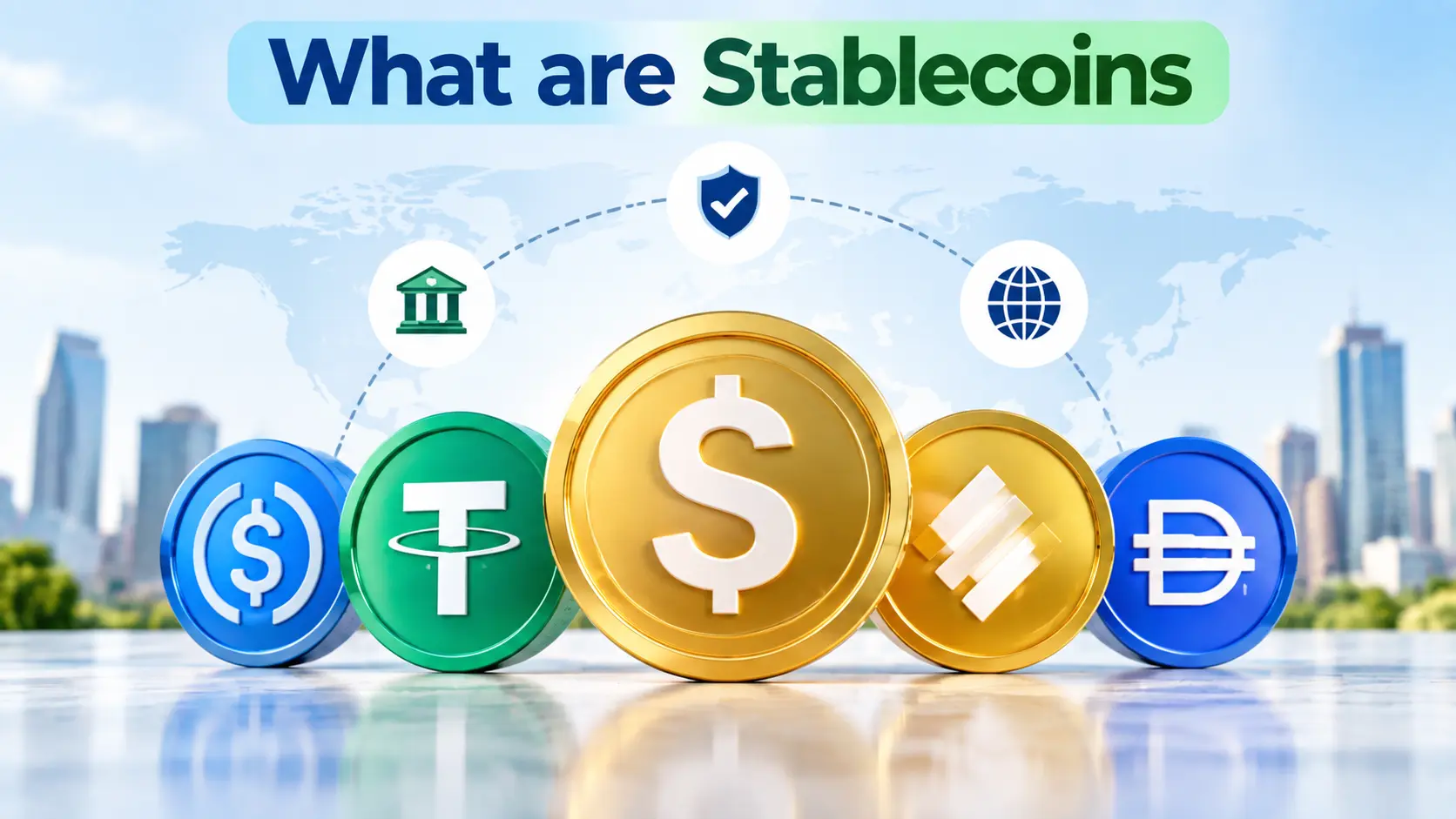
If you’ve ever watched Bitcoin swing 10% in a single day and wondered whether crypto could ever work for everyday payments, stablecoins are the answer the industry built. A stablecoin is a type of cryptocurrency designed to hold a steady value, usually pegged to the US dollar, by backing each token with reserves or code-based mechanisms.
That single idea — price stability on a blockchain — has turned stablecoins into one of the most-used financial tools in crypto. As of mid-2026, the total stablecoin market sits at roughly $310–$320 billion, with monthly transaction volume in the trillions of dollars, according to data from DefiLlama and CoinMarketCap. This guide breaks down what stablecoins are, how they actually work under the hood, which types exist, and what you need to know before using one — without the jargon.
What Are Stablecoins?
A stablecoin is a digital asset built on a blockchain that’s designed to maintain a fixed value, most often $1 USD, by being backed with reserves, collateral, or algorithmic supply controls. Unlike Bitcoin or Ethereum, whose prices are set purely by market demand, a stablecoin’s whole design goal is to not move.
The stablecoin meaning boils down to one trade-off: you give up the speculative upside of a typical cryptocurrency in exchange for price predictability. That predictability is what makes stablecoins useful for payments, savings, and trading, rather than just speculation.
How Stablecoins Differ From Bitcoin and Other Cryptocurrencies
The core difference is intent. Bitcoin and most cryptocurrencies are open-supply, market-priced assets — their value comes purely from what buyers and sellers agree to pay, which is why prices can move sharply in short windows. Stablecoins are engineered against that volatility on purpose.
| Feature | Bitcoin / Volatile Crypto | Stablecoins |
|---|---|---|
| Price driver | Open market supply and demand | Pegged to a reference asset (usually USD) |
| Typical use | Store of value, speculation | Payments, trading, savings, remittances |
| Daily price swings | Can be significant | Typically fractions of a cent |
| Backing | None (network-secured only) | Reserves, collateral, or algorithms |
| Supply | Often fixed or scheduled | Expands/contracts with demand |
Both run on blockchain technology and can move peer-to-peer without a bank, but only one of them is designed to sit still in price.
Why Stablecoins Were Created (Solving Crypto’s Volatility Problem)
Stablecoins exist because crypto’s biggest strength — a decentralized, always-on network — was also its biggest weakness for everyday use. Nobody wants to price a coffee in an asset that could be worth 8% less by the time it clears.
Traders needed a way to exit volatile positions without leaving the blockchain entirely (cashing out to a bank account and back is slow and costly). Tether’s USDT, launched in 2014, solved that by offering a token that traded 1:1 with the dollar but still moved at blockchain speed. That single use case — a stable “parking spot” for crypto value — snowballed into the payments, lending, and savings ecosystem stablecoins support today.
How Do Stablecoins Work?
Stablecoins maintain their value through a mix of backing assets, market incentives, and blockchain infrastructure. Fiat-backed coins hold real dollars or Treasury bills in reserve and let large holders redeem 1:1; crypto-backed coins over-collateralize with volatile assets; algorithmic ones adjust token supply. Smart contracts handle issuance, transfers, and (for some models) automatic supply changes.
The Role of Reserves and Collateral
Most stablecoins by market share — including USDT and USDC — are backed by reserve assets held by the issuing company. For every token in circulation, the issuer is supposed to hold an equivalent value in cash, short-term US Treasury bills, or similarly liquid instruments.
This reserve model is why “collateralization” and “reserve assets” matter so much in stablecoin discussions. If reserves are thin, mismanaged, or invested in illiquid assets, the peg is only as strong as the issuer’s honesty and transparency. That’s why independent attestations and audits of reserves have become a major trust signal in the industry.
Smart Contracts and Blockchain Technology Behind Stablecoins
Stablecoins are issued as tokens on blockchain networks like Ethereum, Solana, Tron, and Polygon, using smart contracts — self-executing code that governs minting, burning, and transferring tokens. When you buy USDC, for example, a smart contract mints new tokens; when it’s redeemed for dollars, the contract burns (destroys) an equivalent amount.
This on-chain structure is what enables stablecoin transactions to move globally, 24/7, without a bank intermediary, and it’s the same infrastructure that powers decentralized finance (DeFi) lending, trading, and yield products.
How Stablecoin Issuers Maintain Stability and Generate Revenue
Issuers keep the peg stable mainly through redemption guarantees: large institutional clients can typically exchange the stablecoin for actual dollars 1:1, which keeps arbitrageurs correcting small price deviations in the open market.
As for revenue, issuers like Tether and Circle don’t charge users transaction fees for holding stablecoins. Instead, they earn interest on the reserves backing the tokens — largely by holding short-term US Treasury bills. With hundreds of billions of dollars in reserves and elevated interest rates in recent years, this has made fiat-backed stablecoin issuance a highly profitable business model.
Peg Mechanisms: Arbitrage and Algorithmic Supply Adjustments
What makes stablecoins stable comes down to two main mechanisms:
- Arbitrage-driven stability: If a stablecoin trades below $1, traders buy it cheap and redeem it for $1 with the issuer, pocketing the difference — this buying pressure pushes the price back up. If it trades above $1, traders mint new tokens at $1 and sell them at the higher market price, increasing supply and pushing the price back down.
- Algorithmic supply adjustments: Some stablecoins use code instead of (or alongside) reserves, automatically expanding or contracting token supply based on demand signals to defend the peg.
Fiat-backed coins rely mostly on the first mechanism; algorithmic stablecoins rely mostly on the second — which, as later sections cover, has proven far less reliable in practice.
Types of Stablecoins and How They Are Backed
There are four main types of stablecoins, each backed differently: fiat-collateralized (cash and cash equivalents), crypto-collateralized (other cryptocurrencies, over-collateralized), commodity-backed (physical assets like gold), and algorithmic (code-based supply control, with no direct collateral). A fifth category, hybrid stablecoins, blends two or more of these approaches.
Fiat-Collateralized Stablecoins
Fiat-backed stablecoins are backed 1:1 by traditional currency and cash-equivalent reserves held by a central issuer — think dollars in a bank account or short-term Treasury bills. USDT and USDC are the two dominant examples, together making up close to 80–95% of the entire stablecoin market by supply, depending on the tracker used.
Pros: Simple to understand, highly liquid, generally the most price-stable category.
Cons: Centralized — you’re trusting the issuer’s solvency, custody practices, and reserve disclosures.
Crypto-Collateralized Stablecoins
Crypto-backed stablecoins are backed by other cryptocurrencies (like ETH) locked in smart contracts, rather than fiat currency. Because crypto collateral is itself volatile, these stablecoins are over-collateralized — meaning a user might need to lock $150 worth of ETH to mint $100 worth of the stablecoin, giving the system a buffer against price drops.
Dai (DAI) from the Sky Protocol (formerly MakerDAO) is the leading example. If collateral value falls too close to the minted amount, the smart contract automatically liquidates the position to protect the peg.
Pros: More decentralized — no single company controls the reserves.
Cons: Capital-inefficient, and still exposed to sharp crypto market crashes that can trigger cascading liquidations.
Commodity-Backed Stablecoins
Commodity-backed stablecoins are pegged to physical assets, most commonly gold, with each token representing a claim on a specific quantity (like one troy ounce) held in a vault. Examples include Tether Gold (XAUT) and Pax Gold (PAXG).
These aren’t pegged to $1 — their value floats with the underlying commodity price — but they offer the same blockchain-based transferability and fractional ownership benefits as other stablecoins, letting people trade gold exposure without physical delivery.
Algorithmic Stablecoins
Algorithmic stablecoins use code-driven supply expansion and contraction — rather than collateral — to try to hold a peg, often through a second, related token that absorbs volatility. When demand rises, the algorithm mints more tokens; when demand falls, it burns tokens or incentivizes selling the companion token to restore balance.
This category has the weakest track record of the four. The collapse of TerraUSD (UST) in May 2022, covered in detail later in this guide, wiped out roughly $40 billion in value in days and remains the industry’s clearest cautionary tale about algorithmic designs that rely purely on market confidence rather than hard collateral.
Hybrid Stablecoins
Hybrid stablecoins combine two or more stabilization methods — for example, partial fiat reserves plus algorithmic supply adjustments, or crypto collateral plus a fiat-backed buffer — to try to capture the benefits of each approach while reducing single-point failure risk. Frax (FRAX) is a well-known example that has evolved through several hybrid designs. These models are less common than pure fiat-backed coins but continue to be an active area of DeFi experimentation.
Popular Stablecoins in the Market
Tether (USDT)
Tether (USDT) is the largest and oldest major stablecoin, launched in 2014, and remains the dominant stablecoin by market capitalization — commanding roughly 58–60% of total stablecoin supply as of mid-2026, according to market trackers like CoinMarketCap and DefiLlama. USDT is fiat-collateralized, backed primarily by cash, cash equivalents, and short-term US Treasury bills, and is available across many blockchain networks, including Ethereum, Tron, and Solana.
Tether publishes quarterly attestations of its reserves rather than full independent audits, which has historically drawn scrutiny — though the company has significantly increased reserve transparency and Treasury holdings in recent years. You can check Tether’s own reserve disclosures on the Tether official website for the latest figures.
USD Coin (USDC)
USD Coin (USDC), issued by Circle, is the second-largest stablecoin, holding roughly 23–24% of total market supply. USDC is also fiat-collateralized and is widely regarded as one of the more transparent major stablecoins, with monthly attestations from independent accounting firms and reserves held mostly in cash and short-dated US Treasuries.
Circle went public in 2025, adding a layer of public-market financial disclosure that’s uncommon among stablecoin issuers, which has helped position USDC as a preferred option for institutions and regulated businesses.
Dai (DAI)
Dai (DAI), issued by the Sky Protocol (the rebranded MakerDAO), is the largest crypto-collateralized, decentralized stablecoin. Rather than one company holding reserves, DAI is backed by a mix of crypto assets and, increasingly, tokenized real-world assets locked in transparent, on-chain smart contracts governed by a decentralized community.
DAI trades at a small market share compared to USDT and USDC but plays an outsized role in DeFi, where it’s widely used as collateral and a base trading pair.
Other Notable Stablecoins
Several other stablecoins have carved out meaningful niches:
- PYUSD (PayPal USD) — issued by PayPal, aimed at mainstream payments and integrated directly into PayPal and Venmo.
- USDe (Ethena) — a synthetic dollar using a delta-neutral hedging strategy rather than traditional reserves.
- USDS (Sky Dollar) — the successor token in the Sky Protocol ecosystem, alongside DAI.
- RLUSD (Ripple USD) — issued by Ripple, targeting cross-border payment use cases.
- USDG (Global Dollar) — a bank-and-fintech-backed stablecoin initiative aimed at institutional adoption.
Benefits of Using Stablecoins
Faster and Cheaper International Transactions
Stablecoin payments can settle in seconds to minutes for a fraction of a cent to a few dollars in network fees, compared to traditional international wire transfers that often take 1–5 business days and charge $25–$50 or more per transfer. For cross-border transactions and remittances, this speed and cost difference is one of the single biggest drivers of real-world stablecoin adoption.
Reduced Cryptocurrency Price Volatility
Stablecoins let crypto users move value between assets or wait out market turbulence without fully exiting the crypto ecosystem back into a bank account. A trader closing a Bitcoin position can settle into USDT or USDC in seconds, preserving dollar value while staying on-chain and ready to re-enter the market instantly.
Access to Decentralized Finance (DeFi)
Stablecoins are the primary medium of exchange and collateral type across DeFi lending, borrowing, and trading platforms. Their price stability makes them far more practical than volatile tokens for use cases like collateralizing a loan or providing liquidity to a trading pool, where sudden price swings could trigger unwanted liquidations.
Improved Financial Inclusion
In countries with unstable local currencies or limited banking infrastructure, stablecoins offer a way to hold dollar-denominated value and transact digitally using only a smartphone and internet connection — no traditional bank account required. This has driven notable stablecoin adoption in parts of Latin America, Sub-Saharan Africa, and South Asia as a hedge against local currency devaluation.
Earning Yield on Stablecoin Holdings
Beyond simply holding stablecoins, many platforms let users lend them out or supply them to liquidity pools to earn stablecoin interest rates, often ranging from low single digits to higher rates depending on platform and market conditions. It’s worth noting that yield always carries counterparty and smart contract risk — a higher advertised rate typically means higher underlying risk, not free money.
Risks and Challenges of Stablecoins
Reserve Transparency and Counterparty Risks
The core risk with fiat-backed stablecoins is trust: you’re relying on the issuer to actually hold the reserves it claims, invest them conservatively, and honor redemptions. Attestations (point-in-time reserve snapshots) are common, but they’re not the same as full audits, and the difference matters if an issuer’s claims don’t match reality.
Regulatory Uncertainty and Compliance Challenges (GENIUS Act, MiCA & Global Rules)
Stablecoin regulation is actively taking shape but remains incomplete in several major markets as of late 2026. In the US, the GENIUS Act — signed into law in July 2025 — created the first comprehensive federal framework for “payment stablecoins,” requiring 1:1 reserve backing in cash or short-term Treasuries, licensing for issuers, and legal priority for token holders if an issuer becomes insolvent. However, US regulators missed the law’s one-year deadline to finalize implementing rules, with the Federal Reserve, OCC, FDIC, and NCUA still working through proposals as of mid-2026. Full compliance is required no later than January 18, 2027, regardless of regulatory delays.
In the European Union, the Markets in Crypto-Assets Regulation (MiCA) already imposes licensing, reserve, and disclosure requirements on stablecoin issuers (categorized as e-money tokens and asset-referenced tokens) operating in the EU. Other jurisdictions, including the UK, Singapore, and Hong Kong, have introduced or are finalizing their own stablecoin-specific frameworks.
For businesses and individual users, this patchwork means: rules differ meaningfully by country, requirements are still evolving even in the most advanced markets like the US, and compliance obligations can change with little notice — so anyone using stablecoins for business purposes should track regulatory developments in their jurisdiction rather than assume today’s rules are final.
Depegging and Liquidity Risks
“Depegging” happens when a stablecoin’s market price drifts meaningfully away from its intended $1 value — sometimes briefly, sometimes catastrophically. Minor depegs (a fraction of a cent) happen regularly and usually self-correct through arbitrage within minutes or hours. Severe depegs are rarer but far more damaging, and are typically triggered by a loss of confidence in the issuer’s reserves, a broader market panic, or a fundamental flaw in the stability mechanism itself.
Case Study: What Happened to TerraUSD (UST)
TerraUSD (UST) was an algorithmic stablecoin that maintained its peg through a mint-and-burn relationship with a companion token, LUNA, rather than holding hard collateral. In May 2022, a large UST sell-off broke this delicate balance: as UST fell below $1, the algorithm minted enormous quantities of LUNA to try to restore the peg, which crashed LUNA’s price and destroyed the entire system’s underlying value in days.
The collapse erased an estimated $40 billion in combined value and remains the largest stablecoin failure to date. It’s the primary reason algorithmic stablecoins are now viewed with far more caution by both users and regulators, and it directly shaped stricter collateral requirements in frameworks like the GENIUS Act and MiCA.
Smart Contract and Security Risks
Because most stablecoins operate through smart contracts, they inherit blockchain-level risks: coding bugs, exploited vulnerabilities, or bridge hacks (when moving tokens between blockchain networks) can all result in losses, even for well-collateralized stablecoins. Choosing widely audited, established stablecoins and reputable platforms reduces — but never fully eliminates — this risk.
Real-World Use Cases of Stablecoins
Cross-Border Payments and Remittances
Migrant workers and international businesses increasingly use stablecoins to send money home or pay overseas suppliers, bypassing slow, fee-heavy correspondent banking networks. A worker sending remittances via stablecoin can often settle a transfer in minutes for a small fraction of the cost of traditional money transfer services.
Trading, Hedging, and DeFi Applications
On cryptocurrency exchanges, stablecoins serve as the primary base pair for trading — letting users move in and out of positions without converting back to fiat currency. In DeFi, stablecoins are used as collateral for loans, liquidity in automated market makers, and a relatively low-volatility way to earn yield.
Everyday Payments and Digital Transactions
Merchants and payment processors are increasingly integrating stablecoin payment options, letting customers pay directly from a crypto wallet with near-instant settlement and lower processing fees than traditional card networks. Platforms like PayPal and Visa have both built stablecoin settlement capabilities into parts of their infrastructure.
Business and Institutional Use Cases
Corporate treasurers use stablecoins for 24/7 cash management, cross-border supplier payments, and payroll for globally distributed teams — use cases that don’t require crypto speculation, just faster and cheaper money movement. This institutional demand, rather than retail trading, has been a major driver of stablecoin transaction volume growth in 2025 and 2026.
Are Stablecoins Safe to Use?
Stablecoin safety depends heavily on which stablecoin and platform you use — not on stablecoins as a category. Major, transparent, fiat-backed stablecoins like USDC and USDT have strong track records for maintaining their peg, but risks around reserve transparency, regulation, and smart contract security mean no stablecoin is entirely risk-free, and users should treat them as digital assets rather than guaranteed cash equivalents.
Factors That Determine Stablecoin Safety
- Reserve quality and transparency — cash and short-term Treasuries are safer than illiquid or opaque holdings.
- Audit and attestation frequency — regular, independent verification builds trust.
- Regulatory status — licensed, regulated issuers face more oversight and accountability.
- Track record — how the stablecoin performed during past market stress (like the 2022 crypto downturn).
- Redemption mechanism — how easily and reliably large holders can redeem tokens for cash.
Importance of Choosing Trusted, Regulated Stablecoins
Sticking to established, well-capitalized, and increasingly regulated stablecoins — rather than newer or unaudited tokens promising unusually high yields — significantly reduces exposure to depegging and issuer-failure risk. As frameworks like the GENIUS Act and MiCA phase in, licensed and compliant stablecoins are likely to become the practical default for both consumers and businesses.
How Users Can Reduce Stablecoin Risks
- Diversify holdings across more than one reputable stablecoin rather than concentrating risk in a single issuer.
- Store funds in a secure, self-custodied wallet rather than leaving large balances on exchanges.
- Read reserve attestation reports periodically for any stablecoin you hold long-term.
- Be skeptical of unusually high stablecoin interest rates, which often signal higher underlying risk.
- Keep some funds in traditional savings alongside crypto holdings — a principle worth understanding through the broader lens of saving vs investing.
How to Buy, Store, and Use Stablecoins Safely
How to Buy Stablecoins
Stablecoins can be purchased on most major cryptocurrency exchanges using a bank transfer, debit card, or by trading another cryptocurrency for them. The general process: create an account on a regulated exchange, complete identity verification, deposit funds, and place a buy order for the stablecoin of your choice (USDT and USDC are the most widely available).
If you’re new to the space, it’s worth understanding the practical difference between CEX and DEX before choosing where to trade, since centralized and decentralized exchanges handle custody, fees, and verification very differently.
Choosing a Secure Wallet and Storage Best Practices
Once purchased, stablecoins can stay on an exchange or be moved to a personal crypto wallet for greater control. For anything beyond small, active-trading balances, moving funds to a wallet you control is generally safer than leaving them on an exchange. It also helps to understand hot wallet vs. cold wallet options, since cold storage offers stronger protection for long-term holdings, and to review why crypto wallet security is important before moving meaningful amounts.
Common Mistakes to Avoid
- Sending to the wrong network or address — a common and often irreversible error; see this guide on what to do if you sent crypto to the wrong wallet address.
- Confusing a wallet with an exchange account — understanding crypto wallet vs crypto exchange prevents this mix-up.
- Ignoring network fees and congestion, which vary significantly depending on the blockchain used.
- Chasing high-yield platforms without checking their collateral, licensing, or track record.
- Overlooking liquidity conditions — for large trades, it helps to understand crypto market liquidity so you’re not caught off guard by slippage.
Conclusion
Stablecoins solve a genuinely practical problem: they bring the speed and openness of blockchain technology to a form of money that doesn’t swing wildly in price. Whether backed by fiat reserves, crypto collateral, or a mix of mechanisms, the best-performing stablecoins share the same traits — transparent reserves, a strong redemption track record, and growing regulatory oversight.
As frameworks like the GENIUS Act and MiCA mature through 2026 and into 2027, expect the stablecoin market to keep consolidating around licensed, well-audited issuers, while use cases expand well beyond crypto trading into everyday payments, remittances, and corporate treasury management. For most people, the practical takeaway is simple: stick to established, transparent stablecoins, understand what backs them, and treat yield offers with the same scrutiny you’d apply to any other financial product.
FAQs
What Are Stablecoins and How Do They Work?
Stablecoins are cryptocurrencies designed to hold a steady value, usually $1, by being backed with reserves like cash and Treasury bills, collateralized with other crypto assets, or stabilized through algorithmic supply adjustments on a blockchain.
What Backs the Value of a Stablecoin?
It depends on the type: fiat-backed stablecoins (like USDT and USDC) are backed by cash and cash-equivalent reserves, crypto-backed stablecoins (like DAI) are backed by over-collateralized crypto assets, and algorithmic stablecoins rely on code-based supply adjustments instead of direct collateral.
Why Do Stablecoins Lose Their Peg?
Stablecoins can depeg due to a loss of confidence in the issuer’s reserves, extreme market volatility, low liquidity, or — in the case of algorithmic models — a fundamental design flaw that fails under heavy selling pressure, as seen with TerraUSD in 2022.
Is USDT Safe and Fully Backed?
Tether publishes quarterly attestations claiming full 1:1 backing, primarily in cash and short-term US Treasuries, and has significantly increased reserve transparency in recent years, though it still relies on attestations rather than full independent audits, which some analysts flag as a lingering trust gap.
What Is the Difference Between USDT and USDC?
USDT (Tether) is the largest stablecoin with the deepest liquidity across exchanges, while USDC (Circle) is generally viewed as more transparent, with more frequent independent attestations and a stronger institutional and regulatory compliance focus.
Are Stablecoins Regulated and Legal?
Stablecoins are legal in most major markets and increasingly regulated: the US GENIUS Act (signed 2025) and the EU’s MiCA framework both impose licensing, reserve, and disclosure requirements on issuers, though full US implementation isn’t required until January 2027.
Can You Lose Money Holding Stablecoins?
Yes — while designed to hold steady value, stablecoins can depeg, an issuer could fail to honor redemptions, or a platform holding your stablecoins could be hacked, so they carry real (if generally lower) risk compared to typical bank deposits.
Are Stablecoins Safe for Beginners?
Established, transparent, fiat-backed stablecoins like USDC and USDT are reasonable starting points for beginners, but new users should stick to reputable exchanges, understand basic wallet security, and avoid unfamiliar tokens promising unusually high returns.
What Happens If a Stablecoin Issuer Fails?
If a stablecoin issuer becomes insolvent, outcomes depend on reserve quality and legal protections — frameworks like the GENIUS Act now grant token holders priority claims over other creditors in the US, but recovery isn’t guaranteed and could take time, especially for less-regulated issuers.
What Is the Future of Stablecoins?
The future of stablecoins points toward tighter regulation, greater institutional adoption for payments and treasury management, and continued market concentration among transparent, well-capitalized issuers — with some analysts projecting the total stablecoin market could reach $1–2 trillion by 2028–2030 as banks and payment processors formally integrate stablecoin rails.
Disclaimer –
The information provided in this article is intended for general educational and informational purposes only and should not be interpreted as financial, investment, legal, or tax advice. Stablecoins, cryptocurrencies, and blockchain-based assets are subject to market volatility, regulatory changes, and technical risks — including but not limited to depegging, reserve insufficiency, and smart contract vulnerabilities. Past performance or stability of any stablecoin does not guarantee future results. Regulatory frameworks such as the GENIUS Act and MiCA are still evolving and may change without notice. We do not endorse or recommend any specific stablecoin, exchange, or platform mentioned in this article. Readers are strongly advised to conduct their own independent research (DYOR) and consult a licensed financial advisor before making any investment or trading decisions. The Digital Articles and its authors accept no liability for any financial loss or damage arising from the use of this content.
If you found this blog helpful, share it with your friends and family — it might help them understand stablecoins better too.