
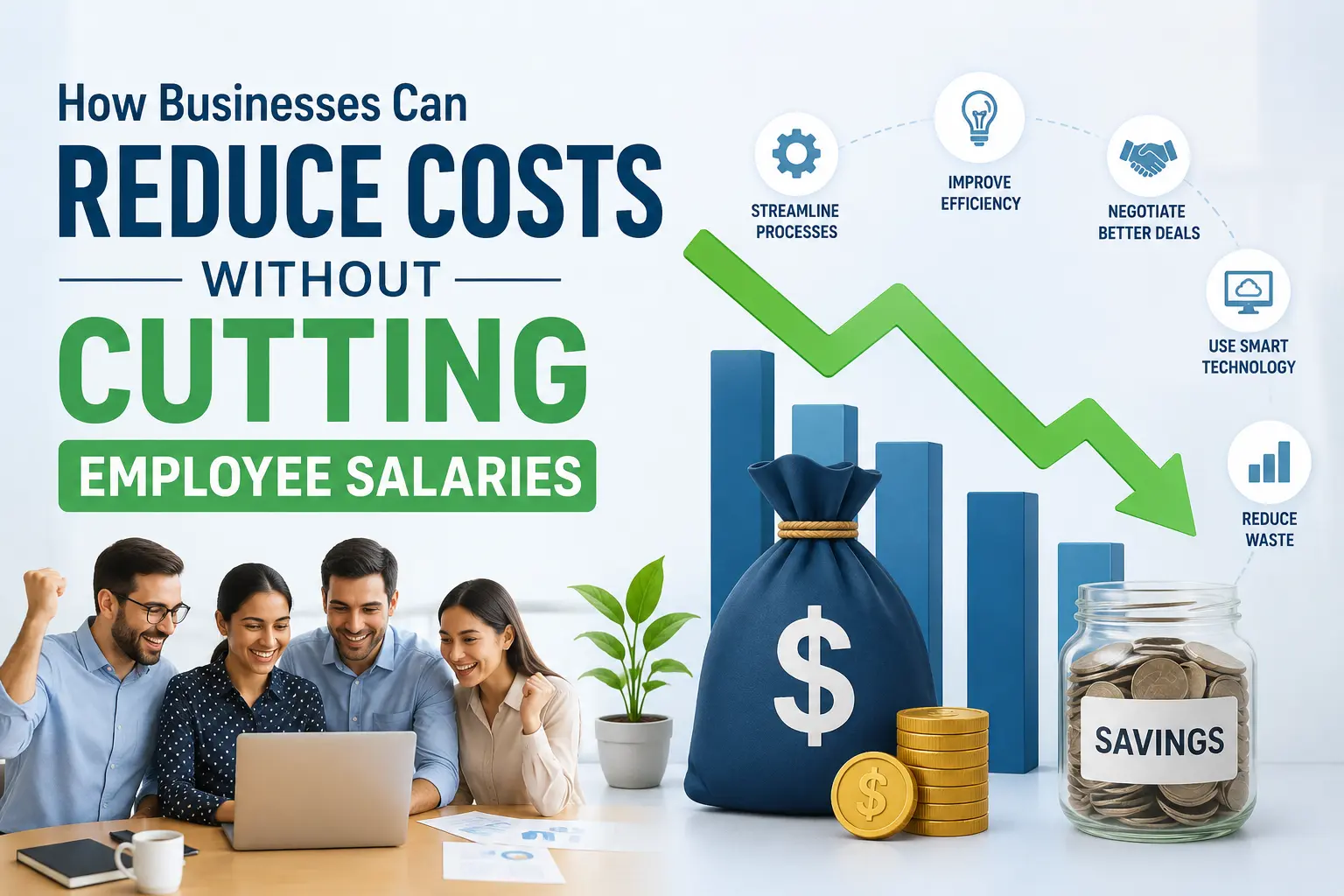
When revenue tightens, salary cuts are usually the first idea on the table — and often the worst one. Businesses can reduce costs without cutting employee salaries by focusing on operational efficiency, smarter vendor management, automation, and eliminating waste instead of trimming pay. This approach protects morale, retains talent, and builds a financially healthier company for the long run.
This guide walks through practical, proven cost reduction strategies for businesses that don’t put employee paychecks on the chopping block. Whether you run a five-person startup or manage a mid-sized company, you’ll find a structured way to think about business cost optimization — from process improvements and technology adoption to vendor negotiation and workplace culture — so you can strengthen your bottom line while keeping your team intact and motivated.
Salary cuts feel like a quick fix, but they tend to create slower, more expensive problems: disengaged employees, higher turnover, and a damaged employer brand. The businesses that come out of financial pressure stronger are usually the ones that treated cost management as an ongoing discipline, not a one-time emergency reaction. That’s exactly what this article covers.
Cost Cutting vs Cost Optimization: Understanding the Difference
Cost cutting and cost optimization are not the same thing. Cost cutting is a reactive, short-term reduction in spending — often across the board — while cost optimization is a strategic, ongoing process of improving how resources are used to get more value for the same or lower spend. Understanding this difference is the foundation of sustainable business expense management.
What is Traditional Cost Cutting?
Traditional cost cutting is a reactive approach where businesses reduce expenses quickly, usually in response to a financial crisis, without fully analyzing long-term consequences. It typically involves salary cuts, layoffs, freezing hiring, or slashing budgets across departments regardless of their actual performance or value.
This approach can produce fast, visible savings, but it often comes with hidden costs:
- Reduced employee morale and trust
- Loss of institutional knowledge when experienced staff leave
- Damage to product quality or customer service
- A shrinking talent pool that’s harder to rebuild later
Traditional cost cutting treats every expense the same way — as something to reduce — instead of asking which expenses actually drive growth and which ones are pure waste.
What is Smart Cost Optimization?
Smart cost optimization is a data-driven, ongoing process of analyzing spending patterns to eliminate waste, renegotiate terms, and improve efficiency, while protecting the investments that drive revenue and employee performance. It’s less about “spending less everywhere” and more about “spending better.”
Smart cost optimization typically includes:
- Reviewing every expense category against its actual business impact
- Automating manual, repetitive processes
- Renegotiating vendor contracts based on current usage
- Reallocating budget toward high-return activities
- Continuously monitoring costs rather than reviewing them once a year
This method protects employee compensation and critical growth investments while trimming the costs that don’t contribute meaningfully to outcomes.
Why Businesses Are Choosing Sustainable Cost Management
More companies are shifting toward sustainable cost reduction because reactive cuts tend to create repeat problems — the same crisis returns a year or two later, often worse, because the underlying inefficiencies were never fixed. Sustainable cost management treats expense control as a permanent business function rather than an emergency response.
This shift is driven by a few realities:
- Rehiring and retraining after layoffs is expensive and slow
- Employees who survive layoffs often experience lower engagement and productivity
- Customers notice when service quality drops due to understaffing
- Long-term financial management strategies create more predictable, resilient businesses
Sustainable practices build a cushion — including a stronger emergency fund — so the business doesn’t have to choose between paying people fairly and staying afloat during the next downturn.
Why Businesses Should Avoid Cutting Employee Salaries
Salary cuts are one of the costliest “savings” decisions a business can make. They reduce morale and productivity almost immediately, increase voluntary turnover among top performers, damage the company’s reputation as an employer, and often cost more in rehiring and lost output than the money they save. Protecting pay while optimizing elsewhere is nearly always the smarter financial move.
Impact of Salary Cuts on Employee Morale and Productivity
Pay cuts send a clear signal to employees: the company sees them as an expense line, not an investment. This directly affects employee morale, engagement, and day-to-day output.
Common effects include:
- Decreased discretionary effort — employees do only what’s required, not what’s possible
- Increased absenteeism and disengagement
- Slower decision-making as trust in leadership drops
- Reduced willingness to take initiative or suggest improvements
Even employees who understand the business reasoning behind a pay cut often experience a lasting shift in how much effort and loyalty they’re willing to give. Workforce productivity rarely recovers to pre-cut levels quickly, even after pay is restored.
How Salary Cuts Increase Employee Turnover Costs
Salary reductions push your best people — the ones with options — to look elsewhere first. Losing them triggers a chain of expensive events: recruiting, interviewing, onboarding, training, and a productivity gap while the new hire ramps up. These employee turnover costs frequently exceed what the salary cut actually saved.
A simplified way to see the trade-off:
| Action | Short-Term Impact | Hidden Long-Term Cost |
|---|---|---|
| Salary cut | Immediate payroll savings | Turnover, disengagement, recruiting costs |
| Process optimization | Slower initial savings | Compounding efficiency gains over time |
| Vendor renegotiation | Moderate, quick savings | Minimal downside if managed well |
| Automation investment | Upfront cost | Long-term operational savings |
When top performers leave after a pay cut, the business often ends up paying more in recruiting fees and onboarding time than it saved in reduced salaries — while also losing institutional knowledge that’s hard to replace.
Damage to Employer Brand and Workplace Trust
Salary cuts don’t stay internal. Employees talk, and platforms like Glassdoor, LinkedIn, and industry networks make that conversation public. Once a company gets a reputation for cutting pay under pressure, it becomes harder to attract quality candidates — even after the crisis passes.
This damages workplace trust in a few specific ways:
- Current employees start job-hunting quietly, even if they don’t leave immediately
- Future candidates negotiate harder or decline offers, assuming instability
- Trust in leadership communication weakens for future decisions, even good ones
- Internal referrals — usually a strong hiring channel — dry up
Rebuilding an employer brand after salary cuts takes far longer than the financial crisis that caused them.
Building Cash Reserves for Long-Term Financial Stability
The real alternative to salary cuts isn’t a single tactic — it’s building enough financial cushion that pay never becomes the first lever pulled. A dedicated emergency fund, reviewed and replenished regularly, gives leadership room to manage downturns through operational adjustments instead of compensation cuts.
Practical steps toward this stability include:
- Setting a target reserve (commonly a few months of operating expenses, adjusted to your industry and risk level)
- Separating reserve funds from day-to-day operating accounts
- Reviewing cash flow monthly, not just at year-end
- Building reserve contributions into regular financial planning cycles, not just good years
This is also where understanding saving vs investing matters at the business level — cash reserves need to be liquid and low-risk, while surplus capital beyond the reserve can be allocated toward growth.
How to Reduce Operational Costs Without Affecting Employees
Businesses can reduce operational costs without touching payroll by targeting inefficiencies in processes, vendor contracts, office space, and resource allocation. These areas often carry more waste than people assume, and fixing them protects both the budget and the workforce.
Identifying and Removing Unnecessary Expenses
The fastest way to reduce unnecessary expenses is a full audit of every recurring cost — subscriptions, service contracts, memberships, and tools — checked against actual usage.
A practical audit process looks like this:
- List every recurring expense across departments
- Check actual usage or adoption for each item
- Flag anything unused, duplicated, or underutilized
- Cancel, downgrade, or renegotiate flagged items
- Repeat the audit quarterly, not just once
Software subscriptions are a common offender — many companies pay for tools that overlap in function or that employees stopped using months ago. Subscription management as an ongoing habit, rather than a one-time cleanup, prevents this waste from creeping back.
Improving Business Processes to Reduce Operational Waste
Operational waste often hides in workflows that were designed years ago and never revisited. Business process improvement means mapping how work actually happens, finding redundant steps, and simplifying them.
Signs of process waste include:
- Multiple approval layers for low-risk decisions
- Manual data entry that’s repeated across systems
- Duplicate reporting that no one reads
- Employees routinely working around a broken process instead of through it
Fixing these issues doesn’t just save money — it also removes daily friction for employees, which supports morale rather than undermining it.
Optimizing Resources and Managing Fixed Costs Effectively
Resource optimization means matching what you spend to what you actually need, especially for fixed costs like software licenses, equipment, and facility contracts that renew automatically.
Effective fixed-cost management includes:
- Right-sizing software license counts to actual headcount
- Consolidating vendors offering overlapping services
- Reviewing insurance and service contracts annually for better terms
- Matching equipment purchases to real usage patterns instead of anticipated ones
This kind of operational efficiency work is rarely glamorous, but it consistently produces steady, compounding savings.
Reducing Office and Infrastructure Expenses
Physical space is one of the highest fixed costs for many businesses, and it’s also one of the easiest to optimize without affecting a single paycheck.
Options worth evaluating:
- Downsizing to a smaller office if space is underused
- Negotiating lease terms at renewal, not just accepting the increase
- Switching to energy-efficient lighting and equipment for energy cost reduction
- Sharing or subletting unused space where lease terms allow
Facility costs tend to be “set and forget” line items — reviewing them even once a year often reveals savings leadership didn’t know were available.
Using Remote and Hybrid Work Models to Lower Costs
Remote and hybrid models reduce real estate, utility, and office supply costs while often improving employee satisfaction — a rare case where a cost-saving move and a morale-boosting move are the same decision.
Remote work benefits for cost control include:
- Lower or eliminated office lease costs
- Reduced utility and maintenance expenses
- Smaller equipment and furniture budgets
- Access to a wider talent pool without relocation costs
Many companies find that remote work cost savings extend beyond real estate — reduced commuting stress and better work-life balance also support retention, which reinforces the savings over time.
How Technology and Automation Help Businesses Save Money
Automation and modern software reduce costs by handling repetitive tasks faster and more accurately than manual processes, freeing employees for higher-value work instead of replacing them outright. This is one of the most reliable long-term operational savings strategies available today.
Automating Repetitive Tasks to Improve Efficiency
Process automation targets the tasks that consume hours but require little judgment — data entry, invoice processing, scheduling, and routine reporting.
Common areas to automate first:
- Invoicing and payment reminders
- Employee onboarding paperwork
- Inventory and stock-level tracking
- Repetitive customer service responses (FAQs, order status)
Workflow automation doesn’t need to be complex to be effective. Even simple automation — like auto-generated reports or scheduled reminders — removes hours of manual work every week across a team.
Using AI and Software Tools to Reduce Errors and Costs
Manual work introduces human error, and errors are expensive — from incorrect invoices to missed compliance deadlines. AI-assisted and rule-based software tools catch these issues before they become costly problems.
Practical applications include:
- Expense management software that flags duplicate or out-of-policy spending automatically
- AI-assisted forecasting tools that improve financial forecasting accuracy
- Automated quality checks in data entry and reporting
- Smart scheduling tools that reduce overstaffing or understaffing
The goal isn’t to replace judgment — it’s to remove the repetitive checking work so employees can focus on decisions that actually need human attention.
Benefits of Cloud Solutions for Cost Reduction
Cloud-based solutions shift costs from large upfront infrastructure investments to predictable, scalable subscription models — a meaningful advantage for budget optimization.
Key benefits include:
- No large capital investment in physical servers or hardware
- Pay-as-you-scale pricing that matches actual usage
- Reduced IT maintenance and support costs
- Easier remote access, supporting hybrid work models
Digital transformation cost savings compound over time: cloud tools typically reduce both the direct cost of infrastructure and the indirect cost of IT staff time spent maintaining it.
How Better Vendor Management Helps Reduce Costs
Strong vendor management reduces costs by ensuring a business always pays fair, current-market pricing and never overpays due to outdated contracts or inertia. Regular vendor negotiation and supplier comparison are among the fastest ways to cut expenses without any operational disruption.
Negotiating Better Deals With Vendors and Suppliers
Most businesses accept vendor price increases without pushing back, assuming the relationship or contract is fixed. In reality, most vendors expect and allow for negotiation, especially for long-term or high-volume customers.
Effective negotiation tactics include:
- Reviewing contracts before auto-renewal dates, not after
- Bringing competitor pricing into the conversation
- Bundling services with a single vendor for volume discounts
- Asking directly for loyalty discounts on long-standing accounts
A short, well-prepared negotiation call can produce savings that last for the entire length of the renewed contract.
Comparing Suppliers for Better Pricing and Value
Sticking with the same supplier out of habit often means missing better pricing or service elsewhere. A periodic supplier comparison — even when you don’t plan to switch — keeps your current vendor honest and gives you leverage.
A simple comparison approach:
- List your top spending categories by vendor
- Request quotes from two or three alternative suppliers annually
- Compare not just price, but reliability, support, and contract flexibility
- Use competitive quotes as leverage in renewal conversations
This process supports both supply chain optimization and general cost discipline without requiring a full vendor switch every time.
Building Long-Term Partnerships With Reliable Vendors
Cost reduction isn’t only about squeezing prices lower — reliable, long-term vendor partnerships often deliver better value through consistency, priority service, and flexible terms during tight periods.
Strong vendor partnerships typically offer:
- Priority support during supply shortages or urgent needs
- More flexible payment terms when cash flow is tight
- Willingness to customize service packages to your actual needs
- Early access to new pricing tiers or service upgrades
The goal is a balance: negotiate firmly, but invest in vendors who consistently deliver value, since switching costs and onboarding time for new vendors carry their own hidden expenses.
Using Smart Budgeting to Control Business Expenses
Smart budgeting controls costs by replacing guesswork with real spending data, giving leadership visibility into where money goes and where it’s being wasted. A data-driven budget is one of the most direct paths to consistent cost management across a growing business.
Creating a Data-Driven Budget Plan
A data-driven budget starts with actual historical spending, not assumptions or last year’s number with a small increase applied.
Steps to build one:
- Pull 12 months of actual spending by category
- Identify trends, seasonal spikes, and one-time expenses
- Set budget targets based on real patterns, not guesses
- Review and adjust the plan quarterly as conditions change
This approach connects directly to broader business growth strategies, since accurate budgeting reveals exactly how much room exists for reinvestment versus how much needs to go toward reserves.
Tracking Expenses and Identifying Cost Leakage
Cost leakage — small, recurring overspends that go unnoticed — adds up quietly over time. Regular expense tracking catches these before they become significant.
Common sources of leakage:
- Unused software licenses still being paid for
- Duplicate subscriptions across departments
- Small vendor price increases that were never questioned
- Manual expense approvals that skip proper review
Expense management tools that flag anomalies automatically make this process far less time-consuming than manual spreadsheet reviews.
Forecasting Future Spending More Effectively
Financial forecasting helps a business anticipate cash flow gaps and spending spikes before they cause a crisis, giving leadership time to adjust calmly instead of reactively.
Effective forecasting includes:
- Modeling multiple scenarios (best case, expected, worst case)
- Factoring in seasonal or industry-specific fluctuations
- Updating forecasts monthly using real, current data
- Aligning forecasts with cash flow management practices across departments
Accurate forecasting is what allows a business to make calm, planned decisions rather than sudden, disruptive ones — including avoiding emergency salary cuts altogether.
Setting Department-Wise Spending Limits
Clear departmental budgets create accountability and prevent overspending from going unnoticed until year-end reviews.
Best practices include:
- Setting limits based on historical need plus planned growth
- Requiring approval for spending beyond the set limit
- Reviewing department budgets monthly with team leads
- Adjusting limits transparently as business priorities shift
This creates a natural checkpoint system without requiring constant top-down monitoring of every transaction.
How Outsourcing Helps Businesses Reduce Expenses
Outsourcing reduces costs by converting fixed employee expenses into variable, as-needed spending for specific functions, without requiring layoffs or pay cuts for core staff. It works best when applied to specialized or non-core tasks rather than critical, ongoing functions.
Business Functions That Can Be Outsourced
Not every function should be outsourced, but several are well-suited to it because they’re specialized, periodic, or don’t require deep institutional knowledge.
Commonly outsourced functions include:
- Bookkeeping and payroll processing
- IT support and cybersecurity monitoring
- Customer support (especially after-hours coverage)
- Content creation, design, and performance marketing
- HR administrative tasks and recruiting support
Comparing In-House and Outsourcing Costs
Choosing between in-house staff and outsourcing depends on volume, consistency of need, and required expertise.
| Factor | In-House | Outsourcing |
|---|---|---|
| Cost structure | Fixed (salary, benefits) | Variable (project or contract-based) |
| Best for | Core, ongoing functions | Specialized or periodic work |
| Ramp-up time | Slower (hiring, training) | Faster (existing expertise) |
| Control level | Higher | Moderate, depends on contract |
| Scalability | Harder to scale down quickly | Easier to scale up or down |
The right approach is usually a mix — keeping core functions in-house while outsourcing specialized or fluctuating workloads.
Choosing the Right Outsourcing Partner
A poorly chosen outsourcing partner can cost more in rework and miscommunication than it saves. Vetting partners carefully protects both budget and quality.
Key evaluation criteria:
- Relevant experience in your specific industry or function
- Clear, verifiable references or track record
- Transparent pricing with no hidden fees
- Communication style and time-zone compatibility
- Data security practices, especially for financial or customer data
Outsourcing works best as a long-term partnership, not a one-off transaction — treating it that way tends to produce more consistent quality and pricing over time.
How to Improve Employee Productivity Without Increasing Pressure
Businesses can raise productivity without adding stress by giving employees better tools, clearer goals, and more autonomy — not by demanding longer hours or micromanaging output. Sustainable productivity gains come from removing friction, not applying pressure.
Providing Employees With Better Tools and Training
Outdated tools slow employees down and create frustration that has nothing to do with effort or skill. Investing in the right employee productivity tools and training often produces faster results than any performance push.
High-impact investments include:
- Modern project management and communication platforms
- Regular skills training tied to actual role needs
- Clear onboarding processes that reduce ramp-up time
- Access to automation tools that remove repetitive manual work
Encouraging Collaboration and Work-Life Balance
Burned-out employees are less productive, not more — regardless of how many hours they log. Supporting genuine work-life balance protects both wellbeing and output quality.
Practical approaches include:
- Encouraging realistic workloads instead of constant overtime
- Supporting flexible scheduling where roles allow it
- Building collaborative team structures instead of isolated silos
- Recognizing that rested employees consistently outperform exhausted ones
Setting Clear Goals Instead of Micromanagement
Micromanagement slows decision-making and signals distrust, which undermines the exact employee engagement leadership is trying to build. Clear goals with defined outcomes let employees manage their own path to results.
Effective goal-setting includes:
- Defining clear, measurable outcomes rather than dictating every step
- Setting regular check-ins instead of constant oversight
- Giving employees ownership over how they reach a target
- Trusting experienced employees to manage their own workflow
Why Employee Retention Helps Businesses Save Money
Employee retention saves money by avoiding the recruiting, onboarding, and training costs tied to replacing staff, while preserving institutional knowledge and team stability. Strong employee retention strategies are, in practical terms, a cost reduction strategy.
Understanding the Hidden Cost of Employee Turnover
Turnover costs go far beyond the recruiting fee. They include lost productivity during the vacancy, onboarding time for the new hire, and the slower output of a team member still learning the role.
Hidden turnover costs include:
- Recruiter or job board fees
- Manager and team time spent interviewing
- Reduced team output during the transition period
- Lost institutional knowledge that isn’t documented anywhere
How Employee Retention Improves Business Performance
Stable teams work faster together because they’ve already built trust, shared context, and efficient working habits — advantages that reset every time a role turns over.
Retention supports performance through:
- Faster decision-making among familiar colleagues
- Fewer errors from institutional knowledge gaps
- Stronger client relationships built over time
- More consistent quality in ongoing projects
Building a Stable and Productive Workforce
A stable workforce isn’t built by chance — it comes from consistent, fair treatment and genuine investment in people, not just competitive pay.
Practical retention drivers include:
- Transparent communication about company direction and challenges
- Fair, consistent performance recognition
- Career growth paths that are actually followed through on
- A workplace culture that treats employees as long-term partners, not short-term costs
Creating a Cost-Saving Culture in the Workplace
A cost-saving culture makes expense awareness part of everyone’s job, not just finance and leadership. When employees understand and care about company spending, savings ideas surface from every level of the organization, not just the top.
Leadership’s Role in Building Cost Awareness
Cost-saving culture starts at the top. When leadership models thoughtful spending and communicates the “why” behind cost decisions, employees are far more likely to engage with the effort rather than resent it.
Leadership actions that build this culture:
- Sharing high-level financial context regularly, not just during crises
- Modeling frugal, thoughtful spending decisions visibly
- Framing cost management as shared responsibility, not punishment
- Avoiding mixed messages, like cost talk paired with visible executive excess
Encouraging Employees to Share Cost-Saving Ideas
Employees on the front lines often see waste that leadership never notices — an unused tool, a redundant process step, an inefficient supplier relationship.
Ways to surface these ideas:
- Creating a simple, low-friction submission process for cost-saving suggestions
- Reviewing submitted ideas regularly, not letting them disappear
- Publicly acknowledging ideas that get implemented
- Making it clear that suggestions are welcomed, not seen as criticism
Creating Transparency Around Business Expenses
Transparency builds trust, and trust makes employees more willing to support cost decisions, even difficult ones, because they understand the reasoning behind them.
Transparent practices include:
- Sharing general budget priorities during team meetings
- Explaining the reasoning behind major spending or cutback decisions
- Being honest about financial challenges before they become emergencies
- Avoiding vague or evasive answers when employees ask direct questions
Rewarding Cost-Saving Contributions
Recognition reinforces the behavior you want to see more of. Employees who contribute meaningful cost-saving ideas should see that contribution acknowledged.
Recognition doesn’t have to be expensive:
- Public recognition in team or company meetings
- Small bonuses or rewards tied to implemented savings
- Career development opportunities tied to demonstrated initiative
- Simple, sincere acknowledgment from leadership directly
Common Cost Reduction Mistakes Businesses Should Avoid
The most common cost reduction mistakes are cutting too fast without analysis, chasing only short-term savings, ignoring the impact on employees and customers, and applying the same strategy regardless of the business’s specific situation. Avoiding these mistakes is often what separates a successful cost reduction effort from one that backfires.
Cutting Important Resources Too Quickly
Panic-driven cuts often remove resources the business actually needs, creating new problems that cost more to fix later than the original savings were worth.
This is one of the most common business mistakes new entrepreneurs should avoid — reacting to pressure with blanket cuts instead of a targeted review of what’s actually non-essential.
Focusing Only on Short-Term Savings
Savings that damage long-term capability — like cutting training budgets or critical software — often cost more down the line than they save immediately.
Sustainable cost management always weighs short-term savings against long-term impact before making a final decision.
Ignoring Employee and Customer Experience
Cost cuts that degrade product quality or customer service can drive away the very revenue the business is trying to protect. Similarly, cuts that frustrate employees can trigger the turnover and morale problems discussed earlier in this guide.
Using the Same Cost Strategy for Every Business
What works for a retail business won’t necessarily work for a software company or a professional services firm. Effective cost reduction accounts for industry, business model, and current growth stage — copying a generic playbook rarely produces the best results.
Examples of Companies Reducing Costs Without Salary Cuts
Many companies across industries have found that operational and process changes deliver more sustainable savings than salary reductions. While specific company data varies and shouldn’t be generalized without verification, the patterns below reflect widely recognized approaches used across industries.
Using Technology and Automation to Reduce Costs
Organizations that automate repetitive back-office work — invoicing, scheduling, basic customer service — typically see meaningful reductions in operational costs within the first year, without reducing headcount or pay.
Improving Efficiency Through Better Processes
Companies that map and simplify internal workflows often uncover redundant approval steps, duplicate reporting, and unnecessary manual work that, once removed, save both time and money without touching payroll.
Key Lessons From Successful Cost Reduction Strategies
Across these approaches, a few consistent lessons emerge:
- Sustainable savings come from process and technology, not payroll
- Employee input often surfaces savings leadership couldn’t see alone
- Gradual, well-planned changes outperform sudden, reactive cuts
- Protecting employee trust protects long-term profitability
Conclusion
Reducing business costs doesn’t have to mean reducing what your employees take home. The strategies covered here — process improvement, automation, vendor negotiation, smart budgeting, outsourcing, and a genuine cost-saving culture — consistently deliver more sustainable savings than salary cuts, without the morale damage and turnover costs that come with them.
The businesses that manage this well treat cost control as an ongoing discipline, not a one-time emergency response. Building this mindset early — alongside strong financial planning for businesses and a healthy cash reserve — gives leadership room to navigate downturns calmly, protecting both the team and the bottom line.
FAQs
How can businesses reduce costs without cutting employee salaries?
Businesses can reduce costs by improving operational efficiency, automating repetitive tasks, renegotiating vendor contracts, reducing office and infrastructure expenses, and creating a data-driven budget. These strategies target waste and inefficiency instead of employee pay.
What is the difference between cost cutting and cost optimization?
Cost cutting is a reactive, often across-the-board reduction in spending, usually made under pressure. Cost optimization is a strategic, ongoing process of improving how resources are used to maximize value while protecting critical investments like employee compensation.
Why should companies avoid salary cuts during financial challenges?
Salary cuts reduce morale and productivity, increase voluntary turnover among top performers, and damage the company’s reputation as an employer. These hidden costs often outweigh the short-term payroll savings.
What are the best ways to reduce operational costs?
The most effective ways include auditing recurring expenses, improving inefficient processes, renegotiating vendor contracts, adopting remote or hybrid work models, and investing in automation tools that reduce manual labor.
Can automation and technology help businesses save money?
Yes. Automation reduces the time and cost associated with repetitive manual tasks, while software tools like expense management platforms and cloud solutions lower errors and infrastructure costs, producing measurable operational savings.
How does outsourcing help reduce business expenses?
Outsourcing converts fixed employee costs into variable, as-needed spending for specialized or non-core functions like bookkeeping, IT support, or customer service, without requiring layoffs or pay cuts for core staff.
How can vendor management help control business costs?
Regularly negotiating contracts, comparing supplier pricing, and building strong long-term vendor relationships ensures a business consistently pays fair, current-market rates instead of overpaying due to outdated agreements.
What expenses can businesses reduce without affecting employees?
Businesses can reduce spending on unused software subscriptions, oversized office space, outdated vendor contracts, redundant processes, and inefficient energy use — all without touching payroll or benefits.
How can businesses improve productivity while controlling costs?
Providing better tools, clear goals, and reasonable workloads improves productivity more effectively than pressure or micromanagement. Supporting work-life balance and collaboration also sustains output over time.
Why is employee retention important for reducing business expenses?
Retaining employees avoids the high hidden costs of turnover, including recruiting, onboarding, training, and lost productivity during transitions, while preserving institutional knowledge and team stability.
How does smart budgeting help control unnecessary spending?
A data-driven budget based on real historical spending — rather than assumptions — helps businesses spot cost leakage, forecast future expenses accurately, and set clear department-level spending limits.
How can small businesses manage costs effectively?
Small businesses benefit most from regular expense audits, negotiating vendor terms early, adopting affordable cloud-based tools, and building even a modest emergency fund to avoid reactive decisions during slow periods.
What mistakes should businesses avoid during cost reduction?
Common mistakes include cutting essential resources too quickly, focusing only on short-term savings, ignoring the impact on employees and customers, and applying a generic cost strategy without considering the specific business context.
How can businesses create a cost-saving culture without hurting employee morale?
Leadership can build this culture through transparency about financial decisions, actively encouraging employee cost-saving suggestions, and recognizing contributions — framing cost awareness as shared responsibility rather than a punitive measure.
Disclaimer
This article is intended for general informational purposes only and does not constitute financial, legal, or professional business advice. Cost reduction strategies should be evaluated based on your company’s specific financial situation, industry, and legal obligations. We recommend consulting a qualified financial advisor or business consultant before making major operational or financial decisions.