
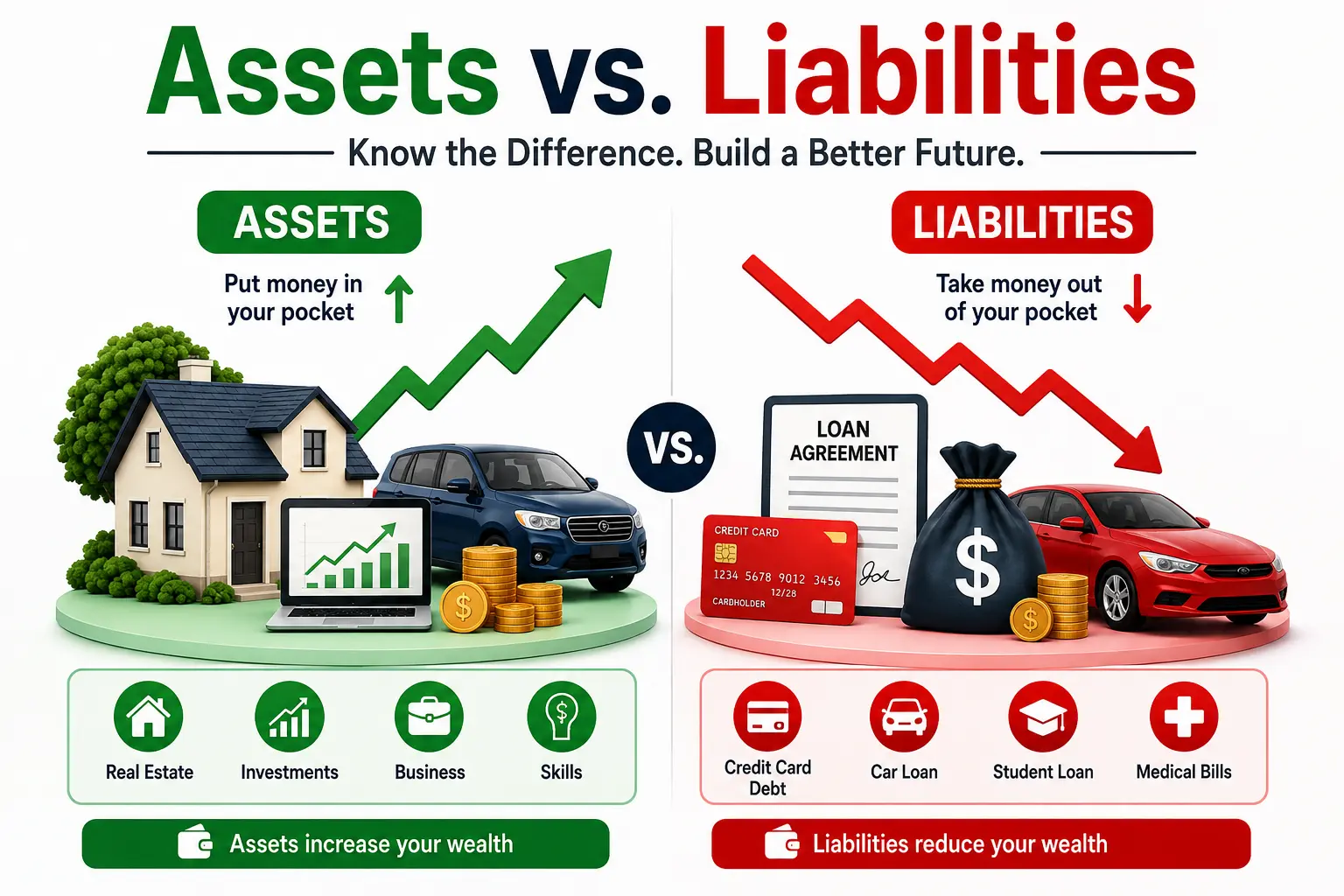
An asset is something you own that adds value or puts money in your pocket. A liability is something you owe that takes money out of your pocket. Understanding assets and liabilities is the foundation of personal finance, because the balance between the two determines your net worth, your financial health, and your ability to build long-term wealth.
Most people learn about money by trial and error — a mortgage payment here, a credit card bill there — without ever stepping back to ask a basic question: is this thing I’m spending money on actually working for me, or against me? That question sits at the center of assets vs. liabilities, and once you can answer it confidently, budgeting, investing, and debt management all start to make a lot more sense.
This guide breaks down what assets and liabilities are, how they connect through the accounting equation, real examples from everyday life, and a step-by-step method to calculate your net worth. Whether you’re just starting your financial literacy journey or brushing up on personal finance basics, this article will give you a clear, practical framework you can apply immediately.
What Are Assets?
An asset is anything of value that you own which can provide future economic benefit — either by generating income, appreciating over time, or being converted into cash. In accounting terms, assets are resources controlled by a person or business that are expected to bring future value.
Assets and liabilities explained simply: assets add to your financial position, while liabilities subtract from it. Cash in a savings account, a rental property, shares of stock, and even a paid-off car all qualify as assets because they hold value you could use or sell.
Types of Assets: Short-Term and Long-Term Assets
Assets are generally grouped by how quickly they can be converted into cash.
- Current assets (short-term): Cash, checking and savings account balances, money market funds, and accounts receivable. These are typically expected to be used or converted to cash within a year.
- Fixed assets (long-term): Real estate, vehicles, equipment, and retirement accounts. These are held for years and are not meant to be liquidated quickly.
Within these categories, financial assets and liabilities deserve special mention. Financial assets include stocks and bonds, mutual funds, and retirement accounts — instruments that represent ownership or a claim on future cash flow rather than a physical item.
Tangible vs. Intangible Assets
Assets can also be split by whether you can physically touch them.
- Tangible assets have physical form: a house, a car, jewelry, equipment, or inventory.
- Intangible assets have no physical form but still hold real value: patents, trademarks, copyrights, goodwill, and even a strong professional network or brand reputation for a business.
Both categories matter. A small business’s intangible assets, like its brand or customer relationships, can sometimes be worth more than its physical equipment — which is one reason business assets are valued differently than personal ones.
What Are Liabilities?
A liability is a financial obligation or debt you owe to another person, bank, or institution. Liabilities represent claims against your assets — money you’re required to pay back, usually with interest, at some point in the future.
In short, if assets are things you own, liabilities are money you owe. Every loan, credit card balance, or unpaid bill reduces your overall financial position until it’s paid off.
Types of Liabilities: Current vs. Long-Term Liabilities
Like assets, liabilities are categorized by their repayment timeline.
- Current liabilities: Debts due within a year, such as credit card debt, utility bills, and the portion of a loan payment due in the next twelve months.
- Long-term liabilities: Debts that extend beyond a year, such as mortgage debt, auto loans, and student loans.
Not all debt is equal. Some liabilities help you build wealth over time (a mortgage on a property that appreciates), while others simply drain your income with little return (high-interest credit card debt). Knowing this distinction is central to smart debt management.
The Accounting Equation: How Assets and Liabilities Connect
Assets = Liabilities + Equity Explained
The accounting equation states that Assets = Liabilities + Equity. This means everything you own (assets) is financed either by what you owe (liabilities) or by what actually belongs to you outright (equity, also called net worth).
This equation is the backbone of every balance sheet, whether it belongs to a Fortune 500 company or an individual household. If you rearrange the formula, you get Equity = Assets − Liabilities, which is exactly how net worth is calculated.
How the Accounting Equation Applies to Personal Finance
You don’t need to run a business to use this formula. Picture your own finances as a personal balance sheet: list what you own on one side and what you owe on the other. The difference is your real financial standing.
For example, if you own a home worth $300,000 (asset) but still owe $220,000 on the mortgage (liability), your equity in that home is $80,000. This same logic applies across every asset and liability you hold, giving you a clear, honest snapshot of where you stand financially.
Assets vs. Liabilities: Key Differences Explained
How Assets and Liabilities Affect Your Net Worth
Assets increase your net worth; liabilities decrease it. Net worth is simply the gap between the two — the more valuable assets you accumulate and the fewer liabilities you carry, the higher your net worth climbs.
This is why wealth building isn’t only about how much you earn. Two people with identical incomes can have very different net worth figures depending on how much of that income goes toward acquiring assets versus servicing debt.
Assets vs. Liabilities Comparison Table
| Aspect | Assets | Liabilities |
|---|---|---|
| Definition | Things you own that hold or create value | Money you owe to others |
| Effect on net worth | Increases net worth | Decreases net worth |
| Cash flow impact | Can generate positive cash flow (income) | Usually creates negative cash flow (payments) |
| Examples | Cash, savings, real estate, stocks and bonds, retirement accounts | Mortgage, credit card debt, student loans, car loans |
| Balance sheet placement | Left side (what you own) | Right side (what you owe) |
| Goal | Grow and accumulate | Minimize and pay down |
Productive vs. Unnecessary Liabilities
Not every liability works against you. A “good” liability, sometimes called productive debt, helps you acquire an appreciating asset or generate income — a mortgage on a home, a business loan that funds equipment generating revenue, or a student loan that increases earning potential.
An unnecessary or “bad” liability funds depreciating items or lifestyle spending with no return, like high-interest credit card debt used for vacations or gadgets. Distinguishing good debt vs bad debt is a core skill in personal finance, because it helps you decide which liabilities are worth taking on and which ones to avoid.
Common Examples of Assets and Liabilities in Everyday Life
Everyday Examples of Assets (Home, Savings, Investments, and Other Valuable Resources)
Examples of assets you’ll recognize from daily life include:
- A home or other real estate you own
- Savings and checking account balances
- An emergency fund set aside for unexpected costs
- Stocks and bonds, mutual funds, and retirement accounts (401(k), IRA)
- A paid-off or partially paid-off vehicle
- Valuable personal property like jewelry or collectibles
- Business assets such as equipment, inventory, or intellectual property, for those who own a company
Everyday Examples of Liabilities (Mortgage, Loans, Credit Card Debt, and Other Obligations)
Examples of liabilities that most households deal with include:
- Mortgage debt on a home
- Auto loans
- Student loans
- Credit card debt
- Personal loans
- Medical bills carried as unpaid balances
- Any unpaid taxes or outstanding bills
Why Understanding Assets and Liabilities Matters for Financial Success
How Assets Help Build Long-Term Wealth
Assets are the engine behind wealth building. Income-producing assets — rental property, dividend-paying stocks, or a business — generate passive income, meaning money continues to flow in with limited ongoing effort. Over time, appreciating assets like real estate and equities can also grow in value, compounding your net worth.
This is the core idea behind the popular distinction, often associated with the personal finance book Rich Dad Poor Dad, between assets that put money in your pocket and liabilities that take money out. Whatever framework you use, the underlying principle stands: consistently acquiring income-generating assets is one of the most reliable paths toward financial independence.
How Liabilities Affect Financial Stability
Liabilities aren’t inherently bad, but unmanaged debt can undermine financial stability quickly. High monthly obligations reduce the cash flow available for savings and investing, and high-interest debt in particular can trap households in a cycle where payments barely cover interest, let alone the principal balance.
This is also where inflation’s impact on savings becomes relevant — when the cost of living rises faster than income, households with heavy liabilities and thin savings feel the squeeze first. Keeping liabilities in check protects your ability to absorb financial shocks.
How to Calculate Your Net Worth Using Assets and Liabilities
The Net Worth Formula Explained
Net worth is calculated with a simple formula: Net Worth = Total Assets − Total Liabilities. This single number is the clearest snapshot of your financial health, because it accounts for everything you own and everything you owe at once.
Step-by-Step Guide to Calculating Net Worth
- List all your assets. Include cash, savings, investments, retirement accounts, real estate, and vehicles at their current market value.
- Add up the total value of your assets.
- List all your liabilities. Include mortgage balance, loans, credit card debt, and any other money owed.
- Add up the total value of your liabilities.
- Subtract total liabilities from total assets. The result is your net worth.
- Repeat this calculation periodically (quarterly or annually) to track progress over time.
Example of Net Worth Calculation
Suppose someone has the following:
- Savings account: $10,000
- Retirement account: $40,000
- Home value: $300,000
- Car value: $15,000
Total assets: $365,000
- Mortgage balance: $220,000
- Car loan: $8,000
- Credit card debt: $3,000
Total liabilities: $231,000
Net worth = $365,000 − $231,000 = $134,000
This example shows how to calculate net worth in practice, and why tracking both sides of the equation — not just income — gives a far more accurate picture of financial progress.
Common Mistakes Beginners Make When Managing Assets and Liabilities
Confusing Assets With Expenses
One of the most common financial mistakes is treating a purchase as an asset when it’s really just an expense. A new phone, designer clothing, or a vacation might feel like a worthwhile purchase, but unless it holds resale value or generates income, it’s an expense, not an asset. Getting clear on needs vs. wants helps prevent this confusion before it affects your budget.
Taking on Too Much Unnecessary Debt
Financing depreciating items — electronics, furniture, or vacations — with high-interest credit is one of the fastest ways to erode financial stability. Unlike a mortgage or a business loan tied to an appreciating or income-generating asset, this type of debt offers no long-term return, only a shrinking net worth.
Ignoring the Importance of Building Assets
Many beginners focus entirely on cutting expenses or paying down debt while forgetting the other half of the equation: acquiring assets. Debt reduction matters, but wealth building requires actively directing income toward savings, investments, and other assets, not just minimizing what you owe.
How to Build More Assets and Reduce Unnecessary Liabilities
Ways to Build More Assets Over Time
- Contribute consistently to a retirement account, even in small amounts
- Build an emergency fund before pursuing higher-risk investments
- Learn the difference between saving vs investing so your money is positioned correctly for your goals and timeline
- Explore how to start micro-investing if you’re beginning with limited funds
- Reinvest dividends or rental income rather than spending it
- Consider real estate, stocks and bonds, or a small business as long-term asset classes, based on your risk tolerance
Strategies to Reduce Unnecessary Liabilities
- Pay off high-interest credit card debt before other lower-interest obligations
- Avoid financing depreciating purchases whenever possible
- Refinance loans when a meaningfully better interest rate is available
- Follow personal budgeting tips to control spending before it turns into debt
- Review recurring subscriptions and obligations that quietly add up
Creating a Balanced Financial Plan
A sound financial plan balances asset accumulation with responsible liability management. This typically means building an emergency fund, maintaining manageable debt levels, and directing surplus income toward investments — all while keeping monthly cash flow positive. For those running a business alongside personal finances, avoiding common business mistakes new entrepreneurs should avoid and applying sound business growth strategies can also protect both personal and business net worth over time.
How to Track and Manage Your Assets and Liabilities
Tracking doesn’t need to be complicated. A simple spreadsheet listing assets on one side and liabilities on the other works well, and many personal finance management apps can automate this by syncing with bank and investment accounts. Whatever method you choose, consistency matters more than complexity — reviewing your numbers monthly or quarterly keeps you aware of your financial trajectory.
Final Thoughts
Assets and liabilities aren’t just accounting terms — they’re the two forces that shape your financial future every day. Assets work for you, liabilities work against you, and your net worth is simply the ongoing scorecard of that balance.
The path forward is straightforward, even if it takes patience: build more income-generating assets, keep unnecessary liabilities in check, and track your progress consistently. Small, steady decisions — an extra contribution to savings, a debt paid off ahead of schedule, an unnecessary purchase avoided — compound into meaningful financial progress over time.
FAQs
What is the Difference Between an Asset and a Liability?
An asset is something you own that holds or creates value, while a liability is money you owe to someone else. Assets increase your net worth; liabilities decrease it. The simplest way to remember it: assets put money in your pocket; liabilities take money out.
Is a House an Asset or a Liability?
A house is generally considered an asset because it holds market value and can appreciate over time. However, the mortgage attached to it is a liability. Your actual equity — the true asset value to you — is the home’s market value minus the remaining mortgage balance.
Is Buying a Car an Asset or a Liability?
A car is technically an asset because it has resale value, but it’s a depreciating one, meaning its value typically declines over time. If you’re still making loan payments, the auto loan itself is a liability. Most personal finance experts treat cars as necessary but low-value assets rather than wealth-building ones.
Is Debt Always Considered a Liability?
Yes, debt is always a liability in accounting terms, since it represents money owed. However, not all debt has the same impact — a mortgage or business loan tied to an appreciating or income-generating asset is considered more productive than high-interest debt used for depreciating purchases.
What Are the Main Types of Assets?
The main types of assets include current assets (cash, savings, short-term investments), fixed assets (real estate, vehicles, equipment), and financial assets (stocks and bonds, retirement accounts). Assets can also be classified as tangible (physical) or intangible (non-physical, like patents or goodwill).
What Assets Should Beginners Invest In?
Beginners often start with a mix of an emergency fund, employer-sponsored retirement accounts, and low-cost index funds before exploring individual stocks, bonds, or real estate. The right mix depends on individual goals, timeline, and risk tolerance, so it’s worth researching or consulting a financial advisor for beginners before committing significant funds.
How Do I Calculate My Net Worth?
Add up the current value of everything you own (assets), then subtract everything you owe (liabilities). The result is your net worth. Recalculating this figure periodically helps you track whether your financial decisions are moving you in the right direction.
Can a Liability Turn Into an Asset?
A liability itself doesn’t become an asset, but the thing it financed can become one. For example, once a mortgage is paid off, the loan (liability) disappears while the home (asset) remains, along with any equity or appreciation built up over the years.
What is a Good Asset-to-Liability Ratio?
There’s no single “correct” ratio, since it depends on age, income, and financial goals, but many financial professionals view a higher and growing ratio of assets to liabilities over time as a sign of improving financial health. The trend matters more than any single snapshot.
Do Liabilities Include Monthly Expenses Like Rent or Groceries?
No. Recurring expenses like rent, groceries, and utility bills are cash flow expenses, not liabilities, because they don’t represent an ongoing debt obligation. Liabilities specifically refer to money owed, such as loans or unpaid bills, not the cost of daily living.
How Can I Reduce My Liabilities?
Focus on paying down high-interest debt first, avoid financing depreciating purchases, and stick to a realistic budget that prevents new debt from accumulating. Reviewing your liabilities regularly and refinancing when better terms are available can also reduce the long-term cost of the debt you carry.
Disclaimer –
This article is intended for general educational and informational purposes only. It is not intended to be, and should not be interpreted as, financial, investment, tax, legal, or accounting advice.
The examples, calculations, and figures used throughout this guide (including the net worth example) are illustrative only and do not reflect actual market data, real financial products, or guaranteed outcomes. Every individual’s financial situation is different, and factors such as income, debt, goals, risk tolerance, and local regulations can significantly affect what strategies are appropriate for you.
Before making any financial decisions — including investing, taking on debt, or restructuring your assets and liabilities — we strongly recommend consulting a licensed financial advisor, accountant, or other qualified professional who can review your specific circumstances.
We have made every effort to ensure the accuracy and reliability of the information in this article at the time of publishing. However, financial markets, regulations, and best practices change over time, and we do not guarantee that all information will remain current or applicable to your situation.