
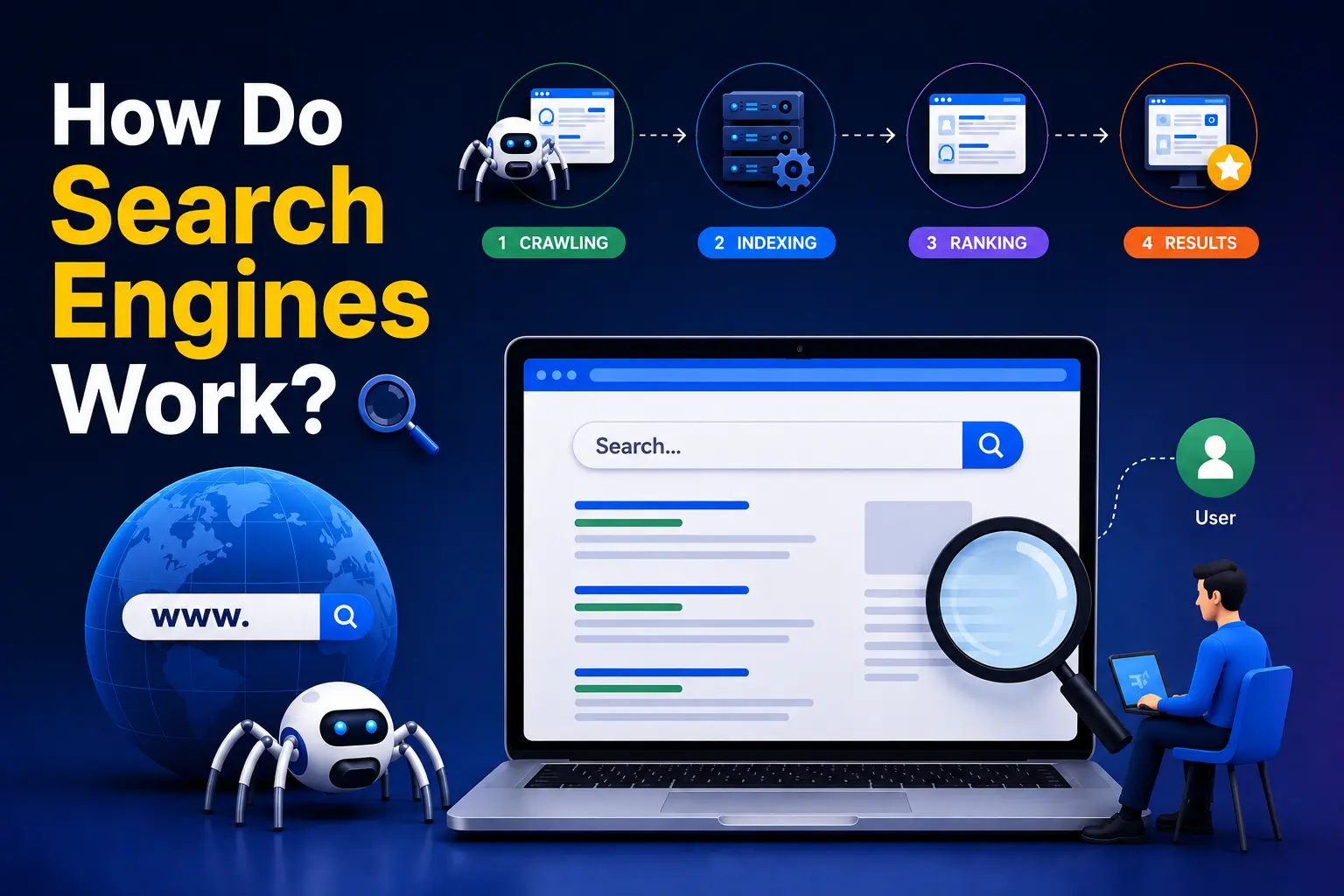
Every time you type a question into Google, a process involving billions of web pages, complex algorithms, and machine learning models runs in a fraction of a second to hand you an answer. Understanding how search engines work isn’t just useful for SEO professionals — it helps anyone who publishes online understand why some pages get found and others don’t.
This guide walks through the full search engine process, from how bots discover a page for the first time to how AI systems like Google AI Overviews now generate answers directly on the results page. It’s written for site owners, marketers, developers, and content creators who want a practical, accurate understanding of search engine working, not just surface-level definitions.
What is a Search Engine?
A search engine is a system that discovers, organizes, and retrieves information from the web so it can return relevant results for a user’s query. It does this through three core processes — crawling, indexing, and ranking — that work together every time someone searches.
Search engines like Google, Bing, and increasingly AI-powered systems like ChatGPT Search and Perplexity all follow the same basic logic: find content, understand it, store it in a searchable database, and rank it by relevance and quality. What differs between them is scale, algorithm sophistication, and how they present results (traditional blue links versus AI-generated summaries).
Crawling – How Search Engines Discover Web Pages
Crawling is the discovery phase of search. Search engines use automated programs called crawlers to find pages on the internet by following links and reading sitemaps, then download their text, images, and video content for later processing. Google explains that there isn’t a central registry of all web pages, so it must constantly look for new and updated pages and add them to its list of known URLs — a process it calls “URL discovery.” Google
To understand what actually happens when a crawler visits your site — and how that connects to the browser rendering a visitor eventually sees — it’s worth reading about what happens when you open a website, since crawling and normal browsing rely on many of the same underlying web technologies.
What is a Web Crawler (Spider)?
A web crawler (also called a bot or spider) is a software program that automatically visits web pages, reads their content, and follows links to discover new pages. Google’s crawler is called Googlebot; Bing’s is Bingbot. The “spider” nickname comes from the way these bots move across the interconnected web of links, much like a spider moving along a web.
Google downloads text, images, and videos from pages it finds on the internet using these automated crawler programs. Crawlers don’t just grab raw HTML — modern crawlers render pages much like a browser does, which matters for sites built heavily on JavaScript.
How Crawlers Discover and Follow URLs (Links, Sitemaps, Submissions)
Search engine crawlers find new pages through three main channels:
- Following links – When a crawler visits a page it already knows, it extracts every link on that page and adds newly discovered URLs to its crawl queue. This is why internal linking matters: pages with no incoming links are much harder to discover.
- XML sitemaps – A sitemap.xml file lists the URLs you want crawled, often with metadata like last-modified dates. It acts as a roadmap that speeds up discovery, especially for large or new sites.
- Direct submission – Tools like Google Search Console let site owners manually request a crawl or submit a sitemap, giving search engines a nudge toward new or updated content.
This discovery logic is one reason internal linking strategy matters so much for site structure — a concept relevant well beyond SEO, including when businesses plan a mobile app development company build, where discoverability and information architecture come up in similar ways.
Robots.txt and Other Crawl Directives
Not every page a crawler finds gets visited. Robots.txt is a file at the root of a domain that tells crawlers which parts of a site they’re allowed or disallowed to access. Google notes that some pages may be disallowed by site owners for crawling by Googlebot, while others may require a login to access.
Common crawl directives include:
- robots.txt disallow rules – Block crawlers from specific folders or URLs (e.g., admin panels, internal search results).
- Meta robots tags – Placed in a page’s HTML <head> to instruct crawlers on indexing behavior at the page level.
- X-Robots-Tag HTTP headers – Server-level instructions useful for non-HTML files like PDFs.
It’s important to understand that robots.txt controls crawling access, not indexing directly — a page blocked in robots.txt can sometimes still appear in search results (without a snippet) if other pages link to it.
Crawl Budget and Crawl Frequency
Crawl budget is the amount of time and resources a search engine allocates to crawling a given site. Larger sites with many pages, or sites with slow servers, may not get every page crawled promptly. Google’s crawlers use algorithmic processes to determine which sites to crawl, how often, and how many pages to fetch from each site, and they’re programmed to avoid crawling a site too fast so they don’t overwhelm it — this pacing responds to how the site’s server behaves, including reacting to error signals like HTTP 500 responses.
Practical ways sites manage crawl budget:
- Keeping XML sitemaps current and free of broken or redirected URLs
- Blocking low-value URLs (faceted filters, internal search, duplicate parameters) via robots.txt
- Fixing server errors and slow response times, since crawlers slow down when servers struggle
- Consolidating duplicate content so crawlers aren’t wasting visits on near-identical pages
Indexing – How Search Engines Organize Web Content
Indexing is the process where a search engine analyzes a crawled page’s content and stores relevant information in its database, called the search index. During indexing, Google processes and analyzes the textual content and key content tags and attributes, such as <title> elements and alt attributes, images, and videos.
Being crawled doesn’t guarantee being indexed. Indexing is where search engines decide whether a page is worth storing and serving at all.
How Search Engines Process and Render Web Pages (HTML, JS, CSS)
Google uses a recent version of Chrome to render pages during crawling and runs any JavaScript it finds, similar to how a browser renders the page you visit — this rendering step matters because sites often rely on JavaScript to load content onto the page, and without rendering, Google may not see that content at all.
This means:
- Server-side or pre-rendered content is generally the safest for full indexability, since it doesn’t depend on JavaScript execution.
- Client-side rendered content (common in single-page apps) can be indexed, but delays, errors, or blocked JS resources can prevent Google from seeing it properly.
- CSS-hidden content (like text behind tabs or accordions) is usually still crawlable, but visibility and user experience still matter for ranking.
Canonicalization and Duplicate Content Handling
Canonicalization is how search engines decide which version of duplicate or near-duplicate pages should represent that content in search results. Google groups similar pages found across the web into clusters and picks the most representative one as the canonical page, while other pages in that group may still be served as alternate versions in specific situations, such as when someone searches on mobile. google
Common causes of duplicate content issues:
- URL parameters creating multiple versions of the same page (tracking tags, session IDs)
- HTTP vs. HTTPS or www vs. non-www versions not properly redirected
- Printer-friendly or paginated versions of the same content
- Syndicated or republished content across multiple sites
Site owners can specify a preferred URL using a rel=”canonical” tag, consistent internal linking, and 301 redirects.
Why Some Pages Aren’t Indexed (Noindex, Directives & Other Factors)
Google explicitly states it cannot guarantee that a page will be indexed — not every page it processes makes it into the index. Common reasons a page gets excluded include:
- Low content quality — thin, duplicate, or unhelpful content
- Noindex directives — a meta robots tag or header explicitly telling search engines not to index the page
- Poor site architecture — pages that are hard to discover or render properly
- Crawl errors — server issues, blocked resources, or timeouts
If you’re troubleshooting a page that Search Console shows as crawled but not indexed, quality and directive issues are usually the first places to check.
Ranking – How Search Engines Choose Search Results
Ranking is the process where a search engine orders indexed pages by relevance and quality for a specific query. When a user searches, Google’s systems look through the index for matching pages and return what it judges to be the highest-quality results that are most relevant to the query, and relevance is determined using hundreds of factors — which can include the user’s location, language, and device.
No single factor decides rankings. Instead, search algorithms weigh a large combination of signals together.
Key Ranking Factors: Relevance and Content Quality
Relevance means matching a page’s content to the searcher’s actual intent, not just matching keywords. Search engines evaluate:
- How well the content answers the specific query
- Depth and completeness of the topic coverage
- Use of relevant keywords, synonyms, and related entities in context
- Content structure (headings, formatting) that helps both users and algorithms parse meaning
Content quality goes beyond relevance — it includes originality, accuracy, and whether the content provides real value versus rehashing what’s already ranking.
The Role of Backlinks and Domain Authority
Backlinks are links from other websites pointing to your page, and they remain one of the strongest ranking signals because they act as a vote of confidence from other sites. The quality and relevance of linking sites matter far more than sheer link volume — a handful of links from authoritative, topically relevant domains typically outweighs hundreds of low-quality links.
Domain authority (a concept popularized by third-party SEO tools, not an official Google metric) reflects a site’s overall trustworthiness and link profile built up over time. Newer sites without established backlink profiles typically need to earn links gradually through genuinely useful content, digital PR, or partnerships.
E-E-A-T and Content Trustworthiness
E-E-A-T stands for Experience, Expertise, Authoritativeness, and Trustworthiness — a framework Google’s human quality raters use to evaluate content, but it is not itself a direct, measurable ranking factor. Google has stated there is no such thing as an “E-E-A-T score,” and instead its ranking systems use a variety of signals that align with the concepts of experience, expertise, authoritativeness, and trustworthiness. rankability
Google’s guidance recommends aligning content with E-E-A-T principles through clear authorship and author bios with credentials, demonstrating methodology through tests, photos, and data, prioritizing user-first content over content written purely to rank, and maintaining transparency with editorial standards and correction policies.
E-E-A-T carries more weight on YMYL (Your Money or Your Life) topics — content that could affect a person’s health, finances, safety, or major life decisions — where inaccurate information can cause real harm.
User Experience Signals (Page Speed, Mobile-Friendliness, Core Web Vitals)
Core Web Vitals are Google’s set of real-user experience metrics — Largest Contentful Paint (LCP), Interaction to Next Paint (INP), and Cumulative Layout Shift (CLS) — used as page experience ranking signals. LCP measures loading speed, INP measures responsiveness, and CLS measures visual stability, and Google’s Search Central documentation assigns each metric that specific role. accs-net
Current good-score thresholds:
| Metric | Measures | Good | Needs Improvement | Poor |
|---|---|---|---|---|
| LCP (Largest Contentful Paint) | Loading speed | ≤ 2.5s | ≤ 4.0s | > 4.0s |
| INP (Interaction to Next Paint) | Responsiveness | ≤ 200ms | ≤ 500ms | > 500ms |
| CLS (Cumulative Layout Shift) | Visual stability | ≤ 0.1 | ≤ 0.25 | > 0.25 |
INP officially replaced First Input Delay (FID) as the responsiveness metric in March 2024, capturing the worst interaction delay across an entire visit rather than just the first click. Mobile-friendliness and HTTPS security remain baseline expectations rather than differentiators — nearly all competitive pages already meet them.
Why Search Rankings Change Over Time
Rankings shift for several reasons: algorithm updates (both broad “core updates” and targeted updates), competitors publishing better content, changes in search intent for a query, link profile changes, technical issues on your site, or simple content decay as information ages. Google typically rolls out multiple confirmed updates per year, and unconfirmed smaller adjustments happen continuously.
How Search Engines Understand and Match Search Queries
Before ranking anything, search engines have to correctly interpret what a searcher actually wants — which is often harder than matching literal words.
Search Intent: Informational, Navigational, and Transactional
Search engines classify queries into intent categories to decide what kind of results to show:
- Informational intent – The user wants to learn something (“how do search engines work”)
- Navigational intent – The user wants to reach a specific site or page (“Google Search Console login”)
- Transactional intent – The user wants to complete an action, often a purchase (“buy running shoes online”)
- Commercial investigation – A hybrid intent where users compare options before buying (“best SEO services for small business”)
Matching content to the correct intent type is often more important for ranking than keyword density alone.
Keyword Matching vs. Semantic Search
Early search engines relied heavily on literal keyword matching — pages ranked mainly by how many times a term appeared. Modern search engines use semantic search, which interprets the meaning and context behind a query rather than just matching exact words, drawing on related concepts, synonyms, and entity relationships to understand what a page is really about.
This shift means content stuffed with exact-match keywords but lacking depth typically underperforms compared to content that thoroughly covers a topic using natural language and related terminology.
Handling Ambiguous and Conversational Queries
Search engines increasingly deal with longer, conversational queries — a trend accelerated by voice search and AI chat interfaces. Ambiguous queries (like “jaguar,” which could mean the animal, the car brand, or a sports team) are resolved using context clues: the user’s search history, location, device, and prior queries in the same session.
The Role of Algorithms and AI in Search Engines
Search algorithms are the rule sets and models search engines use to decide what content is relevant and high-quality. Over the past decade, these algorithms have shifted heavily from rule-based logic toward machine learning.
Core Algorithm Updates and Why They Happen
Google periodically rolls out core updates — broad changes to its overall ranking systems meant to improve result quality across many types of queries simultaneously, rather than targeting one specific issue. Sites that see ranking drops after a core update aren’t necessarily penalized; often the update simply re-evaluates relevance and quality more accurately, and previously underperforming pages may rise while others fall.
Alongside core updates, Google also runs targeted spam updates aimed specifically at manipulative tactics rather than general quality.
Machine Learning and NLP in Search (RankBrain, BERT, and Beyond)
Google has layered several AI systems into search over the years, each solving a different language-understanding problem:
- RankBrain (2015) – Google’s first major deep learning system in Search, used to interpret search queries, especially new or unusual word combinations, by connecting them to related concepts rather than treating them as isolated keywords.
- Neural Matching (2018) – Helps Google understand how queries relate conceptually to page content, even without exact keyword overlap.
- BERT (2019) – Processes the context of full sentences and considers how word meaning shifts based on surrounding words, complementing RankBrain’s semantic analysis of longer or unusual queries.
- MUM (2021) – A multitask, multimodal model capable of combining information across text and images and understanding complex, layered search intentions.
Google has confirmed that RankBrain, neural matching, and BERT are not designed to act in isolation on just a query or a page — they work together to understand language across both the search query and the content being evaluated, and are used globally across all languages Google Search operates in. searchengineland
How AI Is Changing Search Result Generation (AI Overviews, Generative Search)
Google AI Overviews are AI-generated summaries that appear above traditional search results, synthesizing information from multiple web sources with citations, while AI Mode is a separate, conversational search experience for deeper, multi-step research. AI Overviews passively enhance standard search by providing a direct, comprehensive answer at a glance, appearing automatically when Google’s systems judge it helpful, while AI Mode requires active opt-in and is designed for complex, multi-part questions handled through conversational dialogue. bookassist
Google Search Central has explained that AI Overviews and AI Mode can use a technique called query fan-out — issuing several related searches across subtopics and data sources before composing a single response — meaning the underlying retrieval process can be far broader than the ten links traditionally shown on a results page. The system works by searching for relevant content (factoring in what users have historically clicked on for similar queries), using a large language model similar to Gemini to summarize the findings, then grounding the generated answer with citations back to source web pages. serpapi and saffronedge
This is closely related to how conversational AI tools generate responses more broadly — see how AI chatbots generate answers for a deeper look at the underlying mechanics that also inform how businesses evaluate an enterprise AI agents vendor for internal use cases.
How Search Engines Understand Different Types of Content
Search engines don’t just process plain text — they analyze multiple content formats and the relationships between them.
Understanding Text Content
For written content, search engines analyze word usage, sentence structure, headings, topic depth, and the relationships between concepts on the page. Structural elements like <title> tags, headers (H1–H3), and alt text give search engines strong contextual signals about what a page covers.
Images and Video Content
Images and video are indexed separately but linked back to the page they appear on. Search engines rely on alt text, file names, surrounding text, captions, and (for video) transcripts and metadata to understand visual content, since they can’t “watch” or “see” media the way humans do without these contextual cues.
Structured Data and Schema Markup
Structured data (schema markup) is code added to a page that explicitly labels its content for search engines — for example, marking up a recipe’s cook time, a product’s price, or an article’s author. It doesn’t directly boost rankings, but it helps search engines understand content more precisely and can unlock rich results like star ratings, FAQ dropdowns, or product snippets in the SERP.
Understanding Entities and Relationships (Knowledge Graph)
Search engines increasingly think in terms of entities — distinct people, places, organizations, or concepts — rather than isolated strings of text. Google’s Knowledge Graph connects entities and their relationships (e.g., a company, its founder, and its products) to power knowledge panels and improve how it interprets ambiguous or complex queries. Content that clearly establishes entity relationships tends to be easier for both traditional and AI-driven search systems to summarize accurately.
How Search Engines Handle Freshness and Updated Content
When Freshness Matters for Search Results
Freshness matters more for some queries than others. Time-sensitive topics — breaking news, product releases, “best of” lists, or year-specific queries — benefit heavily from recently updated content. Evergreen topics (historical facts, foundational concepts) are less freshness-sensitive, since accuracy matters more than recency.
How Search Engines Detect Updated Content
Search engines detect changes through re-crawling and comparing new content against previously indexed versions, looking at signals like updated publish/modified dates, new sections, revised statistics, and changed metadata. Superficial changes (swapping a date without substantive edits) are generally recognized as such and carry little ranking benefit.
Why Some Pages Get Re-Crawled More Frequently
Pages that update often, attract strong engagement, or sit on high-authority domains tend to get crawled more frequently, since search engines allocate more crawl budget toward content likely to change. Static, rarely updated, low-traffic pages may be re-crawled only occasionally.
How Search Engines Detect Spam and Low-Quality Content
Common Types of Web Spam and Manipulative Practices
Search engines actively work to detect and suppress manipulative tactics, including:
- Keyword stuffing – Unnaturally repeating keywords to manipulate relevance signals
- Cloaking – Showing different content to search engines than to users
- Link schemes – Buying, selling, or exchanging links purely to manipulate rankings
- Doorway pages – Multiple near-duplicate pages built to funnel traffic through search rather than serve users
- Scraped or auto-generated content – Content copied or spun from other sources with little added value
- Site reputation abuse – Third-party content hosted on a trusted domain mainly to exploit its existing authority
Manual Actions vs. Algorithmic Penalties
A manual action is a penalty applied by a human reviewer at Google after determining a site violates its spam policies, while an algorithmic penalty is an automated demotion triggered by ranking systems without human review. Manual actions exist because automated systems have limits — spam classifiers handle most enforcement silently, but some manipulation is too novel, contextual, or coordinated for a classifier to judge confidently, so manual review fills that gap. PPC
The practical difference matters for recovery: a manual action appears in Google Search Console under Security & Manual Actions with specific details about the violation, while an algorithmic demotion produces no such notification and must instead be diagnosed by analyzing traffic data against the timeline of known algorithm updates. A manual action persists until the underlying problem is corrected and a reconsideration request is reviewed and approved by another Google reviewer, whereas algorithmic demotions have no formal appeal process. cyberoptik
How Low-Quality Content Affects Search Visibility
Even without a formal penalty, low-quality content — thin pages, unoriginal material, excessive ads that disrupt usability, or content that doesn’t fulfill searcher intent — tends to rank poorly or get filtered out of the index entirely as unhelpful. Google’s algorithmic quality systems continuously reassess content quality, meaning a page’s visibility can decline gradually even without any specific spam violation.
How Search Engines Display and Personalize Search Results
How Search Results Pages Are Generated
When a query is submitted, the search engine matches it against its index, applies ranking algorithms to that pool of relevant pages, and assembles a results page combining organic listings with any applicable SERP features. This entire process — retrieval, ranking, and formatting — happens in a fraction of a second.
SERP Features and Rich Results (Featured Snippets, Knowledge Panels, etc.)
Modern search results pages include far more than ten blue links. Common SERP features include:
- Featured snippets – A direct answer pulled from a page and displayed at the top of results
- Knowledge panels – Entity-based information boxes drawing from the Knowledge Graph
- People Also Ask boxes – Related question-and-answer accordions
- Image and video carousels
- Local pack results – Map-based results for location-specific queries
- AI Overviews – AI-generated summaries citing multiple sources
Personalization Factors: Location, Language, Device, and Search History
Search results aren’t identical for everyone. Google explains that when a user searches, it returns results relevant to that query, with the appearance of certain search features varying based on the query — for example, a “bike repair shops” search may trigger local results, while a search for a general product concept is more likely to show image results without local listings. Location, device type, language settings, and (for signed-in users) search history all influence which results and features appear.
Common Myths About How Search Engines Work
Myth: Paying Google Improves Organic Rankings
This is false. Google states plainly that it does not accept payment to crawl a site more frequently or to rank it higher, and any claim suggesting otherwise is false. Paid Google Ads campaigns appear in clearly labeled ad sections and have no bearing on organic (unpaid) rankings.
Myth: Google Ranks Pages Simply by Using Keywords
Keywords still matter for relevance signaling, but modern ranking relies heavily on semantic understanding, entity recognition, and quality signals like E-E-A-T and user experience. Stuffing a page with exact-match keywords without genuine depth or usefulness is more likely to hurt rankings than help them today.
Myth: Every Crawled Page Gets Indexed
Crawling and indexing are separate steps. Google explicitly notes that it can’t guarantee a page will be indexed, and not every page it processes ends up in the index — a page can be fully crawled and still excluded due to low quality, robots directives, or technical issues.
Myth: SEO Guarantees Higher Rankings
No reputable SEO practice can guarantee a specific ranking position, since algorithms weigh hundreds of factors, change continuously, and respond to what competitors are doing too. Legitimate SEO improves the odds of ranking well by aligning a site with what search engines are trying to reward — it isn’t a purchasable outcome.
Conclusion
Search engines run on a continuous cycle of crawling, indexing, and ranking — discovering pages, understanding their content, and matching them to what searchers actually need. What’s changed most in recent years isn’t the fundamental process but the sophistication behind it: machine learning models like BERT and MUM now interpret language and intent far more precisely, and generative AI features like AI Overviews and AI Mode are reshaping how answers get presented directly on the results page.
For anyone creating content or building a website, the practical takeaway is consistent: focus on genuinely useful, well-structured, technically sound content that serves a clear search intent. That approach has always aligned with how search engines evaluate quality, and it’s becoming even more important as AI-powered search systems decide what to cite and summarize.
FAQs
How do search engines work in simple terms?
Search engines find web pages using automated crawlers, store and analyze that content in a massive database called an index, and then rank the most relevant, trustworthy pages when someone searches. The whole process is: crawl, index, rank, serve.
What is the difference between crawling and indexing?
Crawling is the discovery step — a bot finds and downloads a page’s content. Indexing is the analysis step — the search engine processes that content and decides whether and how to store it in its searchable database. A page can be crawled without ever being indexed.
What is ranking in search engines?
Ranking is the process of ordering indexed pages by relevance and quality for a specific search query, using hundreds of signals including content relevance, backlinks, user experience, and trustworthiness factors like E-E-A-T.
How does Google decide which pages to show first?
Google combines relevance signals (how well content matches the query and intent), quality signals (E-E-A-T, originality, accuracy), authority signals (backlinks, reputation), and user experience signals (page speed, mobile-friendliness) to order results, personalizing further based on location, language, and device.
Why isn’t my website showing up on Google?
Common causes include the page never being crawled (poor internal linking, no sitemap), being crawled but not indexed (low content quality, accidental noindex tags), technical rendering issues, or the site being too new to have earned enough authority signals yet. Checking Google Search Console’s coverage report is the fastest way to diagnose which stage is failing.
How long does it take for a new page to appear in search results?
It varies widely — anywhere from a few hours to several weeks — depending on crawl frequency, site authority, sitemap submission, and server response times. Submitting a URL directly through Search Console can speed up initial discovery, though indexing still isn’t guaranteed.
Do keywords still matter to search engines?
Yes, but their role has shifted. Keywords still help signal topical relevance, but modern search engines rely far more on semantic search and entity understanding than exact keyword matching, so content depth and natural language matter more than keyword density.
What is search intent, and why does it matter?
Search intent is the underlying goal behind a query — informational, navigational, transactional, or commercial investigation. Matching content to the correct intent type is often more important for ranking than any single on-page optimization, since search engines prioritize satisfying what the user actually wants.
Can search engines penalize low-quality or spammy content?
Yes, through two mechanisms: algorithmic demotions applied automatically by ranking systems, and manual actions applied by human reviewers for clear spam policy violations, which appear as a notice in Google Search Console and require a reconsideration request to lift.
How do search engines personalize results?
Search engines personalize results using signals like the searcher’s location, device type, language settings, and (for signed-in users) recent search history, which can change both which pages appear and which SERP features are shown.
Do search engines use AI, and how is it changing results?
Yes — Google has used AI systems like RankBrain, BERT, and MUM for years to understand language and intent, and now uses generative AI directly in features like AI Overviews and AI Mode, which synthesize information from multiple sources into a single cited summary rather than just listing links.
Does updating old content help it rank higher?
It can, but only when the update is substantive — adding new information, correcting outdated facts, expanding thin sections, or improving structure. Superficially changing a “last updated” date without real content improvements typically provides little to no ranking benefit.
Disclaimer –
This article is written for informational and educational purposes only. While every effort has been made to ensure accuracy based on publicly available documentation from Google Search Central and other reputable industry sources, search engine algorithms, ranking systems, and features are updated frequently and may change without notice. Readers should refer to official Google Search Central documentation for the most current guidance.
Google, Googlebot, PageRank, Google Search, AI Overviews, AI Mode, and related trademarks are the property of Google LLC. This website is independently operated and is not affiliated with, endorsed by, or sponsored by Google LLC.
This content does not constitute professional SEO, legal, or business consulting advice. Results from implementing SEO strategies discussed in this article may vary based on individual website factors, competition, and search engine updates.
Thanks for reading! If this helped you, feel free to pass it along to a friend or colleague.