
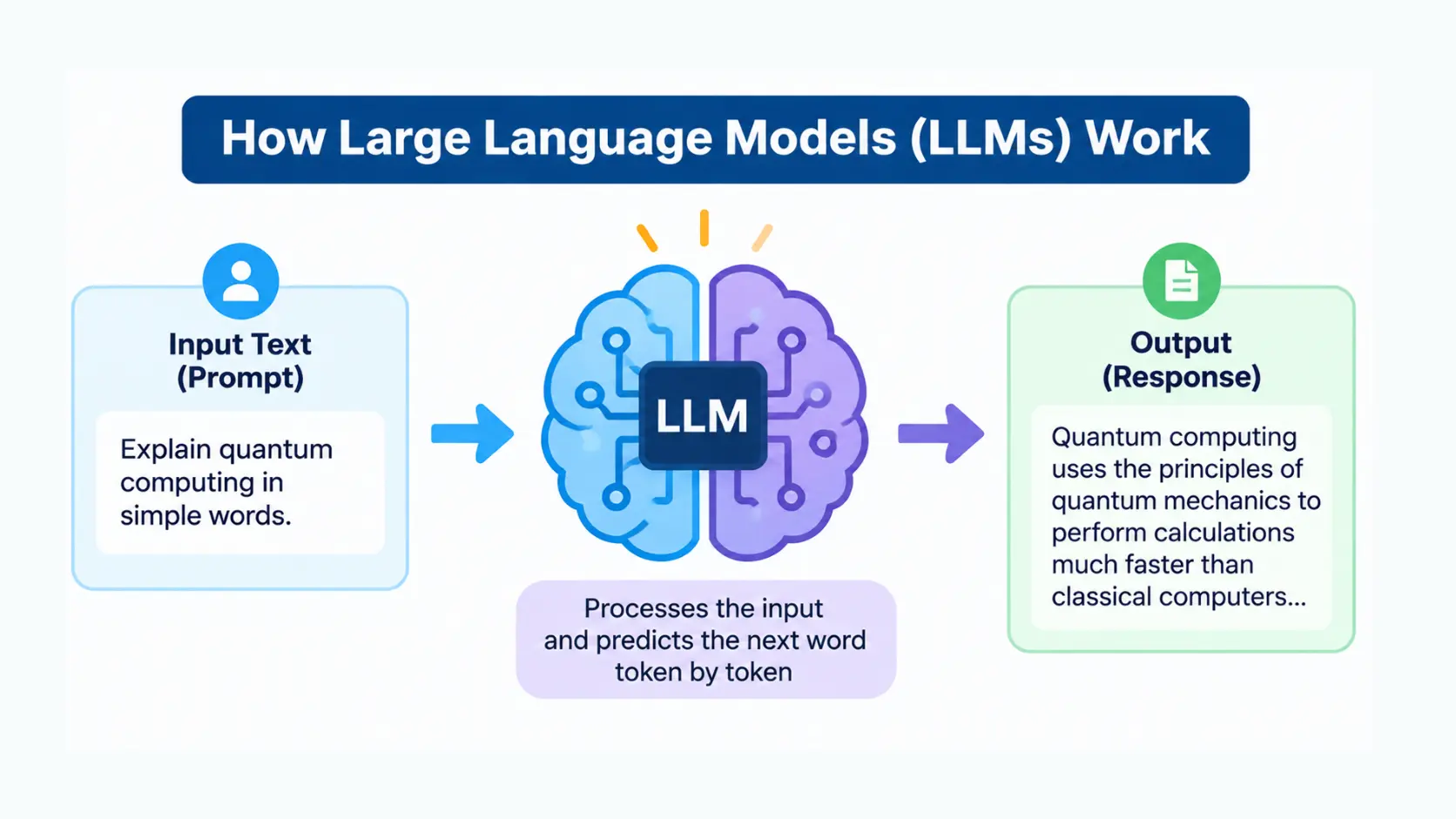
A large language model is a type of AI system trained on enormous amounts of text to predict, understand, and generate human-like language. If you’ve used ChatGPT, Google Gemini, or Claude AI, you’ve already interacted with one. This guide breaks down how LLMs actually work — tokenization, neural networks, attention mechanisms, training, and real-world use — in plain language, without requiring a technical background.
Understanding this technology matters because LLMs now sit behind customer support chatbots, coding assistants, search experiences, and countless business tools. Knowing how they work helps you use them more effectively and evaluate their output with the right amount of trust.
What Are Large Language Models (LLMs)?
A Large Language Model (LLM) is a deep learning model trained on massive text datasets to recognize patterns in language and generate coherent, context-aware responses. LLMs are a type of foundation model — a broad AI system that can be adapted to many tasks like writing, summarizing, translating, and answering questions, rather than being built for just one narrow job.
Unlike earlier AI language tools that relied on fixed rules or simple statistical patterns, LLMs use neural networks with billions of parameters — internal values the model adjusts during training to capture grammar, facts, reasoning patterns, and relationships between concepts. This scale is what allows models like GPT, Gemini, and Claude to hold natural conversations, write code, and explain complex topics.
LLMs fall under the broader umbrella of generative AI, meaning they don’t just classify or retrieve information — they generate new text, one piece at a time, based on everything they’ve learned during training.
How Do Large Language Models Work
At a high level, an LLM works by breaking text into small units, converting those units into numbers the model can process, passing them through a neural network that identifies relationships between words, and then predicting the most likely next piece of text — repeating this process until a full response is generated.
Each of the steps below plays a specific role in that process.
Understanding Tokens and Text Processing in LLMs
Tokenization is the process of breaking text into smaller units called tokens — which can be whole words, parts of words, or even punctuation — so the model can process language mathematically. A word like “unbelievable” might be split into tokens like “un,” “believ,” and “able.”
This matters for a few practical reasons:
- Models have a maximum number of tokens they can process at once, known as the context window.
- Pricing for many AI APIs is calculated per token, not per word.
- Different languages tokenize differently, which affects cost and performance.
Once text is tokenized, the model doesn’t see words at all — it sees a numerical representation of each token.
Embeddings — How Words Become Numbers
An embedding is a numerical representation of a token that captures its meaning and relationship to other tokens, allowing the model to perform mathematical operations on language. Each token gets converted into a long list of numbers (a vector), positioned in a multi-dimensional space where similar concepts sit closer together.
For example, the embeddings for “king” and “queen” would be positioned closer to each other than “king” and “bicycle,” because the model has learned they appear in similar contexts. This is what allows LLMs to grasp meaning, synonyms, and relationships rather than just matching exact words — a foundational concept in natural language processing.
The Role of Neural Networks and Transformer Architecture
Modern LLMs are built on the transformer architecture, a neural network design introduced in 2017 that processes entire sequences of text in parallel rather than word by word, making it far more efficient at understanding context. Before transformers, older neural network architectures processed text sequentially, which made them slower and worse at handling long-range relationships between words.
A transformer model is made up of layers that repeatedly refine the model’s understanding of a sentence — passing information through attention mechanisms and feed-forward neural networks to build an increasingly accurate representation of meaning. This architecture underpins essentially every major LLM in use today, including GPT, Gemini, and Claude.
The Attention Mechanism — How LLMs Focus on Relevant Words
The attention mechanism, specifically self-attention, allows an LLM to weigh how relevant every other word in a sentence is to the word it’s currently processing — regardless of how far apart they appear. This is what lets a model correctly interpret a sentence like “The trophy didn’t fit in the suitcase because it was too big,” and know that “it” refers to the trophy, not the suitcase.
Self-attention assigns different weights to different tokens for each word being processed, effectively letting the model ask, “which other words matter most for understanding this one?” across the entire input at once. This mechanism is a major reason transformer models handle long, complex sentences better than earlier neural network architectures.
How LLMs Are Trained on Massive Amounts of Data
LLMs are trained by feeding them enormous volumes of text — books, articles, websites, code, and more — and having the model repeatedly predict the next token in a sequence, adjusting its internal parameters each time it gets a prediction wrong. This process, called pretraining, happens across trillions of tokens and requires massive GPU computing infrastructure running for weeks or months.
The training process generally involves:
- Data collection and preprocessing — gathering text and cleaning it (removing duplicates, low-quality content, and formatting issues).
- Tokenization — converting all training text into tokens.
- Pretraining — the model predicts the next token across billions of examples, gradually adjusting its parameters.
- Evaluation — testing the model’s performance on benchmarks and held-out data.
This is a computationally expensive process, which is one reason only a small number of organizations — OpenAI, Google, Anthropic, Meta, and a handful of others — build foundation models from scratch.
Fine-Tuning and RLHF — Teaching LLMs to Follow Instructions
Fine-tuning is the process of further training a pretrained LLM on a narrower, curated dataset so it becomes better at specific tasks, such as following instructions or holding a conversation. Reinforcement Learning from Human Feedback (RLHF) goes a step further: human reviewers rank multiple model responses, and that feedback is used to train the model to prefer answers people find more helpful, accurate, and safe.
This two-stage approach — broad pretraining followed by targeted fine-tuning and RLHF — is why a raw pretrained model can complete text but a fine-tuned assistant like ChatGPT or Claude can hold a coherent conversation, refuse harmful requests, and follow multi-step instructions.
How LLMs Understand Context and Meaning
LLMs understand context by analyzing patterns across embeddings and attention layers to infer meaning from surrounding words, prior conversation turns, and learned associations from training data — not through genuine comprehension the way humans experience it. Everything within the model’s context window (the current input plus recent conversation) directly shapes its next prediction.
This is fundamentally different from how a traditional system processes information — for instance, how search engines work by matching keywords and ranking indexed pages, LLMs generate original responses based on statistical patterns rather than retrieving a stored document.
How LLMs Predict and Generate Human-Like Text
An LLM generates text by predicting the single most probable next token based on everything that came before it, adding that token to the sequence, and repeating the process one token at a time until the response is complete. Each prediction is based on probability scores across the model’s entire vocabulary — tens of thousands of possible tokens — with the highest-scoring options most likely to be chosen.
Settings like “temperature” control how predictable or varied the output is: lower temperature favors the most probable next token (more focused, repetitive answers), while higher temperature allows more creative, varied word choices. This token-by-token prediction process is why LLM responses generate progressively, and why the model has no fixed “answer” until generation is complete.
Popular Examples of Large Language Models (GPT, Gemini, Claude, and More)
Several organizations have built widely used LLMs, each with different strengths, training approaches, and product ecosystems.
| Model Family | Developer | Known For |
|---|---|---|
| GPT models | OpenAI | Conversational AI, ChatGPT, broad general-purpose use |
| Gemini | Multimodal capabilities, integration with Google products | |
| Claude | Anthropic | Safety-focused design, long context windows, reasoning |
| Llama | Meta | Open-source availability for developers |
| Mistral | Mistral AI | Efficient open-weight models |
GPT Models by OpenAI
GPT (Generative Pre-trained Transformer) models are OpenAI’s family of LLMs that power ChatGPT and are widely used for conversational AI, content generation, and software development support. Successive GPT versions have expanded context windows, improved reasoning, and added multimodal capabilities like image and voice understanding.
Gemini Models by Google
Gemini is Google’s family of multimodal AI models, built to process and generate text, images, audio, and code, and integrated across Google Search, Workspace, and Android. Gemini models are designed with deep integration into Google’s existing product ecosystem and infrastructure.
Claude Models by Anthropic
Claude is Anthropic’s family of LLMs, developed with a strong emphasis on AI safety, reliability, and helpfulness, and known for handling long documents and nuanced instructions well. Claude models are used both through Anthropic’s consumer apps and via API for business and developer integrations.
Other Notable Large Language Models
Beyond the major commercial players, the LLM landscape includes open-source and specialized models:
- Meta’s Llama models — openly available for developers to fine-tune and self-host.
- Mistral models — known for strong performance relative to their size.
- Small Language Models (SLMs) — compact models optimized for speed, lower cost, and on-device use rather than raw scale.
How LLMs Differ From Traditional AI and Rule-Based Systems
Traditional rule-based AI systems follow explicit, pre-programmed instructions (“if X happens, do Y”), while LLMs learn statistical patterns from data and generate flexible responses to inputs they’ve never seen before. This is the core distinction between older AI and modern generative AI.
| Aspect | Rule-Based Systems | Large Language Models |
|---|---|---|
| Logic | Explicit, hand-coded rules | Learned statistical patterns |
| Flexibility | Struggles with unseen inputs | Generalizes to new phrasing and topics |
| Maintenance | Requires manual rule updates | Improves through retraining/fine-tuning |
| Output | Fixed, predictable responses | Generated, variable responses |
| Example | Basic chatbot decision trees | ChatGPT, Gemini, Claude |
This difference is also why LLMs behave differently from how search engines work: a search engine primarily indexes and ranks existing content to point you toward it, while an LLM synthesizes an original answer based on patterns learned during training.
Real-World Applications of Large Language Models
LLMs are now embedded across a wide range of everyday business and consumer tools, well beyond chatbots.
Content Creation and Writing Assistance
LLMs assist with drafting articles, marketing copy, product descriptions, and social posts by generating first drafts, suggesting edits, and adapting tone for different audiences. Many marketing teams now pair this capability with broader performance marketing strategies to scale content production without sacrificing consistency.
Customer Support and AI Chatbots
LLM-powered chatbots handle customer inquiries by understanding natural language questions and generating contextually relevant answers, reducing wait times and support costs. If you’re curious about the mechanics behind this, see how AI chatbots generate answers for a deeper look at the process.
Coding and Software Development Assistance
Developers use LLMs to generate code snippets, debug errors, explain unfamiliar codebases, and accelerate routine programming tasks. This has led to a growing category of AI coding agents for developers that integrate directly into development workflows.
Education, Research, and Knowledge Management
LLMs help students and researchers summarize dense material, explain concepts at different difficulty levels, and organize information from large documents — functioning as an on-demand tutor or research assistant.
Business Automation and Productivity Tools
Organizations use LLMs to automate repetitive tasks like drafting reports, analyzing feedback, and organizing internal knowledge. This connects closely with broader trends in AI in data analysis, and companies weighing build-versus-buy decisions often compare custom software vs. off-the-shelf software before deciding how deeply to integrate LLM capabilities into their own systems.
Limitations and Challenges of Large Language Models
LLMs are powerful but not infallible. Understanding their limitations is essential for using them responsibly.
AI Hallucinations and Accuracy Issues
AI hallucinations occur when an LLM generates information that sounds plausible but is factually incorrect, because the model is predicting statistically likely text rather than verifying facts against a trusted source. This happens because LLMs don’t “know” facts the way a database does — they generate responses based on learned patterns, which can occasionally produce confident-sounding errors.
Bias and Ethical Challenges in LLMs
Because LLMs learn from large volumes of human-generated text, they can absorb and reproduce societal biases present in that data, affecting fairness in areas like hiring recommendations or content generation. Responsible AI development involves ongoing efforts to identify, measure, and reduce these biases through curated training data and fine-tuning.
Context Window Limits and Memory Constraints
Every LLM has a context window — a maximum number of tokens it can process in a single interaction — and once that limit is reached, earlier information may be dropped or “forgotten.” This is why very long conversations or documents can cause a model to lose track of earlier details.
Data Privacy and Security Concerns
Sharing sensitive information with an AI chatbot carries privacy risks, since inputs may be stored, reviewed, or used to improve future models depending on the provider’s policies. Understanding the importance of data privacy is essential before entering confidential business or personal data into any LLM tool, and organizations should also account for AI in cybersecurity when deploying these systems at scale.
High Computing Costs and Resource Requirements
Training and running LLMs requires substantial GPU computing power and cloud AI infrastructure, making development and operation expensive — a major reason only well-resourced organizations build foundation models from scratch. This cost pressure is also driving interest in smaller, more efficient models for everyday use cases.
The Future of LLMs and Generative AI
Multimodal AI and Advanced LLM Capabilities
Multimodal AI models can process and generate multiple types of content — text, images, audio, and video — within a single system, moving beyond text-only interactions. Expect LLMs to increasingly act as general-purpose reasoning engines connected to tools, documents, and live data through approaches like retrieval augmented generation (RAG).
Smaller, Faster, and More Efficient AI Models
Small Language Models (SLMs) are compact AI models designed to run faster and cheaper than large foundation models, often on local devices, while still handling many everyday tasks effectively. This trend toward efficient AI model optimization is making generative AI more accessible for smaller businesses and on-device applications.
Ethical and Regulatory Developments in AI
Governments and industry bodies are developing AI safety standards and regulatory frameworks to address concerns around bias, misinformation, data privacy, and accountability as LLMs become more embedded in daily life. Expect continued development of responsible AI guidelines alongside technical advances.
Conclusion
Large Language Models work by breaking text into tokens, converting them into numerical embeddings, processing them through transformer neural networks using attention mechanisms, and predicting text one token at a time — all shaped by massive-scale training and fine-tuning. While models like GPT, Gemini, and Claude differ in design philosophy and strengths, they share this same underlying foundation.
Understanding how LLMs work doesn’t just satisfy curiosity — it helps you use these tools more effectively, recognize their limitations like hallucinations and context constraints, and make informed decisions about where they fit into your work or business.
FAQs
What are Large Language Models (LLMs) in simple terms?
An LLM is an AI system trained on huge amounts of text that learns to predict and generate human-like language, powering tools like ChatGPT, Gemini, and Claude.
What is the difference between AI, Machine Learning, and LLMs?
AI is the broad field of building systems that mimic intelligent behavior. Machine learning is a subset of AI where systems learn from data rather than explicit rules. LLMs are a specific type of deep learning model within machine learning, focused on language.
How many parameters do LLMs like GPT-4 or Claude have?
Exact parameter counts for most current commercial models, including GPT-4 and Claude, are not publicly disclosed by their developers. In general, larger parameter counts allow a model to capture more complex patterns, though newer models increasingly focus on efficiency alongside scale.
Can LLMs think or truly understand language?
No. LLMs generate responses by identifying statistical patterns learned during training, not through genuine comprehension, consciousness, or reasoning the way humans experience it.
Why do LLMs sometimes generate incorrect information (hallucinate)?
Because LLMs predict statistically likely text rather than verifying facts against a trusted source, they can occasionally generate confident-sounding but inaccurate information, especially on niche or rapidly changing topics.
Is it safe to share personal or sensitive data with an LLM chatbot?
It depends on the provider’s data policies. Many LLM tools may store or review conversation data, so it’s best to avoid sharing highly sensitive personal or business information unless you’ve confirmed the platform’s privacy practices.
Do LLMs get “smarter” over time on their own?
No. A deployed LLM doesn’t learn or update itself automatically from conversations. Improvements come from developers retraining or fine-tuning new model versions and releasing them separately.
What is the difference between a free and paid LLM tool?
Free tiers typically offer limited usage, older or smaller models, and slower response times, while paid tiers usually provide access to more capable models, higher usage limits, faster performance, and additional features like larger context windows.
What are the limitations of Large Language Models?
Key limitations include AI hallucinations, potential bias inherited from training data, context window constraints, data privacy risks, and the high computing costs required to train and run these models.
What is the future of Large Language Models and generative AI?
The future points toward more multimodal capabilities, smaller and more efficient models for everyday use, deeper integration with real-time data through techniques like RAG, and stronger regulatory frameworks around AI safety and accountability.
Disclaimer –
The information provided in this article is for general educational and informational purposes only. While every effort has been made to ensure accuracy at the time of publishing, AI technologies, models, and their capabilities (including GPT, Gemini, and Claude) evolve rapidly, and some details may become outdated over time. Readers are encouraged to verify current information directly from official sources.
All product names, trademarks, and registered trademarks mentioned — including ChatGPT and GPT (OpenAI), Gemini (Google), and Claude (Anthropic) — are the property of their respective owners. This article is independently written and is not affiliated with, sponsored by, or endorsed by OpenAI, Google, or Anthropic.
This content does not constitute professional, technical, or legal consulting advice. For decisions related to AI adoption, implementation, or data privacy, please consult a qualified professional or the relevant service provider.
Thanks for reading! If you found this guide helpful, feel free to share it with colleagues or peers in the SEO and digital marketing space — it might help them too.