
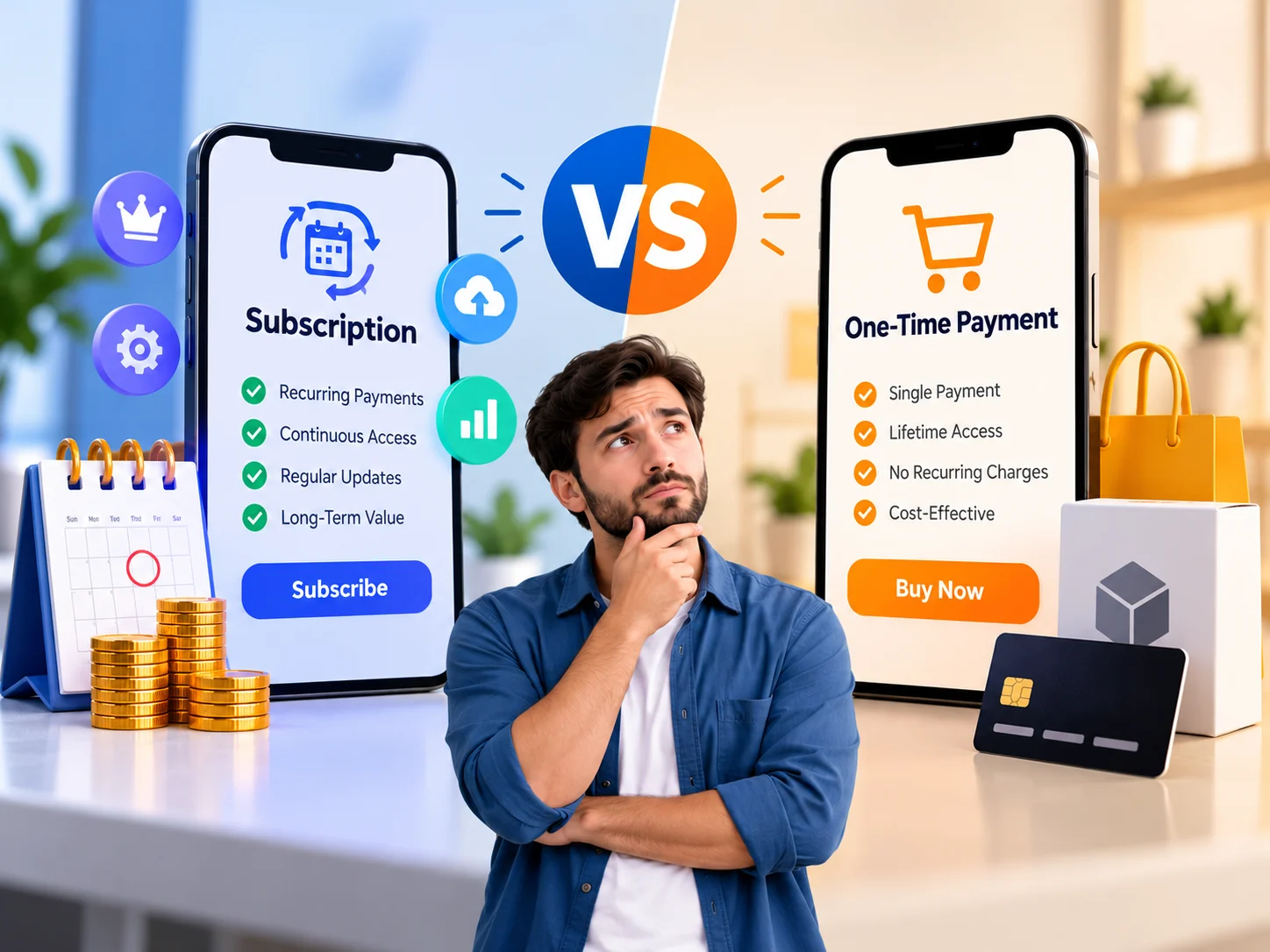
Neither model is better in every case. A subscription business model trades bigger upfront cash for recurring revenue and long-term customer relationships. A one-time payment model brings cash in immediately but forces you to find new buyers constantly. The right choice depends on your product, your costs, and how customers actually use what you sell.
If you are weighing subscription vs. one-time payment for a new product, or thinking about changing an existing one, you are really answering three questions. How fast do you need cash? How much does it cost to acquire and serve a customer? And does the customer keep getting value after the first purchase?
This guide walks through both models in plain language: what each one is, where each one shines, what the numbers look like, and how to decide. You will also see hybrid pricing, common mistakes, and answers to the questions founders ask most.
What is a Subscription-Based Business Model?
A subscription business model charges customers a recurring fee, usually monthly or annually, for ongoing access to a product or service. Instead of selling something once, you sell continued value. Software, streaming, memberships, meal kits, and news sites all work this way.
The core appeal is the recurring revenue model. Each active subscriber produces predictable income every billing cycle, which makes revenue forecasting easier and rewards you for keeping customers happy rather than just winning them.
Here is how it typically works:
- Recurring billing: The customer’s card or account is charged automatically each billing cycle (monthly billing or annual billing).
- Subscription fees: Pricing is tied to a plan, tier, seat count, or usage level.
- Renewal: The subscription renews until the customer cancels, so subscription renewal rates and subscription cancellation behavior become core numbers to watch.
- Metrics that matter: Monthly recurring revenue (MRR), annual recurring revenue (ARR), churn rate, customer acquisition cost (CAC), and customer lifetime value (CLV or LTV).
Subscriptions are most common in SaaS pricing, but the subscription economy now reaches far beyond software, including membership sites, digital content, and physical goods delivered on a schedule.
What is a One-Time Payment Business Model?
A one-time payment model charges the customer once for a product or a permanent license. After they pay, the transaction is complete. Any ongoing support, upgrades, or add-ons are either optional extras or sold separately.
This is the traditional approach: a customer makes a one-time purchase, pays the upfront price, and owns the product. Examples include physical goods, a perpetual license for software, a downloadable template pack, an online course sold with lifetime access, or a one-off service project.
Key characteristics:
- Upfront payment: All revenue from that customer arrives at the moment of sale.
- Simple pricing structure: There is one price and no billing cycle to manage.
- Customer ownership: Buyers often see this as a clearer, fairer deal, which can help conversion.
- Revenue depends on new sales: Once the sale is made, there is no built-in income from that customer unless you sell them something else.
Because growth comes from continually finding new buyers, customer acquisition cost has a direct and constant effect on profit.
Subscription vs. One-Time Payment: Key Differences at a Glance
The main difference is timing and predictability: subscriptions spread payment over time and reward retention, while one-time payments collect everything upfront and reward volume. The table below shows how the two compare on the factors that matter most.
| Factor | Subscription Model | One-Time Payment Model |
|---|---|---|
| Payment structure | Recurring (monthly or annual) | Single upfront payment |
| Revenue predictability | High, based on active subscribers | Lower, depends on new sales |
| Initial cash per customer | Lower | Higher |
| Long-term revenue per customer | Can be much higher if retained | Fixed at the sale price |
| Customer acquisition cost payback | Spread across months | Usually immediate |
| Main risk | Churn and subscription fatigue | Constant need for new customers |
| Customer relationship | Ongoing and long-term | Often transactional |
| Operational complexity | Higher (billing, renewals, retention) | Lower |
| Best for | Ongoing value, updates, access | Finite, self-contained products |
Think of it this way: a one-time payment sells a product, and a subscription sells an outcome that continues. That single distinction explains most of the differences above.
Pros and Cons of Subscription vs. One-Time Payment Models
Both models have real strengths and real weaknesses. Looking at the subscription model pros and cons next to the one-time payment model pros and cons makes the trade-offs easier to see.
Subscription Model: Pros and Cons
Subscriptions give you predictable recurring income and higher potential lifetime value, but they demand strong retention and ongoing delivery of value.
Pros (subscription model benefits):
- Predictable revenue: Recurring income makes budgeting, hiring, and revenue forecasting more reliable.
- Higher customer lifetime value: A customer who stays for years can be worth far more than a single sale.
- Lower barrier to entry: A smaller monthly fee is easier to say yes to than a large upfront price, which helps with customer willingness to pay.
- Pricing flexibility: You can test plans, tiers, and add-ons, and adjust the subscription pricing model over time.
- Business scalability: Once acquisition and onboarding work, revenue compounds as subscribers accumulate.
- Customer insight: Ongoing usage data helps you improve the product and spot at-risk accounts.
Cons (subscription business model advantages and disadvantages):
- Churn risk: Subscribers can cancel at any time, so a high subscription churn rate quietly erodes growth.
- Slower cash recovery: If your CAC is high, it can take months to earn back what you spent to win the customer.
- Ongoing obligation: You must keep delivering value, support, and updates for as long as people pay.
- Subscription fatigue: Many customers now manage numerous recurring charges and are quicker to cancel what they do not use.
- Operational overhead: You need billing infrastructure, failed-payment recovery, and renewal handling. Customers also trust you with billing data, so the importance of data privacy applies directly to how you store and protect it.
- Processing and billing costs: Recurring billing software usually adds fees on top of standard payment processing. For example, Stripe lists its Billing product at 0.7% of billing volume on the pay-as-you-go plan, on top of regular processing fees. Always confirm current rates before you budget.
One-Time Payment Model: Pros and Cons
One-time payments are simple and bring cash in immediately, but they put constant pressure on sales and marketing.
Pros:
- Immediate cash flow: You receive the full amount at the point of sale, which helps early-stage cash flow management.
- Simple pricing and operations: There is no billing cycle, no renewal process, and no cancellation flow to manage.
- Customer appeal: Many buyers prefer to pay once and own the product, especially for tools they use occasionally.
- Faster CAC payback: If your margin on the sale covers acquisition cost, you are profitable on day one.
- Fewer ongoing commitments: Support and updates can be limited or sold separately.
Cons:
- Unpredictable revenue: Sales can swing from month to month, which makes forecasting harder.
- Constant need for new customers: Revenue resets every period, so you must keep spending on acquisition.
- Lower long-term value per customer: Unless you sell upgrades or add-ons, each customer pays once.
- Pricing pressure: A big upfront price can slow conversion, especially for newer brands with little trust.
- Weaker customer relationship: After the sale, there is less built-in reason to stay in contact or keep engaging.
Which Model Generates More Revenue, Profit, and Better Cash Flow?
Subscriptions usually generate more total revenue over time and more predictable income, while one-time payments usually generate faster cash. Which one is more profitable depends on your retention, margins, and acquisition costs, so there is no universal winner.
Revenue Potential and Predictability
Subscriptions tend to win on predictability and cumulative revenue; one-time payments can win on short-term revenue when the price is high, and the buyer base is large.
With recurring revenue, each active subscriber is a known income stream. Add them up, and you get MRR and ARR, which are the numbers investors and lenders pay close attention to. That predictability helps with hiring, inventory, and planning.
A one-time model can produce strong spikes, such as a product launch or a seasonal rush, but next month starts from zero. Revenue is only as stable as your sales pipeline.
A subscription becomes more valuable than a one-time sale only if customers stay long enough. If they cancel early, you may earn less than you would have from a single upfront payment.
Profit Margins and Customer Lifetime Value
Customer lifetime value (LTV) is the key to profit in a subscription model; as long as LTV comfortably exceeds CAC, the model is healthy.
A simple way to estimate LTV:
LTV = Average revenue per customer per period × Gross margin × Average customer lifespan
A common rule of thumb in SaaS is to aim for an LTV that is several times your CAC, though the right ratio varies by industry and growth stage. The point is to check that each customer earns back what you spent to win them, with room to spare.
Here is a hypothetical example (not real data) to show the logic:
- A one-time license sells for $300.
- A subscription version costs $15 per month.
- Break-even: $300 ÷ $15 = 20 months.
If the average subscriber stays longer than 20 months, the subscription earns more per customer. If most cancel before that, the one-time license earns more.
Profit margins also depend on costs that continue after the sale:
- Subscription: You pay hosting, support, and updates for as long as customers stay, plus payment processing fees and billing fees on every charge.
- One-time: Costs are concentrated at the beginning, but you still pay processing fees on each sale and may face support requests with no ongoing revenue to fund them.
Cash Flow and Upfront Costs
One-time payments improve short-term cash flow; subscriptions improve long-term cash flow stability but can strain you in the early months.
A subscription business often spends heavily before it earns. You pay for acquisition today and collect revenue in small pieces over many months. This is why fast-growing subscription companies can look profitable on paper while still needing cash to operate.
Annual billing can ease that gap, because you collect twelve months upfront. The trade-off is that annual plans often come with a discount and can increase refund requests if the customer is dissatisfied.
Accounting also differs. Prepaid annual subscriptions are typically recorded as deferred revenue, which sits as a liability until you deliver the service. If that sounds unfamiliar, the guide on assets vs. liabilities explains the basics, and the difference between a balance sheet vs. income statement helps clarify why cash collected and revenue earned are not the same thing. Speak to an accountant about how your jurisdiction treats it.
How Do Both Models Affect Customer Retention and Experience?
Subscriptions make retention the center of your business, while one-time payments make the first purchase experience the most important moment. Each model shapes how you treat customers after they pay.
Customer Retention and Churn
In a subscription model, churn is the number to watch: every cancelled subscription is lost recurring income. Reducing churn is often cheaper than acquiring new customers, which is why customer retention strategies carry so much weight here.
Practical ways to improve retention:
- Onboard well. Help users reach their first win quickly, because early value predicts long-term use.
- Track engagement. Low usage often shows up before a cancellation does.
- Recover failed payments. Card expiry and declines cause involuntary churn; automatic retries and reminder emails help.
- Make cancellation honest and easy. Offering a pause or a downgrade can save a customer without damaging trust.
- Ask why people leave. Short exit surveys reveal fixable problems.
- Offer annual plans. They increase customer commitment and reduce billing events where someone might cancel.
One-time models do not have churn in the same sense, but they have a similar challenge: repeat purchases and referrals. Without a recurring relationship, you rely on good products, follow-up emails, upgrades, and brand reputation to bring customers back.
Customer Experience and Perceived Value
Customers accept subscriptions when the value keeps showing up, and they prefer one-time payments when the product is a finished tool they use occasionally.
Subscriptions feel fair when:
- The product is updated or improved regularly.
- Usage is frequent, such as daily or weekly.
- The service itself keeps delivering, such as storage, content, or support.
They feel unfair when the customer pays every month for something they rarely touch. This is where subscription fatigue comes in. People increasingly judge subscriptions on a needs vs. wants basis, and the ones that feel like wants are the first to go when budgets tighten.
One-time purchases give buyers certainty. They know the total cost of ownership upfront, and there is no worry about price increases at renewal. That clarity supports pricing transparency and trust. The risk is that buyers may expect free updates forever, which can be expensive to honor.
Which Model Works Best for Startups, Small Businesses, and SaaS Products?
SaaS products almost always suit subscriptions, while startups and small businesses should choose based on how quickly they need cash and how often customers will use the product. The best business model for startups is the one that matches the product’s delivery cost and usage pattern, not the one that sounds more modern.
Pricing Considerations for Startups and Small Businesses
Early-stage businesses should weigh cash needs first: a subscription builds steady revenue slowly, while a one-time payment funds growth faster.
Questions to ask:
- How long can you operate without profit? If runway is short, upfront payments or annual plans may help.
- Does the product have ongoing costs? If each customer costs you money every month, a one-time price can lose money over time.
- Do customers need the product repeatedly? Ongoing need supports a subscription; one-off needs support a single payment.
- How will you handle billing? Subscriptions require systems for recurring payments, failed charges, and cancellation. Simple tools may be enough at first.
For tools, small businesses often start with a subscription payment gateway or an e-commerce platform’s built-in options, such as Shopify subscription apps, then move to dedicated subscription management software as volume grows. Options such as Stripe, PayPal, Razorpay, Chargebee, Recurly, and Paddle serve different needs, so compare fees, supported regions, tax handling, and reporting before committing. For a sense of how billing-layer costs scale, one Recurly vs. Stripe cost comparison published in August 2026 models how fees change with monthly billing volume; note that it comes from a competing vendor, so verify figures with each provider.
A useful middle route for new products: start with a one-time or annual-plan offer to validate demand, then add recurring options once you understand how often customers use the product.
Pricing Considerations for Digital Services and SaaS Products
SaaS and digital services usually fit subscriptions because hosting, support, and updates are continuous costs. Charging once for something you must run forever makes it hard to cover those costs.
For SaaS pricing, consider:
- Value metric: Charge by something that grows with customer value, such as seats, projects, or usage.
- Tiering: Offer good, better, and best plans so customers can self-select.
- Annual vs monthly billing: Offer both, with a modest annual discount to improve cash flow and retention.
- Freemium or trial: Lower the barrier to entry, but make sure the paid tier has a clear upgrade reason.
- Usage-based pricing: Works well when cost scales with consumption, though it makes revenue less predictable.
- Metrics to monitor: MRR, ARR, churn rate, renewal rate, CAC, and LTV. Tools like ProfitWell (now part of Paddle) and subscription analytics tools can help track these.
Not every digital product needs a subscription. A fixed template, a finished course, or a downloadable asset pack may sell better as a one-time purchase, with a membership layered on for community or new content.
Can You Combine Subscription and One-Time Payments? (Hybrid Pricing)
Yes. A hybrid pricing model mixes recurring fees with one-time charges, giving you steadier income without forcing every customer into a subscription. Many businesses use it because it matches how people actually buy.
Common Hybrid Pricing Models
Hybrid pricing comes in a few familiar forms.
- Setup fee plus subscription: A one-time onboarding or implementation fee, followed by a monthly or annual plan.
- Perpetual license plus maintenance: The customer buys the software once and pays annually for updates and support.
- Base subscription plus usage: A fixed plan covers a set allowance, and extra usage is billed separately (pay-as-you-go on top of a subscription).
- Subscription plus one-time add-ons: Core access is recurring, while extras like templates, hardware, or premium packs are sold once.
- Freemium with paid upgrades: Free access for basic use, then a subscription or one-time purchase to unlock more.
- Lifetime deal alongside plans: A limited one-time offer for lifetime access, with standard subscription pricing for everyone else.
When a Hybrid Approach Makes Sense
Hybrid pricing makes sense when your product has both a one-off component and an ongoing component, or when your customers have very different needs.
Consider it when:
- Setup is complex. A one-time fee covers onboarding costs that a low monthly price cannot.
- Some customers hate subscriptions. Offering a one-time option captures buyers who would otherwise walk away.
- Usage varies widely. A base plan with usage charges keeps pricing fair for light and heavy users.
- You sell hardware or physical goods with services. The device is a one-time sale; the app or service is recurring.
- You want to test demand. A hybrid can reveal which model your customers prefer.
The main risk is complexity. If customers cannot understand your pricing in one glance, conversion drops. Keep the structure as simple as the product allows.
How to Choose the Right Business Model for Your Business
Choose the model that best matches how your product delivers value, what your costs look like, and how customers prefer to pay. Use a three-step process: match the model to your product, compare the numbers, then test and refine.
Match the Pricing Model to Your Product and Customer Needs
Start with the product: ongoing value points toward subscriptions, finished one-off value points toward one-time payments.
A quick guide:
| If Your Product | Lean Toward |
|---|---|
| Is used continuously and updated often | Subscription |
| Has ongoing hosting, content, or support costs | Subscription |
| Delivers a complete, finished result | One-time payment |
| Is used occasionally | One-time or pay-as-you-go |
| Has a one-off setup plus continued use | Hybrid |
| Sells to customers who dislike recurring charges | One-time or lifetime option |
Also think about your customer’s payment flexibility. Some prefer small monthly payments; others want to pay once and be done.
Compare Costs, Revenue Goals, and Customer Lifetime Value
Run the numbers for both models using your own CAC, margins, churn estimate, and costs to serve each customer.
A simple checklist:
- Calculate CAC. Add up sales and marketing spend and divide by new customers.
- Estimate gross margin. Remove hosting, support, payment processing fees, and billing fees.
- Estimate retention. Use a realistic churn range, not a best-case guess. If you have no data, say so and model several scenarios.
- Model LTV for each option. Compare subscription LTV with the one-time price plus any expected upsells.
- Find the break-even point. Divide the one-time price by the monthly subscription price to see how many months of retention a subscription needs to match it.
- Check cash runway. Make sure the model you pick will not leave you short before revenue catches up.
If you do not yet have real data, treat your first model as a hypothesis, not a forecast.
Test Pricing and Refine It Based on Results
Treat pricing as an experiment: launch, measure, and adjust. Few teams get pricing right the first time.
Ways to run pricing experiments:
- A/B test price points or plan structures on new visitors.
- Try annual vs. monthly emphasis on your pricing page.
- Offer a limited one-time option to see whether it attracts different customers.
- Interview customers about what they consider fair and what they would pay for.
- Track the right signals: conversion rate, churn, renewal rate, average revenue per customer, and support load.
- Change gradually. Grandfather existing customers when raising prices to protect trust.
For value-based pricing, anchor price to the outcome the customer gets rather than only to your costs.
Common Mistakes to Avoid When Choosing a Pricing Model
Most pricing mistakes come from copying competitors or ignoring unit economics. Watch for these:
- Choosing subscriptions by default. Not every product deserves a monthly fee, and customers can tell.
- Ignoring churn. A leaky subscription can look healthy until growth slows.
- Underpricing. Pricing too low to attract customers can make it impossible to cover support and development.
- Ignoring CAC and LTV. If acquiring a customer costs more than they will ever pay, volume will not fix it.
- Offering lifetime deals without limits. A one-time payment for permanent access can create costs you cannot fund years later.
- Overcomplicating plans. Too many tiers and add-ons confuse buyers.
- Hiding cancellation. Difficult cancellations cause chargebacks, complaints, and lost trust, and may create legal issues depending on your region.
- Forgetting fees. Payment processing, recurring billing, tax, and chargeback costs all affect profit margins.
- Never revisiting price. Costs, competitors, and customer expectations change.
Final Verdict
Choose a subscription if your product delivers continuing value and you can retain customers; choose a one-time payment if your product is complete on delivery and you need cash quickly; choose hybrid when you have both.
Subscriptions favor predictable revenue, higher lifetime value, and long-term growth. One-time payments favor simplicity, immediate cash flow, and customer clarity. The strongest businesses are not loyal to a model; they pick the one that fits their costs and customers, measure the results, and adjust.
If you are unsure, start by modeling both with your real numbers, then test with a small group before committing.
FAQs
Is a Subscription Model More Profitable Than One-Time Payments?
Not automatically. Subscriptions are more profitable when customers stay long enough for lifetime value to exceed acquisition and service costs. If churn is high or support costs are heavy, a one-time payment can earn more per customer. Compare LTV, CAC, and gross margin for both options.
How Do You Calculate the Break-Even Point Between One-Time and Subscription Pricing?
Divide the one-time price by the subscription’s monthly price. A $300 one-time price and a $15 monthly plan break even at 20 months. If the average subscriber stays longer, the subscription earns more; if they leave sooner, the one-time price earns more. Adjust for margin and fees for a fairer comparison.
How Can a Business Switch from One-Time Payments to Subscription Pricing?
Plan the move in stages: define what ongoing value the subscription includes, announce the change early, and consider grandfathering existing customers or offering them a discounted transition plan. Set up recurring billing and renewal communications, and track churn closely in the first few months. A hybrid step, such as paid updates, can soften the change.
How Can a Business Reduce Churn in a Subscription Model?
Improve onboarding, monitor usage, recover failed payments with retries and reminders, and ask cancelling customers why they are leaving. Offering pauses, downgrades, or annual plans can also help. Most importantly, keep delivering visible value so customers feel the fee is worth paying.
Is a Lifetime Deal a Good Alternative to a Subscription Model?
It can be useful for short-term cash and early validation, but it carries risk. You take on support and hosting costs for the life of the product without ongoing revenue. If you offer one, limit availability, define what “lifetime” means, and consider pairing it with standard subscription plans.
Should a Business Offer Monthly and Annual Subscription Plans?
Usually yes. Monthly plans lower the barrier to entry, while annual plans improve cash flow and retention. A modest discount on annual billing is common. Watch refund rates and renewal rates to make sure the annual option is working as intended.
Can Physical Products Use a Subscription Model?
Yes. Products that are consumed or replaced regularly, such as coffee, razors, supplements, or meal kits, fit well. Success depends on delivery reliability, margins after shipping, and making it easy to skip, pause, or cancel. Subscriptions are a weaker fit for durable goods people buy once.
Disclaimer –
This article is for general informational purposes only and does not constitute financial, legal, tax, or accounting advice. Pricing, fees, and platform features mentioned (such as payment processor rates) may change, so please verify current details with the provider. Examples used are hypothetical. Consult a qualified professional before making business or financial decisions.