
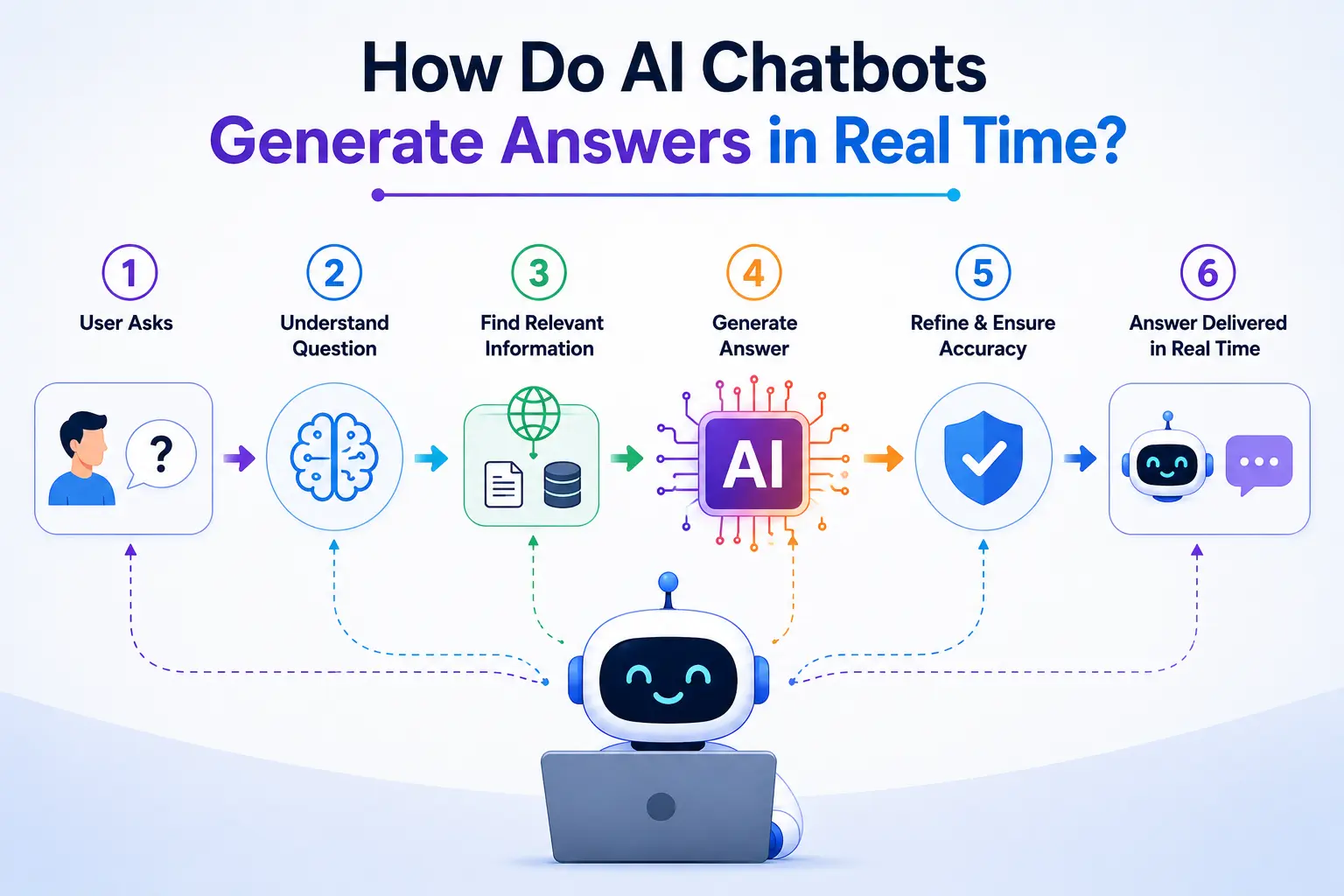
Ask an AI chatbot a question and the answer appears in seconds. It reads like something a knowledgeable person typed out, yet no human is on the other end. What’s actually happening behind that response involves a chain of technical steps: language processing, pattern prediction, context retrieval, and rapid computation, all completed in the time it takes to blink.
This matters more than ever because AI chatbots have moved from novelty to infrastructure. Businesses use them for customer support, developers use them to write code, and everyday users ask them everything from recipe substitutions to legal definitions. Understanding how these systems actually produce an answer helps you use them more effectively, trust them appropriately, and know where their limits lie.
This guide breaks down exactly how AI chatbots work, from natural language processing and large language models to the step-by-step pipeline that turns a typed question into a real-time answer. We’ll also cover what affects speed and accuracy, common failure points like hallucinations, and where this technology is headed next.
What Are AI Chatbots and How Do They Work?
An AI chatbot is a software program that uses artificial intelligence, primarily natural language processing and machine learning, to understand human input and generate relevant, human-like responses. Unlike simple automated messaging tools, an AI-powered chatbot interprets meaning and intent rather than just matching exact phrases.
The core purpose of an AI chatbot is to simulate a natural conversation while completing a task: answering a question, resolving a support issue, retrieving information, or guiding a user through a process. This is achieved through a combination of natural language understanding (NLU), natural language generation (NLG), and, in modern systems, large language models that handle both comprehension and response creation in a single unified architecture.
What separates a genuinely intelligent chatbot from a scripted one is adaptability. A rule-based system can only respond to inputs it was explicitly programmed to recognize. An AI chatbot, by contrast, can generalize from patterns learned during training and respond sensibly to phrasing it has never seen before.
➤ Different Types of AI Chatbots and Their Capabilities
Not all chatbot technology works the same way. Broadly, chatbots fall into a few categories, each with different levels of intelligence and flexibility:
- Rule-based chatbots: Operate on decision trees and predefined scripts. They respond well to expected inputs but fail on anything outside their programmed flow.
- Retrieval-based chatbots: Select the best-matching response from a fixed set of answers using pattern matching or basic NLP, without generating new text.
- Generative AI chatbots: Use large language models to generate original responses word by word based on the input and context, rather than picking from a predefined list.
- Hybrid chatbots: Combine rule-based logic for specific workflows (like booking a ticket) with generative AI for open-ended conversation.
- Autonomous AI agents: A newer category that goes beyond conversation, capable of taking multi-step actions like searching the web, calling APIs, or executing tasks independently.
Most modern AI chatbot platforms marketed as intelligent chatbot solutions today are generative, built on large language models, and often layered with retrieval systems that pull in outside information before generating a response. This layered approach is part of why enterprise AI agent vendor platforms are increasingly popular for businesses that need both structured workflows and open-ended conversational ability.
How AI Chatbots Understand User Queries Using Natural Language Processing
Natural language processing (NLP) is the technology that allows AI chatbots to convert raw human text into a structured format a machine can analyze, combining natural language understanding to interpret meaning and natural language generation to produce a coherent, human-like reply.
♦ How Natural Language Processing Helps Chatbots Understand Human Language
NLP breaks language down into components a computer can work with: grammar structure, word relationships, and meaning in context. This is what allows a chatbot to tell the difference between “book a flight” (a request) and “I read a good book” (a statement), despite both containing the word “book.”
Modern natural language processing chatbot systems don’t just parse grammar. They build a contextual representation of the entire input, factoring in word order, surrounding phrases, and even prior messages in the conversation. This is fundamentally different from older keyword-based systems, which simply looked for trigger words.
♦ Tokenization and Text Preprocessing in AI Chatbots
Before any understanding happens, the input text goes through tokenization: the process of breaking a sentence into smaller units called tokens, which can be whole words, subwords, or even individual characters depending on the model’s design.
Text preprocessing typically includes:
- Splitting text into tokens using the model’s tokenizer
- Converting tokens into numerical IDs the model can process
- Normalizing text (handling capitalization, punctuation, and special characters)
- Mapping tokens to embeddings, which are numerical vectors representing meaning
This tokenization step is foundational. Every large language model has a fixed vocabulary of tokens, and how a sentence gets split directly affects how efficiently and accurately the model interprets it.
♦ Intent Recognition and Entity Extraction
Once text is tokenized, the chatbot needs to determine intent, essentially, what the user actually wants. Is this a question, a complaint, a command, or small talk? Alongside intent, the system performs entity extraction, identifying specific pieces of information like dates, names, locations, or product names embedded in the query.
For example, in the query “What’s the weather in Jaipur this weekend?”, intent recognition identifies this as a weather inquiry, while entity extraction pulls out “Jaipur” (location) and “this weekend” (time frame). Both pieces of information shape how the chatbot formulates its response.
Semantic Understanding vs. Keyword Matching
Semantic understanding refers to a system’s ability to grasp meaning based on context, not just literal words. Keyword matching, by contrast, just looks for exact term overlap and often misses intent entirely.
| Aspect | Keyword Matching | Semantic Understanding |
|---|---|---|
| Basis | Exact word overlap | Contextual meaning |
| Handles synonyms | No | Yes |
| Handles typos/variations | Poorly | Generally well |
| Understands intent | No | Yes |
| Used in | Older/rule-based bots | Modern AI chatbots, LLMs |
This difference is why older systems often produced frustrating, irrelevant answers, while modern AI chatbot technology can understand paraphrased or loosely worded questions and still respond appropriately.
The Role of Large Language Models (LLMs) in Generating Responses
Large language models (LLMs) are the engine behind most modern AI chatbots. They are deep learning models trained on massive amounts of text data, enabling them to predict and generate coherent, contextually appropriate language one token at a time.
► What Are Large Language Models and How Do They Work?
An LLM is a type of neural network, specifically built on transformer architecture, trained to predict the next most probable token in a sequence based on everything that came before it. Rather than storing fixed answers, the model learns statistical patterns in language: grammar, facts, reasoning structures, and style, from the training data it was exposed to.
The transformer architecture introduced a mechanism called the attention mechanism, which allows the model to weigh the importance of different words in a sentence relative to one another, regardless of their distance apart. This is what enables an LLM to track that “it” in a sentence refers to something mentioned three sentences earlier, something older models struggled with badly.
► How LLMs Predict and Generate Human-Like Responses
At a technical level, generating a response is a repeated cycle of token prediction. The model looks at the input tokens, calculates a probability distribution over its entire vocabulary for what token should come next, selects one (using a sampling strategy), appends it to the output, and repeats the process until the response is complete.
This process, called language model inference, happens extremely fast, often producing dozens of tokens per second. Because each token is generated based on everything before it, including its own previous outputs, the model builds a response incrementally rather than composing it all at once the way a person might draft an email.
► The Role of Training, Parameters, and Fine-Tuning in LLM Performance
Three factors heavily influence how good an LLM is at generating useful answers:
- Training data: The scale, diversity, and quality of text the model learned from directly shapes its knowledge and language ability.
- Parameters: These are the internal numerical values (weights) the model adjusts during training. Generally, models with more parameters can capture more complex patterns, though efficiency and training quality matter just as much as raw size.
- Fine-tuning: After initial training, models are often further trained on specific datasets or with human feedback to improve accuracy, safety, and alignment with what users actually want, a process often called instruction tuning or reinforcement learning from human feedback.
This combination is why two chatbots built on similar-sized models can perform very differently depending on how they were trained and fine-tuned.
Step-by-Step: How AI Chatbots Generate Answers in Real Time
Understanding the full pipeline makes it clear that a chatbot’s instant reply is actually the result of five distinct stages happening in rapid succession, from receiving your text to delivering a validated, formatted response.
Step 1: Receiving and Processing User Input
The moment you hit send, the chatbot interface captures your text and forwards it to the backend system. It’s a similar handshake to what happens when you open a website: a request travels from your device to a server, gets processed, and a response is prepared for return. The input then goes through tokenization and preprocessing, exactly as described earlier, converting your words into a numerical format the model can interpret.
Step 2: Understanding User Intent and Retrieving Relevant Context
Next, the system determines what you’re actually asking for through intent recognition and, where applicable, retrieves supporting context. This might include your conversation history, external documents, or knowledge base integration if the chatbot is connected to a company’s internal data or a live search tool. This is also where retrieval-augmented systems pull in fresh, relevant information rather than relying solely on what the model memorized during training.
Step 3: Generating Responses Using AI Models
With intent and context established, the language model begins language model inference: predicting the response token by token based on the input, retrieved context, and conversation history. This is the computational core of the process, running on specialized hardware designed to handle the intense matrix calculations transformer models require.
Step 4: Validating, Filtering, and Improving Response Accuracy
Before a response reaches you, most production AI chatbot systems run it through safety and quality filters. This step checks for harmful content, factual inconsistencies where possible, formatting issues, and policy violations. Some systems also apply post-processing to improve tone or clarity before finalizing the output.
Step 5: Delivering the Final Response Instantly
Finally, the response is streamed back to your screen, often word by word or chunk by chunk, which is why you frequently see the reply appear progressively rather than all at once. This streaming approach improves perceived speed even when full generation takes a few seconds behind the scenes.
How Context and Conversation History Shape Better Responses
AI chatbots maintain context by feeding prior messages back into the model along with your newest input, all within what’s called a context window, the maximum amount of text the model can consider at once. This is how a chatbot can understand a follow-up question like “what about next week?” after you’ve already asked about tomorrow’s weather, because it re-reads the earlier exchange rather than treating each message in isolation.
Context retention is what makes multi-turn conversations feel natural instead of robotic. Without it, every message would need to be a fully self-contained question, and the chatbot would essentially have no memory from one message to the next.
✸ Limitations of Context Memory in AI Chatbots
Context windows are not unlimited. Once a conversation grows long enough to exceed the model’s context window, earlier parts of the conversation get dropped or summarized, which can cause the chatbot to “forget” details mentioned much earlier. Additionally, most consumer-facing chatbots don’t retain memory across separate sessions unless the platform is specifically designed with persistent memory features, meaning a new conversation typically starts with no knowledge of previous ones.
This is an important limitation to understand, especially in longer working sessions, as it explains why chatbots sometimes seem to lose track of instructions given far earlier in a conversation.
How Training Data Helps AI Chatbots Deliver Relevant Answers
✦ The Importance of Quality Training Data
An AI chatbot is only as good as the data it learned from. High-quality, diverse, and well-curated training data allows a model to develop accurate language patterns, broad general knowledge, and fewer harmful biases. Poor-quality or narrow training data, on the other hand, tends to produce a chatbot with gaps in knowledge, outdated information, or skewed responses.
This is why the importance of data privacy is also a major consideration for companies building AI chatbot tools, since training data often needs careful handling to avoid exposing sensitive or personal information the model might have been exposed to.
✦ How AI Models Learn Patterns From Training Data
During training, the model doesn’t memorize exact sentences the way a database would. Instead, it adjusts its internal parameters to recognize statistical patterns, grammar rules, factual associations, and stylistic conventions across billions of examples. This is what allows the model to generalize, producing coherent answers to questions it never saw verbatim during training, rather than simply recalling stored text.
✦ The Role of Data Updates and Continuous Model Improvement
Because language, facts, and world events constantly change, AI models require periodic retraining or updates to stay useful. Many modern systems supplement this by connecting the model to live data sources or search tools, allowing it to pull current information rather than relying solely on a training cutoff. This hybrid approach, combining a trained model with real-time retrieval, is increasingly standard in enterprise conversational AI and AI-powered search tools.
Key Factors That Affect Response Speed and Performance
➤ Model Size, Architecture, and Computing Power
Larger models generally require more computation per token generated, which can slow down response time unless offset by more powerful hardware or optimization techniques. The underlying architecture also matters: efficient transformer designs and optimized attention mechanisms can significantly reduce the computational load without sacrificing response quality.
➤ Server Infrastructure and Data Processing Speed
The physical infrastructure behind a chatbot- the servers, specialized chips (like GPUs or TPUs), and network speed- directly impacts how quickly a response gets generated and delivered. Enterprise-grade AI chatbot development often includes significant investment in this infrastructure to ensure consistent performance under heavy user load.
➤ Query Complexity and Response Generation Time
A short factual question typically generates faster than a long, multi-part request requiring reasoning across several pieces of context. Complex queries may require the model to process more tokens, retrieve more context, or run additional reasoning steps, all of which add to processing time.
➤ Caching and Optimization Techniques for Faster Responses
To speed things up, many systems use caching, storing the results of frequent or repeated computations, so the model doesn’t have to redo identical work. Techniques like key-value caching during inference, batching multiple requests together, and model quantization (reducing numerical precision to speed up calculations) are all common optimization techniques for faster responses without a major loss in output quality.
Common Challenges in Real-Time AI Answer Generation
♦ Hallucinations and Incorrect AI Responses
A hallucination occurs when an AI chatbot generates information that sounds plausible but is factually incorrect or entirely fabricated. This happens because the model is fundamentally predicting likely-sounding text based on patterns, not verifying facts against a database. Retrieval-augmented approaches and stronger fact-checking layers help reduce this, but they haven’t eliminated it entirely.
♦ Handling Complex and Ambiguous User Queries
Ambiguous phrasing, sarcasm, or questions that require multi-step reasoning remain genuinely difficult for AI systems. A vague query like “is it good?” without clear context forces the model to guess at intent, which can lead to answers that miss the mark.
♦ Reducing Bias in AI-Generated Answers
Because models learn from real-world text, they can absorb and reproduce biases present in that data. Reducing bias requires careful dataset curation, ongoing evaluation, and fine-tuning specifically aimed at identifying and correcting skewed patterns in outputs.
♦ Balancing Response Speed With Accuracy
There’s a persistent tension between generating answers quickly and ensuring they’re accurate. Adding more verification steps, retrieval calls, or reasoning passes generally improves accuracy but adds latency, meaning developers constantly have to balance the two based on the chatbot’s intended use case.
♦ Privacy and Data Security Concerns
Chatbots that process sensitive information raise real questions about data handling, storage, and exposure. This connects closely to the importance of data privacy and, more broadly, AI in cybersecurity, since poorly secured chatbot systems can become a vector for data leaks or exploitation if not properly designed and monitored.
The Future of Real-Time AI Chatbot Technology
► Advancements in AI Reasoning and Personalization
Newer models are increasingly capable of multi-step reasoning, breaking a complex problem into smaller logical steps before answering, rather than generating a single-pass response. Combined with better personalization based on user history and preferences, this points toward chatbots that feel less generic and more tailored to individual needs over time.
► Integration With Voice, Vision, and Multimodal AI
Multimodal AI systems that can process text, images, audio, and video together are becoming more common, allowing chatbots to answer questions about a photo, transcribe and respond to spoken input, or analyze a document, all within a single conversational interface. This shift is part of why AI in data analysis and AI-powered virtual assistants are converging into broader, more capable systems.
► The Growing Role of AI Chatbots Across Industries
From customer service to software development, AI chatbots are expanding well beyond simple Q&A. This includes everything from best AI coding agents for developers assisting with programming tasks, to AI agents automating entire business workflows, to industry-specific tools built through custom AI chatbot development for healthcare, finance, retail, and beyond. As this expands, the decision between custom software vs off-the-shelf software becomes increasingly relevant for businesses deciding how to deploy this technology.
Conclusion
Behind every instant chatbot reply is a tightly coordinated sequence: understanding your words through natural language processing, drawing on patterns learned from vast training data, predicting a response token by token through a large language model, and validating that response before it ever reaches your screen. None of this involves the chatbot “thinking” the way a person does, but the underlying combination of transformer architecture, context retention, and rapid inference is what makes the experience feel remarkably close to a real conversation.
As reasoning capabilities improve and multimodal integration expands, real-time AI chatbot technology will keep getting faster and more capable, but the fundamentals covered here, tokenization, intent recognition, model inference, and response validation- will remain the backbone of how these systems work.
FAQs
How do AI chatbots generate responses so quickly?
AI chatbots generate responses quickly because the underlying language model performs rapid token-by-token prediction on specialized hardware, combined with optimization techniques like caching and efficient model architecture that reduce computation time per response.
What is the difference between AI chatbots and traditional rule-based chatbots?
Rule-based chatbots follow predefined scripts and can only respond to inputs they were explicitly programmed for. AI chatbots use natural language processing and machine learning to understand intent and generate original responses, allowing them to handle a much wider range of phrasing and questions.
What is a large language model (LLM), and how is it different from a chatbot?
A large language model is the underlying AI system trained to understand and generate text based on patterns in data. A chatbot is the application built around that model, adding the conversational interface, context handling, and safety layers needed to interact with users.
Do AI chatbots remember previous conversations?
Within a single conversation, most AI chatbots use a context window to remember earlier messages. However, unless a platform specifically includes persistent memory features, chatbots typically don’t retain information across separate, unrelated conversations.
Are AI chatbot responses generated in real time, or pre-written?
Modern generative AI chatbot responses are generated in real time, token by token, based on the input and context at that moment. They are not pulled from a list of pre-written answers, which is why responses can vary even for similar questions.
Why do AI chatbots sometimes give incorrect or made-up answers?
This happens because language models predict statistically likely text rather than verifying facts against a database. When a model lacks reliable information on a topic, it can still generate a fluent-sounding but incorrect response, known as a hallucination.
What factors affect the accuracy of AI chatbot answers?
Accuracy depends on the quality and recency of training data, how well the model was fine-tuned, whether it has access to retrieval tools or live data, and how well it interprets the specific query’s intent and context.
Can AI chatbots understand and respond in multiple languages?
Yes, many modern AI chatbots are trained on multilingual datasets and can understand and generate responses in multiple languages, though accuracy and fluency can vary depending on how much training data existed for each specific language.
Disclaimer
The content on this website is provided for general informational and educational purposes only. While we aim for accuracy, technology and AI-related topics evolve quickly, and some information may become outdated over time.
Nothing on this site constitutes professional, legal, financial, or medical advice. Use any information here at your own discretion, and consult a qualified professional where appropriate.
Some content may be created with AI assistance, along with human review and editing.
This site may contain links to third-party websites, which we are not responsible for. It may also display ads through third-party networks, including Google AdSense, which may use cookies to serve relevant ads.