
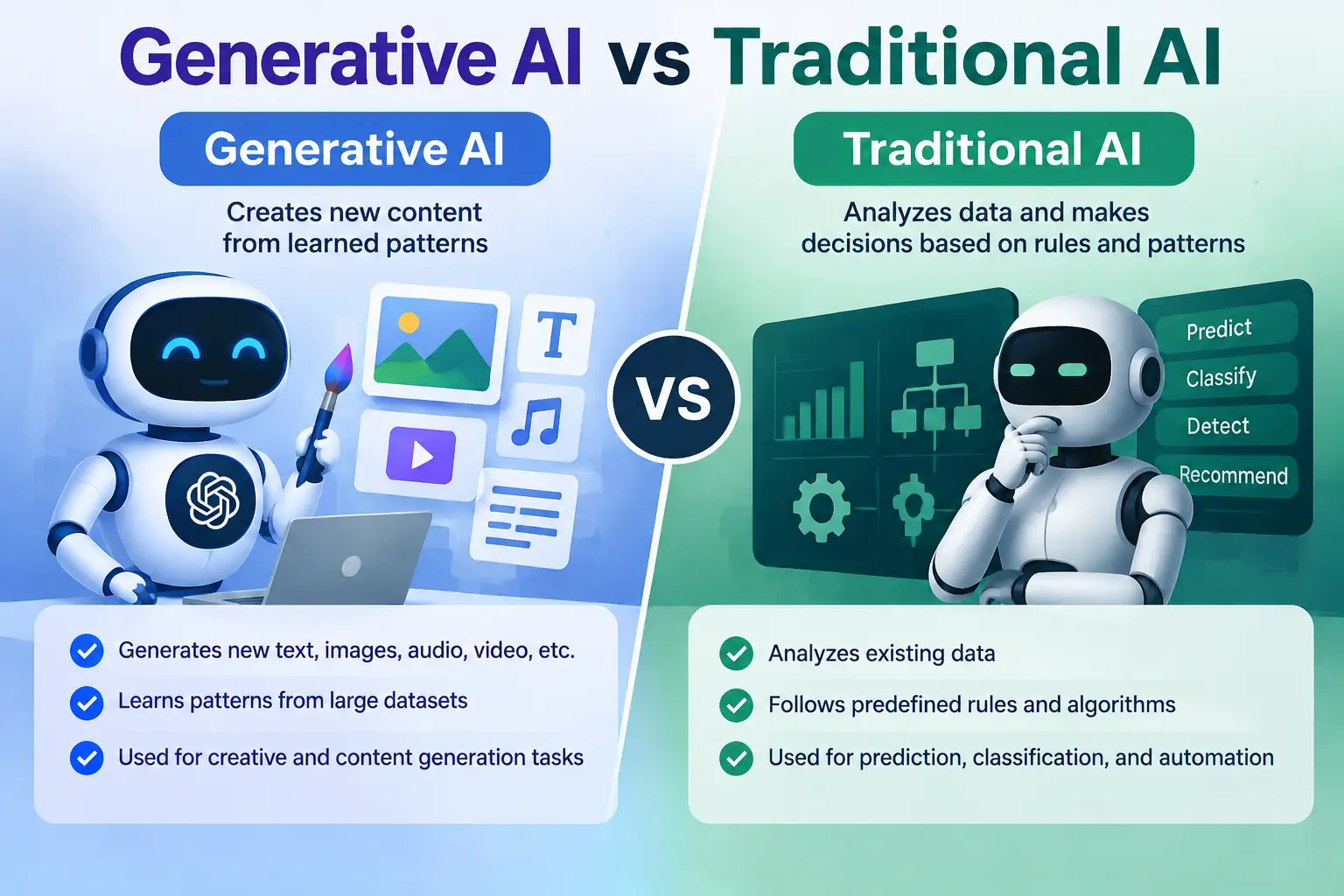
Generative AI creates new content, such as text, images, audio, code, and video, while traditional AI analyzes existing data to classify, predict, or recommend. Both are types of artificial intelligence (AI), and both rely on machine learning (ML). They differ in what they produce, how they learn, and which business problems they suit.
The difference matters more now because adoption is broad. Stanford’s 2026 AI Index reports that organizational AI adoption reached 88%, and generative AI hit 53% population adoption within three years. Adoption is not the same as results, though. Many teams pick a tool before they know the problem it should solve.
This guide covers:
- What each approach is and how it works
- How they differ in output, data, accuracy, and cost
- Real-world use cases and where the two work together
- How to choose for your business
What is Generative AI and How Does It Work?
Generative AI is a branch of artificial intelligence that produces new content, including text, images, audio, video, and code, by learning patterns from large amounts of training data. Instead of labeling or scoring an input, it generates something that did not exist before.
How does generative AI work?
Most generative AI models follow three stages:
- Pre-Training: The model learns statistical patterns from huge datasets of structured and unstructured data, such as books, code, images, and audio.
- Fine-Tuning and Alignment: Developers adapt the pre-trained model to specific tasks, tone, or safety requirements. This is where model fine-tuning comes in.
- Inference: When you enter a prompt, the model predicts the most likely next piece of content (a word, pixel, or sound) step by step. This is why outputs are probabilistic rather than fixed.
Large language models (LLMs) are the best-known example. If you want a deeper look at the mechanics, see how LLMs work and how AI chatbots generate answers.
A practical note: the quality of your output depends heavily on the instruction you give. That is why prompt engineering has become a real skill for teams using these tools.
Common examples: ChatGPT and other OpenAI generative AI models, Google Gemini, and Microsoft Copilot.
What is Traditional AI and How Does It Work?
Traditional AI, also called conventional AI, narrow AI, or classical AI, is built to perform a specific task, such as classifying data, detecting patterns, or predicting outcomes, using rules or models trained on historical data. It analyzes what already exists and returns a decision, label, score, or forecast.
How does traditional AI work?
- Collect and prepare data. Teams gather historical, usually structured data.
- Train a model. Supervised learning uses labeled examples. Unsupervised learning finds hidden groupings without labels.
- Deploy and monitor. The model scores new inputs, for example, “fraud” or “not fraud.”
Traditional AI sits across two broad categories:
- Rule-based AI: Fixed if-then logic written by humans.
- Machine learning: Algorithms such as decision trees, regression, and clustering that learn from data.
This is also what people mean by predictive AI or analytical AI. Its strength is consistency in narrow, well-defined jobs.
Generative AI vs Traditional AI: What Are the Key Differences?
The core difference is that generative AI creates new content, while traditional AI analyzes existing data to predict or classify. Everything else, including data needs, predictability, explainability, and cost, follows from that.
| Factor | Generative AI | Traditional AI |
|---|---|---|
| Main goal | Create new content | Predict, classify, or recommend |
| Output | Text, images, audio, video, code | Labels, scores, forecasts, decisions |
| Typical data | Large, mostly unstructured | Often structured, task-specific |
| Models | Transformers, diffusion models, GANs | Decision trees, regression, classifiers |
| Output consistency | Probabilistic, can vary | More repeatable |
| Explainability | Harder | Often easier |
| Compute needs | High | Usually lower |
Purpose and Type of Output
Generative AI produces open-ended content. Traditional AI produces a bounded answer. Ask a generative model for a product description and you get paragraphs. Ask a traditional model about a transaction, and you get a fraud probability.
This is the heart of generative AI vs predictive AI: one makes, the other forecasts.
Learning Methods and Data Requirements
Generative AI usually needs far more data and learns broad patterns. Traditional AI needs data matched to one task.
- Generative models train on massive volumes of structured and unstructured data, often through self-supervised learning, and are later adapted through fine-tuning.
- Traditional models rely on supervised learning (labeled data) or unsupervised learning (unlabeled data) built for a defined objective.
- Traditional AI is often easier to start with if you have clean historical records and a clear question.
Creativity, Adaptability, and Predictability
Generative AI is more flexible and creative but less predictable. Traditional AI is rigid but consistent.
A generative model can handle many tasks (summarize, translate, draft, code) from a single foundation model. A traditional model does one job well, and retraining is often needed if the task changes. The trade-off is that identical prompts can yield different outputs, which matters for regulated or repeatable processes.
Accuracy and Explainability
Traditional AI is generally easier to measure and explain. Generative AI can sound confident while being wrong.
- Traditional AI: You can evaluate prediction accuracy with clear metrics, and simpler models like decision trees can show how they reached a result. That supports explainable AI and audit needs.
- Generative AI: Quality is harder to score because “good” is subjective. Models can also produce hallucinations, which are fluent but false statements. Retrieval-augmented generation (RAG) reduces this by grounding answers in trusted documents, but human oversight is still needed.
Cost and Resource Requirements
Generative AI typically costs more to train, run, and scale, though many businesses avoid the training cost by using pre-trained models through APIs.
- Training from scratch: Very high computational resources, usually out of reach for most companies.
- Using existing models: Costs shift to usage fees, integration, data preparation, and governance.
- Traditional AI: Often cheaper to run, with lighter infrastructure, but still requires data engineering and maintenance.
I can’t give a reliable universal price range because costs vary widely by vendor, data volume, and architecture. Get quotes against your specific use case.
What Are the Real-World Use Cases of Generative AI and Traditional AI?
Generative AI fits creation-heavy work such as writing, design, coding, and conversation. Traditional AI fits prediction-heavy work such as fraud detection, forecasting, and recommendations. Many strong solutions combine both.
Generative AI Use Cases
- Content generation: Marketing copy, product descriptions, reports, and other AI-generated content.
- AI-powered chatbots and copilots: Customer service automation and internal assistants.
- Code assistance: Drafting, reviewing, and explaining code. See AI coding agents for developers.
- Image, audio, and video generation: Creative assets and prototypes.
- Synthetic data: Artificial datasets for testing or training where real data is limited or sensitive.
- Knowledge search and summarization: Turning long documents into usable answers.
Traditional AI Use Cases
- Fraud detection: Flagging unusual transactions.
- Demand forecasting: Predicting inventory and sales.
- Data classification: Sorting emails, tickets, or documents.
- Recommendation engines: Suggesting products or content.
- Predictive maintenance: Anticipating equipment failure.
- Search ranking: Understanding how search engines work involves many classic ML techniques.
Where Generative AI and Traditional AI Work Together
The strongest business systems often pair both: traditional AI makes the prediction, and generative AI explains or acts on it.
Examples:
- A fraud model flags a transaction, and a generative assistant drafts the analyst’s case summary.
- A forecasting model predicts demand, and a generative tool turns the output into a plain-language report for managers.
- A classifier routes support tickets, and a generative model drafts the reply for human review.
For more on analytical pairings, read about AI in data analysis and AI in cybersecurity.
What Are the Advantages and Limitations of Generative AI and Traditional AI?
Generative AI offers flexibility and speed for content-heavy work but carries risks around accuracy and governance. Traditional AI offers reliability and efficiency for narrow tasks but is less flexible.
Advantages and Limitations of Generative AI
| Advantages | Limitations |
|---|---|
| Creates text, images, audio, video, and code | Can produce hallucinations |
| One model supports many tasks | Outputs vary and can be hard to verify |
| Understands natural language and context | Higher compute and infrastructure needs |
| Speeds up drafting and ideation | Data privacy, bias, and security risks |
| Lowers the barrier for non-technical users | Harder to explain and audit |
Stanford’s AI Index notes that responsible AI practice has lagged behind capability growth, so transparency scores for major foundation model developers fell from an average of 58 to 40 points between 2025 and 2026. For businesses, that is a reason to ask vendors hard questions about training data and risk controls. Review the importance of data privacy before sending sensitive data to any model.
Advantages and Limitations of Traditional AI
| Advantages | Limitations |
|---|---|
| Strong at specific, repeatable tasks | Cannot create new content |
| Easier to test, measure, and explain | Needs retraining when conditions change |
| Typically lower compute cost | Depends on quality, structured data |
| Mature tooling and best practices | Limited understanding of language and context |
| Better fit for regulated decisions | Narrow scope, one task per model |
How to Choose Between Generative AI and Traditional AI for Your Business
Choose based on the task, not the trend. If you need to create or converse, consider generative AI. If you need to predict or classify with consistent accuracy, consider traditional AI. Many businesses need both.
Key Business Factors to Consider
- Goal: Create content, or make a prediction?
- Data: Do you have clean, structured data, or large volumes of documents and text?
- Risk tolerance: Can an occasional wrong answer be caught before it causes harm?
- Explainability needs: Do regulators or customers require clear reasoning?
- Budget and infrastructure: What are your AI development costs, infrastructure costs, and ability to scale?
- Integration: How will it connect with existing systems?
- Privacy and security: What data will the model see?
When to Choose Generative AI
- You need drafts, summaries, answers, or creative assets quickly.
- Your data is mostly text, images, or documents.
- A human can review outputs before they go out.
- The task varies and needs natural-language interaction.
When to Choose Traditional AI
- The task is narrow, well-defined, and repeated at scale.
- You need consistent, measurable prediction accuracy.
- Decisions must be explainable, as in credit, insurance, or compliance.
- You have solid historical, structured data.
When to Combine Both Approaches
- A prediction needs a readable explanation.
- A workflow has both analysis and communication steps.
- You want AI agents to take actions guided by predictive signals. If you are evaluating this route, see how to choose an enterprise AI agents vendor.
If you need to weigh building versus buying, the guide on custom software vs. off-the-shelf software applies to AI projects as well. For governance, the NIST AI Risk Management Framework is a credible starting point.
What Technologies and Models Power Generative AI and Traditional AI?
Generative AI runs mainly on deep learning architectures such as transformers, diffusion models, and GANs. Traditional AI runs on algorithms such as decision trees, regression, and classifiers.
Technologies and Models Behind Generative AI
- Neural networks and deep learning: The foundation for modern generative models.
- Transformer models: The architecture behind most large language models and much of natural language processing (NLP).
- Diffusion models: Common in image and video generation, they create content by gradually refining noise into a coherent output.
- Generative adversarial networks (GANs): Two networks, a generator and a discriminator, compete to produce realistic outputs.
- Foundation models: Large pre-trained models adapted for many tasks.
- RAG and fine-tuning: Methods to ground and specialize model behavior.
- Multimodal AI: Models that handle text, images, audio, and video together.
- Small language models: Compact models suited to lower-cost or on-device use.
Technologies and Models Behind Traditional AI
- Decision trees and random forests: Rule-like models for classification and regression.
- Linear and logistic regression: Core statistical learning methods.
- Clustering and anomaly detection: Unsupervised learning for pattern recognition.
- Discriminative models: Models that learn the boundary between categories. This is the heart of the generative vs discriminative distinction: discriminative models predict a label, while generative models learn how data is produced.
- Expert and rule-based systems: Logic encoded by humans.
Platforms such as Microsoft Azure AI, IBM watsonx, Google Cloud, and AWS offer both kinds of tools, so the vendor is rarely the deciding factor. The use case is.
Conclusion
Generative AI and traditional AI solve different problems. Generative AI creates, and traditional AI predicts and classifies. Neither is simply better, and the right choice depends on your goal, data, risk tolerance, and budget.
A practical path: start with one clear use case, define how you will measure success, keep humans in the loop for high-stakes outputs, and add the second approach when your workflow needs it.
FAQs
What Is the Main Difference Between Generative AI and Traditional AI?
Generative AI creates new content, such as text, images, audio, and code. Traditional AI analyzes existing data to classify, predict, or recommend. One produces new outputs, the other produces decisions or forecasts.
Is ChatGPT an Example of Generative AI?
Yes. ChatGPT is a generative AI tool built on large language models. It generates text responses based on patterns learned from training data, and newer versions can also work with images and other inputs.
Is Generative AI a Type of Machine Learning?
Yes. Generative AI is built on machine learning, specifically deep learning and neural networks. Not all machine learning is generative, though. Many ML models only classify or predict.
Can Generative AI Replace Traditional AI?
Not entirely. Generative AI is strong at language and content tasks, but traditional AI is often better for consistent, explainable predictions. Most organizations get better results by using both.
Can Traditional AI Generate New Content?
Generally no. Traditional AI is designed to analyze and predict, not create. Some rule-based systems fill templates, but they don’t generate original content the way generative models do.
Is Generative AI Reliable Enough for Business-Critical Decisions?
Not on its own. Generative AI can hallucinate, and its reasoning is hard to audit. It works well for drafting and decision support with human review. For high-stakes decisions, pair it with validated traditional models, grounding methods like RAG, and clear oversight.
Disclaimer –
This article is for general informational purposes only and does not constitute professional, legal, or financial advice. AI technologies, tools, and statistics change quickly, so please verify current details with official sources before making business decisions. Product and company names mentioned belong to their respective owners, and no affiliation or endorsement is implied.