
If you have spent any time in crypto, you have probably run into the terms Layer 1 and Layer 2 and wondered what they actually mean beyond the jargon. Maybe you were trying to send ETH and got hit with a gas fee that cost more than your actual transaction. Maybe you noticed that some networks confirm transactions in seconds while others take minutes. That difference usually comes down to which layer of the blockchain you are using.
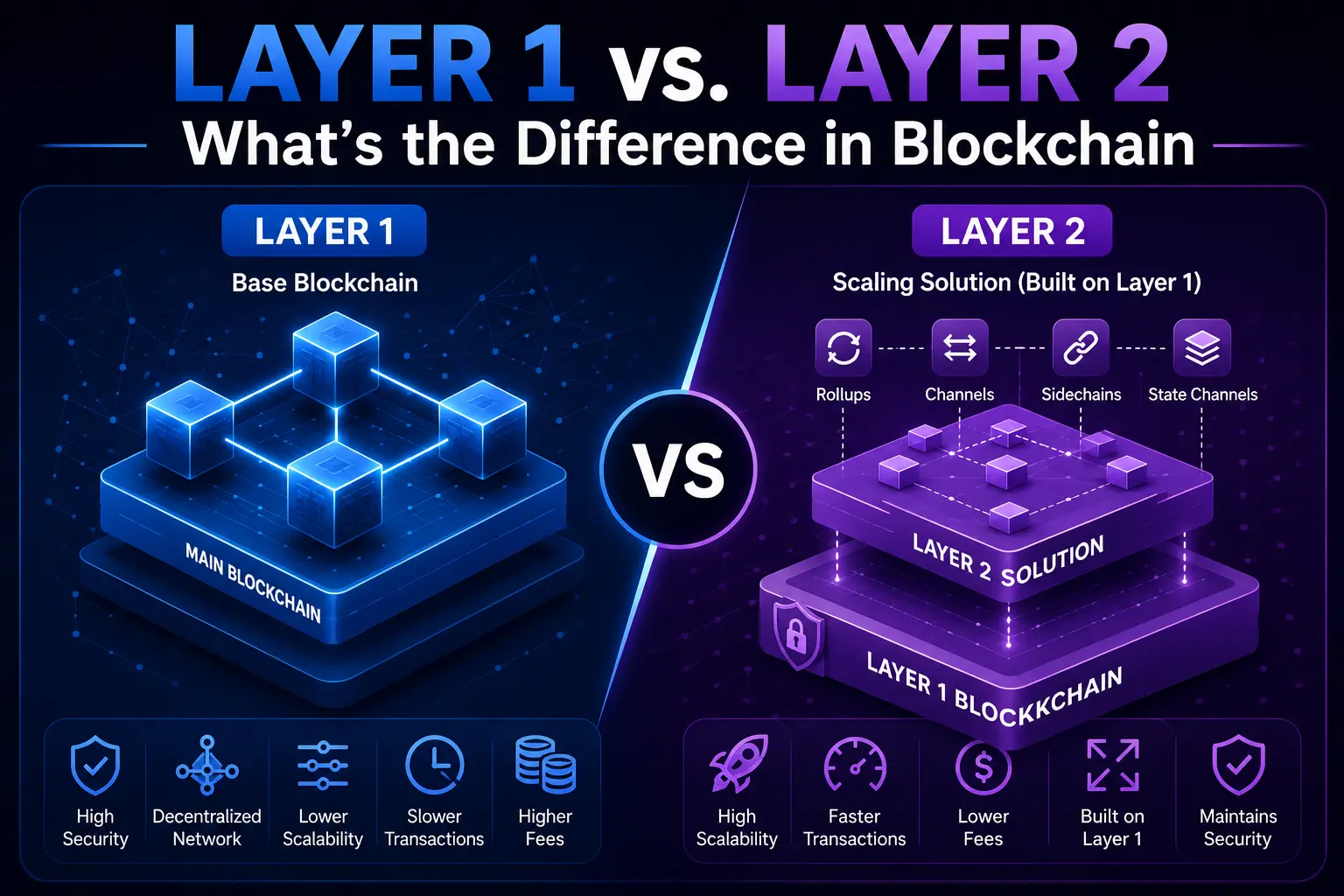
Layer 1 and Layer 2 describe two different parts of how a blockchain network is built and how it processes transactions. Layer 1 is the base network — think Bitcoin, Ethereum, or Solana. Layer 2 is a separate protocol built on top of that base network to help it handle more transactions without changing its core rules.
Understanding this distinction matters whether you are a developer picking a network to build on, an investor trying to make sense of where value is flowing in the ecosystem, or simply someone who wants to know why some crypto transactions are nearly free while others aren’t. In this guide, we will break down what Layer 1 and Layer 2 blockchains actually are, how they work together, where they differ, and which one makes sense depending on what you are trying to do.
What is Layer 1 in Blockchain?
Layer 1 blockchain refers to the base or main network of a blockchain ecosystem — the foundational layer where transactions are finally recorded and where the network’s core rules, consensus mechanism, and security are defined. Bitcoin, Ethereum, Solana, Avalanche, and Cardano are all examples of Layer 1 blockchains. Everything else in that ecosystem, including Layer 2 networks, ultimately depends on this base layer for settlement and security.
When people talk about “the blockchain” in a general sense, they are usually referring to a Layer 1 network. It is the original, self-sufficient chain that does not rely on any other blockchain to function.
➤ How Layer 1 Blockchains Work
A Layer 1 blockchain handles three core jobs on its own: transaction validation, consensus, and data storage. Every transaction submitted to the network gets broadcast to validator nodes (or miners, depending on the consensus mechanism), which then verify it, group it into a block, and add that block to the chain.
The consensus mechanism is what keeps everyone on the same page about which transactions are valid. Bitcoin uses proof of work, where miners compete to solve a computational puzzle to add the next block. Ethereum, since its 2022 transition, uses proof of stake, where validators are chosen based on the amount of cryptocurrency they have staked as collateral. Both approaches aim to keep the network decentralized and resistant to fraud, but they process transactions differently, which directly affects speed and throughput.
Because every full node on a Layer 1 network typically needs to process and store every transaction, scaling this system without compromising decentralization or security is genuinely difficult. This is where the well-known scalability trilemma comes in — the idea that a blockchain can usually optimize for only two of three properties at a time: decentralization, security, and scalability.
➤ Key Features of Layer 1 Blockchains
- Native security: Layer 1 networks secure themselves directly through their consensus mechanism, without depending on any external chain.
- Decentralization: Validator or miner nodes are distributed globally, which reduces the risk of any single party controlling the network.
- Settlement finality: Once a transaction is confirmed on a Layer 1 chain, it is considered final and immutable, according to that network’s confirmation rules.
- Smart contract support: Many Layer 1 chains, especially Ethereum, allow developers to deploy smart contracts and build decentralized applications directly on the base layer.
- Independent governance: Protocol changes on Layer 1 chains typically go through community governance or core developer proposals specific to that network.
➤ Common Challenges of Layer 1 Blockchains
The biggest challenge most Layer 1 blockchains face is limited transaction throughput. Bitcoin processes roughly seven transactions per second, and Ethereum’s base layer handles somewhere in the range of 15 to 30 transactions per second under normal conditions. Compare that to traditional payment networks that handle thousands of transactions per second, and the gap becomes obvious.
This limited throughput leads directly to network congestion during periods of high demand. When too many people try to transact at once, transactions compete for limited block space, and fees rise as a result. During Ethereum’s most congested periods before recent upgrades, gas fees occasionally spiked to extreme levels during network stress events. Some Layer 1 blockchains have addressed this through sharding or by increasing raw throughput at the base layer, but each approach comes with trade-offs in decentralization or security.
What is Layer 2 in Blockchain?
Layer 2 blockchain refers to a secondary framework or protocol built on top of an existing Layer 1 blockchain to improve its speed and transaction capacity, without changing the base layer’s core properties. Instead of processing every transaction directly on the main chain, Layer 2 solutions handle transactions off-chain or in batches, then settle the final results back to the Layer 1 network.
The goal is straightforward: keep the security and decentralization of the base chain intact while dramatically increasing how many transactions the overall ecosystem can process. Ethereum Layer 2 networks like Arbitrum, Optimism, and Base are the most widely used examples today.
♦ How Layer 2 Blockchains Work
Most Layer 2 networks operate by executing transactions in their own environment and then periodically submitting compressed transaction data back to the Layer 1 chain for final settlement. This is often referred to as the difference between the execution layer, where transactions actually happen, and the settlement layer, where they are finalized and secured.
Rather than every node on the network processing every single transaction individually, a Layer 2 network bundles hundreds or thousands of transactions together and posts a single, compact proof or data summary to the base chain. This dramatically reduces the load on Layer 1 while still allowing the base chain to act as the ultimate source of truth and dispute resolution layer.
♦ Types of Layer 2 Solutions (Rollups, Sidechains, State Channels)
There isn’t just one way to build a Layer 2 network. Several distinct architectures have emerged, each with different trade-offs:
Rollups are currently the dominant Layer 2 model, especially in the Ethereum ecosystem. They execute transactions off-chain and post transaction data (or proofs of that data) back to Layer 1.
- Optimistic rollups (used by Arbitrum and Optimism) assume transactions are valid by default and only run computation to verify them if someone formally disputes a transaction within a set challenge window, typically around seven days.
- Zero-knowledge rollups, or ZK-rollups (used by zkSync and Starknet), use cryptographic proofs to verify the validity of transactions almost immediately, without needing a challenge period. This offers faster finality but historically required more complex engineering to support full smart contract compatibility.
Sidechains are independent blockchains that run in parallel to a Layer 1 network and connect to it through a bridge. Polygon’s original PoS chain is a well-known example. Sidechains have their own consensus mechanism and validator set, which means they do not inherit Layer 1 security directly the way rollups do.
State channels, such as the Bitcoin Lightning Network, allow two or more parties to conduct multiple transactions off-chain and only settle the final balance on the main chain. This model works especially well for repeated, high-frequency transactions between the same participants, like micropayments.
Plasma chains, an earlier scaling approach, created child chains that periodically committed data back to the main chain, though this model has largely been succeeded by rollup technology due to certain security and usability limitations.
♦ Key Features of Layer 2 Blockchains
- Higher transaction throughput: Layer 2 networks can process thousands of transactions per second by moving execution off the congested base layer.
- Lower transaction fees: Because computation happens off-chain and costs are shared across batched transactions, fees on most Layer 2 networks are a fraction of what they would cost directly on Layer 1.
- Inherited security: Rollups in particular inherit much of their security from the underlying Layer 1 chain, since final data and disputes are settled there.
- Faster confirmations: Transactions on Layer 2 networks are typically confirmed in a few seconds, compared to the longer block times of many base layers.
- Compatibility with existing tools: Most major Layer 2 networks are compatible with existing wallets and crypto exchange apps, so users don’t need entirely new tools to interact with them.
How Do Layer 1 and Layer 2 Work Together?
Layer 1 and Layer 2 are not competitors in the way they are sometimes portrayed. They are complementary parts of the same system. Layer 1 provides the security and decentralization foundation, while Layer 2 provides the scalability that lets the ecosystem actually grow to support real-world usage.
► How Layer 2 Improves Layer 1 Scalability
Instead of forcing the base layer to process every transaction directly, which would require increasingly centralized and resource-heavy validator requirements to keep up, Layer 2 networks absorb the bulk of transaction volume. Ethereum’s own upgrade roadmap has leaned into this design intentionally. The Dencun upgrade in March 2024 introduced a data format known as blobs specifically to make it cheaper for Layer 2 networks to post their transaction data to Ethereum, and later upgrades such as Pectra and Fusaka expanded this data availability capacity even further.
The results have been significant. As of May 2026, everyday Ethereum transactions cost a small fraction of a cent under typical network conditions, largely because so much activity has migrated to Layer 2 networks, and the base layer itself has become more efficient at supporting them (source: ethereum.org, “Building on Ethereum in 2026“).
► How Transactions Move Between Layer 1 and Layer 2
Moving assets between Layer 1 and Layer 2 typically happens through a bridge. When you “bridge” funds to a Layer 2 network, your assets are usually locked in a smart contract on Layer 1, and an equivalent amount is minted or made available on the Layer 2 network. When you want to move back, the process reverses — the Layer 2 assets are burned or locked, and the original Layer 1 assets are released.
For optimistic rollups, withdrawing funds back to Layer 1 typically involves a challenge period, often about seven days, during which the transaction can be disputed if something looks fraudulent. ZK-rollups, by contrast, can often process withdrawals faster because validity proofs confirm correctness almost immediately, without needing an extended waiting window.
► Why Layer 2 Relies on Layer 1 for Security
This is one of the most important and often misunderstood parts of the relationship. A rollup does not need to build its own independent security model from scratch because it borrows security from its underlying Layer 1 chain. Transaction data and proofs are posted to Layer 1, which means that even if a Layer 2 network’s own operators misbehave, the data needed to reconstruct and verify the correct state still exists on the more secure and decentralized base chain.
This is fundamentally different from a fully independent Layer 1 blockchain, which has to secure itself entirely through its own validator or miner network. It is also different from sidechains, which typically rely on their own separate consensus and security assumptions rather than inheriting them directly from Layer 1.
Layer 1 vs. Layer 2: Key Differences
1. Scalability
Layer 1 blockchains are constrained by how much data their own validator network can process and store. Increasing throughput at the base layer usually requires trade-offs, such as increasing hardware requirements for validators, which can reduce decentralization. Layer 2 networks are built specifically to solve this problem by moving execution off-chain, allowing far higher transaction throughput without altering the base layer’s validator requirements.
2. Security
Layer 1 blockchains provide native, self-contained security through their own consensus mechanism and validator network. Layer 2 security depends on the specific design: rollups inherit strong security guarantees from their underlying Layer 1 chain, while sidechains and some other Layer 2 models rely on their own separate validator sets, which can introduce different trust assumptions.
3. Decentralization
Layer 1 networks like Bitcoin and Ethereum have spent years building large, geographically distributed validator or miner networks. Many Layer 2 networks, especially newer rollups, currently operate with a more limited or even partially centralized set of sequencers (the entities that order and batch transactions), though most have public roadmaps to decentralize this role over time.
4. Transaction Speed
Layer 1 blockchains confirm transactions based on their native block time, which can range from roughly ten minutes on Bitcoin to around twelve seconds on Ethereum. Layer 2 networks generally confirm transactions in one to two seconds, since execution happens off the congested base layer before being batched and settled later.
5. Transaction Costs
Layer 1 transaction costs fluctuate based on network demand and can rise sharply during periods of congestion. Layer 2 transaction costs are typically far lower and more stable, since costs are shared across many batched transactions. As of mid-2026, typical Layer 2 transactions on networks like Base or Arbitrum cost a few cents or less, compared to potentially higher costs for equivalent activity directly on a congested Layer 1 chain (source: SpotedCrypto, “DeFi Layer 2 Comparison Guide 2026“).
| Factor | Layer 1 | Layer 2 |
|---|---|---|
| Scalability | Limited by base layer capacity | High, built specifically to scale |
| Security | Native and self-contained | Often inherited from Layer 1 (varies by type) |
| Decentralization | Generally high, well-established | Varies; some sequencers are still centralized |
| Transaction speed | Slower (seconds to minutes) | Faster (typically 1–2 seconds) |
| Transaction cost | Can be high during congestion | Generally low and more stable |
Popular Layer 1 Blockchain Examples
✸ Bitcoin
Bitcoin is the original Layer 1 blockchain and still the most widely recognized. It uses proof of work consensus and prioritizes security and decentralization over raw transaction throughput. Because Bitcoin’s base layer processes a limited number of transactions per second, Layer 2 solutions like the Lightning Network have been built on top of it to support faster, cheaper payments.
✸ Ethereum
Ethereum is the leading Layer 1 blockchain for smart contracts and decentralized applications. Since transitioning to proof of stake, Ethereum has focused much of its development roadmap on becoming a strong settlement and data availability layer for the growing ecosystem of Layer 2 rollups built on top of it, rather than trying to scale everything at the base layer alone.
✸ Solana
Solana takes a different approach from Ethereum by prioritizing high throughput directly at the Layer 1 level, using a combination of proof of stake and a unique timestamping mechanism to achieve fast block times and high transaction capacity without relying heavily on separate Layer 2 networks.
✸ Other Notable Layer 1 Blockchains (BNB Chain, Cardano, Avalanche, etc.)
Several other Layer 1 blockchains have carved out their own niches. BNB Chain offers a high-throughput, EVM-compatible environment closely tied to the Binance ecosystem. Cardano emphasizes a research-driven, peer-reviewed approach to protocol development. Avalanche uses a distinctive consensus protocol and a subnet architecture that allows developers to launch customized, application-specific blockchains while still connecting back to the main Avalanche network.
Popular Layer 2 Blockchain Examples
✦ Arbitrum
Arbitrum, built by Offchain Labs, is currently the largest Ethereum Layer 2 network by total value locked. It uses optimistic rollup technology and has built a deep, composable DeFi ecosystem that includes major protocols for lending, trading, and derivatives (source: CoinGabbar, “Best Layer 2 Blockchain“).
✦ Optimism
Optimism is another leading optimistic rollup and the creator of the OP Stack, a modular framework that other networks — including Base — have built upon. This shared technology approach, often referred to as the Superchain vision, aims to let multiple Layer 2 networks interoperate more easily.
✦ Polygon
Polygon started as a sidechain and scaling aggregator and has since expanded into a broader ecosystem that includes zero-knowledge rollup technology alongside its original proof-of-stake chain, giving developers multiple scaling options depending on their needs.
✦ Other Notable Layer 2 Solutions (zkSync, Base, StarkNet, etc.)
Base, developed by Coinbase on the OP Stack, has grown rapidly and now ranks among the top Layer 2 networks by both total value locked and daily user activity. zkSync Era, built by Matter Labs, uses ZK-rollup technology and has recently shifted some of its strategic focus toward institutional and permissioned enterprise use cases. Starknet, another ZK-rollup, uses its own custom virtual machine and continues to focus on scalability and proof efficiency for developers building complex applications.
Benefits and Limitations of Layer 1 and Layer 2 Solutions
➤ Benefits of Layer 1 Solutions
- Strong, self-contained security and decentralization
- No dependency on external networks or bridges
- Long track record and battle-tested infrastructure, particularly for Bitcoin and Ethereum
- Full control over protocol-level governance and upgrades
➤ Limitations of Layer 1 Solutions
- Lower transaction throughput compared to Layer 2 networks
- Fees can rise significantly during periods of network congestion
- Scaling the base layer often involves difficult trade-offs with decentralization
➤ Benefits of Layer 2 Solutions
- Significantly lower transaction fees for everyday use
- Much faster transaction confirmation times
- Ability to support high-frequency use cases like gaming and micropayments
- Continued access to the underlying Layer 1’s security, especially with rollups
➤ Limitations of Layer 2 Solutions
- Some networks still rely on a limited number of sequencers, which affects decentralization
- Withdrawal times to Layer 1 can be slower for optimistic rollups due to challenge periods
- Bridging assets between layers introduces additional smart contract risk
- Ecosystem fragmentation, since liquidity and users are spread across multiple Layer 2 networks
When Should You Choose Layer 1 or Layer 2?
♦ When to Choose Layer 1
Layer 1 makes the most sense when security and decentralization are the top priority, such as for large, infrequent settlements, institutional custody, or storing significant value over the long term. It also suits projects that need maximum control over protocol-level rules and are not primarily concerned with high-frequency, low-value transactions.
♦ When to Choose Layer 2
Layer 2 is the better fit for applications that need frequent, low-cost transactions — think decentralized applications with high user interaction, gaming platforms, or everyday payments. If your use case involves many small transactions where fees would otherwise add up quickly on Layer 1, a Layer 2 network is almost always the more practical choice.
♦ When a Hybrid Approach Makes Sense
Many real-world applications end up using both layers together. A common pattern is to handle frequent user interactions and transaction execution on Layer 2, while settling final balances, major asset transfers, or governance actions on Layer 1. This hybrid model captures the cost and speed benefits of Layer 2 while preserving the security guarantees of the base chain for the transactions that matter most.
Real-World Use Cases of Layer 1 and Layer 2 Blockchains
► Layer 1 Use Cases (DeFi, NFTs, Institutional Adoption)
Layer 1 networks remain the foundation for large-scale DeFi protocols, high-value NFT transactions, and institutional custody solutions where the priority is maximum security and settlement finality. Many institutions evaluating blockchain infrastructure still favor direct Layer 1 exposure for core holdings, given its longer track record.
► Layer 2 Use Cases (Gaming, Micropayments, High-Frequency Trading)
Blockchain gaming platforms rely heavily on Layer 2 networks because games require frequent, low-value transactions that would be impractical to process directly on Layer 1. Micropayment systems, such as those built on the Bitcoin Lightning Network, also depend on Layer 2 infrastructure. High-frequency trading applications benefit from the faster confirmation times and lower costs that Layer 2 networks provide.
► Combined Layer 1 + Layer 2 Use Cases in DeFi and Web3
Modern DeFi applications increasingly span both layers, with users executing frequent trades or interactions on a Layer 2 network while relying on the underlying Layer 1 for final asset security. This combined model also affects broader market dynamics, including crypto market liquidity, since capital increasingly flows between base layer chains and their associated Layer 2 ecosystems depending on where yield and activity are concentrated.
The Future of Layer 1 and Layer 2 Blockchain Technology
✸ Scalability and Interoperability Improvements
Ongoing Ethereum upgrades continue to focus on expanding data availability specifically to support Layer 2 networks, rather than trying to scale everything at the base layer. At the same time, blockchain interoperability protocols are working to make it easier to move assets and data between different Layer 2 networks and even between entirely separate Layer 1 ecosystems, reducing the friction that currently comes with a fragmented multi-chain landscape.
✸ The Growing Role of Layer 2 Solutions
By 2026, Layer 2 networks have moved from an experimental scaling concept to core infrastructure. Dozens of active rollups now secure tens of billions of dollars in value, though the ecosystem has also consolidated significantly around a small number of dominant networks, with the largest few capturing the majority of total value and activity (source: The Block, “2026 Layer 2 Outlook“). This consolidation suggests that distribution, developer tooling, and real user demand — not just technical differentiation — are becoming the deciding factors for which Layer 2 networks thrive long term.
✸ Will Layer 1 and Layer 2 Coexist?
Given how deeply integrated Layer 2 networks have become with their underlying Layer 1 chains, it is unlikely that one will simply replace the other. Instead, the more probable path is continued specialization: Layer 1 blockchains focusing on security, decentralization, and data availability, while Layer 2 networks continue to handle the bulk of everyday transaction execution. This modular blockchain architecture appears to be the direction most major ecosystems are heading toward, rather than a single all-in-one chain trying to do everything itself.
Final Thoughts
Layer 1 and Layer 2 blockchains are not rivals competing for the same job — they are two layers of the same system, each doing what it does best. Layer 1 provides the security, decentralization, and settlement finality that everything else depends on. Layer 2 builds on top of that foundation to deliver the speed and low costs that make blockchain technology practical for everyday use, from gaming to micropayments to high-frequency DeFi activity.
If you are deciding where to build, invest, or simply transact, the right answer usually is not “Layer 1 or Layer 2” but rather understanding how the two work together for your specific goal. As the ecosystem matures, expect this relationship to deepen further, with Layer 1 chains acting as secure settlement and data layers while an increasingly capable set of Layer 2 networks handles the growing volume of real-world blockchain activity. Whichever layer you interact with, the fundamentals still apply — understanding basic stock market terms and financial principles can help make sense of how these networks create and transfer value, and practicing good habits like the importance of crypto wallet security and knowing the difference between a hot wallet vs cold wallet will serve you well regardless of which layer you are using.
FAQs
What is the main difference between Layer 1 and Layer 2 blockchain?
Layer 1 is the base blockchain network that handles its own consensus, security, and settlement, such as Bitcoin or Ethereum. Layer 2 is a separate protocol built on top of a Layer 1 network to increase transaction speed and reduce costs, while still relying on the base layer for final security and settlement.
Is Layer 2 safer than Layer 1?
Not exactly. Well-designed Layer 2 rollups inherit much of their security from the underlying Layer 1 chain, but they can introduce additional risks through bridges, sequencer centralization, or smart contract vulnerabilities. Layer 1 blockchains generally offer more self-contained, battle-tested security, though at the cost of lower throughput.
What are some examples of Layer 1 blockchains?
Bitcoin, Ethereum, Solana, BNB Chain, Cardano, and Avalanche are all examples of Layer 1 blockchains.
What are some examples of Layer 2 blockchains?
Arbitrum, Optimism, Base, Polygon, zkSync, and Starknet are among the most widely used Layer 2 networks today.
Why do blockchains need Layer 2 solutions?
Layer 2 solutions exist because most Layer 1 blockchains cannot process enough transactions per second to support widespread, low-cost, everyday use without significant congestion and rising fees. Layer 2 networks move much of that transaction load off-chain while still relying on Layer 1 for security.
What are the different types of Layer 2 solutions?
The main types include rollups (optimistic and zero-knowledge), sidechains, state channels, and older models like Plasma chains. Each takes a different approach to processing transactions off-chain before settling back to the base layer.
Which is better for developers — Layer 1 or Layer 2?
It depends on the application. Developers building applications that need frequent, low-cost transactions, such as games or consumer apps, generally benefit from deploying on Layer 2. Developers building infrastructure that requires maximum security and decentralization, without dependency on another network, may prefer building directly on Layer 1.
Can Layer 1 and Layer 2 work together?
Yes. In fact, most modern blockchain ecosystems are designed for Layer 1 and Layer 2 to work together, with Layer 2 handling transaction execution and Layer 1 providing security and final settlement.
Does using Layer 2 reduce transaction fees?
In most cases, yes. Because Layer 2 networks batch many transactions together before settling on Layer 1, individual transaction costs are typically a small fraction of what the same transaction would cost directly on a congested Layer 1 chain.
Will Layer 2 solutions eventually replace Layer 1 blockchains?
This is unlikely. Layer 2 networks depend on their underlying Layer 1 chain for security and settlement, so rather than replacing Layer 1, the trend points toward Layer 1 and Layer 2 becoming more specialized and interdependent parts of the same blockchain ecosystem.